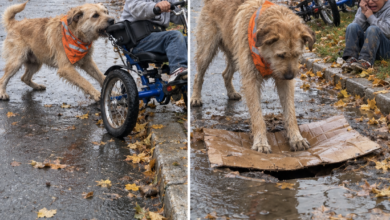
Part 2: A Biker Saw a Stray Dog Dragging an Empty Wheelchair Down a Country Road — Half a Mile Later, the Chair Revealed Who Needed Saving Before Time Ran Out
Part 2 — The Man at the Bottom of the Ditch
Marcus knelt beside Eli without moving the injured arm. His years of metal fabrication had taught him how structures failed, while volunteer rescue training had taught him not to treat a human body like damaged equipment.
Eli was conscious but disoriented. His skin felt cold, and his pulse was faster than Marcus expected. The old man had been exposed to damp October air for nearly twelve hours.
“You called somebody?” Eli asked.
“Ambulance is coming.”
“My chair?”
“On the road.”
Eli closed his eyes.
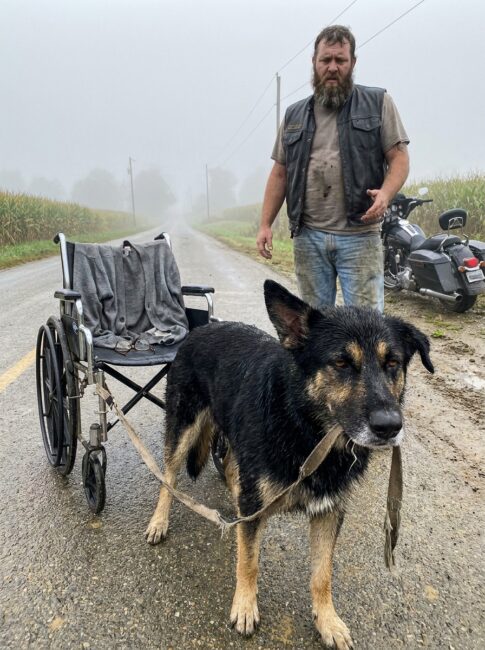
The dog stood several feet away, wet fur dark against the grass. He watched Marcus place a thermal blanket over Eli, but he would not approach when Marcus offered water.
“Does he have a name?” Marcus asked.
“I call him whatever comes out.”
“Helpful.”
“Mostly ‘you again.’”
Despite the pain, Eli’s mouth lifted slightly. He explained that the stray appeared three years earlier during a snowstorm. Eli found him beneath the porch, ribs showing beneath a wet coat. He left a bowl of stew outside and returned indoors.
The dog ate after the door closed.
The following morning, he was gone.
He returned the next evening.
For three years, that pattern continued. Eli placed food on the porch. The dog waited near the fence until Eli retreated behind the door. They shared the property without agreeing that either belonged to the other.
“Never touched him?” Marcus asked.
“Not once.”
The dog had come close enough to smell Eli’s shoes and wheelchair. Sometimes he slept beside the ramp. During summer afternoons, he rested beneath the maple tree while Eli read on the porch.
But if Eli extended a hand, the dog stepped away.
“He had reasons,” Eli said.
“You know what they were?”
“No. I just figured they belonged to him.”
Marcus looked toward the road. The wheelchair stood at an angle above them, its bent front caster catching the gray morning light.
“Whatever his reasons were, he dragged that chair half a mile.”
Eli opened his eyes and looked at the dog.
“I noticed.”
The ambulance arrived twenty-one minutes after the call. Two paramedics stabilized Eli’s arm and prepared to carry him up the slope. The dog retreated when the stretcher appeared.
“He’ll run,” Eli said.
Marcus removed the belt from his leather vest and looped it loosely through a small circle of rope tied around the dog’s neck. He did not pull. The rope was old and worn, likely something the animal had acquired before meeting Eli.
The dog could slip free whenever he wanted.
Instead, he watched the paramedics lift the old man.
When they reached the road, Eli’s hand hung over the side of the stretcher. The dog walked beneath it, close enough that Eli’s fingers brushed his torn ear.
The animal startled.
Then he returned.
Eli touched the ear again.
Three years of distance ended beside an ambulance.
The paramedics could not transport an unrestrained dog. Marcus offered to follow with him, but the stray backed away from the motorcycle’s engine.
Eli looked toward Marcus.
“My house is the green one past the church. Food’s in the metal bin.”
“I’ll take care of him.”
“He won’t come inside.”
“That makes two of us who don’t know what he’ll do.”
The ambulance left.
The dog ran behind it for almost a hundred yards before stopping. He stood in the center of the road, breathing hard, watching the red lights disappear.
Marcus rolled the damaged wheelchair toward his truck later that morning. The dog followed him to Eli’s house but remained outside the fence.
Food waited inside the metal bin exactly where Eli had said. Marcus filled the bowl and placed it near the porch.
The dog ignored it.
He lay beside the ramp, facing the road.
That afternoon, rain began falling.
The animal stayed.
At midnight, Marcus returned with a tarp and dry blanket. The food remained untouched.
“You saved him,” Marcus said. “You can eat now.”
The dog looked toward the empty road.
He was still waiting for Eli to come home.
Part 3 — Three Years of Almost Belonging
Eli Dawson had lived alone since his wife, Margaret, died eight years earlier. Their only son, Thomas, was killed in a construction accident two years before that. A framed photograph of both stood on the living-room mantel beside an old school-bus route map.
Eli’s legs had weakened after a spinal infection. He could stand briefly with support but relied on a manual wheelchair for daily movement. He refused assisted living, home aides, and most offers of help.
His nearest neighbor lived nearly a mile away.
The mail carrier saw him four mornings each week. A church volunteer delivered groceries on Fridays. If the accident had occurred after the weekend delivery, nobody might have noticed his absence until Monday.
The dog knew within seconds.
Marcus learned these details from Nora Bell, a sixty-five-year-old neighbor who drove him to Eli’s property after the hospital called. She recognized the stray beneath the porch.
“That’s Porch Dog,” she said.
“Porch Dog?”
“Nobody knows his name.”
She explained that residents had tried trapping him after he first appeared. Animal control left food inside a humane cage, but the dog never entered. A farmer approached with a rope and received a warning growl. Eventually, people stopped trying.
Only Eli continued feeding him.
“Eli says the dog isn’t his,” Nora said. “But he buys the expensive food because cheap food upsets the dog’s stomach.”
Marcus looked at the unopened bag inside the bin.
“He knows that?”
“He notices everything while pretending he notices nothing.”
The dog’s history remained uncertain. A faded groove around his neck suggested he had once worn a tight collar. He flinched at raised hands, truck doors, and the clatter of metal tools. Those reactions explained why he avoided Marcus’s fabrication shop when the damaged wheelchair was taken there.
Marcus owned Dalton Mobility and Metalworks, a small business that built ramps, handrails, wheelchair components, and vehicle adaptations. He began the work after his younger brother returned from military service with a spinal injury. Over twenty-seven years, the shop had repaired hundreds of chairs.
Eli’s model was old but salvageable. The right caster fork was bent, one brake cable had snapped, and the frame had twisted where it struck the ditch.
The dog had made the damage worse by dragging it.
Marcus did not care.
Those scratches were the reason Eli was alive.
He placed the wheelchair inside the open garage and worked with the doors raised. The dog watched from the gravel lot each evening but refused to cross the concrete threshold.
Marcus began leaving water outside.
The dog drank only after he stepped away.
It was the same arrangement he had maintained with Eli.
At the hospital, doctors confirmed Eli’s right forearm was broken in two places. He also had mild hypothermia and dehydration but no head injury. They expected him to remain for at least five days.
Marcus visited on the second evening.
Eli’s first question concerned the dog.
“He ate?”
“Not much.”
“Put a little chicken broth over the food.”
“You’ve been pretending that animal is a casual visitor for three years, but you know his preferred dinner.”
Eli adjusted the blanket across his knees.
“He stops by.”
“He dragged a wheelchair up a hill for you.”
“He’s stubborn.”
“So are you.”
Eli looked out the hospital window. “Did he go somewhere?”
“He sleeps beside your ramp.”
The old man’s fingers tightened around the edge of the blanket.
“He could leave.”
“He could.”
“Why doesn’t he?”
Marcus thought about the dog standing in the road after the ambulance disappeared.
“You already know.”
Eli did not answer.
On the fourth day, the hospital allowed a controlled visit outside. Marcus brought the dog in his pickup after spending forty minutes coaxing him onto a blanket in the truck bed.
Eli waited beneath the covered entrance in a hospital wheelchair.
The dog jumped down and stopped twenty feet away.
Neither moved.
Eli extended his uninjured hand.
“You again,” he said.
The dog approached slowly. He smelled the wheelchair, the hospital blanket, and Eli’s shoes. Then he placed his head beneath the old man’s hand.
Eli’s fingers rested behind the torn ear.
“I suppose you want breakfast.”
The dog closed his eyes.
A nurse standing near the entrance turned away to wipe her glasses.
Marcus remained quiet.
The dog had spent three years coming close enough to eat but never close enough to be held. Eli had spent eight years insisting that needing no one was safer than losing someone again.
At the hospital entrance, both surrendered one step.
Neither called it that.
Part 4 — The Chair He Dragged as Evidence
Marcus reconstructed the accident using the marks on the wheelchair and Eli’s account.
At approximately 7:10 the previous evening, Eli rolled toward the roadside mailbox. Heavy rain earlier that week had washed away gravel beneath the shoulder. When the right caster reached the soft edge, the ground collapsed.
The chair tipped.
Eli fell into the drainage ditch and struck his arm against the concrete culvert. The wheelchair rolled several yards downhill before becoming tangled in weeds.
The dog arrived while daylight remained. Eli heard him moving through the brush but could not see him clearly.
“I told him to go home,” Eli recalled.
“Which home?” Marcus asked.
Eli ignored that.
The dog entered the ditch and smelled Eli’s face. He pulled at the cardigan sleeve, trying to move him uphill. When Eli cried out, the dog released him.
For hours, the animal alternated between the old man and the road. He barked whenever a vehicle passed, but the ditch lay below the driver’s line of sight. Only two cars used the road that night, and neither stopped.
Shortly before dawn, the dog changed his strategy.
He climbed toward the wheelchair.
Eli heard metal moving through weeds. The dog apparently caught the safety strap and dragged the chair onto the road. Instead of returning it to Eli, he pulled it uphill toward the intersection where traffic was more likely.
“He couldn’t bring me to help,” Eli said. “So he brought something of mine.”
The wheelchair was not merely an object.
It was evidence.
A barking stray might be ignored. A stray dragging an empty wheelchair could not be.
Marcus understood because the sight had forced him to stop before he knew a person was missing. The cardigan, glasses, and medicine pouch transformed the chair into a message.
Somebody belonged in this seat.
Somebody was not there.
The dog had created that message without training.
Hospital staff discussed the story with local news, but Eli refused interviews. He did not want his face on television and did not think anyone needed to know he had fallen while collecting mail.
Marcus respected the refusal.
The dog became more difficult to protect from attention. People drove past Eli’s house hoping to see him. Some approached with treats, phones, and children. The animal retreated beneath the porch.
Marcus placed a temporary sign near the driveway asking visitors to give him space. There was no plea for donations and no photograph.
The dog needed quiet more than admiration.
When Eli was discharged, the repaired wheelchair waited outside the hospital. Marcus had replaced the caster, brake cable, and damaged frame section. He also cleaned everything except one scratched area near the safety strap.
“Missed a spot,” Eli said.
“No.”
Marcus pointed to the marks left by the dog’s teeth.
“That stays.”
Eli ran his thumb across them.
The dog waited near Marcus’s truck. He approached the wheelchair cautiously, smelling each repaired component. When he reached the scratched strap, he placed it briefly between his teeth.
“You don’t have to pull it today,” Marcus said.
The dog released it.
At home, Eli rolled up the ramp and opened the front door. The animal stopped at the bottom.
For three years, that threshold had separated them. Food came outside. Eli went inside. The dog remained free to disappear before attachment became something either had to acknowledge.
Eli turned his chair.
“You coming?”
The dog sat.
Eli waited.
Ten minutes passed. Then twenty.
The October sun dropped behind the trees. Marcus leaned against his truck without speaking.
Finally, Eli rolled backward into the living room and left the door open.
The dog climbed the ramp.
He placed one front paw across the threshold, withdrew it, and looked toward the road. Then he entered far enough to smell Eli’s chair.
The old man lowered his hand.
The dog crossed the remaining distance and rested his chin on Eli’s knee.
“What do I call you now?” Eli whispered.
Marcus looked at the scratched wheelchair strap.
“Rider.”
The dog’s torn ear moved.
Eli repeated it.
“Rider.”
The stray had entered the house.
This time, the door remained open because he was no longer expected to leave.
Part 5 — The Man Who Said the Dog Wasn’t His
Official adoption required more than giving the dog a name. Rider needed a veterinary examination, vaccination records, a microchip, and legal clearance confirming no previous owner could claim him.
The first challenge was getting him into a clinic.
Rider would ride in Marcus’s truck only if Eli’s wheelchair was visible. Marcus secured the chair beside a padded area in the cargo van, then built a low ramp so the dog could enter without being lifted.
At the clinic, Rider refused the examination table. Dr. Melissa Grant sat on the floor and examined him where he stood. She discovered an old shoulder injury, worn teeth, intestinal parasites, and scar tissue around his neck from a collar that had once been too tight.
No microchip was found.
His estimated age was six.
Eli signed the adoption papers with his left hand because his right arm remained in a cast. The signature slanted downward and ended in an ink mark where the pen slipped.
“Want another form?” the receptionist asked.
“No,” Eli said. “That’s how it happened.”
Rider watched from beneath his chair.
The receptionist stamped the papers.
For three years, Eli had repeated that the dog was not his. The document revealed the truth more clearly: Rider had already behaved as though Eli belonged to him.
Legal ownership simply allowed the human to catch up.
Life inside the house developed slowly. Rider would not sleep in the dog bed Marcus purchased. He chose the rug beside Eli’s wheelchair. He avoided the kitchen when pans struck the sink and hid whenever the front door slammed.
Eli changed his routines.
He closed doors gently. He placed the food bowl inside rather than on the porch. Each evening, he rolled to the same window where Rider used to wait outside.
The dog now sat on the other side of the glass.
Eli’s recovery took months. His broken arm prevented him from propelling the wheelchair normally, so home-health workers visited twice each week. Rider watched every movement but never interfered.
When a therapist helped Eli stand, the dog placed himself against the old man’s uninjured side. No one trained him to do it. He seemed to understand that bodies could fall and that his own could become a brace.
Marcus visited each Saturday.
He noticed Rider attempting to climb onto the footrests during walks. The dog wanted to remain near Eli, but trotting beside the wheelchair tired his old shoulder and created a risk near the casters.
That gave Marcus an idea.
He began sketching a detachable front platform that could connect to the reinforced wheelchair frame without interfering with the footrests, steering, or brakes. The platform would sit low between extended supports and include a padded seat, non-slip floor, protective side rails, and a short safety tether attached to a harness rather than Rider’s collar.
A rehabilitation engineer reviewed the design. Eli’s physical therapist tested its balance. Marcus added reflective panels, a manual release, and a removable weather cover.
He refused payment.
“You already have a business,” Eli said.
“I also have scrap metal.”
“This isn’t scrap.”
“Your dog advertised the shop.”
Rider approached the finished platform cautiously. Marcus placed his leather glove on the padding and stepped away. The dog smelled it, climbed inside, and turned once.
Eli rolled forward.
Rider remained seated.
They traveled twenty feet across the shop floor. At the open garage door, Eli stopped.
For years, Rider had walked beside the wheelchair but never allowed the man to touch him. Now he sat at the front, close enough for Eli’s hand to rest behind his torn ear.
The arrangement was not decorative. It reduced strain on the dog and allowed Eli to stop safely before uneven sections of road. Marcus insisted that Rider walk part of each outing for exercise and ride only on smooth, low-traffic routes.
They began with the mailbox.
The repaired shoulder had been reinforced, and Marcus filled the washed-out section with compacted gravel. Eli rolled slowly while Rider walked beside him.
At the place where the accident occurred, the dog stopped.
He smelled the ditch.
Then he climbed onto the front platform without being asked.
Eli touched his back.
“We don’t have to prove anything today.”
Rider looked ahead.
Together, they crossed the repaired section and collected the mail.
No one fell.
No one had to drag the chair home.
Part 6 — The Road Became Their Routine
By spring, Eli and Rider became a familiar sight along Lick Branch Road. Eli wore a gray cap and kept one hand near the controls. Rider rode on the front platform during the uphill section, ears moving with every passing bird.
At the maple tree, Rider climbed down to walk.
At the mailbox, he checked the ditch.
On the return journey, he usually sat in front again, one shoulder leaning against the padded rail while Eli’s fingers rested on his back.
The route was less than a mile, yet it changed how neighbors saw both of them. People who had known Eli only as the stubborn widower in the green house began stopping at the fence. Children brought drawings of the empty wheelchair. The mail carrier left dog biscuits beside the letters.
Eli accepted the attention in small amounts.
Rider accepted even less.
Marcus made another sign for the porch:
RIDER IS FAMILY. PLEASE LET HIM APPROACH FIRST.
There was no demand for photographs or interaction. Visitors learned to stand quietly until the dog chose.
He began choosing more often.
Eli’s niece Rachel visited from Tennessee after hearing about the accident. She had repeatedly invited him to live closer to her, and he had repeatedly refused. This time, she found the house fitted with a safer ramp, bathroom handrails, emergency-alert buttons, and motion lighting installed by Marcus and the club.
She also found Rider sleeping across Eli’s feet.
“You adopted a dog,” she said.
“He adopted a wheelchair.”
“Uncle Eli.”
“He eats here.”
Rachel pointed to the tag carrying Eli’s address.
“He lives here.”
Eli looked at Rider.
“I’m aware.”
The accident exposed a larger problem: Eli’s isolation. Rider could find help once, but no one wanted the dog forced to repeat the task. Rachel arranged daily phone check-ins. The church created a rotating visit schedule. Marcus installed a cellular emergency button on the wheelchair and another near the porch.
Rider learned the sound of the test alarm. Each time it activated, he moved toward the door, ready to search for help.
Eli scratched behind his ear.
“Not today.”
The Iron Lantern Riders included Eli’s road in their weekend route, though they approached quietly and cut their engines near the house. Rider initially disliked motorcycles. Over time, he associated their low rumble with Marcus arriving.
When Marcus appeared, Rider brought him the old wheelchair strap.
The strap had been replaced for safety, but Eli kept the scratched one beside the door. Rider carried it by the undamaged end and placed it near Marcus’s boots.
It became their private greeting.
Marcus would pick it up, inspect the tooth marks, and say, “Message received.”
Then Rider allowed him to touch the torn ear.
On the first anniversary of the rescue, Marcus expected Eli to avoid the ditch. Instead, the old man asked for help carrying three wooden posts to the roadside.
Together, they installed a small guardrail along the repaired shoulder. No plaque named Eli, Marcus, or Rider. Reflective strips made the barrier visible at night.
Eli tested it with his wheelchair.
Rider walked beside him.
When they reached the exact place where the chair had tipped, Eli stopped and looked down the slope. Rider placed both front paws on the platform but did not climb aboard.
“He wants you to keep moving,” Marcus said.
“I know.”
Eli rolled forward.
Rider followed.
The old man who had once insisted he needed nobody now had a dog, a niece calling each morning, bikers checking his ramp, and neighbors who noticed when his curtains stayed closed.
Rider had not merely found help at the roadside.
He had carried proof that Eli existed beyond his quiet house.
People began looking.
Part 7 — A Place at the Front
Rider’s muzzle began turning gray two years after the rescue. His old shoulder stiffened during cold mornings, so Marcus widened the padding on the wheelchair platform and added a clear weather shield.
Eli called it unnecessary.
Rider climbed into it before the installation was finished.
Their afternoon walk remained unchanged. At 4:30, Eli checked the brakes. Rider waited beside the ramp. They traveled toward the mailbox, paused beneath the maple tree, and returned before sunset.
Sometimes Rider walked.
Sometimes he rode.
He always sat at the front.
The scratched strap hung inside Eli’s hallway. When visitors asked about it, Eli rarely told the entire story. He pointed toward Rider and offered the same short explanation.
“He went for help.”
Marcus knew the rest.
The dog had tried pulling Eli from the ditch. When that failed, he had climbed through wet brush, found a wheelchair heavier than himself, and dragged it half a mile until an intimidating stranger stopped.
Rider did not know that Marcus understood mobility equipment or carried emergency supplies. He could not know the next person on the road would help.
He simply kept pulling until somebody did.
On the fifth anniversary, Marcus rode to Eli’s house shortly before sunset. He found the old man and dog returning from their walk.
Eli’s white hair showed beneath his cap. Rider sat on the platform with his torn ear lifted into the wind.
Marcus stopped beside them.
“Need a hand?”
Eli looked at Rider. “We have four.”
The dog stepped down beneath the maple tree. He walked beside the chair for the final stretch, close enough that his shoulder brushed Eli’s knee.
At the ramp, Eli lowered his hand.
Rider placed his head beneath it without hesitation.
Three years of untouched meals had once separated them. Neither seemed to remember why.
That evening, they sat on the porch while Marcus repaired a loose bolt beneath the platform. Rider watched his hands. Eli held the old strap across his lap.
“I fed him for three years,” Eli said. “Kept telling everybody he wasn’t my dog.”
Marcus tightened the bolt.
“What changed your mind?”
“I fell into a ditch.”
“That’ll do it.”
Eli looked toward Rider.
“He dragged my chair down the road because he couldn’t drag me. All that time, I thought he was only coming here for food.”
Rider rested his chin on the wheelchair platform.
“Turns out,” Eli said, “I was his person. I was just the last one to know.”
The next afternoon, they followed the same road again.
The wheelchair moved steadily.
Rider rode in front.
The ditch remained empty.
Follow this page for more stories about dogs whose quiet loyalty finds help, restores trust, and turns a daily kindness into a lifelong home.
They reached the mailbox together.
Then they came home together.