Part 2: A Boy With a Prosthetic Leg Found a Three-Legged Dog Abandoned in a Park — Five Years Later, That Dog Taught Him How to Run
Part 2 — What Caleb Would Not Say
Before the accident, Caleb ran everywhere.
He did not walk to the kitchen. He sprinted. He did not go down hallways. He launched himself through them like every doorway was a finish line. At seven years old, he believed his body was something that only moved forward. He played soccer, raced shopping carts, jumped curbs, and once tried to outrun a sprinkler system at the city library because he thought water moved “too slow to beat him.”
Then one rainy October evening, another driver ran a red light on our way home from a school fundraiser.
I will not turn that night into spectacle. Some memories deserve privacy, even in a story. What matters here is that Caleb survived, and survival came with loss. His left leg was amputated below the knee after doctors spent two days trying to save what could not be saved. When he woke fully enough to understand, he stared at the blanket for a long time and asked the question that split my life into before and after.
“Can I still run?”
I said yes.
Not because I knew how.
Because mothers sometimes answer from faith before facts arrive.
The months afterward were hard in ordinary, unphotographed ways. Pain. Skin irritation. Phantom sensations. Shrinker socks. Appointments. Insurance calls. Prosthetic fittings. Caleb crying in the bathroom because the first socket hurt and he did not want me to know. Caleb refusing to look at himself in mirrors below the waist. Caleb deleting old soccer videos from my phone, then pretending he had not done it.
People tried to help.
Some helped.
Some did not.
They said things like “you’re so brave” when he was just trying to get through a grocery store. They said “everything happens for a reason” when I wanted to throw something heavy. They said “at least he’s alive”, which was true and terrible because gratitude does not erase grief. At school, children asked questions because children do that. Most were not cruel. But curiosity can still hurt when it arrives twenty times before lunch.
By eleven, Caleb had learned to manage people by disappearing.
He stopped playing sports. He wore loose jeans. He laughed before anyone else could joke. His prosthetist, Megan Ross, told me his gait was improving, but I could see the rest of him withdrawing from the world that used to be his playground.
Aaron Pike, his physical therapist, tried everything.
Balance boards. Strength bands. Obstacle courses. Timed walks. Videos of Paralympic athletes. Caleb would participate just enough to satisfy adults, then shut down.
“I’m not them,” he said once after Aaron showed him a sprinter with a blade.
“No,” Aaron answered. “You’re you.”
Caleb looked away. “That’s the problem.”
I did not know what to do with a sentence like that.
Then came the dog in the park.
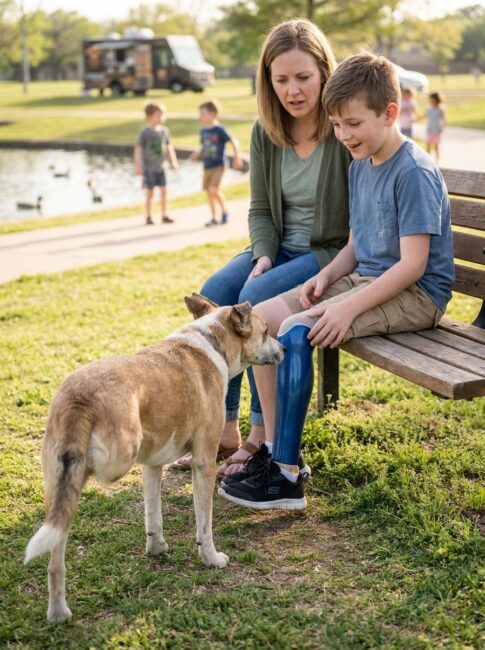
After Caleb touched his head, the dog stayed there like he had been waiting for permission to belong to someone. I checked for a collar. There was none. His coat was dusty, his belly too thin, and his paws had little raw places from walking on rough ground. He did not seem feral. He knew hands, though he flinched if they came from above. He knew sitting. He knew how to look at a person and ask without making a sound.
A parks employee named Mr. Harris came over after noticing us crouched by the bench. He was a sixty-four-year-old Black man with a white mustache, a green city uniform, and the careful sadness of someone who had seen too many animals dumped where families were supposed to play.
“He been around since Thursday,” Mr. Harris said.
“Thursday?” I asked.
“Found him near the restrooms after closing. Thought he belonged to somebody. But nobody came back.”
Caleb’s hand tightened on the dog’s neck.
“Someone left him?”
Mr. Harris sighed. “Looks that way.”
The dog leaned harder against Caleb’s shin.
I saw the change in my son’s face before he said a word. It was not pity exactly. Caleb hated pity too much to offer it easily. It was recognition. A child seeing an animal not as broken, not as sad, but as familiar.
“We can’t leave him,” Caleb said.
I looked at the dog.
Then at my son’s hand, still resting in plain view on his prosthetic leg because for once he had forgotten to hide it.
“I know,” I said.
And with that, our family shifted around a creature we had met less than ten minutes earlier.
Part 3 — Naming What Was Missing
The first place we took him was Willow Creek Veterinary Clinic, fifteen minutes from the park.
Caleb insisted on sitting in the back seat with the dog. I almost said no because the dog was dirty and nervous and we did not know his medical status, but I had learned by then that sometimes safety has to make room for meaning. So I spread an old picnic blanket across the seat, and Caleb climbed in beside him. The dog rested his head on Caleb’s prosthetic ankle the whole ride.
At the clinic, Dr. Sofia Ramirez scanned him for a microchip.
Nothing.
She examined the missing leg carefully. The amputation had been done surgically at some point, not from a fresh injury, but it was not recent enough to explain why he was abandoned now. His body showed mild malnutrition, flea irritation, worn pads, and fatigue. His remaining back leg was strong but overworked. He would need rest, nutrition, and possibly joint support as he aged. No major infection. No emergency surgery. No obvious reason he could not live a full life.
Caleb listened to every word.
“What happened to his leg?” he asked.
Dr. Ramirez sat back on her stool. “I can’t know for sure. Maybe an accident. Maybe he was born with a deformity and had surgery. Maybe something happened before his last family had him. But he’s adapted very well.”
Caleb frowned.
“Adapted” was one of those words adults used about him.
The dog sat on the exam room floor, slightly off balance but calm, as if medical rooms did not impress him.
“He walks funny,” Caleb said.
“So do I sometimes,” Dr. Ramirez replied gently.
Caleb looked up at her.
She tapped her own left knee brace under her scrub pants. “Old soccer injury. Bodies collect stories.”
That sentence mattered.
Bodies collect stories.
It made the dog’s missing leg sound less like a defect and more like a chapter.
Animal control had to be contacted, and there was a stray hold period. I explained that to Caleb in the lobby while the dog drank water from a stainless bowl like he had forgotten bowls could stay full.
“So we can’t keep him?” Caleb asked.
“We can apply to adopt him if nobody claims him.”
“What if the people who left him come back?”
The question carried more fear than anger.
I wanted to give the clean answer. That people who abandon dogs do not usually return. That if they did, we would ask questions. That there were laws. That I would not let him be taken by someone careless.
Instead, I said, “We will do everything we can to make sure he’s safe.”
Caleb knelt, ignoring the way his prosthetic knee clicked against the tile. “I think he should be named Scout.”
“Scout?” I asked.
“Because he found me.”
That was not how the word usually worked.
But it was exactly how this dog had entered our lives.
Scout spent the stray hold in a foster kennel connected to the clinic because regular shelter runs were crowded and his mobility needed monitoring. Caleb called every day. Not casually. Religiously. How much did he eat? Did he sleep? Did he limp? Did he miss us? Did he still have the blanket? Did they tell him we were coming back?
That last question hurt.
Because I realized Caleb was not only worried the dog would feel abandoned.
He was worried belonging could be temporary.
On the fourth day, the clinic allowed us to visit. Scout saw Caleb through the playroom gate and hopped toward him in a three-legged rush so joyful he nearly tipped over. Caleb laughed—a real laugh, not a polite one—and dropped to the floor. Scout climbed into his lap as if he had been waiting all day for the only person who made sense.
Megan Ross, Caleb’s prosthetist, happened to be there that afternoon with her own elderly dog for an appointment. She stopped in the hallway and watched.
“Is this him?” she asked.
Caleb nodded.
Scout rolled onto his side, missing leg up, belly exposed.
Megan looked at Caleb’s prosthetic, then at Scout.
“Well,” she said, “that dog isn’t hiding anything.”
Caleb went quiet.
The words were kind, but they landed deeply.
Scout’s body was visible. His difference impossible to miss. And he had no shame in it. He moved how he moved. Sat how he sat. Fell over sometimes and got back up without apologizing to the room.
That night, Caleb wore shorts to bed for the first time in over a year.
He did not say anything about it.
Neither did I.
Sometimes healing enters a house quietly enough that you can scare it away by naming it too soon.
Part 4 — The Adoption Paper and the First Walk
No one claimed Scout.
I expected that.
Caleb prayed they would not.
That admission came later, whispered from the passenger seat on our way to sign the adoption papers.
“I know that sounds mean,” he said.
“It doesn’t.”
“What if they missed him?”
“People who miss dogs look for them.”
He looked down at his prosthetic foot. “Maybe they thought he was too hard.”
I did not answer immediately.
“Some people do,” I said finally. “That doesn’t make the dog too hard. It makes those people not ready.”
Caleb thought about that for a while.
“Was I too hard after the accident?”
The question hit like air leaving a room.
I pulled into the clinic parking lot and turned off the car.
“No,” I said, facing him fully. “You were hurt. You were scared. You were grieving. You were learning a new body. That is not too hard.”
He looked away, and his jaw worked like he was trying not to cry.
“You got tired sometimes.”
“Yes,” I said. “I got tired. I got scared. I got angry. But never of you.”
That was the kind of truth I should have said earlier and more often.
He nodded once.
Then opened the car door.
Scout came home that afternoon.
The adoption photo is still on our refrigerator. Caleb standing beside me, trying not to smile too hard. Scout leaning against his right leg. My hand on Caleb’s shoulder. The clinic receptionist crying behind the camera and pretending allergies were involved. On paper, Scout became our dog. In practice, he had already become Caleb’s mirror, coach, secret keeper, and co-conspirator.
Their first walk as an official pair took forty minutes to cover three blocks.
Not because the distance was long.
Because both of them were learning each other’s rhythm.
Caleb’s prosthetic foot clicked lightly on sidewalk seams. Scout’s three-legged gait made a soft hop-step, hop-step beside him. Sometimes Scout moved too fast and had to stop. Sometimes Caleb’s socket pinched, and he sat on the curb while Scout leaned against him. A neighbor offered help too quickly, and Caleb shook his head.
“We’re good,” he said.
We.
That word changed everything.
At physical therapy, Aaron Pike noticed within a week.
Caleb arrived with Scout and refused to sit in the waiting room while I filled out paperwork. Scout wore a blue harness with a patch that said ADOPTED, which Caleb had chosen online after rejecting twelve others for being “too babyish.” Aaron came out with his clipboard and raised an eyebrow.
“New assistant coach?”
Caleb shrugged. “He’s missing a leg too.”
Aaron crouched to greet Scout. “Then he probably knows more than I do.”
Scout was allowed to attend certain sessions as long as he stayed calm and the clinic remained safe for other patients. He became the unofficial morale supervisor. When Caleb practiced balance, Scout sat facing him. When Caleb worked on step-ups, Scout rested his chin on the mat. When Caleb got frustrated and snapped, “I can’t,” Scout often chose that moment to stand, wobble, and hop across the room for no reason except existence.
It was very difficult for Caleb to stay dramatic while a three-legged dog cheerfully failed at moving gracefully and then tried again.
One afternoon Aaron set up a row of low cones.
“We’re going to work on speed transitions,” he said.
Caleb groaned.
Scout, excited by cones, knocked one over with his nose.
Caleb laughed.
Aaron pointed. “Scout just ran the drill.”
“He cheated.”
“Then beat him.”
Caleb took three quick steps.
Not running.
Not yet.
But faster than walking.
The room went still in the way rooms do when hope arrives and everyone pretends not to stare directly at it.
Scout barked once.
Caleb smiled.
That was the first time I saw him move toward running instead of away from it.
Part 5 — Falling Together
Progress did not become a straight line because Scout entered our lives.
That is not how any honest story works.
Caleb still had bad days. Socket sores. Growth adjustments. School comments. Phantom pain. Anger that came out sideways over homework, socks, cereal, or me breathing too loudly. Scout had bad days too. Overuse soreness in his remaining back leg. Anxiety around loud trucks. A habit of freezing if someone dropped a metal bowl. The first thunderstorm after adoption sent him under Caleb’s desk for three hours.
But now Caleb had someone beside him who did not need explanations.
That mattered more than all my speeches.
When Caleb fell during therapy, Scout often got up too fast and slipped, which made both of them look betrayed by gravity. When Scout stumbled in the yard, Caleb would say, “It’s okay, buddy,” in the same tone Aaron used with him. I noticed that the gentleness Caleb resisted receiving was easier for him to offer. Then, little by little, offering it made room for receiving it too.
At school, things shifted slowly.
Caleb’s teacher, Mrs. Nolan, allowed him to bring a photo of Scout for a presentation about “a family member who teaches you something.” Caleb stood in front of the class wearing shorts, his prosthetic visible, and held up a picture of Scout hopping through our backyard with his tongue out.
“This is Scout,” he said. “He has three legs. He doesn’t care if people notice.”
The class laughed, but kindly.
Caleb continued.
“He falls sometimes. Then he gets up. If he’s tired, he rests. If he wants something, he tries anyway. I think he’s better at being different than I am.”
Mrs. Nolan told me later there were no jokes after that.
Children can be cruel, yes.
But sometimes they are waiting for the right permission to be kind.
One boy named Tyler asked at recess if Caleb’s prosthetic hurt. Caleb answered honestly. Another asked whether he could run with it. Caleb said, “Not fast yet.” Yet. That was the word I noticed.
That summer, Aaron introduced the idea of adaptive running again.
Not as a dream.
As a question.
“What would happen if we tried?”
Caleb said no immediately.
Then went home and watched videos of blade runners for forty minutes while pretending YouTube autoplay had trapped him.
Scout slept beside him.
A week later, Caleb asked, “Do they make running legs for kids?”
They do.
They are expensive.
They require fitting, training, approvals, fundraising, paperwork, and the kind of stubbornness that makes mothers both proud and permanently tired. Megan helped us apply for a grant through a children’s mobility foundation. Aaron wrote a letter. Mrs. Nolan organized a school fun run. The Iron Hounds, a local motorcycle charity group that had once done a pet-food drive at Scout’s foster clinic, heard about it and sent a donation with a note that said, For the boy and the three-legged coach.
The day Caleb tried his first running blade, he brought Scout to the track.
Of course he did.
The blade looked strange and beautiful, curved like a question mark made of carbon fiber. Caleb stood with it attached, uncertain and pale.
“I look weird,” he said.
Scout chose that moment to trot past him, trip over a lane marker, recover badly, and continue with great dignity.
Aaron said, “Scout says weird is survivable.”
Caleb laughed despite himself.
Then he took the first steps.
Running with a blade was not like the videos. Not at first. It was awkward, technical, springy, and frightening. Caleb fell within five minutes. Hard. His palms scraped the track. His face twisted with humiliation before pain even arrived.
Scout rushed over and fell trying to stop.
For one second, Caleb stared at him.
Then he started laughing.
Not because falling was funny.
Because he was not alone in it.
That became their rhythm.
Fall.
Breathe.
Check the dog.
Stand.
Try again.
Part 6 — Five Years of Trying
Five years is a long time in a child’s body.
Caleb grew taller, then taller again, as if determined to make every prosthetic fitting immediately outdated. His voice changed. His hair got darker. His shoulders widened. He became, to my ongoing disbelief, a teenager who ate like groceries were temporary enemies. Scout aged too, though slower in spirit than in joints. His muzzle silvered. His remaining back leg needed supplements and careful monitoring. He still insisted on attending track practices, though by then he watched from a shaded mat instead of trying to supervise every drill.
The boy who once hid his prosthetic became the kid younger amputees stared at in clinic waiting rooms.
He hated that at first.
Then one day a six-year-old girl with a new pink prosthetic asked if his running blade made him “like a robot cheetah.” Caleb looked at her, considered, and said, “Only on good days.”
She giggled.
Her mother cried.
Caleb pretended not to see, because teenagers are allergic to visible emotion unless they are producing it themselves.
He trained through middle school into high school. Local adaptive meets first. Then regional competitions. Then national junior events. He was not always the fastest. Sometimes he was angry about that. Sometimes he forgot how far he had come and only saw who crossed before him. Scout helped there too, not through magic but through perspective. The dog had no interest in medals. He cared whether Caleb came home, whether dinner happened, whether the couch was available, and whether someone had accidentally left peanut butter within reach.
After tough races, Caleb would lie on the living room floor beside Scout.
“I lost,” he would say.
Scout would sigh dramatically.
“You don’t care, do you?”
Scout would lick his wrist.
That became enough.
At sixteen, Caleb qualified for a major Paralympic youth track development meet in Arizona. It was not the Paralympics themselves, though some people online called it that because the internet loves shortcuts. But it mattered. Scouts, coaches, adaptive sports organizations, families, athletes of every shape and story. For Caleb, it felt like stepping into a world where bodies were not judged by what was missing but by what they could still do with training, courage, and technology.
Scout was twelve by then.
Too old to travel easily.
I thought Caleb would accept leaving him home with Aaron.
He did not.
“He has to come,” Caleb said.
“Scout gets tired.”
“So do I.”
Hard to argue with poetry from a sixteen-year-old who usually communicated in refrigerator raids and one-word answers.
We drove instead of flying. It took two days. Scout slept in the back seat on his orthopedic bed, waking occasionally to look at Caleb as if confirming the boy had not escaped the mission. At rest stops, Caleb walked slowly beside him, patient with the dog’s pace. Once, watching them cross a parking lot together—teen athlete with a running blade in his duffel, old three-legged dog in a blue harness—I realized the teaching had reversed. Scout had once shown Caleb how to move without shame. Now Caleb was showing Scout how to age without apology.
The race day was bright, hot, and loud.
Caleb stood at the starting line in a black racing singlet, running blade shining under the Arizona sun. Scout lay near the fence with me, head lifted, ears alert despite age. Aaron stood near the coaches’ area. Megan had flown in and cried before the race even started, which annoyed Caleb and comforted me.
Before stepping into his lane, Caleb came to the fence.
He crouched in front of Scout.
The dog lifted his gray muzzle and pressed it against Caleb’s hand.
I could not hear what Caleb whispered at first.
Then I caught the last part.
“You taught me.”
The starting official called athletes to position.
Caleb stood.
For one moment, I saw him at eleven years old in Riverside Park, hand over his prosthetic, afraid of being seen. Then I saw the boy now—shoulders back, blade visible, body not perfect, not hidden, not apologizing.
The gun went off.
And Caleb ran.
Not because a dog fixed him.
Not because disability vanished.
Not because inspirational stories make pain disappear on cue.
He ran because years of falling, training, healing, frustration, laughter, therapy, technology, and love had taught him that missing one leg did not mean missing the future.
He did not win that race.
He placed third.
You would have thought from our section that he had set a world record.
Scout tried to stand when Caleb crossed the line, then wisely decided enthusiasm could happen lying down. Caleb came straight to him, medal bouncing against his chest, and dropped to the ground beside him.
The cameras caught that part.
The athlete with one prosthetic leg.
The dog with three legs.
Foreheads touching near the track fence.
That photo went everywhere.
The caption people shared most was Caleb’s own line from a later interview:
“My three-legged dog taught me that missing one leg doesn’t stop you from running.”
Part 7 — What Scout Taught Us
Scout died two years after that race, at home, on a warm April morning with Caleb beside him and sunlight across the floor.
He was fourteen, maybe older. We never knew his exact age. His body had done more than anyone had a right to ask from it. His remaining back leg finally weakened beyond what medication and rest could soften. Dr. Ramirez came to the house because Scout had earned every gentle ending we could give.
Caleb was eighteen by then, taller than me, accepted into a university with an adaptive athletics program, and still capable of crying like the eleven-year-old boy who first touched a three-legged dog under a park bench.
He held Scout’s head in his lap.
“You found me,” he whispered.
That was the truth of it.
People always said Caleb rescued Scout. We did adopt him. We fed him, treated him, loved him, and gave him a home. But rescue rarely moves in one direction for long. Scout had walked into a park as an abandoned three-legged dog and somehow found the one child who believed his own body had become too strange for joy.
Scout never gave speeches.
He never understood prosthetics, disability language, training plans, grant forms, pity, inspiration, or the pressure adults put on stories to mean something neat.
He simply lived.
He hopped across rooms without shame.
He fell and stood again.
He rested when tired.
He accepted help without acting smaller for needing it.
He loved Caleb’s prosthetic leg because it smelled like Caleb.
That was enough to change a life.
At Scout’s memorial, Caleb placed the old blue harness beside a framed photo from the Arizona track. The picture showed Caleb crouched by the fence after the race, medal hanging from his neck, Scout pressing his forehead into his hand. Under it, Caleb wrote:
HE TAUGHT ME TO RUN BEFORE I BELIEVED I COULD WALK PROUDLY.
Every year after, on the anniversary of the day we found Scout, Caleb visits Riverside Park. Sometimes I go with him. Sometimes he goes alone. He sits on the same bench where a three-legged dog first stared at his prosthetic and made him forget to hide it. He brings flowers sometimes, or a tennis ball, or nothing at all. Once he left a pair of old running spikes under the bench for a photo and laughed because Scout would have tried to chew the laces.
Caleb still runs.
Not every day. Not always fast. Bodies still hurt. Sockets still need adjustment. Phantom pain still visits without invitation. But he runs with the knowledge that his body is not a problem to be solved before life can begin. It is the body that carried him here.
Scout taught him that.
A three-legged dog abandoned by someone who could not see past what was missing taught a boy with a prosthetic leg to see what remained, what adapted, what strengthened, what could still launch forward when given time, tools, and love.
That is the lesson I keep returning to.
Not that disability is easy.
Not that dogs cure grief.
Not that every child with a prosthetic should become an athlete.
The lesson is simpler and stronger.
Difference does not cancel motion.
Loss does not erase possibility.
A missing limb does not get to define the size of a life.
Caleb learned that first from a dog who hopped out from under a park bench and sat beside him like a mirror.
The rest of us were just lucky enough to witness it.
Follow this page for more unforgettable dog stories about rescue, healing, loyalty, and the animals who teach us that what is missing from the body never has to be bigger than what is still alive in the heart.