Part 2: A Burned-Pawed German Shepherd Walked the Same Two Miles Across Phoenix Asphalt Every Day — What Rescuers Found Beneath a Dry Culvert Changed the Meaning of Every Step
Part 2 — The Route That Began at 1:17
To understand how we reached that culvert, I need to return to the first phone call and the ordinary man who decided that a limping dog was worth making one more delivery late.
Marcus called the county animal-care line at 1:24 p.m. on June 26. The dispatcher logged a thin shepherd-type dog behind a strip mall, possibly injured, still mobile, no aggression observed. Every field officer in the southern district was already assigned, and the earliest estimated response was ninety minutes.
Marcus could have left.
Instead, he moved his van so its shadow covered the water bowl. He photographed the dog from a distance, sent the picture to a neighborhood lost-pet group, and called the number a restaurant worker gave him for our foster network.
I was stacking compressor motors when my phone vibrated.
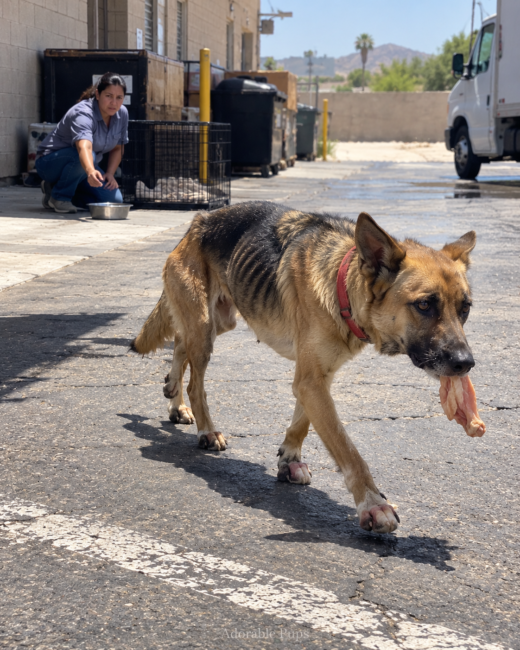
The photograph showed a dust-covered German Shepherd mix, perhaps four years old, standing with her body angled away from the camera. Her black saddle had faded brown in the sunlight. Her tan legs were thin enough for the tendons to show, and her abdomen curved inward beneath her ribs.
The most important detail was easy to miss.
She held a piece of chicken in her mouth, but she was not eating it.
I arrived at 2:03 with water, a collapsible kennel, two slip leads, canned puppy food, and a thermal blanket I knew we probably would not need. By then, the dog had left.
Marcus pointed east.
“She took the food that way.”
“Did she run?”
“No. She looked like she couldn’t. But she didn’t stop.”
We searched the alleys behind the tire shop and laundromat for thirty-eight minutes. The ground was a patchwork of gravel, concrete, and new black sealant that stuck slightly beneath my shoes. We found no dog.
We did find three pale paw marks on spilled landscaping dust beside a wall.
The prints were small for a German Shepherd. Each front print looked incomplete, as if the dog had refused to press the center of her pad against the ground.
That became the first clue we misunderstood.
I assumed the dog had wandered into the commercial district looking for food and had returned to whichever vacant lot she used for shelter. Marcus disagreed. He had watched her look behind herself twice before crossing the road.
“She wasn’t checking for us,” he said. “She was checking the way back.”
The next day, he parked behind the same restaurant during his lunch break. At 1:12, no dog appeared. At 1:15, the alley remained empty.
At 1:17, she came around the dumpster.
The timing was not mystical. At 1:10, a kitchen worker emptied a tray of plain chicken scraps into a tied bag. At 1:15, the bag was carried outside. The dog had learned the schedule.
Marcus placed food in a paper tray. She approached him with her head low, swallowed two pieces, and took a third away. He watched her disappear along the exact route she had used the day before.
He sent me one message.
She came back. Same minute. Same road.
I returned on June 28 with Tasha, the county field officer assigned after Marcus updated the report. Tasha was thirty-two, calm, and careful about the difference between what we could see and what we only suspected.
She did not call the dog’s paws burned when she first saw them. She described swelling, protective weight-shifting, surface discoloration, and reluctance to bear full weight. A veterinarian would decide what had caused the damage.
Tasha scanned the dog from twelve feet away with an infrared thermometer. The temperature near her paws was high, but the tool could not tell us how deep the injury went.
“We need a clinic,” she said.
The dog drank from the bowl. Her tongue moved slowly at first, then faster. She stopped before the bowl was empty.
Another strange detail.
A desperately thirsty stray usually finished what was available. This dog drank enough to stand, then turned away as though time mattered more than thirst.
Tasha prepared the kennel. I laid a trail of food. Marcus blocked the safest exit without cornering her.
For three minutes, the plan appeared to work.
The dog placed her head inside the kennel, then one front paw. Her shoulders followed. Only her hips remained outside.
A truck horn sounded on the main road.
She jerked backward.
The kennel scraped across the pavement. She spun toward the sound, looked down the road, and picked up the largest piece of chicken from the ground.
Her decision had already been made.
“She’s going somewhere,” Marcus said.
Tasha watched the dog reach the edge of the parking lot.
“No,” she answered. “She’s going back to someone.”
That was the moment we stopped trying to make her mystery fit our equipment and began following the route she had built to survive.
Part 3 — The Road That Burned Her Twice
Tasha drove while Marcus sat beside her with the crate folded behind his seat. I followed in my aging pickup, keeping two car lengths between us and watching the dog through the waves of heat above the road.
The distance from the restaurant to the culvert was later measured at 1.86 miles. A direct route across the open lots would have been shorter by almost half a mile, but the dog did not take it.
She turned behind the tire shop, where the building cast a strip of shade less than two feet wide. She walked inside that strip with her left shoulder brushing the wall.
At the corner, she waited.
A white service truck passed. She stepped onto the road, crossed to the painted median, stopped with all four paws on the faded white line, and waited again. The white paint was not cool, but it absorbed less heat than the black pavement around it.
That became the second clue we misunderstood.
I thought she was simply hesitating because her feet hurt. Tasha believed the pauses might be deliberate, but we could not prove it while moving.
The dog continued behind a laundromat. Warm air blew from its vents, yet the narrow service lane remained shaded by the building. An employee had left a mop bucket beneath a leaking outdoor faucet. The dog drank from the shallow water collected around one wheel.
She did not drink long.
Again, she chose movement.
At the next intersection, she made a mistake. A turning car forced her away from the shadow of a bus shelter and onto exposed pavement. She hurried, but her right front leg folded.
Her chest struck the road.
I stopped my truck hard enough to send the metal water bowls behind my seat into the floorboard. By the time I reached her, she had pushed herself upright.
“Easy,” I said. “Please.”
She backed away from me with the chicken still in her mouth.
I lowered both hands and stepped back. Her chest moved fast beneath her ribs. She lifted one front paw, set it down, then lifted the other.
For two seconds, she looked ready to surrender.
Then a faint gust moved through the drainage corridor beyond the road. It carried no sound I could hear. The dog raised her nose.
She walked on.
The route led past an apartment complex, an abandoned car wash, and a construction lot where crews had poured fresh asphalt during the previous week. Orange barriers blocked the shortest path toward the flood-control channel.
A worker named Darnell Price stood beside a water cooler near the gate. When he saw the dog, he removed his hard hat.
“That shepherd again,” he said.
“You’ve seen her?” Tasha asked.
“Four days. Maybe five. She used to cut through here before we sealed it.”
Darnell said the dog had first appeared early in the morning on June 23. She crossed the construction lot while the old surface was still broken and gray. Later that day, crews spread dark sealant across the access road and closed the gate.
The following morning, she tried to use the same path.
Darnell saw her step onto the new surface, jump sideways, and retreat. He tried to approach with water, but she ran behind a wall.
“She came back that afternoon,” he said. “Went the long way around.”
The long route added distance, yet it gave her a chain of shadows: the tire shop wall, the laundromat, the bus shelter, the apartment fence, and the western side of the abandoned car wash.
She had not chosen the same road because she lacked imagination.
She had redesigned the journey.
We still did not know why.
Darnell offered a shallow plastic lid filled with water. The dog drank while watching the exit from the construction lot. When he placed food beside the lid, she ignored it. The chicken from the restaurant remained in her mouth.
“Been trying to feed her,” he said. “She won’t stay.”
Tasha asked whether he had seen puppies nearby.
Darnell shook his head. “Never heard any.”
The answer seemed important because lactating mothers often showed physical signs, but the dog’s body was too thin and dusty for us to judge from a distance. We could see enlarged mammary tissue beneath her abdomen, though that alone did not tell us where her litter was or whether the puppies had survived.
Tasha called for another unit and gave our route. The nearest officer remained twenty-five minutes away.
The dog moved again.
Beyond the car wash, the sidewalk ended. Gravel and broken glass covered the shoulder. The dog chose the gravel, even though it forced her to limp harder. She avoided the black road whenever she could.
Her body was solving one problem after another: shade, traffic, water, broken glass, fences, distance. Every choice preserved enough strength for the next section.
At 2:41, she reached the flood-control channel.
The chain-link fence had been pushed upward near the ground, creating an opening perhaps ten inches high. The dog dropped onto her elbows and squeezed beneath it. Her loose collar caught on a wire point.
She froze.
Marcus approached from behind the fence, speaking softly. The dog pulled once, but the collar tightened.
“Don’t,” Tasha said. “Let me.”
Tasha lay on the gravel and reached through the opening with a pair of cutters. She clipped the faded collar, and it fell beside the dog.
The German Shepherd did not run.
She looked at Tasha’s hand.
Then she picked up the chicken she had dropped and descended the bank.
The channel smelled of sun-baked concrete and dust. A few brittle weeds grew along a seam where water had once collected. Forty yards ahead, three drainage tunnels passed beneath an access road.
The dog chose the center opening.
Before entering, she stopped and looked back at us.
That was the first time she had checked whether we were following.
I remember the exact position of her body: one front paw lifted, chicken held gently between her teeth, ears raised despite her exhaustion. She did not look trapped.
She looked as though she had reached the end of what she could do alone.
Then she stepped into the darkness.
We went after her.
Part 4 — Five Small Faces Beneath the Concrete
The center culvert measured about five feet across, forcing Tasha and me to bend as we entered. Marcus remained near the opening with the crate, water, towels, and his phone raised for light.
The temperature dropped, but the concrete released the heat it had stored all day. Fine dust coated my tongue. Each movement sent the smell of dried mud and animal waste into the air.
The mother walked twenty feet inside and stopped beside a torn rectangle of carpet.
Five puppies lay against one another near the wall.
The first was tan with a black muzzle. The second had a dark stripe down its back. The third was smaller and nearly black. Two more pressed beneath their mother’s abdomen, their paws resting over each other.
None ran toward us.
One lifted its head.
The others remained still.
The mother lowered the chicken to the carpet. Two puppies crawled toward it. She pulled the strip into smaller pieces with her front teeth, then stepped away.
She did not take a bite.
Tasha whispered, “Five.”
I counted them again because numbers can become strange when you are afraid. Five heads. Five narrow bodies. Five tails.
The largest puppy tried to stand, took one step, and sat down. The smallest opened its mouth without making a sound.
We had no way to know their exact condition inside the culvert. What we could see was low body weight, dull coats, slow movement, and gums that looked paler than expected when one puppy yawned. They needed veterinary examination, controlled cooling, fluids if indicated, and careful feeding rather than a large meal.
Tasha placed the slip lead over the mother’s head.
The dog stiffened.
I stopped reaching for the puppies.
“No one moves until she does,” Tasha said.
The mother smelled the lead. She smelled Tasha’s wrist. Then she looked at the crate beside Marcus.
Her body lowered.
The fight seemed to leave her shoulders all at once.
I wrapped the first puppy in a towel. The mother watched my hands but did not interfere. I placed the puppy inside the crate and returned.
The second followed.
The third trembled against my chest, its heart beating so quickly that the rhythm reached my palm through the towel.
The mother licked its ear once before I moved it.
The fourth puppy was heavier but less responsive. Tasha supported its chest while I wrapped the towel. The fifth tried to follow us, dragging the piece of chicken toward the crate.
Marcus turned his face away for a moment. When he looked back, his eyes were wet, but he said nothing.
Five puppies were inside.
I believed the worst part had ended.
We gave the mother water in a low bowl. She placed her muzzle near the surface but did not drink. Her eyes remained fixed on a darker side passage behind the carpet.
The opening had been partly blocked by a rusted grate, branches, plastic bags, and sand carried in by previous storms. From where I knelt, it appeared too narrow for an adult dog.
“Come on, Mama,” I said. “They’re going.”
Marcus began sliding the crate toward the entrance.
The mother lunged toward the side passage.
Tasha caught the lead before the dog reached the grate. The movement pulled weight onto both front paws, and her legs buckled. She hit the concrete, rose, and pulled again.
Her mouth remained closed.
She did not bark.
She released one low, broken sound from deep in her chest.
The puppies inside the crate shifted toward it.
“Stop the crate,” Tasha said.
Marcus stopped.
The mother pawed at the sand beside the grate. She used her right foot once, then switched to the left. Pain forced her backward, but she lowered her head and began pushing debris with her nose.
I aimed the flashlight beyond the bars.
The passage bent to the right. A mound of branches blocked most of the beam. I saw old plastic, a crushed cup, and strips of gray fabric caught beneath the grate.
No animal.
No movement.
Tasha called the second field officer and requested tools for debris removal. She warned that the culvert could become dangerous if we disturbed unstable material or if water entered the channel upstream, though no rain was forecast.
The officer was sixteen minutes away.
The mother did not understand sixteen minutes.
She scraped the concrete again.
I placed my ear near the ground. Trucks moved on the road above us, sending a low vibration through the culvert. Somewhere near the entrance, Marcus opened a water bottle.
Then silence settled.
Nine seconds passed.
On the tenth, something made a sound behind the debris.
It lasted less than a second.
A thin squeak.
The mother answered.
Tasha and I looked at each other.
“That wasn’t one in the crate,” I said.
“No.”
We counted again.
Five puppies inside the crate.
The mother stared through the grate.
Five were safe.
One was not.
The second officer arrived with bolt cutters, work gloves, a pry bar, and a collapsible rigid carrier. He was followed by Darnell, the construction worker, who had driven around the channel after seeing our vehicles leave.
The grate was secured by two rusted bolts and one twisted wire tie. The officers cut the wire but stopped when the lower edge shifted beneath the debris.
Darnell studied the opening.
“If we pull that straight out, the branches come with it,” he said. “Could bury whatever’s behind there.”
We cleared the sand by hand, moving one small layer at a time. The mother lay beside us, her nose less than six inches from the opening. She trembled whenever the metal moved.
After eleven minutes, Tasha created a gap beneath the grate.
I pushed the flashlight through.
The beam caught a tiny paw.
Then an eye.
A sixth puppy lay behind a bundle of branches, separated from the others by the fallen barrier. A strip of gray fabric was twisted around one back leg—not tight enough to cut the skin, but enough to prevent the puppy from crawling free.
The mother had known exactly where it was.
She had probably heard it each time she returned.
We widened the gap. Tasha reached through first, supporting the puppy while Darnell cut the fabric. When she slid the puppy into my hands, its body felt lighter than the others.
It took one breath.
Then another.
The mother pressed her nose against its face.
For the first time since Marcus had seen her behind the restaurant, she stopped looking toward the road.
Part 5 — Why She Chose the Long Way Home
We transported the mother and six puppies to an after-hours veterinary clinic eight miles away. The clinic had limited space, so the puppies shared two warmed kennels while the mother was examined in the treatment room beside them.
The intake clock read 4:36 p.m.
The mother weighed forty-three pounds. Based on her frame, the veterinarian estimated that a healthy weight might fall in the mid-fifties, though recovery and repeated measurements would be needed before choosing a final target.
Her body-condition score was recorded as two out of nine.
Both front paw pads showed heat-related injury and abrasion. The right side was swollen; the left had shallow blistering across the central pad and two toes. The injuries were painful but did not require amputation or the dramatic procedures people sometimes imagine after seeing a photograph.
They required cleaning, medication prescribed by the veterinarian, protective bandaging, limited walking, and time.
The puppies were estimated to be between four and five weeks old. All six were dehydrated to different degrees. The sixth puppy—the one behind the grate—was smaller, weaker, and mildly hypothermic despite the outside heat because its body could not regulate temperature well.
A technician placed it inside a controlled warming unit.
The mother watched through the open treatment-room door.
We named her Mara for the intake sheet because every animal needed a name. The name came from Marcus, who said his grandmother used it to mean a woman who kept going after everyone else had stopped.
Mara accepted water once all six puppies were in sight.
Only then.
She drank slowly for nearly a minute and lay down on the folded blanket. Her bandaged front feet rested in front of her. The puppies were brought close enough for her to smell them while staff monitored feeding and hydration.
We thought the sixth puppy was the final explanation.
It was not.
The deeper truth appeared in pieces over the next three days.
Darnell sent us security-camera clips from the construction lot. The footage was grainy, silent, and incomplete, but it showed Mara crossing the original access road before the new surface was laid.
On June 22 at 5:48 a.m., she traveled from the drainage channel toward the commercial district.
At 6:37, she returned carrying something pale in her mouth.
At first we thought it was food.
When Darnell enlarged the clip, the shape showed a tiny tail.
Mara had carried a puppy.
The next clip showed her returning toward the channel alone. Forty-seven minutes later, she came back with another puppy.
The camera captured four trips before a truck blocked the view.
We drove to the far side of the construction lot and found an abandoned shallow drainage box behind a wall. Inside were pieces of the same gray carpet found in the culvert. Windblown plastic and flattened cardboard covered the floor.
Mara had not originally given birth beneath the road.
She had moved the litter there.
A crew had begun clearing weeds and debris near the shallow box on June 22. No one knew puppies were inside. Mara must have sensed the machinery, heard the workers, or watched the habitat change.
She chose the deeper culvert because people rarely entered it and the concrete stayed cooler than the open lot.
But moving six puppies required at least six separate journeys. The route crossed broken ground, and every return trip placed her on the heating pavement later in the morning.
The footage explained why her feet were already injured before Marcus first saw her.
It also explained the gray fabric around the sixth puppy’s leg. Mara had carried pieces of carpet into the deeper culvert or dragged the carpet while moving the litter. During a later shift in debris, one strip became trapped near the grate.
Yet one question remained.
Why did Mara travel nearly two miles to the restaurant when several dumpsters and apartment buildings stood closer to the culvert?
Marcus and I walked the route again at 6:00 the next morning, before the pavement heated. We started at the culvert and followed every turn.
The closer dumpsters were locked.
One apartment complex had bowls outside, but two territorial dogs barked behind the fence whenever we approached. A gas station used sealed compactors. The car wash offered water but no food.
The restaurant behind the strip mall discarded plain chicken at the same time every day.
Mara had tested the neighborhood and found one predictable food source.
The route was not the shortest. It was the route that connected the resources she needed: shade behind the tire shop, spilled water at the laundromat, the irrigation leak, the car-wash wall, and chicken at 1:17.
Reordering those stops would not have worked.
Crossing earlier meant the chicken was not outside.
Crossing later meant the pavement grew hotter.
Taking the direct road removed shade and exposed her to faster traffic.
Mara had built a chain of small survivable distances. Each shaded place allowed her to reach the next.
That was why she paused at the same walls.
That was why she drank for only eleven seconds.
That was why she always carried the largest piece of chicken instead of eating it.
She was not wandering between food and shelter.
She was running a supply route for six lives.
The clinic called while Marcus and I stood beside the faded white median where Mara had rested her paws.
The sixth puppy had responded to warming and measured fluids. It had swallowed a small amount of food under veterinary supervision. Its temperature was improving.
Marcus sat on the curb.
He placed both hands over his face and remained that way until a passing truck blew dust across his boots.
“I almost drove away that first day,” he said.
“But you didn’t.”
“I was twelve minutes late.”
“Twelve minutes can be late,” I said. “It can also be exactly when somebody needs you.”
He looked toward the road Mara had crossed.
The white paint no longer looked like an accidental place to stop.
It looked like one link in a path she had calculated with pain.
Part 6 — What Every Small Clue Had Meant
Mara stayed at the clinic for two nights. The six puppies remained longer because the smallest needed additional monitoring and all required a feeding plan that would not overload their weakened systems.
Recovery did not arrive in one clean upward line.
Mara ate well the first evening, then refused breakfast the next morning when a technician moved the puppies to another room for examination. She paced three careful circles on her bandaged paws and stood facing the door.
Staff brought one puppy back in a carrier.
Mara smelled it through the wire.
Then she ate.
The behavior was not treated as proof that she could count to six in a human sense. No one at the clinic made that claim. What we observed was simpler and more convincing: Mara tracked the presence, scent, and location of each puppy, and she became distressed when the arrangement changed.
On the third day, the veterinarian approved transfer to a medical foster home.
I volunteered.
My house was a twelve-minute drive from the clinic, with a quiet spare room, washable flooring, and a fenced yard. I had fostered injured adults before, but never a mother with six puppies and bandaged paws.
Tasha helped me set up two low pens connected by an open gate. We covered the floor with layered blankets and placed Mara’s water where she could reach it without standing.
When the carriers arrived, Mara stepped into the room and inspected every corner.
She smelled the blankets.
She smelled the bowls.
Then she returned to the carriers.
I opened them one at a time.
The tan puppy with the black muzzle came first. Mara smelled its head and nudged it toward the blanket. The sable puppy followed, then the black one, then the two smaller tan puppies.
The sixth emerged last.
We had started calling her June because she had been found in the final days of that month. She was still smaller than the others, with a pale mark beneath her chin and one back leg shaved where the veterinary team had placed a line.
Mara touched her nose to June’s chest.
Then she lay down.
That night, I slept on a camping mat outside the pen. At 2:14 a.m., the sound of movement woke me.
Mara had pushed herself upright. She smelled the first puppy, the second, and the third. She continued until she had touched all six.
Then she lowered her head.
At 3:06, she did it again.
Six touches.
The same order.
The ritual showed us what her behavior in the culvert had meant. Five puppies inside the crate had not matched the group she knew. She had not relaxed because one scent and one sound were missing.
Her refusal to leave the blocked passage had not been panic without direction. It had been an accurate response to an incomplete family.
Other clues changed meaning too.
The unfinished water behind the restaurant had looked strange because we assumed thirst should erase every other priority. Mara drank only enough to continue because remaining at the bowl increased the time her puppies were alone.
Her pauses on white paint had looked like weakness. Weakness was part of them, but the placement mattered. She chose lighter surfaces, narrow shadows, and damp soil whenever possible.
The chicken in her mouth had looked like hoarding. It was delivery.
The long road had looked irrational. It linked every usable resource.
Even her decision to look back before entering the culvert carried new meaning. Mara had allowed us to follow only after she had tried feeding the litter alone, relocating them alone, digging at the barrier alone, and crossing the city alone.
She did not lead us there because she trusted all people.
She led us because her own body was running out.
Her bandages were changed according to the clinic’s schedule. I held her shoulder while a veterinary technician removed the old wraps, examined the pads, cleaned them, and applied fresh protection.
Mara never snapped.
She trembled.
Whenever discomfort increased, she turned her head toward the puppy pen. If the puppies remained quiet, her body softened. If one squeaked, her muscles tightened beneath my hand.
The injuries improved, but not quickly. The blistered areas needed protection from contamination and pressure. For the first ten days, Mara went outside only for short bathroom breaks on a clean, shaded surface.
I carried her twice.
She hated it.
Mara weighed forty-three pounds, but she could make herself feel twice that by spreading her legs and leaning away. On the third attempt, I placed June’s carrier near the back door.
Mara walked beside it without resistance.
The puppies gained weight in small, measurable steps. The largest gained eight ounces during the first week. June gained four. She tired while eating and required more time, but she no longer felt cool when I lifted her.
Marcus visited every evening after his delivery route. He always arrived at 6:20, placed his keys on the kitchen counter, and sat on the floor without reaching for Mara.
On his fourth visit, she approached him.
He had brought plain chicken.
She took one piece, turned toward the pen, and dropped it beside the gate. The puppies were not ready to eat it, so I removed it when she looked away.
Marcus rubbed his thumb over his palm.
“She still thinks it belongs to them.”
“For a long time, it did.”
Three weeks after rescue, Mara walked across the spare room without bandages. Her gait remained cautious, but she placed the full surface of both front paws on the floor.
The veterinarian examined her again. New tissue had formed over the injured areas. Outdoor walks would remain short and limited to cool surfaces, with daily paw checks and no midday pavement.
Her weight had risen to forty-eight pounds.
Her coat began to change. Dust washed away. The black saddle darkened, and tan fur along her neck became soft enough to lift when the air vent turned on.
The puppies became loud.
They pulled towels from the corner, climbed across Mara’s back, and bit the edges of my shoes. June remained the smallest, but she learned to push beneath her larger siblings at feeding time.
Mara corrected them with a look and a low sound that stopped every body in the room.
One afternoon, I set six bowls along the wall.
Mara entered before I had finished. She smelled the first bowl, then the second, continuing along the line until she reached the sixth.
She looked at me.
I placed her bowl at the end.
She waited until all six puppies began eating.
Only then did she lower her head.
That was when I sat on the kitchen floor with my back against the cabinet—not because the moment needed tears, but because my legs would no longer hold me.
Mara had crossed almost two miles on burned paws because she possessed no phone, no address, no words, and no way to explain that six mouths were waiting beneath a road.
She used the only message available to her.
She kept returning.
Eventually, someone followed.
Part 7 — The Mile We Still Walk
The puppies became eligible for adoption after veterinary clearance, vaccinations appropriate for their ages, and several additional weeks in foster care. We did not separate them all at once.
Two left first.
Mara watched the families carry them to their cars. She stood beside me with her recovering paws on a shaded mat. When the cars disappeared, she returned to the spare room and checked every blanket.
She searched for fourteen minutes.
That evening, she ate only after I sat beside her bowl.
The next two puppies left five days later. One went to a retired teacher in Tempe; the other joined a family with an older shepherd mix that slept beside the puppy’s pen during the first week.
Marcus adopted the tan puppy with the black muzzle.
He named him Minute.
When I asked why, he said, “Because one minute is enough time to stop.”
June stayed with Mara.
I told myself the arrangement was temporary. Then I bought two identification tags, two beds, and a larger water bowl. Temporary things do not usually come engraved.
Mara was adopted into my home seventy-two days after Marcus first saw her behind the restaurant.
By then, she weighed fifty-four pounds. Her paw pads had healed, though the left front remained more sensitive on rough ground. She still avoided black pavement in direct sun.
I did not try to make her forget that instinct.
I learned from it.
Every Sunday, before sunrise, Mara, June, and I walk part of the route she once traveled. We begin at 5:42 a.m., while the ground is cool enough to touch with the back of my hand.
We do not walk the full 1.86 miles. The veterinarian advised building distance slowly, and Mara decides when to turn.
We pass the wall behind the tire shop.
We stop near the laundromat, where the leaking faucet has been repaired and a worker now keeps a clean water bowl in the shade.
We cross at the faded white median.
Mara still places her paws on the painted line.
Marcus and Minute join us once a month. Darnell comes when his construction schedule allows. Tasha has met us twice, arriving in ordinary clothes instead of her field uniform.
No speeches are made.
We walk.
The restaurant manager installed a small insulated water station behind the building after learning why Mara had visited. A handwritten note once appeared beside it asking employees to leave only safe, approved food under supervision rather than loose scraps.
No one signed the note.
The dry culvert was inspected and cleared before seasonal storms. The damaged grate was replaced, and the bent section of chain-link fence was repaired. Access is now restricted for safety.
I have not taken Mara back inside.
She does not need to enter that darkness again.
On the first anniversary of her rescue, we gathered near the channel before sunrise. All six puppies returned with their families.
They were no longer small.
Minute had Mara’s ears. June remained lean and quick, with the pale mark beneath her chin. The sable puppy recognized Mara first and lowered his body as he approached.
Mara smelled them one by one.
First.
Second.
Third.
Fourth.
Fifth.
Sixth.
Then she stepped away and drank from the bowl.
She did not check the road.
She did not carry food anywhere.
She lay in the shade with June beside her and watched the others play across the gravel.
Last Sunday, Mara stopped at the point where Marcus had first offered her chicken. She smelled the pavement, looked toward the culvert, and then looked at me.
“Everyone’s here,” I said.
Her ears lowered.
June touched her shoulder.
Mara turned toward home.
For once, she left the road behind.
Follow this page for more gripping dog stories about quiet courage, hidden devotion, and the ordinary people who stop long enough to follow.