Part 2: A Dog Guarded One Grave for Three Years — Then We Learned the Dead Man Had Never Owned Him
Part 2 — The Stranger Who Stayed
Rook first appeared two days after James Carter’s burial.
That fact came from my maintenance notes, though I did not recognize its importance until years later. On November 18, I had written: Fresh paw prints near County Row 17. Replace disturbed soil.
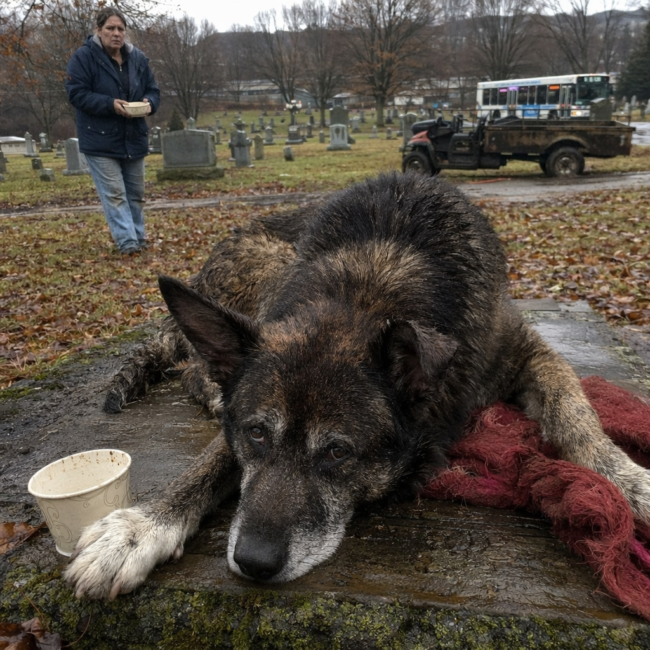
The next morning, I found the dog.
Maple Hill was not a grand cemetery. No stone angels watched over polished family vaults. Most markers were simple granite rectangles surrounded by crabgrass. The county section sat beyond an old maple grove where the ground sloped toward a drainage ditch.
James had been buried there because no relative claimed his body.
His original marker was temporary: a flat concrete slab with a thin metal identification plate. Winter salt, mower blades, and runoff damaged it within months.
Rook treated it like a door.
Each morning, he circled the stone twice before lying down. If leaves covered it, he pushed them away with his nose. If rain filled the letters, he drank from the grooves before settling across them.
He had three white toes on his right front paw. His tail curved slightly to the left, perhaps from an old injury. When he ran, his back legs moved together for several strides before finding their rhythm.
He did not appear fully wild.
He understood food bowls and leashes. He knew cars were dangerous. When I said “sit,” his rear lowered before suspicion pulled him upright again.
Someone had taught him.
Someone had also failed him.
His collar was a strip of cracked brown leather without a tag. The underside had worn smooth against his neck. Dr. Shah at the county shelter estimated his age at seven and found two healed ribs, several damaged teeth, and a BB pellet beneath the skin near his shoulder.
None of those details identified an owner.
We posted his picture in grocery stores, veterinary clinics, and neighborhood groups. Messages arrived from three states. None matched.
A warehouse worker said she had seen a similar dog sleeping beneath the freight bridge near downtown Scranton. A bus driver remembered a brindled stray near the transit station. A restaurant owner said the dog sometimes waited behind his kitchen after closing.
Rook belonged to the city’s edges.
Yet after November 19, he belonged to one grave.
The shelter’s first adoption attempt lasted less than twenty-four hours. The Allen family lived four miles away in a fenced house with two children and another dog. Rook ate dinner, slept in their laundry room, and waited until someone opened the back door at 5:40 the next morning.
He jumped the fence.
A traffic camera later showed him running north along Jefferson Avenue. He crossed six lanes beneath the railroad overpass and reached Maple Hill before the gates opened.
I found him at 10:06.
His breathing came hard. Blood darkened one paw. He had not returned to the shelter, the freight bridge, or the restaurant.
He had returned to James.
The cemetery board did not want a stray living on the grounds. Their concerns were reasonable. Rook might frighten visitors, damage flowers, or be struck by maintenance equipment.
I promised to manage him.
I installed a weatherproof shelter behind my shed, placed water beside it, and persuaded the shelter to list Maple Hill as his temporary foster address. Dr. Shah vaccinated him and treated his paw.
Rook tolerated the arrangement.
He slept inside the shelter during severe weather. He ate near the maintenance building. He allowed me to clip a new identification tag to his collar.
But each day ended in the same place.
Row Seventeen.
At 5:17, he sat upright and looked toward the gate.
That was the first clue.
The second appeared whenever I brought food in a paper soup cup. Rook sniffed the cup before eating, then carried it to James’s grave and placed it beside the marker.
I assumed somebody had once fed him that way.
I did not know who.
Part 3 — Three Winters Beside the Same Stone
Rook’s first winter at Maple Hill was mild until January.
Then the temperature dropped below ten degrees for four nights. Ice sealed the grass, and wind pushed snow beneath the doors of my maintenance shed.
I tried to keep Rook inside.
He paced between the tool cabinets and scratched the door every time the cemetery clock reached five. When I ignored him, he lifted his front paws onto the window ledge and looked toward Row Seventeen.
“You’ll freeze out there.”
Rook looked at me.
I opened the door.
He walked through the snow to James’s grave, circled twice, and lay down.
I carried his insulated shelter closer to the county section. Rook used it after midnight, but he spent every evening on the stone.
Visitors began noticing him.
A retired teacher brought a wool blanket. A mechanic left a bag of dog food near my office. Two college students drove from Philadelphia after seeing a photograph online.
Rook accepted none of their affection.
He took food and stepped away from reaching hands. If a visitor approached the grave too quickly, he positioned himself between the person and the marker. He never lunged. He simply stood.
The grave mattered more than attention.
Spring softened him.
Rook followed me while I trimmed grass and replaced flags. He learned the maintenance cart’s slow route. At noon, he rested beneath the maple tree where he could still see Row Seventeen.
He began allowing me to scratch the fur behind his folded ear.
Only for three seconds.
Then he moved away.
On May 6, I found a red scarf beside James’s marker. It was cheap acrylic, frayed along one edge. Rook lay with his nose pressed against it.
I assumed a visitor had left it.
The scarf vanished the following week. I later found it inside Rook’s shelter, folded beneath his chest.
That was the third clue.
Summer brought heat instead of snow. The grave marker became hot enough to hurt bare skin, but Rook remained beside it. I erected a canvas shade and placed a shallow water pan nearby.
He dug a hollow beside the stone where the earth stayed cooler. His shoulder still touched the marker while he slept.
The story reached local Facebook groups.
People called Rook faithful. They wrote that dogs understood death better than humans. Some claimed he could hear James’s heartbeat beneath the ground.
I deleted those comments when I saw them.
Rook’s behavior was strange enough without turning him into a myth.
I believed a practical answer existed. James had probably owned him. Perhaps housing rules separated them. Perhaps the dog followed a relative to the burial.
The cemetery record would prove it.
But obtaining that record became harder than expected. Maple Hill had changed ownership twice. County burial files from 2021 had been boxed during an office renovation. The temporary marker number contained two unreadable digits.
I searched by date, row, and initials.
Six James Carters had died in Lackawanna County that year.
Three had middle names beginning with M.
One had relatives in Florida. Another had been buried in Pittsburgh. The third had no permanent address.
That third man was ours.
James Michael Carter was fifty-three when he died at St. Agnes Hospital on November 12, 2021. His body remained unclaimed for four days. A county contractor arranged the burial.
The file listed no emergency contact.
The space marked personal property contained three entries:
Gray coat.
Red scarf.
Canvas bag.
No dog.
I contacted shelters and outreach groups. Most could not release information without a clearer reason. One remembered James’s name but little else.
“He stayed around the transit station,” a receptionist said. “Quiet man. Never caused trouble.”
“Did he have a brindled dog?”
“I don’t think so.”
I looked at Rook through my office window.
He was carrying an empty paper cup toward the grave.
During his second winter, a family from Harrisburg offered to adopt him. They visited five times, sitting at a distance until Rook accepted treats from their hands.
They seemed patient.
We arranged a trial.
This time, Rook remained in their house for three days. On the fourth, he stopped eating. On the fifth, he slipped through the front door when a package arrived.
The family called immediately.
Searchers checked roads between Harrisburg and Scranton, though the distance exceeded one hundred miles. Nobody believed Rook could return on foot.
Six days later, a truck driver found him near Interstate 81.
He was moving north.
The driver recognized him from social media and brought him back to Maple Hill. Rook stepped from the truck, ignored the food waiting beside my office, and limped directly to Row Seventeen.
He lay down across the marker.
After that, I stopped trying to send him away.
Rook had made a choice. My job became keeping that choice from killing him.
I built a wooden shelter beside the grave with the board’s reluctant approval. A carpenter donated insulated panels. A veterinary technician brought joint supplements. Children painted small stones for the surrounding garden, though we removed any with readable personal information before posting photographs.
Rook aged.
Gray spread from his muzzle to his eyebrows. His damaged teeth wore down. The old injury in his tail stiffened.
The ritual remained exact.
At 5:17, he faced the gate.
At 5:19, the Route 8 bus passed the cemetery road.
At 5:21, he rested one paw on James’s marker.
I asked a bus driver whether James had used that route.
“He used every route,” the driver said. “He rode until they made him get off when it was cold.”
The answer seemed important, but it did not explain the grave.
During Rook’s third spring, a group of volunteers restored damaged county markers. They lifted James’s stone, cleaned the metal plate, and confirmed his full name.
The local newspaper published a new photograph.
That photograph reached Denise Kline.
She had managed evening outreach at the Scranton Transit Center for eleven years. She called me on May 14, 2024.
“I knew James,” she said.
“Did he own Rook?”
“No.”
“Could the dog have lived with him outside?”
“James didn’t stay in one place. I saw him five nights a week. That dog was never with him.”
My fingers tightened around the phone.
“Then why is he on James’s grave?”
Denise went silent.
“I saw a dog with James once,” she said. “Only once.”
She remembered the date because it was James’s last evening at the station.
November 11, 2021.
At 5:17 p.m.
Part 4 — The Storm That Finally Moved Him
Before Denise found the recording, Rook nearly died on the grave.
The storm arrived on January 9 of his third winter. Forecasts predicted six inches of snow. By midnight, more than fourteen had fallen.
I closed the cemetery at three that afternoon.
Rook refused to enter the maintenance shed.
I clipped a leash to his collar and pulled. He lowered his body, braced his paws, and looked toward James’s grave.
“Not tonight.”
He remained still.
Wind pushed snow against his legs. I wrapped both arms around his chest and lifted. Rook weighed sixty-eight pounds then, but fear gave me enough strength to carry him to the utility cart.
He did not fight.
He watched the grave until the trees blocked it.
Inside the shed, Rook paced. He moved from the door to the window, then back again. At 5:17, he pressed both front paws against the glass.
The Route 8 bus did not run that night.
At 8:40, I drove home after securing him inside. The shed had heat, water, blankets, and a camera linked to my phone.
At 10:12, the camera showed Rook sleeping.
At 10:44, the door alarm activated.
I checked the video.
The lower corner of the old wooden door had broken. Rook had pushed through the opening.
He disappeared into the storm.
I called the cemetery manager, animal control, and Daniel Price, a groundskeeper who lived nearby. We returned with flashlights and snowshoes.
The wind covered tracks within minutes.
We searched the maintenance yard, road, and drainage ditch. I shouted until my throat burned. Snow entered the collar of my coat and melted down my back.
Daniel found him at 12:26.
Rook was lying on James’s grave.
Snow had covered most of his body. Only his head and one white paw remained visible. He had curled himself around the marker, using the raised edge as protection from the wind.
His eyes opened when I touched him.
He could not stand.
We wrapped him in two blankets and carried him to the truck. His temperature had fallen dangerously low. Ice clung between his toes. Every breath made a rough sound in his chest.
At the emergency clinic, technicians warmed him slowly. Dr. Shah sat beside the cage until morning.
Rook survived.
He lost no toes, but the cold worsened the nerve damage in his back legs. For ten days, he remained at my house.
I slept on the living-room sofa beside him. He accepted food from my hand and allowed me to change the bandages on his paws. At night, his legs moved as though he were running.
Each afternoon at 5:17, he raised his head toward the front window.
On the eleventh day, I drove him to Maple Hill.
Rook stepped from the car wearing a support harness. He limped past the office, crossed the frozen grass, and reached Row Seventeen.
He did not lie on the marker.
Instead, he touched his nose to the name.
Then he looked at me.
For the first time, he returned to the car when I called.
I believed the storm had changed our arrangement. Rook would live with me and visit the grave during daylight. He would no longer risk his life for the dead.
For several months, that worked.
He slept beside my back door. He learned the sound of my coffee machine. He waited while I put on my boots each morning.
At the cemetery, he went directly to James.
At closing time, he came home with me.
I thought we had solved the problem.
Then Denise arrived with a laptop and the station recording.
She placed it on my desk.
Rook stood beside her.
The video began at 5:16 p.m.
A thin man in a gray coat sat on a metal bench. A brindled stray watched him from beneath a vending machine awning.
They had never met.
Neither had anywhere safe to go.
Then James opened a paper cup.
Part 5 — The Man Who Never Owned Him
The security recording had no sound.
It did not need any.
James Carter sat beneath the transit station’s fluorescent lights with a paper cup of chicken soup and a wrapped sandwich on his knee. His gray coat was too large, and the red scarf around his neck had one frayed edge.
Rook remained twenty feet away.
James noticed him at 5:17.
He looked at the cup.
Then at the dog.
He removed the plastic lid and poured half the soup into it. He placed the lid on the concrete and stepped back.
Rook approached.
He ate quickly, eyes fixed on James.
James unwrapped the sandwich.
He tore it in half.
Then he gave Rook both pieces.
James kept nothing.
For forty-three minutes, they shared the bench. Rook sat at one end. James sat at the other. The man never reached for the dog. He did not attempt to tie him, command him, or make the animal earn the food.
He simply allowed Rook to stay.
At 6:00, a shelter van arrived.
James stood and entered it.
Rook followed as far as the curb.
The driver closed the door.
The van left.
Rook remained beneath the station lights.
That was their only meeting.
James died the following morning after collapsing at the shelter. An undiagnosed heart condition had caused cardiac failure. He never regained consciousness.
Denise attended the county burial with two outreach workers. They brought James’s gray coat, red scarf, and canvas bag because they did not want him buried without something familiar nearby.
A bus transported them from the transit center to Maple Hill.
Rook followed it.
Nobody noticed him during the service. Denise remembered seeing a dark dog near the maple trees as they left, but strays often crossed the cemetery.
The following morning, Rook lay on James’s grave.
He had stayed there ever since.
The paper cups were not random.
The red scarf was not random.
The 5:17 vigil was not random.
Rook had not spent three years waiting for an owner.
He was remembering the only person who had fed him when every other person at the station had walked past.
One meal.
One bench.
Forty-three minutes.
That was all James had given him.
For Rook, it had been enough.
Part 6 — Everything the Dog Remembered
Denise paused the recording on James’s face.
The image was grainy. Fluorescent light flattened his features, but his expression remained clear. He watched Rook eat with both hands folded between his knees.
“He was hungry too,” Denise said.
“How do you know?”
“He had used his last meal voucher for that food.”
James received two vouchers each week from the outreach center. Denise had signed the one he used that evening. He had not eaten since breakfast.
Still, he gave the sandwich away.
Denise told us what the burial file could not.
James had worked construction until a fall damaged his back. Medical bills followed. Then pain medication. Then missed shifts, eviction, and years spent moving between shelters, warming centers, bus stations, and temporary rooms.
He wrote letters to a daughter in Arizona but never mailed them.
“He was ashamed,” Denise said. “He believed she was better off thinking he had chosen not to call.”
James repaired broken zippers for other shelter residents. He carried spare socks in his canvas bag. When he had coffee, he saved sugar packets for people who arrived after the breakfast line closed.
He disliked dogs.
At least, that was what he told Denise.
As a child, James had been bitten badly enough to require stitches. He avoided dogs on sidewalks and crossed streets when they barked.
Yet on his final evening, he saw Rook watching from the cold.
James did not touch him.
He fed him anyway.
That detail mattered.
Rook was afraid of hands. He stepped away when strangers reached toward his head. James asked for nothing physical in return. He placed the food down, moved back, and gave the dog control over the distance.
Perhaps that was why Rook approached.
Perhaps one creature accustomed to being overlooked recognized another.
We could not know what the dog thought. We could only follow what he did.
He remembered the paper cup because James poured soup into the lid.
He remembered the red scarf because it carried James’s scent to the burial.
He watched the Route 8 bus because similar buses had taken James from the station and later carried the outreach workers to Maple Hill.
He sat upright at 5:17 because that was when James first noticed him.
He carried food to the grave because the first food James gave him had come without a demand.
The clues had been present for three years.
We interpreted them through the story we expected—a dog grieving an owner. The truth was smaller and, for that reason, harder to dismiss.
James had not raised Rook.
He had not trained him, sheltered him, or known his name.
He had seen a hungry animal and divided his final meal.
Rook remembered.
Denise contacted James’s daughter after finding her name in an old outreach file. Her name was Allison Carter. She lived in Tucson and had not seen her father in eleven years.
She flew to Pennsylvania that June.
I met her at the cemetery gate. She was thirty-two, with James’s narrow face and the same habit of folding her hands when she did not know what to do.
Rook stood beside me.
Allison approached the grave slowly.
“Did he know my father?” she asked.
“Once.”
I told her about the station recording.
She sat on the grass.
Rook watched from six feet away. He did not approach until Allison removed a wrapped sandwich from her bag.
“I didn’t know what else to bring,” she said.
She tore it in half and placed one piece beside James’s marker.
Rook sniffed it.
Then he sat beside her.
Allison did not touch him.
They remained there for nearly an hour.
Before leaving, she gave Denise a bundle of letters. James had mailed three during his first year without housing, before shame silenced him. Allison had kept them inside a kitchen drawer.
She read one aloud at the grave.
James had written about losing his apartment, apologizing without asking forgiveness, and hoping she still played the piano.
At the bottom, he had added:
I keep thinking a person should be measured by what he gives when giving hurts.
Allison stopped reading.
Rook lowered his head onto the marker.
The cemetery board replaced James’s damaged slab with a simple granite stone. Allison chose the words beneath his name:
HE SHARED WHAT HE HAD.
She did not mention the dog.
She said the stone belonged to James.
The community created the James Carter Meal Fund at Denise’s outreach center. Donations paid for evening food vouchers that could be used by people with animals beside them. Local shelters supplied collapsible bowls, leashes, and temporary foster care so nobody had to choose between a warm bed and abandoning a dog.
Rook’s photograph appeared on the donation page, but we used no dramatic language.
The facts were enough.
A man with one meal gave it away.
A dog with no home stayed beside his grave.
Within six months, the fund served more than eight hundred meals.
Every cup carried a blank lid.
No slogans.
No logos.
Just food offered without a condition.
Rook continued visiting James.
He no longer slept outside because his joints could not tolerate the cold. Each morning, he rode beside me in the maintenance truck. He rested his chin on the window ledge as we approached Row Seventeen.
At 5:17, he still looked toward the gate.
The Route 8 bus still passed two minutes later.
Then Rook returned to the truck.
He had not forgotten James.
He had simply learned that leaving the grave did not mean leaving the man.
Part 7 — One Meal Every Friday
Rook spent the rest of his life between my house and Maple Hill.
At home, he slept beside the radiator. He learned that my kitchen floor warmed first in winter and that I dropped toast crumbs beside the counter.
At the cemetery, he remained James’s quiet witness.
His routine changed as his body aged. He no longer circled the grave twice. Some mornings, he stopped several feet away and waited for me to support his hips.
I carried a folded blanket in the truck.
Rook lay on it beside the marker, never directly on the cold stone anymore. His white paw still reached toward James’s name.
Allison returned each November.
She brought no flowers. James had disliked cut flowers because he considered them expensive things that died too quickly.
Instead, she brought a sandwich.
At 5:17, she divided it in half.
One piece went to Rook. The other went into a sealed bag for the outreach center.
Friday evenings became our repeating ritual.
Denise, Allison when she was in town, and I met beside the transit station bench where James had fed Rook. We stocked the community refrigerator with sandwiches, soup cups, dog food, and bottled water.
Nobody had to explain why they needed them.
Rook attended while he could. He lay beneath the same awning, watching buses arrive and leave. People who knew the story gave him space. Those who did not sometimes asked why an old dog wore a cemetery identification tag.
“He works with me,” I said.
That answer felt right.
Three years after Denise found the recording, Rook’s back legs stopped supporting him. Dr. Shah came to my house on a quiet September morning.
Before she arrived, I drove him to Maple Hill one last time.
I spread his blanket beside James’s grave.
Rook rested his head over the words HE SHARED WHAT HE HAD. The morning bus passed beyond the trees. His folded ear lifted at the sound.
At 5:17 that evening, Allison called from Tucson.
Denise sat beside me.
Rook’s breathing slowed beneath my hand.
No crowds came. No camera recorded it. The cemetery remained quiet except for maple leaves moving across the grass.
Rook left with his white paw touching James’s stone.
We buried his ashes beside the maple tree, not inside James’s grave. A small marker carries only his name and three dates—the day he appeared, the day we learned why, and the day he rested.
Every Friday, I still visit the transit station.
I place one cup of soup and one wrapped sandwich inside the community refrigerator. Then I fill the small bowl beneath it with dog food.
At 5:17, I sit on James’s bench.
Sometimes nobody comes.
Sometimes a person takes the meal without looking at me.
Sometimes a stray approaches after everyone else has left.
I put the food down.
Then I step back.
That was how James did it.
That was why Rook stayed.
One meal can outlive the hand that gave it.
Follow this page for more unforgettable dog stories about quiet loyalty, forgotten people, and the small acts of kindness animals remember forever.