Part 2: A Dog Was Chained to the Fence While His Family Moved Away Without Him, Until the Neighbor Cut the Chain and Taught Him He Was Not Furniture
Part 2 – The House Across the Street Went Dark
That first evening, I crossed the street with a bowl of water and a soft voice.
I wish I could say I did it immediately. I wish I had marched over the moment the moving truck turned the corner, taken bolt cutters from my garage, freed Buddy, and become the sort of person people clap for in stories. But real people are often slower than the version we later wish we had been. I stood in my kitchen window for too long, staring across the street, making excuses for people who did not deserve them.
Maybe someone is coming.
Maybe I misunderstood.
Maybe they left him for a few hours, not forever.
Maybe this is none of my business.
Then Buddy tried to drink from a tipped-over plastic bucket near the fence, found it empty, and looked back at the road.
That ended my maybes.
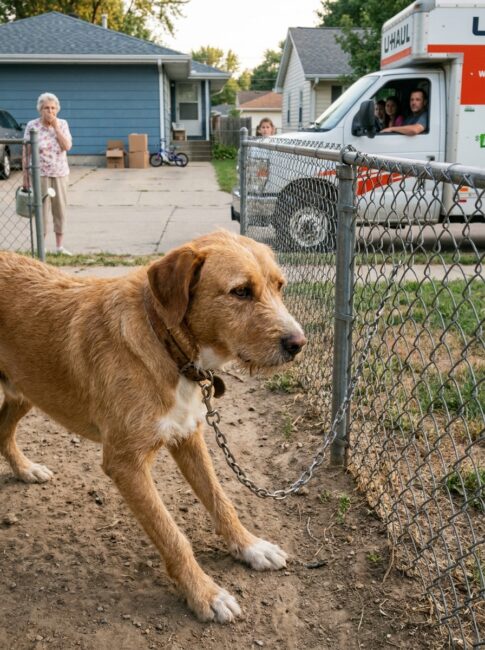
I filled my largest mixing bowl with cool water, carried a few pieces of sliced turkey from the refrigerator, and walked across Hawthorne Street in the fading light. The air was thick with the smell of cut grass, hot pavement, and empty house. The moving truck’s tire marks were still in the driveway. A broken plastic toy lay near the porch. Someone had left a broom leaning against the garage wall as if even the broom had been worth abandoning more carefully than the dog.
Buddy watched me approach.
He did not bark.
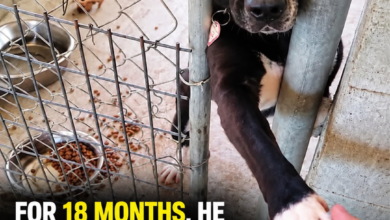
That silence struck me again. Most dogs bark at strangers near their fence. Buddy only lowered his head and stepped back until the chain tightened. The metal links dragged through dirt with a tired sound. His ribs were not showing badly, but he was thinner than a loved dog should have been. His fur had burrs near the tail. A raw circle had formed under the collar where the chain pulled when he reached for people who kept moving away.
“Hello, sweetheart,” I said.
His ears twitched.
“I brought you water.”
I set the bowl just inside his reach and backed away. He looked at the water, then at me, as if permission still mattered. I had seen that look in children at school when they had been scolded too often for normal needs. A look that said, Am I allowed? Will someone be angry? Is this a trick?
“It’s yours,” I whispered.
Buddy lowered his head and drank.
Not greedily. Carefully. He took a few laps, paused, checked my face, then drank again. When I tossed a piece of turkey near his paws, he sniffed it but did not eat until I stepped farther back. Then he swallowed it without chewing and looked ashamed of wanting more.
That nearly broke me.
I walked around the property once, calling toward the empty house. No answer. The back door was locked. The garage was closed. A pile of trash bags sat by the curb, already torn open by wind. I found no food, no note, no leash, no crate, no neighbor waiting to collect him. Only Buddy, chained to a fence post with a padlock through the end of the chain.
A padlock.
That meant this was not a mistake.
That meant someone had made sure he could not follow.
I called the non-emergency police line first because I was a woman who believed in proper channels. The dispatcher was kind but tired. Storm damage had not been the problem; that week, animal calls had been. She said an animal control officer could come out, but it might be morning. She asked if the dog appeared aggressive.
“No,” I said. “He appears heartbroken.”
There was a pause.
“We’ll log that, ma’am.”
I stayed outside until the mosquitoes began finding me. Buddy lay near the fence with the bowl between his paws. Every time a car turned onto the street, his head lifted. Every time it passed, his head lowered again. I sat on my porch and watched him from across the road long after dark.
The blue house looked strange without life in it.
No porch light.
No television flicker.
No children shouting.
No man’s voice snapping.
Only the dark rectangle of the front door and the soft metallic clink of Buddy shifting against his chain.
I slept badly that night. Around two in the morning, I woke because I thought I heard Tom calling from the hallway. Grief does that sometimes, even after years. It throws old sounds into new rooms. I got up, made tea I did not drink, and looked out the front window.
Buddy was still awake.
He was sitting by the fence, facing the corner.
Waiting.
That image settled into me like a stone.
At sunrise, I called animal control again. They said someone would come by late morning. I said the dog had been chained there all night. They said they understood. I said he had no shelter from the sun. They said they were doing their best. I believed them, but their best was not soon enough for Buddy.
So I went into Tom’s garage.
The bolt cutters hung on the wall where he had left them years earlier, above the workbench with coffee rings still stained into the wood. I had not touched them since he died. They were heavier than I remembered, and I had to carry them with both hands.
Buddy stood when he saw me cross the street.
The chain clanged.
That sound no longer sounded like waiting.
It sounded like a sentence.
“Enough,” I said.
I knelt beside the fence, slid the cutters around the chain link nearest the padlock, and squeezed with every bit of strength I had. The handles barely moved. My hands shook. My shoulder complained. I adjusted the jaws and tried again.
The metal snapped.
Buddy flinched.
Then the chain fell into the dirt.
For a moment, neither of us moved.
Buddy looked at the broken chain, then at me, then toward the road where the truck had gone.
I expected him to run.
Instead, he took one uncertain step toward my porch.
Part 3 – The Dog Who Would Not Come Inside
The first thing Buddy did with his freedom was stand still.
That is another detail people do not expect. They think a chained dog will bolt the second the chain breaks, run circles, leap, shake himself into joy. Buddy did none of that. He stood beside the fence with the broken chain hanging from his collar, looking at the empty road as if freedom was a language he had not heard in a long time.
“Come here, sweetheart,” I said.
He looked at me.
Then back at the corner.
There was still hope in him, but it had gone thin and dangerous, like a thread pulled almost to breaking. He took two steps toward the road, stopped, sniffed the air, and gave one soft whine. A car passed. He watched it until it disappeared. Then he looked at the blue house.
The front door stayed closed.
That was the moment I think he understood something.
Not all at once. Dogs are merciful. They do not condemn quickly. But his body changed. His tail, already low, dropped until it nearly touched the grass. His ears folded back. He turned in a small circle near the fence post and lowered himself to the ground, not lying down exactly, more like surrendering to gravity.
I sat on the curb a few feet away.
“I know,” I said.
Of course, I did not know exactly. No human can fully know what abandonment feels like to a dog who believed every engine might be his family returning. But I knew something about a door not opening anymore. I knew something about waiting for a sound that never came. When Tom died, I kept expecting his truck in the driveway at 5:15 for months. Some evenings, I still turned my head when a similar engine passed.
Buddy and I sat there together, both of us facing an absence.
When the animal control officer arrived, Buddy pressed himself behind my legs. Her name was Rachel Kim, a Korean American woman in her early forties with black hair tied under a cap, calm hands, and the patient voice of someone who had learned not to rush frightened animals. She scanned Buddy for a microchip. Nothing. She checked the raw skin at his collar and the broken chain.
“You witnessed the family leave him?” she asked.
“Yes.”
“Did they say anything?”
“No.”
Rachel’s mouth tightened.
She took photographs of the fence, the chain, the empty house, the water bowl, the padlock. She explained that Buddy would normally be taken to the shelter for a stray hold and investigation. Then she looked down at him pressed against my shoe, trembling every time a truck passed.
“He seems attached to you already,” she said.
“I cut his chain. That’s all.”
Rachel gave me a look kind enough to be firm. “To him, that may not be all.”
She allowed me to foster him while the case was documented, provided I brought him to the vet that day and agreed to make him available if a lawful owner came forward. I said yes before fear could talk me out of it.
That was how Buddy crossed the street.
Not proudly. Not happily. He walked beside me with the broken chain still trailing until Rachel removed it gently from his collar. When we reached my porch steps, Buddy stopped. He looked at the open front door, then back toward the blue house.
“Come in,” I said.
He did not.
I placed the turkey pieces just inside the doorway. He stretched his neck, took one, backed out again, and ate it on the porch. I tried water. He drank outside. I tried a soft blanket. He stepped around it. Inside the house, the air smelled like lemon cleaner, old books, and the lavender soap I used because Tom once said it reminded him of clean sheets. Buddy stood at the threshold as if houses were places where love could vanish without warning.
So I did not force him.
I brought an old quilt to the porch and sat there with him most of the morning. Every time he glanced at the blue house, I said nothing. Every time he looked at me, I smiled and looked away so he would not feel watched. Around noon, he put one paw over the threshold.
Then he pulled it back.
“That counts,” I told him.
At Cedar Falls Animal Clinic, Dr. Samuel Greene, a Black American veterinarian in his fifties with kind eyes and a careful way of speaking, confirmed what I suspected. Buddy was dehydrated but not critical, underweight but recoverable, with collar irritation, fleas, and stress behaviors consistent with neglect. No major injuries. No chip. No reason to believe anyone had been planning to care for him properly.
“He’s emotionally shut down,” Dr. Greene said.
I touched Buddy’s head. He leaned slightly into my hand, then caught himself and pulled away.
“What does he need?” I asked.
“Time. Routine. Gentle boundaries. Food he can count on. People who come back when they leave.”
People who come back.
That phrase followed me home.
That night, Buddy finally stepped fully into my house because rain began tapping the porch roof. He walked three feet into the living room, froze, then curled up on the rug near the door so he could watch both the room and the street.
I left the porch light on.
For him, I told myself.
Maybe also for me.
Part 4 – Teaching a Waiting Dog to Stop Waiting
The first week with Buddy was not a rescue montage.
It was not a clean before-and-after photograph. It was not a happy dog instantly forgetting the chain because I owned a soft bed and a full pantry. Buddy had been left behind by the people his whole life had been built around. Love, for him, had become a truck driving away. That sort of wound does not close because someone says, “You’re safe now.”
Dogs listen to patterns more than promises.
So I gave him patterns.
Breakfast at seven.
Walk at eight.
A bowl of fresh water in the kitchen and another on the porch.
Dinner at five-thirty.
Porch time after sunset.
Lights off at ten.
At first, he treated every routine like a test. When I filled his bowl, he stepped back and waited until I moved away. When I reached for the leash, he flinched, then came slowly, as if leashes might lead to fences. When I left to take out trash, he panicked and scratched the inside of the front door. When I returned thirty seconds later, he pressed his body flat to the floor, tail wagging so low it swept dust from the entry rug.
“I came back,” I said every time.
Those three words became our household prayer.
I came back from the mailbox.
I came back from the grocery store.
I came back from the bathroom, which offended his sense of supervision.
I came back after visiting my friend Janice for lunch.
Each return laid down one small stone on the road between fear and trust.
The blue house across the street stayed empty for nearly a month. Buddy watched it from my front window. He did not bark at it. He simply watched. Sometimes his ears lifted when a car slowed near the curb. Sometimes he stood when children walked by. Once, a moving truck from another company turned onto our street by mistake, and Buddy began shaking so hard I sat on the floor beside him until it left.
I hated the Hawthornes then.
I tried not to, because hatred is heavy and I was already carrying enough. But I hated the thought of Brent fastening that padlock. I hated Laura getting into the truck without touching the dog who had probably slept near their back door for years. I hated that the children would grow up with some version of the story that made abandonment sound practical. We could not take him. The new place did not allow pets. It was too hard. Somebody would find him.
Somebody did.
That did not make leaving him right.
Rachel Kim kept me updated. The landlord confirmed the Hawthornes had vacated the rental without notice about the dog. The forwarding information was incomplete. Calls went unanswered. Legally, Buddy would be considered abandoned if no one claimed him within the required period. Rachel warned me that sometimes people resurfaced when consequences appeared.
Part of me feared that.
Part of me wanted it, just so I could ask how they slept after hearing that chain.
Meanwhile, Buddy learned my house in inches.
By the tenth day, he slept on the quilt instead of near the door.
By the twelfth, he ate while I stayed in the room.
By the fifteenth, he followed me into the kitchen and sat while I made coffee.
By the seventeenth, he rested his chin on my knee.
That was the first time I cried in front of him.
I had been reading at the kitchen table, or pretending to read. The page had blurred because my mind was on Tom, as it often was in quiet hours. Buddy came over, placed his chin on my knee, and sighed. Not a dramatic sigh. Just the tired release of a living creature deciding another living creature might be safe.
My hand hovered above his head.
He did not move away.
So I touched him.
Softly.
He closed his eyes.
That simple permission felt larger than adoption papers.
After that, we began taking longer walks. People on the street asked about him, and I told the truth in brief form because some stories are too raw for sidewalks. “He was left behind when the family moved.” Most people looked horrified. A few looked embarrassed, as if they had once made a smaller selfish choice and recognized the road it lived on.
Buddy walked politely, always glancing back at my house as if afraid it might vanish while he was gone. When we returned, he inspected every room. Only then would he relax.
One afternoon, we passed the blue house and found a realtor placing a sign in the yard. Buddy froze.
The woman smiled at me, unaware. “Pretty dog.”
“Yes,” I said, tightening my grip on the leash. “He is.”
Buddy stared at the fence post where the chain had been.
Then he leaned against my leg.
Not much.
Just enough to tell me he knew which side of the street home was on now.
Part 5 – The Day the Old Family Came Back
They came back on a Saturday morning in October.
By then, Buddy had been mine legally for three weeks. The abandonment hold had passed. Rachel had filed her report. No one had claimed him. I had signed the adoption papers at the shelter while Buddy sat beside my chair wearing a new blue collar and looking suspicious of the printer. Dr. Greene had declared him healthier, though still thin. I had bought him a bed for the living room, then another for the bedroom, then a third for the porch because apparently I had become a woman who believed dogs needed real estate.
The blue house had new tenants coming soon, and a cleanup crew had cleared the last trash from the garage. I thought the Hawthornes were gone from our lives.
Then a silver SUV pulled into the empty driveway.
Buddy saw it before I did.
We were on the porch. I had coffee. He had a chew toy shaped like a duck, though he preferred carrying it gently to chewing it. The SUV stopped, and Brent Hawthorne got out wearing a baseball cap and the same annoyed posture he had worn when living there. Laura stepped out of the passenger side with her arms folded. The children stayed in the back seat.
Buddy stood.
His ears lifted.
For one awful second, his tail moved.
Not happily, exactly.
Instinctively.
A body remembering before the heart had time to object.
Brent opened the garage side door with a key he apparently still had. He and Laura began pulling out things they had left behind: a toolbox, two plastic bins, a folded ladder. Not once did they look toward my porch. Not until Buddy made one small sound.
Laura turned first.
Her face changed.
Brent looked over, saw the dog, and frowned like a man seeing a possession in someone else’s yard.
I stood.
Buddy pressed against my leg.
Brent crossed the street without greeting me. “That our dog?”
The words were so wrong I nearly laughed.
Our dog.
Not Buddy.
Not is he okay.
Not thank God someone helped him.
Just ownership, late and convenient.
I set my coffee down carefully because my hands had begun to shake. “This is my dog.”
Laura came up behind him, eyes darting from Buddy to me. “We were going to come back for him.”
“No,” I said.
Brent’s jaw tightened. “You don’t know that.”
“I watched you leave. I watched him wait all night.”
The children had gotten out of the SUV by then. Maddie stood near the curb, pale and miserable. Cole hid partly behind the car door. Buddy looked at them and whined softly. That hurt most of all. His love had not vanished just because they failed him. Dogs are not built that way. They keep rooms open inside themselves longer than people deserve.
Maddie started crying.
Laura looked at the ground.
Brent said, “We couldn’t have a dog at the apartment. I figured animal control would pick him up.”
“With a padlock on the chain?”
He did not answer.
I felt old then, but not weak. There is a difference. Age had thinned my skin, slowed my steps, and made jars harder to open. It had not taken my voice.
“You left him like furniture,” I said. “Like a broken table you didn’t want to move.”
Maddie sobbed harder.
Maybe I should not have said it in front of the children. But perhaps children need to hear the true names of things adults try to soften. Abandonment. Cruelty. Cowardice. Not inconvenience. Not a hard decision. Not we had no choice.
Brent muttered something about calling the police.
“Please do,” I said. “Ask for Officer Rachel Kim. She took the photos.”
That ended the threat.
Laura finally spoke. “Is he okay?”
I looked down at Buddy. He was trembling, but he had not moved toward them. His body leaned into my leg so hard I could feel his heartbeat through my pants.
“He is learning to be,” I said.
Maddie crossed halfway into the street. “Can I say goodbye?”
Brent snapped her name, but she ignored him.
I looked at Buddy, because the answer belonged partly to him. His ears were back. His tail was low. But when Maddie crouched several feet away and whispered his name, he took one step forward, then stopped. He sniffed the air. His body shook.
I knelt beside him and kept one hand on his back.
“You don’t have to,” I whispered.
That mattered to me.
Choice.
For once, Buddy would have a choice.
He took two more steps, reached Maddie, and touched his nose to her hand. She covered her mouth, crying silently. He let her stroke his head once. Then he turned around and came back to me.
Not running.
Not afraid.
Deciding.
He climbed the porch steps and sat by my chair.
Brent and Laura left a few minutes later with their bins and ladder. Maddie looked back through the window until the SUV turned the corner, just as Buddy had once watched the moving truck disappear. But this time, Buddy was not at the fence. He was beside me, wearing a collar with his name and my phone number on it.
When the SUV was gone, Buddy did not run to the street.
He walked into the house.
And for the first time, he did not stop at the doorway to check whether I followed.
Part 6 – Becoming Family
After the Hawthornes came back, Buddy changed again.
The encounter unsettled him for several days. He slept near the front door, woke at every engine, and carried his duck toy from room to room like an anxious parent moving a baby during a storm. But something else had shifted too. The worst thing had happened. The old family had returned, and he had not been taken. He had greeted a piece of his past, touched it gently, and chosen to come back inside.
Trust deepened after that.
He began sleeping beside my bed instead of by the door. He rolled onto his back in the living room, paws in the air, completely undignified. He learned that my friend Janice kept dog biscuits in her purse and therefore became a person of spiritual importance. He discovered squirrels, then developed a dramatic but ineffective policy against them. He started greeting me with a full-body wiggle every time I came home, even if I had only been outside bringing in the trash cans.
“I came back,” I would say.
His tail answered, I know.
The new tenants moved into the blue house in November, a young couple with a baby and no dog. I worried Buddy would struggle watching strangers live where his old life had ended. But he surprised me. The first time the baby cried through an open window, Buddy tilted his head, then brought his duck toy to the fence and dropped it in the grass as if offering assistance.
The young mother, Emily Parker, a white American woman in her late twenties with tired eyes and a grateful smile, laughed when I told her his story. Then she cried. Then she asked if Buddy could visit sometimes because her baby smiled whenever she saw him from the window.
That is how Buddy became not only my dog, but a neighborhood dog in the best sense.
Children asked to pet him, and I taught them to let him approach first. The mail carrier learned he preferred gentle words to sudden hands. Mrs. Alvarez down the block, who had no patience for foolish men and endless patience for animals, called him “Professor Buddy” because of the thoughtful way he sniffed everything before approving it. Rachel Kim stopped by once off duty and smiled when Buddy greeted her without shaking.
“He looks different,” she said.
“He feels different,” I told her.
So did I.
Before Buddy, my days had been organized around absence. Tom’s empty chair. The untouched golf clubs in the garage. The quiet evenings. The birthday cards I sent to grandchildren who texted back with hearts instead of calling. I had not been unhappy exactly. But I had been slowly shrinking into my routines, becoming a woman who watched life through windows.
Buddy pulled me outside.
At first for walks.
Then for training classes.
Then for adoption events where Rachel asked if I would tell Buddy’s story to encourage fostering. I said no twice, then yes once, which is often how service begins. Standing in front of strangers with Buddy beside me, I told them about the moving truck, the chain, the padlock, the waiting. I did not make it softer than it was.
Then I told them the part that mattered most.
“They left him like furniture,” I said, my hand resting on Buddy’s head. “I showed him he was family.”
That sentence became something people repeated.
Not because it was clever.
Because too many dogs have been treated like objects when they became inconvenient. Too many have watched doors close, cars leave, hands withdraw, and learned the wrong lesson about themselves. Buddy’s story reminded people that abandonment is not the end of a dog’s worth. It is only the end of one person’s decency.
Over the next year, three people from those events became fosters. One adopted a senior beagle. Another took in a frightened shepherd mix whose owner had died. A third became a volunteer transport driver. I do not claim Buddy saved them all, but I know this: when people met him, they understood that healing was possible without pretending harm had not happened.
Buddy never stopped loving carefully.
That was his way.
He did not fling his heart at every person. He offered it in measured pieces. A head on a knee. A lean against a leg. A toy placed near a shoe. A soft wag when someone came back. I learned to respect that. Love does not have to become loud to be whole again.
On the anniversary of the day I cut his chain, I took him across the street to the old fence post. The padlock was gone. The chain was gone. The dirt had grown over where his paws had worn a small hollow from waiting.
Buddy sniffed the ground.
Then he turned away and led me home.
That was his ceremony.
That was enough.
Part 7 – The Sound of a Chain No Longer There
Buddy is nine now.
His muzzle has gone white around the edges, and his golden-brown coat has softened with age. He still has the white chest that makes him look slightly dressed up, and the floppy ears that never quite agree on direction. He moves slower in the mornings, though he forgets his age whenever Emily’s little girl, now four, throws a ball across my yard.
The blue house has changed owners twice since the Hawthornes left. The fence post where Buddy waited was replaced last spring. There is no visible sign of what happened there. New grass covers the dirt. A young maple tree stands near the sidewalk. If you walked past today, you would never know a dog once stood chained there, watching his family drive away with everything except him.
But I know.
Buddy knows too.
Not with the same pain, I hope. More like scar tissue. A place that remembers without bleeding.
Sometimes he still lifts his head when a moving truck turns onto the street. He watches, but he no longer shakes. If the truck passes, he lowers his head again. If it stops, he looks at me. I always say the same thing.
“You’re home.”
His tail moves.
That is our answer.
People like to ask who rescued whom. It is a sweet question, and I understand why they ask it. They expect me to say Buddy rescued me too, and of course he did. But the truth is not a neat trade. Rescue is not a balanced receipt. I cut a chain from a fence. Buddy changed the way my house breathed. I gave him water. He gave me mornings. I gave him a collar with my phone number. He gave me a reason to come back from the grocery store with something more than bread and milk.
I showed him that people can return.
He showed me that I still could.
After Tom died, I had become careful with attachment. Careful is a polite word for afraid. I loved my children, my grandchildren, my neighbors from a comfortable distance. I sent cards. I answered messages. I waved from the porch. But I did not invite much in. Loss had made me tidy. Buddy made me messy again.
Dog hair on the couch.
Leashes by the door.
Treat crumbs in my coat pockets.
Vet appointment magnets on the refrigerator.
A muddy paw print once stamped across a tax document, which I mailed anyway because the government needed to know who lived here.
There is life in mess.
I had forgotten that.
Every evening, Buddy and I sit on the porch. He lies beside my chair, front paws crossed, eyes half-closed, listening to the neighborhood. Cars pass. Children shout. Emily’s daughter sings to herself while drawing chalk flowers on the sidewalk. Somewhere, a lawn mower starts. The world keeps moving, but Buddy no longer stands at the fence waiting to be chosen.
He has been chosen.
Fully.
Daily.
In small ordinary ways that matter more than dramatic declarations.
I choose him when I refill the water bowl before bed.
I choose him when I wait for his old legs on the porch steps.
I choose him when I say no to people who want to rush his trust.
He chooses me when he follows me from room to room.
He chooses me when he brings the duck toy to my feet.
He chooses me when I leave and return and he greets me not with panic anymore, but with joy.
That is healing.
Not forgetting.
Not pretending the chain never existed.
Healing is hearing a truck engine and staying relaxed because the person beside you has proved, a thousand times, that departure is not abandonment.
A few months ago, Maddie Hawthorne wrote me a letter.
She is a teenager now. Rachel forwarded it through proper channels after asking my permission. In it, Maddie said she had never forgotten Buddy. She said she was sorry. She said she had been a child and did not understand how to stop what adults were doing, but she understood now that silence can become part of harm. She volunteers at an animal shelter in her new town.
I read the letter twice.
Then I sat on the porch with Buddy’s head in my lap and told him Maddie remembered him.
He thumped his tail once.
I wrote back.
Not to absolve everyone.
Not to reopen wounds.
But to tell a young woman that becoming better matters.
I told her Buddy was safe. I told her he had a yard, a porch, a duck toy, neighbors who loved him, and a woman who came back every time she left. I told her he was family.
That word still feels sacred to me.
Family is not who loads the truck.
Family is who looks at the chain and says no.
Family is who stays through fleas, fear, shaking, setbacks, and long nights by the door.
Family is who teaches a dog that his worth was never measured by whether someone made room in a moving truck.
Buddy is asleep now as I write this. His paws twitch like he is running somewhere in a dream. I hope it is not after the truck. I hope he is running through my yard, across fresh grass, toward the porch where the door is open and someone is waiting with clean water, a soft voice, and a promise kept so many times it no longer needs words.
They left him like furniture.
I showed him he was family.
And in the quiet years since, he has shown me that a heart can be abandoned once and still learn the sound of home again.
If this story touched your heart, follow this page for more unforgettable dog stories about rescue, loyalty, healing, and the quiet people who choose not to look away when a dog is left behind.