Part 2: A Homeless Old Man Pulled a Dog From a Dumpster Minutes Before the Garbage Truck Arrived — Then the Dog Led Strangers Back to the Man Everyone Had Stopped Seeing
Part 2 — Rising Action
I did not name her at first.
Names make things harder to lose.
That was one of the rules I had learned outside. Do not name the pigeon with the broken foot. Do not name the man who sleeps two columns down until he tells you his name first. Do not name anything you cannot protect.
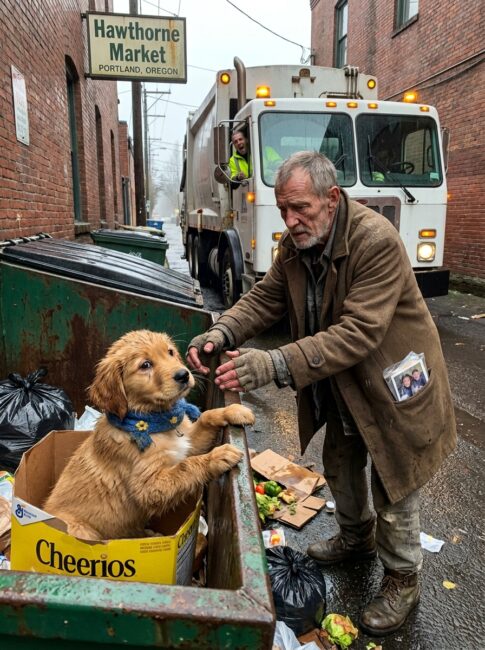
But the brass tag had already done it for me.
June.
The first night, I took her under the Burnside Bridge and made a bed from my second sweater, the one I had been saving for colder weather. She circled it twice, then crawled into the hollow between my knees and my coat.
She smelled like dumpster rain and fear.
I smelled worse.
Neither of us complained.
At dawn, I woke with her nose pressed under my wrist. She was not licking. Not begging. Just checking whether I was still there. When I moved, she exhaled, a small soft sound that fogged the inside of my coat.
That was the first ordinary thing.
It did not feel ordinary then.
On the second day, I spent my last four dollars on a can of chicken noodle soup and a plain biscuit from a diner that still let me stand near the side window. I poured the soup into my dented cup and broke the biscuit in half.
June watched my hands, not my face.
I gave her the bigger half.
She did not take it right away. She sniffed it, looked at me, then picked it up as gently as if I had handed her glass. After she ate, she pushed the smaller crumbs toward my boot with her nose.
I laughed.
It surprised both of us.
A laugh feels dangerous when you have been quiet too long.
On the fourth day, rain came sideways across the river, the kind of Portland rain that does not fall so much as settle into your bones. June hated the thunder of cars overhead, but she hated distance more. Every time I shifted away to keep her dry, she followed, shoving that soft head under my hand.
A college kid in a green raincoat passed us and dropped two granola bars near my cart without looking at me.
June stood.
Not barking.
Just standing between the bars and the boy, tail low, body stiff, watching until he looked back.
“Good dog,” the kid said.
He said it to her.
But for some reason, it landed on me.
After a week, people who had never noticed me began noticing her. A woman from the coffee shop brought a paper bowl of water and said, “Is she yours?” I almost said no. Then June leaned against my leg with her full little weight.
“Yes,” I said.
The word scared me.
It also warmed me.
Winter moved in slowly that year. The air sharpened. The river turned black under the bridges. At night, June tucked her nose beneath my beard and slept with one paw on my chest, as if I were something that might float away.
She learned my routes.
The church on Tuesdays for socks and soup.
The public library on days when the doors opened early and the security guard was in a kind mood.
The laundromat window where heat leaked through a crack near the vent.
And the loading dock behind Hawthorne Market, where I never let her go near the dumpster again.
She did not like that alley.
But every time we passed it, she stopped and stared at the brick wall across from the store.
Not at the dumpster.
At a faded blue door with a scratched brass mail slot.
I thought she remembered being thrown away.
I did not know she remembered something else.
There was one more thing I noticed but did not understand.
When church bells rang from St. Agnes on Division Street, June lifted her head and gave one small whine. Not fear. Not excitement. Recognition.
Then she would search the sidewalk faces.
As if listening for someone behind the sound.
I kept the blue scarf around her neck.
Washed it once in a gas station sink.
It dried stiff and uneven, but the knitted pattern showed after the dirt came out: tiny yellow flowers stitched into the edge.
My wife Elise used to knit flowers into things.
I tried not to think about that.
Some memories are warm only from far away.
Hold them too close, and they burn.
Part 3 — False Climax
The day people finally saw us was the first freeze of December.
Not cold.
Freeze.
There is a difference.
Cold makes you pull your coat tighter. Freeze makes your fingers forget what they are for.
By then, June had grown a little stronger. Her fur had filled out around her neck. Her eyes had lost the flat look of an animal waiting for the next bad thing. She still startled at loud trucks, but she recovered faster if I put my hand on her back.
That morning, the city crews came through under the bridge.
They told us to move.
They always said it like a weather report.
“Cleanup today.”
“Pack what you can.”
“Shelter beds available downtown.”
Available is a complicated word when the shelters are full by sunset, when they separate you from your dog, when the last thing keeping you alive has four paws and a blue scarf.
I packed what I could.
Two blankets.
The coffee can with the photos.
A plastic bag of socks.
June’s bowl.
My hip locked halfway through, and I had to sit on the curb while rain turned to hard little pellets against the pavement. June stood close, pushing her side against my knee. People stepped around us. City workers lifted tents, carts, sleeping bags, pieces of lives into trucks.
Nobody was cruel.
That almost made it worse.
Cruelty gives you a place to put anger.
Efficiency gives you nothing.
By afternoon, we had nowhere dry.
I tried the shelter on Glisan. No dogs unless registered service animals. I tried the church basement. Full. I tried a parking garage until a guard told me to leave before he had to call someone.
June’s paws shook on the concrete.
I wrapped my coat around her first.
The cold went through my shirt like teeth.
Near midnight, we ended up beneath the east ramp of the Morrison Bridge, smaller and meaner than our usual spot, with wind cutting through from both sides. I laid the plastic tarp against the wall and pulled June into my lap. Her body was warm, but not enough.
At some point, my shaking stopped.
That is not good.
I knew that from years outside. Shaking means your body is still fighting. Stillness means it is losing.
June lifted her head.
She nudged my chin.
I tried to speak and made no sound.
Then she stood, stepped out of the tarp, and barked.
Once.
Twice.
I wanted to call her back, but my tongue felt thick.
She barked again.
Then she ran into the rain.
That was the moment I thought the story had turned cruel.
I had saved her from a dumpster.
Fed her before myself.
Wrapped my coat around her.
And when the night got too hard, she left.
I closed my eyes.
The river traffic hummed somewhere beyond the ramp. Tires hissed on wet pavement. My hands were tucked under my arms, but I could not feel my fingers. In my coat pocket, the plastic-wrapped photographs pressed against my ribs.
Elise in a yellow dress.
My son Daniel at nine, holding a baseball glove.
Me in front of the house before everything went wrong.
I remember thinking, very clearly, that I was tired.
Then June came back.
Not alone.
She was pulling a woman by the sleeve.
The woman wore a purple rain jacket, rubber boots, and a badge clipped crookedly to her chest. Behind her came a man with a flashlight and a thermal blanket. June barked at them, then ran back to me, then barked again, furious at how slow humans can be when a life is cooling under a bridge.
The woman dropped to her knees.
“Sir, can you hear me?”
June pushed her nose under my hand.
I opened my eyes.
The woman wrapped the silver blanket around my shoulders, then one around June. The man spoke into a radio. Someone said “hypothermia.” Someone said “transport.” Someone said “dog-friendly placement.”
June climbed onto my lap again and pressed her wet face under my chin.
She had not left.
She had gone for help.
For a few hours, that seemed like the whole miracle.
Part 4 — The Twist
But the woman in the purple rain jacket knew the blue scarf.
Her name was Mara Levin, outreach director for a nonprofit called Harbor Steps. I had seen their van before, white with a painted bridge on the side, stopping near camps with coffee, socks, wound care kits, and questions people answered only when they were ready.
At the warming center, after they checked my temperature and gave June a towel, Mara kept looking at the scarf around June’s neck.
Not curious.
Careful.
“Where did you get the dog?” she asked.
I told her the dumpster story.
I expected suspicion. Outside, you get used to it. If you have something good, people assume you stole it or broke it or found it after someone better lost it.
Mara did not accuse me.
She sat down slowly.
“That scarf,” she said. “May I look?”
June did not move away when Mara touched it. That mattered. June was polite with strangers, but she saved trust like food.
Mara turned the scarf edge over.
There, stitched inside one yellow flower, were three initials in blue thread.
E.L.H.
My breath caught.
Those were my wife’s initials.
Elise Lorraine Hayes.
For a moment, I thought the cold had damaged my thinking.
“That’s not possible,” I said.
Mara looked at me then, fully.
“What’s your name?”
“Walter Hayes.”
The room seemed to narrow.
Mara covered her mouth with one hand, then lowered it.
“Walter,” she said softly. “I knew Elise.”
I sat back as if she had pushed me.
My wife had died four years earlier from an infection that should have been treatable if we had not waited too long, if the clinic had not been closed that weekend, if I had not believed her when she said we could not afford another bill.
After she died, I lost work, then the house, then contact with our son Daniel after a fight I replayed too often. Grief does not always look like crying. Sometimes it looks like unopened envelopes and a man sitting in a truck until the bank comes for it.
I had not heard a stranger say Elise’s name in years.
Mara stood and walked to a file cabinet near the office door. She returned with a folder, the paper edges worn soft from handling. Inside was a photograph of Elise, thinner than I remembered, sitting in a church basement with a basket of knitted scarves on her lap.
My wife had been volunteering there during the last year of her life.
I did not know.
“She helped us start a winter outreach project,” Mara said. “She knitted scarves for people living outside. Blue ones with yellow flowers. She said yellow was for porch lights.”
My throat closed.
Porch lights.
Elise used to say every person needed one place where the light was left on.
Mara looked at June.
“After Elise passed, some of her scarves were donated with pet supplies too. We gave one to a foster family who had a Golden Retriever puppy named Juniper.”
June lifted her head at the sound.
Juniper.
Not June.
The second twist came before I could breathe through the first.
Mara opened another page.
The puppy had belonged to an older woman named Mrs. Whitcomb, who fostered dogs for Harbor Steps’ companion program. The program matched shelter dogs with isolated seniors and people moving into supportive housing. Juniper was meant to become someone’s bridge back to routine, touch, and trust.
But Mrs. Whitcomb died suddenly.
A relative cleaned out her apartment.
The dog vanished.
Mara had been looking for her for six weeks.
That dumpster had not been an accident.
Someone had thrown away a dog wearing my dead wife’s scarf.
And somehow, that dog had found me.
Part 5 — Revelation
The warming center lights buzzed overhead while I held the scarf in both hands and tried to make the world hold still.
E.L.H.
Three tiny letters.
Elise had stitched them so small I had never noticed when I washed the scarf in a gas station sink. I had thought the yellow flowers were coincidence, or maybe memory playing tricks because grief is good at making ghosts out of patterns.
But there it was.
Her initials.
On the dog I had pulled from the trash.
I wanted to say something wise.
Instead, I said, “She always hid her stitches on the inside.”
Mara smiled, but her eyes shone.
“She talked about you.”
That hurt more than I expected.
“What did she say?”
“That you built cabinets so smooth she could close her eyes and tell where your hand had been.”
I looked down at my hands.
Cracked.
Dirty.
Knuckles swollen.
One thumbnail black from cold.
I had not built anything in years.
Mara kept going. Not too fast. Not too soft. Like someone crossing a bridge she knew might shake.
“She said you were quiet when worried. She said you kept every grocery list she wrote because you liked her handwriting. She said if she ever got better, she wanted to find you a dog because you pretended not to need company.”
June, or Juniper, pressed her head against my knee.
I saw it then.
The dumpster.
The scarf.
The way she had hooked one paw inside my coat and held on.
The way people started looking at me only after she arrived.
The way she stared at the blue door across from Hawthorne Market.
Mara explained that the blue door belonged to an old storage room Harbor Steps rented behind the market. Years ago, volunteers had packed winter kits there, including Elise’s scarves. Juniper had likely been fostered nearby before Mrs. Whitcomb died. That alley was not just where someone dumped her.
It was the last place she remembered belonging.
And the church bells?
Mrs. Whitcomb lived near St. Agnes. She took Juniper past the church every morning. The dog had not been searching for a mystery. She had been searching for the old woman who used to walk slowly and smell like lavender hand cream.
“Dogs don’t understand paperwork,” Mara said. “They understand routes.”
Routes.
That word moved through me.
I had routes too.
Soup line.
Library.
Bridge.
Market.
Avoid the street where the house used to be.
Avoid the phone number I still knew by heart.
Avoid my son.
Mara told me Harbor Steps had a small transitional housing program for older adults with companion animals. The waiting list was long. Too long. But they had a room opening because a resident had moved into permanent housing. It was small. One bed. One window. Shared kitchen. Dogs allowed.
I did not answer right away.
People think getting help is easy when you need it badly enough. It is not. Help can feel like a hand reaching into the hole where shame has been living, and shame bites.
June put one paw on my boot.
The same way she had put one paw inside my coat in the alley.
Like she was choosing again.
Mara said, “You saved her.”
I shook my head.
“I climbed into a dumpster.”
“Yes,” she said. “Most people didn’t.”
That stayed with me.
The next morning, they took June to a vet. No microchip. Underweight. Mild infection in one ear. Old bruising near her shoulder. Treatable. The vet said she was young enough to heal and old enough to remember.
I knew what he meant.
That afternoon, Mara drove me to the storage room behind Hawthorne Market. The blue door stuck at the bottom. Inside were shelves stacked with blankets, socks, dog food, hygiene kits, and cardboard boxes labeled by season.
On the wall near the packing table hung a framed photo.
Elise.
Not the hospital version.
Not the tired version.
My Elise, wearing a gray sweater, holding a blue scarf, smiling with her eyes half-closed because she hated cameras.
Below the photo was a small brass plaque.
Porch Light Project — Founded in Memory of Elise Hayes
My knees weakened.
Mara caught my arm.
I had been sleeping under bridges while a piece of my wife’s kindness had been moving through the city without me.
Not because she left me behind.
Because I had disappeared from the places where her light still reached.
In a box beneath the table, Mara found three more blue scarves with yellow flowers.
She handed me one.
“Keep it,” she said.
I could not speak.
June sat beside the door, watching us both.
That was when the biggest truth settled over me, not like thunder, but like a coat placed gently around tired shoulders.
I thought I rescued a dog because I had nothing else to give.
But that dog had been carrying my wife’s unfinished kindness straight back to me.
And she did not come empty.
She came with a bridge.
Part 6 — Echo
The room at Harbor Steps was on the second floor of an old brick building near the river.
The radiator knocked at night.
The window faced a parking lot.
The mattress sagged on the left side.
To me, it looked like a palace.
June inspected every corner before I set down my bag. She sniffed the bed, the chair, the baseboard heater, then turned three circles on the rug Mara had brought from storage. Finally, she dragged the blue scarf onto the rug and lay down with her chin across it.
“All right,” I said. “Home enough.”
Every morning after that, we made a ritual.
At seven, I filled June’s bowl.
At seven-ten, I washed my face in the small sink until the water ran clear.
At seven-thirty, we walked to Hawthorne Market, not to the dumpster, but to the blue door. I helped unload supplies when my hip allowed it. Sometimes I sorted socks. Sometimes I repaired loose cabinet hinges in the storage room because my hands remembered more than my pride wanted to admit.
On Thursdays, I sat at the packing table beneath Elise’s photo and tied blue scarves around winter kits.
Not all of them had yellow flowers.
Those took time.
A woman named Patrice taught me to stitch one simple flower after I admitted Elise had tried to teach me for thirty years and I had only learned how to tangle thread.
June slept under the table during those mornings.
If someone came in too quiet, she lifted her head.
If someone cried while filling out housing forms, she stood and leaned against their legs.
If a volunteer dropped food, she considered it a community donation unless corrected.
She gained weight.
I did too.
After two months, I called Daniel.
My son did not answer.
I left a message.
My voice shook so badly I almost hung up before the beep. I told him I was inside. I told him I had a dog. I told him his mother had started something beautiful and I had only just found my way back to it.
Then I said the thing I had avoided for four years.
“I’m sorry.”
He called back three days later.
We did not fix everything.
That is not how real lives work.
But he asked the dog’s name.
I said, “June.”
Then I corrected myself.
“Juniper, maybe.”
June lifted her head from the rug when she heard it.
Daniel laughed once.
It sounded older than I remembered.
But it was his.
Part 7 — Ending
In spring, Harbor Steps held a small dinner for volunteers.
I wore a clean shirt Mara found in the donation closet.
June wore Elise’s blue scarf.
Not the dirty one from the dumpster. That one I kept folded in my top drawer, wrapped around the brass tag I had saved from the truck’s jaws.
The scarf she wore that night was one I had stitched myself.
The flower was crooked.
Elise would have teased me for it.
After dinner, Daniel came.
He stood in the doorway with his hands in his jacket pockets, looking like a man deciding whether a bridge was safe enough to cross.
June decided for him.
She walked over, sniffed his shoes, then leaned her whole golden body against his legs.
Daniel looked down.
Then up at me.
“She knows me?”
I shook my head.
“No.”
June wagged once.
Maybe twice.
Daniel knelt and touched the scarf around her neck.
For a moment, his thumb rested on the yellow flower.
The crooked one.
He did not say much.
Neither did I.
But later, when the room had emptied and the city lights came on outside the windows, he helped me fold blankets into boxes.
June slept by the blue door.
The same dog I pulled from trash.
The same dog who pulled me from silence.
I still have little.
A room.
A bowl.
A key.
A son who calls on Sundays.
A dog who checks my breathing before dawn.
Some mornings, rain hits the window, and I wake thinking I am back under the bridge.
Then June lifts her head.
The radiator knocks.
My key hangs by the door.
And the light is on.
Follow this page for more unforgettable dog stories about rescue, loyalty, second chances, and the quiet ways love finds people the world forgot.