A Little Cocker Spaniel Rushed to an Officer Lying on the Ground During a Demonstration—But the Man Who Needed Help That Afternoon Was Standing Quietly Beside Me
Part 2 — The Things I Thought I Understood
My father had moved to Madrid three years earlier, after my mother decided that being near her grandson mattered more than remaining near the Ohio house they had already painted twice.
Dad had argued about the distance, the language, the cost of shipping his tools. Mom had listened, then asked whether he intended to repair our kitchen cabinets by telephone.
They rented a ground-floor apartment ten minutes from ours. Mom learned the names of the neighbors before she learned the bus routes. Dad learned which hardware store carried the screws he preferred.
For two years, they made a life out of small arguments and dependable habits. Then Mom became ill, and the life they had built around each other lost its center.
Dad kept all the habits that could be performed alone.
He still bought the bread she liked. He still checked the balcony plants before breakfast, though she had been the one who remembered their names. At dinner, he set out one plate and left the second placemat on the table.
I thought the placemat meant he needed help accepting that she wasn’t coming back. I bought him a different set. He put the unopened package in the cupboard beside the good glasses.
“There’s nothing wrong with these,” he said.
That became our pattern. I offered a change. He defended an object. Neither of us named the thing we were actually discussing.
Owen did better than I did. He brought his grandfather crooked drawings, difficult math problems, and questions about machines. Dad could explain a bicycle chain without being asked how he was coping.
A useful question gave him somewhere to stand.
But even Owen noticed the empty hours. One afternoon, he asked why Grandpa always put his coat on before we had finished dessert.
I said older people got tired. I heard how easy the answer was and disliked myself for using it.
The police demonstration appeared on a school notice. Dogs, family activities, an outdoor visit: something Dad might tolerate because Owen wanted him there. I invited him without mentioning fresh air or the importance of getting out.
He agreed before I finished explaining.
That should have surprised me more. Usually he checked a calendar that contained almost nothing.
On the morning of the outing, I went to collect him and found his shoes already by the door. Beside them sat a small paper bag, folded neatly at the top.
“Lunch?” I asked.
“Something like that.”
He moved the bag into his jacket before I could look inside.
I thought I recognized another shortcut around taking care of himself.
His kitchen offered the usual evidence for my concern: a washed cup, a butter knife, a loaf of bread with one end cut away. But there were other things I failed to understand.
A second pair of walking shoes stood drying beneath the radiator. A short length of blue fabric hung from a chair. On the table lay a card with an address and an appointment time.
I asked whether he had a doctor’s visit.
“No.”
“Then what’s that?”
“Something I said I’d think about.”
He turned the card over and asked whether Owen was ready. I let the question move us along, relieved that he was coming and unwilling to spoil it by pushing.
At the demonstration, Dad stood beside Owen while I translated the opening announcements. He followed the dogs with the focused expression he used to wear when listening to an engine.
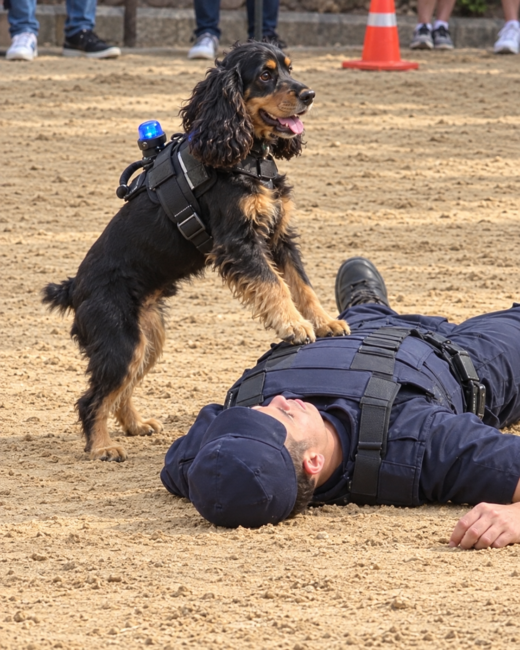
Then Poncho’s officer lay down.
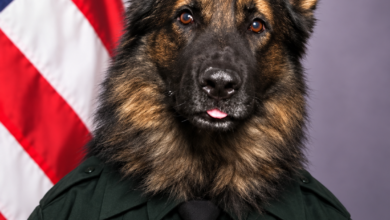
The little spaniel ran across the demonstration area, his ears lifting behind him. The routine was playful, and everyone had been told what it was. No real emergency was taking place.
Owen began narrating it anyway, whispering each movement as if he were the announcer.
Dad laughed.
Not politely. Not because we were watching him.
The sound arrived so unexpectedly that I looked at him instead of the dog. His face had loosened, and for a moment I could see the man who used to call Mom into the garage to witness a joke she had already heard.
Then his expression changed.
He looked beyond the officer, beyond the children, toward the shelter table at the edge of the crowd. His hand went to the folded bag.
I thought laughter had reminded him of what he had lost. That explanation fitted everything I already believed, so I accepted it without looking farther.
I was watching my father closely and still missing him.
When he walked away, I almost called after him. Instead, I took Owen’s hand and followed.
That was how I heard the volunteer say his name.
Part 3 — A Photograph He Already Knew
The volunteer was a woman in her fifties with a sun-faded cap and a pen tucked into the strap of her bag. Her name tag said Isabel.
She greeted Dad without surprise, then saw me and stopped with one hand resting on Bruno’s photograph.
For a few seconds, the three of us performed the awkward dance of people holding different pieces of the same conversation.
Dad introduced me. I introduced Owen. Isabel said she was pleased to meet us, and nobody explained why she knew my father.
Behind us, the demonstration continued. Another burst of applause rose from the crowd, followed by the bright, scattered laughter of children.
“Is Bruno here?” Dad asked.
“He’s at the shelter. We brought the younger dogs today.”
Dad nodded. His thumb moved along the crease in the paper bag.
He had not come looking for any dog. He had come looking for one.
Owen studied the photograph. Bruno had a black saddle, tan legs, a gray muzzle, and a small pale patch on one front toe. His left ear folded at the tip.
“Is he a police dog too?”
“No,” Isabel said. “He doesn’t have a job like Poncho.”
“What can he do?”
She considered the question instead of reaching for a sales pitch.
“He walks nicely when he’s comfortable. He likes company. He knows where we keep the clean blankets.”
Dad smiled at that last detail, and I felt a small, unpleasant pinch.
It was the smile of someone recognizing a fact.
I had spent months trying to find out what interested my father. A stranger had just mentioned a blanket cupboard and reached him without trying.
“How do you know each other?” I asked.
Dad looked toward the demonstration area.
“He’s helped us with a few things,” Isabel said.
“What things?”
“Claire.”
There was a warning in his voice, but underneath it I heard something less familiar than irritation.
He was embarrassed to have been found doing something good.
I stepped back. The shelter table wasn’t the place to make him account for his days, and Owen was watching all of us with the serious attention children give adults who stop speaking plainly.
Dad asked whether Bruno had eaten. Isabel said yes. He asked whether the dog had been out that morning. She said he had, but only for a short walk because the yard was busy.
Then Dad asked, “Anybody come?”
Isabel shook her head.
“Not for him.”
I had heard Dad use that same flat voice after long hospital afternoons. Not because the situations were the same, but because waiting had given his questions a familiar shape.
He wanted news and was preparing himself not to get it.
Owen looked from the photograph to his grandfather.
“We could go.”
Dad’s answer came too quickly.
“No need.”
“We’re already outside,” Owen said, with the plain logic adults spend years complicating.
Isabel did not press. She wrote the shelter’s visiting hours on a card and placed it on the table, leaving Dad free to take it or not.
That restraint changed something for me. I had been offering my father choices with a preferred answer hidden inside them. Isabel gave him information and waited.
We moved away from the table and found a bench beneath a narrow strip of shade. Owen ate the sandwich I had brought. Dad kept the paper bag closed.
I asked whether he wanted to tell me about Bruno.
“Not much to tell.”
“You know what he eats.”
“He likes the plain ones. Nothing fancy.”
“You know where his blankets are.”
Dad looked at me then.
“Does everything have to be an investigation?”
I almost defended myself. I had reasons, good ones, for worrying. Instead, I looked down at my hands and realized I had folded the shelter card in half without noticing.
“No,” I said. “It doesn’t.”
The answer surprised him enough that he stayed quiet.
For once, I had left a space he could choose to fill.
Across the grounds, Poncho’s demonstration had ended. The little dog stood near his officer, looking up with the uncomplicated attention that had drawn everyone toward him.
People had come to watch a skill. What I remembered was the way the dog kept returning to the same man.
I couldn’t know what the routine meant to Poncho beyond his training and familiar relationship. But I could see what it had done to Owen. He no longer looked at working dogs as distant equipment wearing harnesses.
He saw an animal and a person who knew each other.
Dad watched them too.
Then he stood and brushed the sandwich crumbs from Owen’s knee.
“If we’re going,” he said, “we should go before it gets busy.”
He didn’t ask me for the address.
He already knew the way.
Part 4 — The Dog Who Recognized His Hand
The shelter stood behind a plain gate on a quieter road than I expected. Dad guided me through the last two turns and pointed out where I could park without blocking the entrance.
He had gone back to sounding practical. This time, I heard the practicality differently.
Inside, dogs answered the sound of the gate. Owen tightened his grip on my hand, not frightened, just overwhelmed by the number of voices.
Dad paused beside a notice board and waited.
A staff member came toward us carrying a folded towel. She looked at him, smiled, and said, “You’ve brought visitors.”
Not a visitor. Visitors.
My father belonged to a place I hadn’t known existed in his life.
I could have asked him about that immediately. Instead, I signed us in and listened while the woman explained where we could go and how Owen should behave around unfamiliar dogs.
No reaching through gates. No crowding a dog that moved away. Adults would handle the leash.
Dad listened without impatience, though he clearly knew the rules. Owen repeated them under his breath, as if memorizing instructions for an important exam.
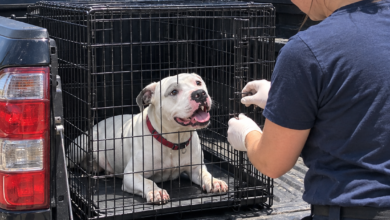
Bruno was brought into a small meeting area with a bench, a water bowl, and a strip of worn grass.
He was larger than the photograph suggested and slower than Owen expected. His hindquarters rose carefully when he changed direction, and his nails clicked before his paws reached the grass.
The woman holding his leash said he had arthritis and was under veterinary care. She described his usual pace and the limits they had noticed, without promising that a different home would make him young again.
He was being introduced as he was, not advertised as he might become.
Dad had gone still.
Bruno lifted his head. His nose worked, his uneven ear shifted, and then he moved straight toward my father.
The lead remained loose.
He stopped close enough to touch Dad’s trouser leg and pressed his muzzle against the hand holding the paper bag.
Owen whispered, “He knows you.”
Dad crouched only halfway, caught by his own knees, and lowered himself onto the bench instead.
“Hello, old man.”
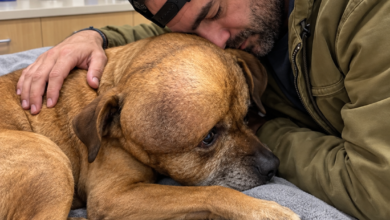
Bruno placed his head between Dad’s knees.
The room did not fill with dramatic silence. Dogs barked beyond the wall. A trolley rattled somewhere behind us. Somebody called for a clean bucket.
But my father rested his empty hand along Bruno’s neck, and the dog stopped searching the room.
I sat at the other end of the bench. Owen waited until the staff member showed him how to offer a hand without putting it in Bruno’s face.
Bruno sniffed, accepted a brief touch on his shoulder, and returned to Dad.
There was no performance in it. He did not sit up, shake hands, or demonstrate anything that might have competed with the little police dog we had just watched.
He leaned.
Dad opened the bag. Inside were small plain dog biscuits, broken into pieces.
“You were right about lunch,” he said, without looking at me. “Not much of one.”
I laughed because he had given me permission to, and because my throat had begun to tighten.
The bags in his kitchen had never been evidence that he wasn’t eating.
They were evidence that someone else was waiting for him.
We stayed for nearly an hour. The staff member told us how Bruno managed walks, what his care involved, and why quiet introductions worked better than busy adoption events.
Dad asked careful questions. Could the dog manage a low step? Did he settle at night? What happened when he was left alone?
The answers were not all convenient.
Bruno needed regular veterinary follow-up. He sometimes paced in unfamiliar places. His mobility required patience, and nobody could promise that settling into a new home would be immediate.
Dad listened to every limitation.
I realized he was not trying to talk himself out of the dog. He was trying to understand what saying yes would require.
When the visit ended, Bruno followed us toward the inner gate. The staff member guided him back gently, and he waited on the other side with his nose near the bars.
Dad took two steps toward the exit, then stopped.
The dog had not barked or pulled. That made it harder.
Dad turned back. Bruno lifted his head.
For a moment, neither of them moved.
Then Dad asked the question I had expected an hour earlier.
“What would we have to do to let him stay with me?”
I thought that was the end of the difficult part.
I had mistaken the first yes for the whole decision.
Part 5 — Why He Had Kept Going Back
We did not take Bruno home that afternoon. The shelter needed information, a discussion of his care, confirmation that Dad’s housing permitted a dog, and a plan for what would happen when he needed help.
Dad accepted all of it. He had spent his working life telling people that a machine should not leave the garage simply because someone wanted it finished.
A living animal deserved at least as much patience.
We arranged another visit. Then we went home, and Dad asked whether Owen could go upstairs to our apartment while he and I talked.
That request worried me more than anything that had happened at the shelter.
We sat at my kitchen table. Dad put the empty paper bag between us and flattened its folded edge with his thumb.
“I’ve been going there six weeks.”
I waited.
“Two mornings at first. Then more.”
“Walking Bruno?”
“Mostly. Some cleaning. They had a cupboard door that wouldn’t close.”
I thought about the walking shoes under his radiator, the blue fabric on the chair, the address card he had turned facedown.
I had mistaken a new routine for the remains of an old one.
“Why didn’t you tell me?”
Dad looked toward the window.
“Because then it would’ve become the answer.”
“The answer to what?”
“To me.”
He said it without anger, which made it harder to defend myself.
I had been trying to find the right activity, the right outing, the right combination of company and exercise that would restore him to the version of my father I missed.
He had found something he wanted to do and kept it private because he did not want it measured against his grief.
He needed a place to go that wasn’t a progress report.
I apologized. Not for worrying, but for turning worry into a kind of supervision.
Dad rubbed the edge of the bag again.
“I didn’t go there looking for a dog.”
“What were you looking for?”
“A door to fix.”
The shelter had asked for practical help through a neighborhood notice. He had gone with a screwdriver and stayed long enough to walk Bruno around the yard.
After that, there had always been another small task. A shelf. A gate latch. A dog whose usual walker was busy.
“Then I started going when nothing was broken,” he said.
He smiled at the table, briefly.
That was when he told me about Bruno’s previous owner. The man had died. A relative had tried to arrange care, but the available home and the dog’s needs had not matched.
Bruno had not arrived because nobody had ever loved him.
He had lost the person around whom his ordinary life was built.
I looked at my father’s hands.
“When I first met him, he kept watching the gate,” Dad said. “They told me not to stand in his way. Let him look.”
He stopped speaking for a while. I left the silence alone.
“I knew how to do that,” he said.
The room changed around those six words.
Dad had not needed Bruno to pull him out of grief. He had recognized a creature whose waiting made sense to him. They could share a path without either of them being told to hurry.
“But why not bring him home before?”
Dad glanced at the empty bag.
“Because I started looking forward to it.”
I did not understand immediately.
“Seeing him,” he said. “I’d wake up and think about taking him out. Some mornings that was the first thing.”
There it was—the thing I had thought was simple because I had been standing outside it.
He had mistaken looking forward to something for leaving someone behind.
My mother had been his first thought for almost fifty years. A new reason to get up felt disloyal before it felt welcome.
At the demonstration, when Poncho ran toward the officer, Dad had laughed without guarding himself. Then he had seen Bruno’s photograph and remembered the morning appointment he had postponed twice.
Not because he didn’t want the dog.
Because he did.
“Do you think she would’ve minded?” he asked.
I wanted to give him a perfect answer in my mother’s voice. Instead, I told him something true.
“She would’ve wanted to meet him.”
Dad nodded once. His shoulders lowered.
We spent the next hour discussing steps, schedules, veterinary costs, and where Bruno could sleep. Not as a cure for anything.
As the needs of a dog who might come home.
For the first time in months, Dad left our apartment with a plan he had made himself.
Part 6 — A Bed Was Not the Same as Belonging
The plan took ten days to become a dog bed beside Dad’s kitchen wall. In between came more visits, a home check, written permission from his landlord, and a conversation with the shelter’s veterinary team about Bruno’s ongoing care.
Dad wanted details. He wrote down the exercise recommendations, the follow-up arrangements, and the signs that should prompt a call rather than a guess.
He did not ask whether Bruno could become less old.
He asked how to make the apartment easier for the dog he was.
We put nonslip runners across the smooth floor. Dad moved a low table out of the narrow hall and chose a bed Bruno could step onto without climbing.
Owen wanted a basket of toys. Dad bought two, then returned for a third because he couldn’t decide whether the soft one would survive.
The shelter arranged an initial foster period before a permanent adoption decision. That gave everyone room to assess how Bruno managed the home, rather than pretending affection could answer every practical question.
On the first evening, the dog drank, sniffed the rooms, and stood beside the front door.
Dad sat in his chair with the leash loose in his hand until Bruno moved away from it. He did not pull him toward the bed we had chosen so carefully.
“He’ll find it,” he said.
For the first time, I understood what the shelter worker had meant about letting Bruno look.
Waiting did not have to be corrected every time it appeared.
The first night was not peaceful. Bruno paced between the hall and the kitchen, and Dad called me at half past one.
I answered too quickly, already imagining a fall.
“He won’t settle.”
“Do you want me to come?”
“No. I want to know if I’m making it worse by sitting here.”
We spoke quietly. Dad had the shelter’s guidance, and he would call the appropriate contact if he saw a health concern. For now, the dog was alert, restless, and in a new place.
I stayed on the phone while Dad described what Bruno was doing.
After a while, his voice changed.
“He’s lying down.”
“On the bed?”
“On my shoe.”
Neither of us wanted to interrupt that.
Bruno had chosen something familiar before he chose something comfortable.
The next days brought small adjustments. He ate more easily when Dad stepped back from the bowl. He startled when a delivery driver knocked hard. He needed shorter walks than Owen had imagined.
Then, after an outing that ran longer than planned, his hindquarters were stiffer the following morning.
Dad called the veterinarian rather than deciding that extra rest would solve everything. The team reviewed his condition and care plan, and Dad followed their instructions about activity and monitoring.
That evening he looked tired.
“I should’ve turned around sooner.”
“You know now.”
“He wanted to keep going.”
“So do you,” I said.
He looked at me, and then we both laughed.
Wanting more and being ready for more were not always the same.
The setback did not become a crisis or vanish overnight. We adjusted. Owen learned that a successful walk could end at the first bench instead of the far end of the park.
Dad learned to pause without feeling that he had failed the dog. Bruno learned the route back to the apartment and began turning toward the gate before Dad reached it.
During those weeks, the things I had misunderstood in Dad’s kitchen found their proper meaning.
The bags were treats, not skipped lunches. The spare shoes were drying after shelter walks, not waiting for a journey he couldn’t make. The blue fabric was a spare lead he had been asked to mend.
His life had been changing before I knew how to recognize it.
And Bruno was not a replacement for my mother. Her photograph stayed where it had always been. Dad still spoke about her, sometimes halfway through a practical task.
One morning, while filling the water bowl, he said she would have complained about the muddy runners and then bought better ones.
He smiled when he said it. Then he put the bowl down.
There was no grand recovery to announce. Dad still had difficult days. Bruno still sometimes waited by the door.
But each had begun to move through the apartment as though another living presence could be counted on.
At the end of the foster period, the shelter asked Dad whether he wanted to proceed.
He did not say the dog had saved him. He did not say he was finally ready to stop grieving.
He asked whether the paperwork could be finished before Bruno’s next walk.
Part 7 — Someone on the Other End of the Lead
The adoption became official on a Thursday morning. Dad wore the jacket with the deep inside pocket and carried a fresh paper bag, though Bruno was staying at the apartment while he signed the forms.
“Habit,” he said when I pointed it out.
Isabel smiled and handed him the documents. She explained the next follow-up, checked that he had the contact details, and thanked him for giving Bruno a home.
Dad looked uncomfortable with the thanking.
“He already knows where everything is.”
That was his answer.
On the way back, he stopped at a shop for bread and bought the kind my mother had liked. For once, I did not turn the purchase into evidence of anything.
At his apartment, Bruno rose from the runner in the hall and came toward us at his careful pace.
Dad put the bread on the table before greeting him. He had learned to leave his hands free.
The dog leaned against his leg, and Dad stayed where he was.
Their days developed a pattern. At eight in the morning, Dad filled the bowl, checked the weather, and put the paper bag in his pocket. Bruno waited near the door, sometimes standing, sometimes sitting when his joints needed more time.
They took the short route past the bakery and stopped at the bench by the small square. On better days, they went a little farther. On slower days, the bench was enough.
Dad began talking to people he had passed for years. A woman with a terrier. A man who opened the newspaper stand. A neighbor who wanted to know whether Bruno’s crooked ear had always been that way.
The dog gave strangers an ordinary reason to speak to him.
Some mornings, I joined them. Most mornings, I didn’t.
That was an adjustment for me too. I had to stop treating every independent choice as something that needed my quiet supervision.
Dad would call if he needed help. Bruno’s care was shared when necessary. But the walk belonged to them.
Owen spent Friday afternoons at the apartment and learned how to scatter a few suitable treats for Bruno to find without demanding too much movement. He stopped asking whether the dog could do tricks.
Instead, he asked whether they could take the short walk together.
One evening, he replayed a video of Poncho’s demonstration on my phone. The little spaniel bounded toward the officer, lifted his paws, and performed the routine that had first brought us to the shelter table.
“Did he save that man?” Owen asked.
“No,” I said. “The man was acting. The dog was doing something he’d learned.”
Owen watched again.
“But he went to him.”
“Yes,” I said. “He did.”
That was enough to admire without changing what had happened.
The performance had not been a medical miracle. It had been a demonstration of training and a relationship, an animal attending to a familiar person in a way people could watch and understand.
In our family, its consequence had been quieter. It had placed us beside a table we might have walked past, at a moment when Dad was tired of postponing an answer.
Poncho had not chosen Bruno for us.
He had not diagnosed my father or understood our loss.
A small public moment had opened a private door.
Months later, Dad still had mornings when his first movement was toward the empty side of the kitchen. There were days he let the phone ring and called back only after he had found his voice.
Bruno did not remove those days.
He needed breakfast during them.
He needed the door opened, the bowl washed, the short walk taken at a pace they could both manage.
Dad found that useful. So did the dog.
One Saturday, I arrived early and watched from the courtyard while Dad prepared to leave. He clipped on the lead, checked the treat bag, and opened the gate.
Bruno stepped through first, then stopped and turned his head.
Dad had paused to adjust his shoe.
“I’m coming,” he said.
The dog waited.
When Dad straightened, he looked back too, checking that the lead wasn’t caught and that Bruno was ready.
Neither of them had been left behind.
They walked toward the corner, slow enough that I could have called out and caught them. I stayed where I was.
Dad was speaking to Bruno, not loudly enough for me to hear the words. The dog kept close, his uneven ear lifting with each careful step.
At the bakery crossing, they stopped together.
Then they went on.
Follow our page for more unforgettable dog stories about second chances, quiet courage, and the bonds that make ordinary days worth sharing.