Part 2: A Patrol Officer Found a Dog Locked in a Metal Cage in an Empty Field — One Year Later, the Dog Helped Him Survive the Cage Inside His Own Mind
Part 2 — The Dog Who Did Not Understand Open Doors
Dr. Maya Patel had a way of speaking to wounded animals before speaking to the humans around them.
She moved slowly, announced every touch, and never let pity make her careless. Anchor lay on the padded examination table while she checked his gums, joints, hips, paws, spine, and sores. Two technicians stood nearby with towels, warmed fluids, and expressions that kept shifting between professional focus and quiet horror.
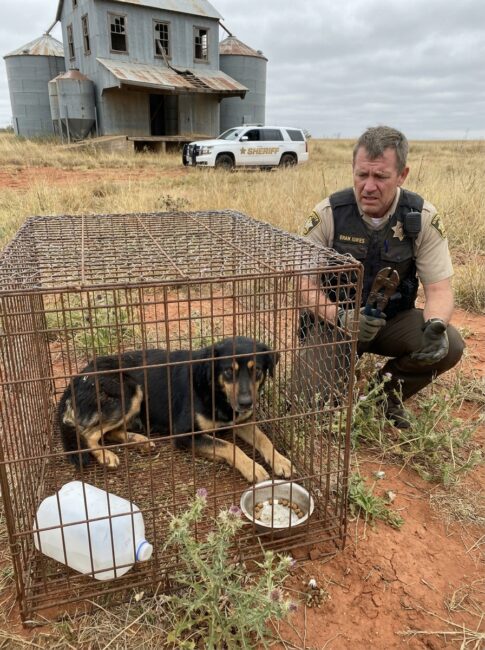
“He has no obvious spinal fracture,” Maya said after the initial exam. “That is good news. But the rear legs are extremely weak. His muscles have wasted from lack of use, poor nutrition, and prolonged restriction. We won’t know how much function can return until we stabilize him.”
“Can he walk again?”
She paused before answering, which I respected.
“Maybe. With nutrition, pain control, wound care, and physical rehabilitation, he has a chance. But he will not understand what we are asking of him at first. A dog kept in a space that small for this long may stop expecting movement to matter.”
That sentence lodged somewhere under my ribs.
Movement may stop mattering.
I had seen that in people too.
The shelter attached to the hospital had no open kennel suitable for a dog who needed intensive care, so the county opened a cruelty hold case, and Anchor stayed at Red River under veterinary supervision. I wrote my report in the waiting room while still smelling the field on my sleeves. Photographs. Location. Lock. Cage. Condition. Estimated exposure. Evidence tags. Tire tracks. The tarp. The food dish. The water container. The absence of any shelter beyond rust and weeds.
A deputy learns to turn suffering into documentation because documentation is how suffering becomes admissible.
It does not make the writing easier.
Animal control identified the property’s previous tenant as Darren Wilkes, a man who had rented storage space behind the old feed mill before being evicted for nonpayment. Several neighbors remembered seeing a black-and-tan dog with him the previous spring. One neighbor thought the dog was named Ranger. Another said Wilkes had complained that the dog “destroyed stuff” and “needed to learn.”
Nobody remembered seeing the dog after midsummer.
By October, the grass had grown around the cage.
That detail would later matter in court.
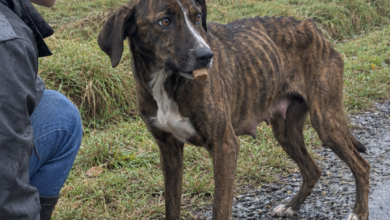
Anchor did not respond to the name Ranger when I tried it, but after months of silence and confinement, I doubted any name could reach him quickly. He responded to very little in those first days. Food interested him only if placed near his nose. Water had to be offered in shallow amounts. He flinched when metal clanged. He shut down when more than two people entered the room.
Open doors did not comfort him.
The first time a technician opened the kennel gate wide, Anchor pressed himself against the back wall and trembled. Maya explained that dogs accustomed to helplessness can interpret change as danger. The cage door opening had not meant safety to him for a long time. It may have meant hands, hunger, punishment, or nothing at all.
So we stopped making the open door the point.
We made the floor safe first.
Thick mats.
Soft bedding.
Food arriving at predictable times.
Hands that moved slowly.
Voices that stayed low.
No dragging.
No forcing.
No celebration so loud it frightened him.
After my shift, I began stopping by the clinic. At first, I told myself it was evidence follow-up. Then I told myself it was community partnership. Eventually Maya looked at me over her glasses and said, “Deputy, you can just say you came to see the dog.”
So I did.
Anchor did not greet me.
Not for two weeks.
I would sit several feet from his kennel with paperwork on my lap and read incident reports aloud in a calm voice. Theft from a farm shed. Loose cattle on Route 9. Vandalism at the water tower. Nothing dramatic. Nothing that asked anything of him.
Sometimes his eyes followed the sound.
Most days, they did not.
On the seventeenth day, while I was reading a report about a mailbox dispute between two brothers who should not have been allowed near property lines, Anchor moved his nose toward the front of the kennel.
One inch.
Maybe less.
Maya saw it from across the room.
Neither of us reacted.
That was the rule with fragile trust.
Do not scare it by cheering.
I kept reading.
Anchor kept listening.
That was the first step before walking.
Not his paws.
His attention.
Part 3 — Learning to Stand
Physical rehabilitation began before Anchor believed in it.
Maya’s clinic worked with a canine rehab specialist named Lydia Shaw, a fifty-eight-year-old woman with steel-gray hair, a soft Georgia accent, and the patience of someone who could wait ten minutes for one paw to shift without calling it failure.
The first session lasted twelve minutes.
Most of that time involved Anchor lying on a mat while Lydia let him smell her hands, the sling, the treats, and the padded support frame. He tolerated touch but did not participate. When Lydia gently placed the sling beneath his belly and lifted a fraction of his weight, his eyes went flat again.
Not scared exactly.
Gone.
Lydia lowered him immediately.
“He leaves when things become too much,” she said.
“What does that mean?”
“Emotionally. Some animals fight. Some flee. He cannot do either, so he disappears inside himself. We have to teach him that staying present is safe.”
I looked at Anchor’s body on the mat.
A trapped dog who survived by leaving himself.
I knew more about that than I wanted to say.
My own leaving happened at night. Not visibly. Not always. But certain sounds could pull me backward without asking permission. A slammed dumpster. Fireworks. Helicopters low overhead. The smell of diesel mixed with hot dust. In the Army, I had been trained to keep people alive under conditions most people only see in films. Afterward, as a deputy, I could manage traffic stops, domestic calls, missing-person searches, and storm evacuations with a steady voice. Then I would go home, lock my door, and sit awake until dawn because my body had not received the message that the war was over.
I had never told Maya that.
I had told very few people.
Anchor’s second rehab session ended with one supported stand lasting three seconds.
Lydia marked it in the chart like it was a championship.
Three seconds weight-bearing with full support.
The third session reached five seconds.
The fourth reached four, because healing does not respect straight lines.
Nutrition slowly rounded Anchor’s body. His coat began to shine in patches where infection cleared. The sores on his elbows scabbed, then healed. His nails were trimmed little by little because removing too much at once would hurt. His eyes remained distant, but less empty.
We changed his name officially during week six.
I had been sitting outside his kennel when he startled at a metal tray dropping in the next room. His body tried to fold into the corner. Without thinking, I said, “Anchor. Stay with me.”
The name came out whole.
Maya, passing behind me, stopped.
“Anchor?”
“He needs something that holds.”
She nodded. “So do most of us.”
The name stayed.
At two months, Anchor took one assisted step with the sling.
His rear legs shook violently. His front paws scrambled. Lydia steadied him. I sat on the floor in front of him with a spoonful of soft food.
“Come on,” I said. “Just one.”
He leaned forward.
His right rear paw dragged, then lifted.
One step.
I felt something crack open inside my chest.
Not victory.
Recognition.
A body remembering that forward still existed.
Maya placed a hand on my shoulder.
I realized I was crying only when the room blurred.
No one commented.
By the fourth month, Anchor could stand with light support and take several uneven steps across the rehab mat. By the fifth, he could walk short distances with a harness. By the sixth, he could cross the treatment room alone if the floor was covered in mats and nobody rushed him.
Every milestone arrived with a shadow.
Some days he refused to leave the kennel.
Some days he froze at doorways.
Some days he startled so hard he urinated.
Healing was not a ladder.
It was a field full of places that looked open but still felt fenced.
During those months, Darren Wilkes was arrested in another county on unrelated warrants. When questioned about Anchor, he claimed the dog had been “aggressive” and had been temporarily caged until he found another place. He said he paid a cousin to feed him. He denied abandoning him.
The evidence disagreed.
The grass around the cage. The condition of Anchor’s muscles. The empty containers. The pressure sores. The eviction timeline. Witness statements. Veterinary records.
A living dog became the testimony.
The prosecutor prepared the cruelty case carefully.
I prepared for court.
Anchor prepared for one more step.
Part 4 — The Veteran Who Recognized the Cage
My connection to Anchor became obvious to everyone before I admitted it to myself.
I visited after day shifts, night shifts, court days, and one holiday I had been scheduled to spend with my sister but canceled because I “needed rest.” My sister, Marianne, had heard that sentence too many times to believe it.
“You mean you’re going to sit with the dog,” she said over the phone.
“He’s part of an active case.”
“Ethan.”
“What?”
“Does the dog know he’s evidence?”
I looked through the clinic glass at Anchor sleeping on his mat, one paw twitching.
“Probably not.”
“Then stop pretending you visit him for the prosecutor.”
Marianne was my older sister, which meant she had earned the right to say things I did not want to hear. She had watched me return from deployment with a duffel bag, a medical discharge, a polite smile, and a sleep pattern that frightened anyone who loved me. She had watched me become a deputy because structure felt safer than stillness. She had watched me avoid barbecues, crowded restaurants, Fourth of July celebrations, and conversations that began with “Are you okay?”
I was functional.
That was the word I used.
Functional can hide a lot.
The first time Anchor helped me, he did nothing visible.
It was late winter, nearly five months after the rescue. I had come to the clinic after responding to a fatal accident involving a teenager and a rain-slick county road. The call had been nothing like Afghanistan. Not really. But trauma is not logical about categories. Blood under flashing lights can find old doors.
I arrived at Red River because I could not face my house yet.
Maya saw me and said nothing. She simply opened the side room where Anchor was resting after rehab.
I sat on the floor with my back against the wall.
Anchor lay several feet away.
My hands were steady, which was never the sign people thought it was. During the worst moments, my body often became too still, as if any movement might trigger something.
Anchor lifted his head.
He looked at me for a long time.
Then he stood.
Slowly.
Awkwardly.
With effort.
He walked across the mat and lowered himself beside my knee. Not touching at first. Just near. After a minute, he leaned his shoulder against my leg.
His body was warm.
His breathing was slow.
My own breathing, which had been trapped high in my chest, began following his without my permission.
Maya remained in the doorway.
“He chose that,” she said softly.
I could not answer.
Anchor had spent months learning that closeness did not always lead to harm. That night, he offered closeness to me.
Not because he was trained.
Not because he knew what PTSD meant.
Because he understood distress in the body beside him.
That was when I stopped thinking of him only as a dog I had found.
He was becoming someone I recognized.
The cruelty trial took place in March. Darren Wilkes pleaded guilty before jury selection after the judge allowed the veterinary muscle-atrophy evidence and confinement timeline into the record. He received jail time, probation, restitution, and a ban on owning animals. It did not feel like enough. It rarely does.
After sentencing, the prosecutor asked whether the county shelter would place Anchor for adoption once medically cleared.
Maya looked at me.
Lydia looked at me.
Even Captain Ruth Bell, who supervised my division, looked at me as though waiting for the obvious to become official.
I said, “I’ll take him.”
Captain Bell smiled. “That was not a question, Hayes.”
The adoption was finalized two weeks later.
Anchor came home to a small brick house with a fenced yard, three orthopedic beds, twenty feet of non-slip runners, and one deputy who had no idea how to explain to a dog that both of them were still learning the difference between quiet and danger.
The first night, Anchor slept in the hallway instead of the bedroom.
I did not force him closer.
At 2:13 a.m., I woke from a nightmare hard enough to knock the lamp off my nightstand. Before I could fully orient, I heard nails on the runner.
Anchor appeared in the doorway.
He did not rush in.
He waited.
I sat on the edge of the bed, shaking.
He took three slow steps and pressed his head against my knee.
The room returned.
Not all at once.
But enough.
I placed my hand on his neck.
“We’re out,” I whispered.
I did not know whether I was telling him or myself.
Maybe both.
Part 5 — Training Without Erasing the Past
People began calling Anchor my service dog before he had earned any such title.
I corrected them every time.
“He is my dog,” I would say. “We are training.”
That distinction mattered because real assistance work requires structure, evaluation, consistency, public-access skills, health screening, and ethical consideration of the dog’s welfare. Anchor had survived prolonged confinement. He did not owe anyone labor because his pain made a good story.
Maya insisted on that.
Lydia insisted harder.
Captain Bell arranged for me to consult with North Star Canine Partners, a nonprofit that trained psychiatric service dogs and handler teams for veterans and first responders. Their lead trainer, Grace Holloway, was a former occupational therapist with thirty years of dog-training experience and no patience for romantic nonsense.
She evaluated Anchor in my living room.
He walked slowly but steadily by then, with occasional stiffness in his hips. He startled at metal clanging but recovered faster than before. He watched me constantly, not in a frantic way, but with careful attention. When I shifted into shallow breathing during one discussion about deployment history, Anchor stood and leaned into my leg.
Grace observed without reacting.
After an hour, she said, “He has natural grounding behavior. That does not automatically make him suitable for service work. We proceed only if training helps both of you.”
“What would make it unfair to him?”
“Too much public stress. Physical strain. Expecting him to manage symptoms instead of supporting tasks. Ignoring his own triggers. We do not turn survivors into equipment.”
I liked her immediately.
Training began at home.
Anchor learned pressure cueing: resting his head or shoulder against my leg when my breathing changed. He learned to wake me from nightmares by nudging my hand after an alarm-like verbal cue. He learned to guide me toward the back door during panic episodes at home, not by pulling, but by moving ahead and checking back. He learned a “behind” position in public spaces so he could settle near my legs without blocking pathways.
I learned more.
I learned to notice my symptoms before Anchor had to.
I learned that using a dog for psychiatric support did not mean hiding from therapy, medication, peer groups, or accountability. Anchor became part of a care plan, not the whole plan.
Grace required that I return to counseling.
Maya required that Anchor receive rest days.
Lydia required that we continue strengthening exercises and avoid overwork.
Marianne required Sunday dinners.
Everyone had requirements.
For the first time in years, I met them.
Anchor’s world expanded carefully. First the front porch. Then the driveway. Then quiet park paths early in the morning. Then the feed store during slow hours. Then veterans’ group meetings where the chairs were spaced widely and nobody minded if a dog needed to leave.
At the veterans’ center, Anchor met Sam Ortega, a Marine veteran who had lost part of his hearing and most of his trust in crowded rooms. Sam watched Anchor for three meetings before speaking to me.
“That dog looks like he’s been inside something too long,” Sam said.
“He has.”
Sam nodded. “So have half the guys here.”
Anchor did not approach everyone. He chose slowly. Some people he ignored politely. Some he watched from a distance. With Sam, he eventually rested his chin on the man’s boot during a meeting about sleep disturbance. Sam looked down and did not move for ten minutes.
Afterward he said, “He gets it.”
That became the phrase people used.
Anchor gets it.
Not because he understood war.
Because he understood confinement.
He understood the strange fear of open doors.
He understood that healing can feel dangerous because it asks the body to move beyond the place where it survived.
One year after I found him, Anchor passed his public-access evaluation for limited psychiatric service work specific to my needs. Grace cried after signing the paperwork, then threatened to deny it if anyone mentioned her tears.
Anchor wore a simple blue vest, not because I wanted attention, but because access requires clarity. The vest did not say hero. It did not say rescue miracle.
It said:
Working Dog — Do Not Distract
The first time we entered the county courthouse together after certification, I felt every old instinct tighten. Too many echoes. Too much marble. Too many doors.
Anchor felt the change through the leash.
He moved close, leaned gently against my leg, and held there.
I breathed.
One count.
Two.
Three.
We walked forward.
The cage inside me did not vanish.
But the door opened wider.
Part 6 — The Man in the Metal Room
The most important call Anchor ever answered did not come through dispatch.
It came from Sam Ortega at 11:46 p.m. on a humid August night.
I almost missed it.
Anchor and I had returned from an evening walk. He was asleep near the couch, paws twitching, when my phone lit up. Sam rarely called. He texted clipped sentences, usually about meeting times or whether the coffee at the veterans’ center had improved, which it had not.
I answered.
No greeting.
Just breathing.
Then Sam said, “I’m in the shed.”
Something in his voice moved me to my feet.
“What shed?”
“My backyard.”
“Are you hurt?”
No answer.
Anchor stood.
The hair along his shoulders did not rise. He did not bark. He simply watched me with focused stillness.
Sam whispered, “Door’s closed.”
The shed behind Sam’s house was a small metal structure where he kept tools. I knew from group conversations that enclosed spaces could trigger him, but I did not know why he was inside at midnight.
“Sam, can you open it?”
“I can’t.”
“Is it locked?”
“I don’t know.”
His breathing became faster.
I put on shoes, clipped Anchor’s working leash, and called Captain Bell while driving. She dispatched local officers and EMS, but I lived closer.
When we reached Sam’s house, his porch light was on. The backyard shed stood beneath a pecan tree, moonlight turning its metal walls pale.
“Sam,” I called through the door.
No answer.
Then a thud from inside.
Anchor pulled—not hard, but forward with purpose. He stopped at the shed door and sniffed along the bottom seam. I heard Sam inside, trapped in a panic spiral, repeating, “I can’t get out. I can’t get out.”
The door was not locked.
A rake had fallen against it from inside, wedging the handle beneath the frame.
I forced it open enough to squeeze through.
The air inside was hot, close, and metallic.
Sam was on the floor between shelves, knees drawn up, hands over his ears. His eyes were open but not fully seeing the shed.
I knew that look.
A body back in another place.
I knelt but did not grab him.
“Sam, it’s Ethan. You’re in your backyard. The door is open.”
He shook his head.
Anchor moved carefully past me. The shed was narrow, full of sharp tools and stored boxes, not an ideal place for a dog with a history of confinement. I almost called him back.
Then Anchor lowered himself beside Sam.
Not on him.
Beside him.
His body pressed lightly against Sam’s shin.
Sam’s breathing hitched.
His hand moved toward Anchor’s back.
“Dog?”
“Anchor,” I said. “He’s here.”
Sam’s fingers sank into Anchor’s fur.
For several minutes, no one tried to make the moment dramatic. The open door let in humid night air. Sirens approached in the distance. Anchor breathed steadily beside a man whose mind had closed around him like metal.
When EMS arrived, Sam was able to stand.
The next day, he called me.
“I froze,” he said.
“You had a panic episode.”
“I was in a metal room, and your dog came in anyway.”
I looked at Anchor sleeping near my chair.
“He knows something about metal rooms.”
Sam was quiet.
Then he said, “Tell him thanks.”
I did.
That incident changed how people understood Anchor at the veterans’ center. He was not a mascot. Not a symbol. Not a magical creature who healed trauma by existing. He was a trained working dog with his own trauma history, carefully supported so he could support me and, in certain controlled situations, provide grounding presence to others.
But the deeper truth was harder to put on a pamphlet.
Anchor reminded us that surviving captivity does not make a creature broken beyond use.
It may make him careful.
It may make him slow.
It may make him need kindness that repeats itself until the body believes it.
But it does not make him empty.
Not forever.
Part 7 — The Door We Leave Open
Anchor lived with me for nine years.
His back legs never became perfect, but they became his. He walked with a slight sway, especially when tired, and hardwood floors remained his lifelong enemy. We kept rugs everywhere. We continued rehab exercises long after the official program ended. He learned the difference between a cage and a crate because Grace helped me teach it with the door always open, bedding soft, meals nearby, and no pressure. Eventually he used his crate as a den during thunderstorms.
The door was never closed.
That was our agreement.
My PTSD did not disappear either.
I still had hard nights. Still avoided fireworks. Still sat near exits in restaurants. Still attended therapy, veterans’ group, and medical appointments. Anchor did not remove the work. He helped me stay present for it.
That was enough to change my life.
The field where I found him changed too.
After the court case, the county cleared the abandoned cages, removed scrap metal, and installed cameras near the feed mill. The property later became part of a community training area for search-and-rescue volunteers. At the entrance, Captain Bell approved a small sign that read:
REPORT ANIMAL CRUELTY.
A LOCKED CAGE IS NOT A HOME.
I took Anchor back there only once.
It was his fifth year with me, long after his adoption, training, and certification. Grace approved the visit because I had asked responsibly, and because we planned carefully: short duration, no pressure, exit available, favorite blanket in the truck, Maya on call, and Marianne ready to scold me if I turned memory into stupidity.
The field looked different, but not entirely.
Grass still moved in the wind.
The old feed mill still leaned.
Red dirt still clung to my boots.
Anchor stepped from the truck and stood beside me. His nose lifted. His body became still, but not shut down.
We walked to the place where the cage had been.
Nothing remained except a rectangle of earth where grass grew thinner.
Anchor smelled the ground.
Once.
Twice.
Then he turned away.
No trembling.
No collapse.
No dramatic breakthrough.
Just a dog choosing the truck, the open door, the road home.
I followed him.
Years later, when Anchor grew old and retired from public work, Sam asked permission to build something for him. He had become a peer-support volunteer by then, helping other veterans navigate the early terror of admitting they needed help. In his backyard, where the metal shed had once triggered his worst night, he built a wooden bench beneath the pecan tree.
On the backrest, he carved:
ANCHOR
HE TAUGHT US THAT HEALING NEEDS TIME AND OPEN DOORS
Anchor visited the bench once during his retirement. He sniffed it, leaned against Sam’s leg, and then tried to steal half a sandwich from my hand.
Old heroes deserve bad manners occasionally.
Anchor died at an estimated age of thirteen, asleep in my living room on a rainy November afternoon. Maya came to the house. So did Lydia, Grace, Marianne, Captain Bell, and Sam. I kept one hand on Anchor’s neck, feeling the slow rise and fall beneath his fur.
Before he went, I told him the truth.
“You got out,” I whispered.
Then, after a moment, I added, “So did I.”
Not completely.
A person does not walk out of trauma once and call the journey finished.
But I had opened doors I used to keep locked.
I had let people into my house.
I had gone back to counseling.
I had answered Sam’s call.
I had stood in court.
I had walked through the courthouse with Anchor’s steady body beside me.
I had learned to say the words I need help without treating them like a confession of failure.
Anchor’s ashes sit in a wooden box near my front door. His blue vest hangs above it, clean and retired. The leash remains on the hook, though I no longer need it there. Some mornings, I still reach for it out of habit.
I adopted another dog two years later, a middle-aged mutt named June who came with opinions and no interest in becoming anyone’s symbol. She is not Anchor. I do not ask her to be.
No one replaces the creature who opened a door inside you.
But love, once reopened, needs somewhere to go.
When people ask about Anchor, I tell them the whole story carefully.
I tell them about the cage.
The muscle atrophy.
The months of rehab.
The first step.
The first time he leaned into my leg.
The professional training.
The night he helped Sam.
The years of work and rest.
But I always return to the moment in the field when I opened the cage and he did not move.
Back then, I thought freedom was the door opening.
Anchor taught me better.
Freedom is what happens slowly afterward.
It is food arriving every day until hunger stops ruling the body.
It is a mat on the floor where feet can learn again.
It is a hand that does not grab.
A voice that does not rush.
A room where a nightmare can end.
A leash that guides without trapping.
A crate door left open.
A person waiting long enough for the one inside to believe that leaving is safe.
Anchor had been locked in metal until his legs forgot him.
Then he learned to walk.
Then he helped me remember how.
Follow this page for more unforgettable dog stories about rescue, loyalty, and the slow healing that begins when someone finally opens the door and stays.