Part 2: A Pit Bull Barked Until His Voice Began to Fail Beside a Man on a Burning Sidewalk—Then One Stranger Stopped and Heard What Everyone Else Had Missed
Part 2, The People Who Finally Stayed
The first paramedic spoke to Elena while his partner knelt beside the man. She gave them the address again, the time she had found him, and the little she knew. She had not seen him fall. She did not know how long he had been there.
She made that clear.
The dog watched the strangers reach toward his owner, then looked at Elena when she touched his collar. She picked up the red leash without pulling him away, allowing enough room for the crew to work.
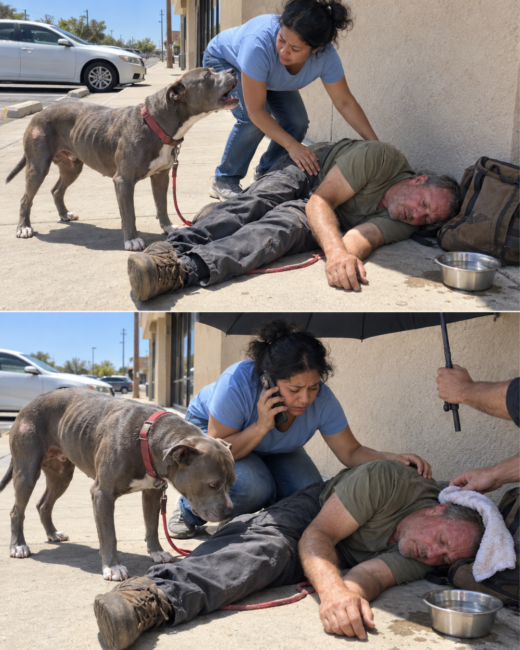
The employees held the umbrella steady above them.
One had brought a chair, though nobody sat in it. The other kept asking whether they needed more water, grateful whenever someone gave him a useful task.
The man began to respond while the paramedics treated him. His eyes opened briefly, then closed again, and he tried to move a hand that seemed too heavy to lift.
“Can you tell us your name?” the paramedic asked.
The first answer was too faint to hear.
He asked again, leaning closer.
“Raymond,” the man said.
Elena repeated it softly, relieved to have a name to use.
“Raymond, your dog’s right here.”
At the sound of her voice, the pit bull moved closer. His nose touched Raymond’s fingers, and Raymond made a small motion toward him before the paramedic resumed his questions.
Elena learned the dog’s name a minute later.
“Otis,” Raymond said, looking past the crew.
“He’s okay. We’ve got Otis.”
The dog’s ears lifted when she said it.
When the stretcher arrived, Elena guided him a few steps aside. He resisted the first movement, stopping with all four feet planted, so she waited until Raymond was where he could see him again.
Then Otis followed.
He walked beside the stretcher to the ambulance, his nose level with Raymond’s hand. Elena kept the leash short enough to prevent it tangling in the wheels but did not hurry him.
At the open doors, they had to stop.
The crew explained that Otis could not travel with them on that transport. Raymond was too weak to sort through the problem, yet the effort showed in his face as he tried to look back.
“Don’t lose him.”
Elena held the red leash where Raymond could see it.
“I won’t. My name’s Elena. I’m taking care of him.”
The words came before she had worked out what that meant. She still had groceries in her car and customers expecting deliveries, and she lived in an apartment where every additional animal required permission.
But Raymond’s eyes stayed on her until she repeated the promise once more.
After the doors closed, Otis stood facing the ambulance.
Elena stood beside him until it turned the corner.
Part 3, The Empty Bottle
The neighboring business let Elena bring Otis into its small, air-conditioned office while she made calls. Someone found a clean bowl, and the dog drank before lowering himself onto the tile, still facing the door.
His barking had stopped.
Elena contacted her delivery service, arranged for the remaining orders to be reassigned, and called the hospital number the ambulance crew had given her. She could provide information, but she wasn’t family, and the staff could not simply tell a stranger everything happening inside.
She left her name, her number, and one message: Raymond’s dog was safe.
Only then did she gather the belongings from the sidewalk.
The canvas backpack held a folded sweatshirt, a small bag of kibble, socks rolled inside a grocery sack, and a toothbrush in a plastic sleeve. A cheap phone was tucked into an outside pocket, its screen dark even when she held down the button.
Everything fit into one bag.
Elena set it beside the desk without searching further.
A woman from a neighborhood outreach program arrived shortly after three. One of the employees had found the number, explained the situation, and asked whether anyone could help with both Raymond and Otis.
Her name was Deanna Brooks.
She recognized Raymond from a water-distribution stop several weeks earlier. She remembered Otis more readily: the gray dog who sat between Raymond’s shoes while he signed a form.
“He always asks where the dog can go,” she said.
Deanna called the hospital’s social-work office and began arranging a temporary place for Otis. She explained each step to Elena, including the parts she could not promise. There was no empty apartment waiting somewhere, and she couldn’t guarantee a pet-friendly placement that afternoon.
But she could start making the calls.
Otis rose whenever Elena stood. When she sat again, he lowered himself beside her chair, resting his chin near the red leash.
Deanna took him to a veterinary clinic that had agreed to examine him. Elena went along, carrying Raymond’s backpack because she had promised not to lose that either.
The veterinarian checked his paws, hydration, breathing, and the thin patch on his hip. Otis needed care and follow-up, but he was well enough to stay with a temporary caregiver rather than remain at the clinic.
By evening, Elena’s husband had agreed to help overnight while Deanna worked on the next day’s arrangements.
Before leaving the office, Elena washed the little metal bowl.
She remembered the water still standing in it beside Raymond’s empty bottle. Later, when he could speak comfortably, he explained that he had poured the last of his water into it before sitting down.
He had expected to refill the bottle nearby.
He never reached the next tap.
Part 4, The Question He Asked First
Raymond woke properly the following morning with a hospital blanket pulled to his chest and no memory of the ambulance ride. The room was dimmer than the sidewalk had been, and for several seconds he couldn’t place the sound coming from beyond the curtain.
Then he reached beside the bed.
His hand found empty space.
A nurse noticed him searching and asked what he needed.
“Gray dog. Red collar.”
She checked the note attached to his belongings and told him that a woman named Elena had called. Otis had been examined by a veterinarian and had spent the night somewhere cool.
Raymond listened without relaxing his hand.
“Can somebody ask her to come?”
Elena arrived that afternoon with his backpack and a photograph her husband had taken of Otis asleep beside their kitchen doorway. The dog’s chin rested on Raymond’s folded sweatshirt, which Elena had put down after he kept nosing the bag.
Raymond held the phone in both hands.
“He doesn’t sleep much someplace new.”
“He did last night,” Elena said. “My husband sat with him.”
Raymond enlarged the picture with a finger, looking at the sweatshirt beneath Otis’s head.
“That’s his side,” he said.
Elena didn’t understand until he explained that Otis usually slept against his left shoulder. When they had still been living in Raymond’s van, the dog had claimed the narrow space between him and the back door.
Raymond had worked maintenance in rental properties before his hours were cut. He found other jobs, but not enough of them arrived in time to catch up with the rent. A room rented week to week became unaffordable, then the van’s transmission failed.
He described those months without making any one event sound large enough to explain the whole result.
“There was always one more thing to pay.”
Otis had been with him for six years.
Raymond had adopted him long before losing his housing, when coming home meant a dog waiting beside a refrigerator that rattled every time the motor started.
He still remembered that sound.
The medical team told Raymond that he had suffered heatstroke and needed continued treatment and monitoring. He would not be leaving that afternoon, no matter how strongly he insisted that he felt better.
When the nurse finished explaining, Raymond nodded and asked about Otis again.
Elena showed him another picture. This one caught the dog standing beside her husband, looking toward the front door.
Raymond studied it, then returned the phone carefully.
“Thank you for stopping.”
Elena could have told him about the people who helped, the umbrella, or the calls Deanna was making. Instead, she gave him the first thing she remembered.
“He made me look twice.”
Part 5, A Bed for Him and a Place for Otis
Deanna came to the hospital on Monday carrying a notebook with more crossed-out numbers than open ones. Raymond was sitting beside the bed in clean clothes when she arrived, the red leash folded across his lap.
Elena had brought it that morning.
Without Otis attached, it looked strangely small.
Deanna sat where Raymond could see her notes. She explained that the hospital team was working toward discharge, but they needed a safe plan for the days that followed. Returning him directly to the sidewalk after what had happened was not a plan anyone wanted.
Raymond listened until she mentioned a temporary bed.
“Where would he sleep?”
Deanna put down her pen.
“That’s what I’m trying to solve.”
He rubbed the leash between his thumb and forefinger. Elena had expected him to become angry, but his voice stayed quiet as he explained how often that same question ended a conversation.
Some places could help him. Others could help the dog.
He needed somewhere for both.
Deanna did not tell him that keeping Otis would be easy. She explained that temporary boarding could protect the dog while Raymond recovered, and that accepting it would not mean giving him away.
Raymond nodded, though he continued rubbing the worn nylon.
After a moment, he asked whether someone would tell Otis where he had gone.
The question stopped Elena from speaking.
She had been ready with practical reassurance about food, water, and kind people. Those things mattered, but Raymond was worrying about the dog waking in another unfamiliar room and waiting beside a door.
Deanna answered carefully.
“We’ll keep bringing him to you whenever the medical team can arrange it. We’ll keep you involved.”
That afternoon, she found a modest motel that accepted dogs and had a room available. Her program could cover ten nights while another worker helped Raymond apply for longer-term assistance.
Ten nights were all she promised.
Raymond asked about the deposit, the bus route, and whether a veterinarian’s paperwork would be enough for Otis. Deanna wrote down the answers rather than expecting him to remember everything.
The room would have air-conditioning and a small refrigerator. Otis could stay beside him, and outreach staff would visit while Raymond recovered.
He looked at the folded leash again.
“Does the door lock?”
“Yes.”
Raymond pressed his lips together and nodded.
For the first time since Elena had met him, he asked a question about himself.
“Is there somewhere to wash clothes?”
Deanna turned to a fresh page in her notebook. They still had plenty to arrange, but he had begun planning beyond that afternoon.
Part 6, The Hand He Recognized
Raymond’s reunion with Otis happened in a shaded hospital courtyard after his medical team agreed he was well enough to go outside with assistance. Elena brought the dog through the side gate while Deanna pushed Raymond’s wheelchair toward a bench.
Otis was sniffing a patch of grass when Raymond spoke.
“Hey, old man.”
His head came up immediately.
For a second he stood without moving, ears lifted unevenly. Then he leaned into the leash, walking faster as Elena caught up beside him.
Raymond bent forward, but Deanna reminded him to stay seated.
“Let him come to you.”
Otis reached the chair and pushed his nose beneath Raymond’s open hand. The motion was so familiar that Elena recognized it before Raymond began rubbing the short fur between his ears.
He had done the same thing on the sidewalk.
Raymond’s fingers shook, and Otis pressed closer when they slipped. His tail struck the wheelchair frame in uneven thumps while he turned his head from one hand to the other, making room for both.
Elena loosened her grip on the leash.
Raymond lowered his face toward the dog’s neck and stayed there. He didn’t make a speech or look around to see who was watching. He kept one hand beneath the faded collar and the other against Otis’s chest.
After a while, he asked whether the dog had eaten breakfast.
Elena smiled.
“He ate all of it.”
“Too fast?”
“A little.”
Raymond nodded with the familiar concern of someone discussing an ordinary morning.
Otis settled between his shoes.
Elena told Raymond about the barking then: how the dog had approached passing people without going far, how he kept returning to the same hand, and how his voice had grown rough by the time help arrived.
Raymond looked down and stroked the notched ear.
“He’s usually quiet.”
That was what stayed with Elena. She had met him at his loudest, when he had every reason to keep making noise, and now he sat without a sound because Raymond was answering him.
They remained outside only as long as the staff allowed. When it was time to return, Elena walked Otis beside the wheelchair so he could follow Raymond to the door rather than watch him disappear from a distance.
The next separation was shorter.
Two days later, Raymond left the hospital with discharge instructions, follow-up appointments, and Deanna waiting beside a van. Otis stood next to her, wearing the same red collar.
The leash passed directly into Raymond’s hand.
At the motel, he checked the water bowl before opening his own bag. Then he sat on the bed while Otis inspected the room, moving from the bathroom doorway to the little refrigerator and back again.
When the dog finally lay down, Raymond lay down too.
Part 7, Two Bowls Beside a Locked Door
The motel room gave Raymond a place to recover, but it did not solve everything waiting outside it. He still needed documents replaced, appointments kept, and enough steady income to hold a room once the temporary funding ended.
Some mornings, the paperwork exhausted him more than he admitted.
Deanna broke it into smaller visits. Elena drove him to one appointment when the bus transfer would have left him walking too far in the heat. Her husband collected dog food from the program’s supply cupboard and stayed to help Raymond work out his phone charger.
Nobody fixed the whole problem at once.
The first ten nights became another week through a second source of funding. Later, the program found a room in a shared house whose owner agreed to Otis after meeting him.
Raymond visited before signing anything.
He checked the bus stop, opened the closet, and asked about the other tenants’ schedules. Then he stood in the doorway while Otis sniffed the floor beside his shoes.
The dog lay down.
Raymond looked at Deanna.
“I could manage here.”
He moved in six weeks after the afternoon on the sidewalk. His belongings still fit into the canvas backpack, though now he also carried a sack of groceries, Otis’s veterinary paperwork, and a donated dog bed too large for the dog to understand immediately.
For the first few nights, Otis ignored it and slept beside Raymond.
Elena continued visiting when her deliveries brought her nearby. She never arrived with a camera, and Raymond never had to repeat the story to earn another bag of kibble or a ride.
One evening, she found him washing the little metal bowl at the kitchen sink.
There was a second bowl beside it now, heavier and wide enough that Otis could not tip it over with one careless paw.
“Still keeping the old one?” she asked.
Raymond dried it with a towel.
“Fits in the backpack.”
He placed it on the shelf, then checked the water in the bowl on the floor. Otis watched from the doorway, his coat cleaner, the thin patch on his hip slowly filling in.
Before Elena left, Raymond walked her to the front step.
Otis came with him, wearing a new identification tag beneath the faded red collar. Raymond readjusted it with his thumb so it rested flat.
Inside, a lamp was on beside the dog bed. A clean shirt hung over the back of a chair, ready for the next morning.
Raymond thanked Elena for the visit and held the door while Otis went in.
Then he followed him home.
Follow this page for more dog stories about steadfast loyalty, unexpected rescues, and the people who make room for both ends of a leash.