Part 2: A Pit Bull Took Two Bullets to the Face While Shielding Her Family—Then She Vanished Into the Texas Night and a Stranger’s Photograph Brought Her Home
Part 2, Before the Shooting, Trinity Was the Dog Who Stayed Close to Her People
Before April 20 became the date attached to gunfire, police reports, hospital rooms, and criminal charges, Trinity was known through ordinary routines.
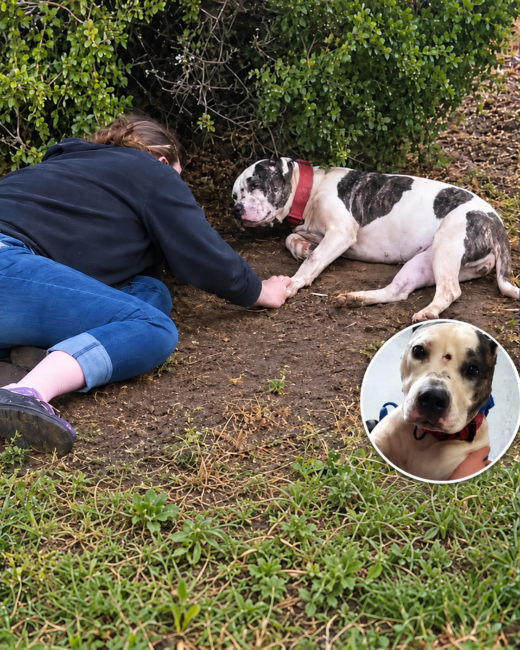
She was a compact Pit Bull with a broad white body, large black patches, a dark marking around one eye, and a red collar that stood out against her coat. Her appearance could be striking to strangers, but inside her home, she was simply the dog who belonged in the middle of family life.
Dogs learn households through repetition. They know the sound of familiar footsteps in the hallway, the movement that means someone is preparing food, and the difference between a person leaving for a few minutes and settling in for the night.
Trinity did not need human language to know which people were hers.
She stayed close.
Jessica Sinclair knew the small details that do not appear in news reports: the way Trinity watched movement inside the apartment, the position she chose when people sat down, and the speed at which she responded when a familiar person moved toward the door.
Those details formed the quiet history behind one violent decision.
The Brigadoon Apartments were not supposed to become the setting of a public tragedy. They were a place where residents moved between doors, parking areas, stairways, and neighboring homes.
On Monday, April 20, 2026, those ordinary spaces changed.
At approximately 5:20 p.m., Wichita Falls police began receiving calls reporting gunfire at the complex. According to the police account, callers identified Jeremy Gibson as a man actively shooting people.
The first arriving officers faced a scene involving multiple victims and more than one apartment.
Police said a witness reported that Gibson knocked at the door of 61-year-old Debra Lucas. When she answered, he allegedly shot her multiple times in the chest.
Another person inside that apartment was reportedly shot in the leg.
The violence then moved toward a neighboring apartment.
That second apartment was where Trinity and her family were.
According to police reporting, a third human victim was shot in the chest there, and a dog was also shot. The public police account established that Trinity was among the victims, but Jessica’s later interview provided the detail that made the dog’s role clearer.
Jessica said the weapon had been directed toward her.
Trinity crossed the space between them.
People often describe dogs as protective without having seen what protection demands. Barking at a door or standing between an owner and a stranger may be instinctive behavior that ends without harm.
What Trinity did carried an irreversible cost.
She entered the path of live gunfire.
No one can interview a dog about intention. It would be irresponsible to claim that Trinity weighed the consequences in the human sense or consciously chose among several plans.
What Jessica witnessed was action.
The gun turned toward her.
Trinity moved forward.
The shots struck the dog instead.
Whether the movement came from attachment, defensive instinct, fear, or several forces occurring at once, the physical result remained the same: Trinity’s body became the barrier between Jessica and the weapon.
The noise would have been overwhelming to a dog. Gunfire inside or near an apartment produces sharp concussion, echoes, and sudden movement from every direction.
People shout, fall, run, or freeze.
Doors open.
Feet move quickly.
A dog cannot understand which person is calling emergency services, which person presents the threat, or where safety exists.
Trinity reacted to the danger closest to her family.
Then pain and panic took over.
Even after two bullets struck her, she remained capable of moving. Adrenaline can push an injured animal to run before the body begins fully registering the damage.
Trinity escaped from the immediate scene.
Her family could not follow her at once. Human victims needed emergency assistance, police were securing the complex, and every person present was struggling to understand what had happened.
Within minutes, the dog who had stayed closest to her family was gone.
Part 3, Trinity Survived the Gunfire but Disappeared Before Anyone Could Help Her
Trinity’s injuries were serious, but the shooting did not leave her motionless.
She ran.
That fact became both a reason for hope and the beginning of another emergency. If she could move, she was alive; if she continued moving without treatment, her family might lose any chance of finding her in time.
A frightened dog does not select a hiding place according to what will make rescue easier.
Instinct pushes the animal away from noise, unfamiliar people, sirens, and the location associated with pain. Trinity left the apartment complex while her body was still reacting to shock.
She may have followed streets, parking areas, or strips of grass without understanding where they led.
The city opened around her.
Wichita Falls contained traffic, commercial areas, medians, fences, drainage spaces, neighborhoods, and countless places where a white-and-black dog might disappear from view.
Every block widened the search.
Every passing minute placed more distance between Trinity and veterinary care.
Her family began sharing information as soon as they could. The description was specific enough to remember: white coat, black patches, dark facial markings, red collar.
Yet a description could not tell searchers how she would behave if found.
Trinity was usually connected to her family by trust. Pain could change the way she responded to strangers.
A person approaching too quickly might believe they were helping while accidentally driving her farther away.
The search therefore required both urgency and restraint.
People watched sidewalks and roadside spaces. They checked areas where an injured animal might seek shelter from visibility, weather, and movement.
Messages arrived asking whether a sighting might be Trinity.
Some produced no result.
A flash of white near a road could be litter, another dog, or Trinity moving out of view before anyone reached the location.
The search continued as daylight faded.
Night transformed every familiar place. Bushes became dark shapes, empty lots widened, and headlights revealed only short sections of the road at a time.
Trinity’s family had no way to know whether she was still traveling or had finally collapsed.
They could not know whether the bullets had damaged structures that would fail gradually rather than immediately.
The medical uncertainty sharpened every fear.
Jessica later described one projectile entering between Trinity’s eyes and passing through her mouth. Veterinarians reportedly suspected she might have swallowed a bullet during her escape.
Another wound was described around the cheek and neck area.
Those details became clearer only after Trinity was found.
During the search, her family knew only that two rounds had struck her face at close range.
Rain and exposure added to the concern described in community accounts. A dog already struggling with trauma and blood loss could become chilled while remaining still.
If Trinity crawled beneath cover, the same shelter protecting her from the weather might hide her from everyone searching.
The family kept circulating her image.
Community members shared posts and watched for movement.
The search expanded beyond the apartment grounds toward Kell Boulevard and surrounding roads.
Trinity had apparently traveled farther than an injured dog should have been able to travel.
The distance showed her physical determination, but it created danger. Busy roads surrounded the areas where reports placed her.
A frightened approach could send her into traffic.
The person who eventually found Trinity understood that risk.
Nearly one day after the shooting, a motorist or passerby noticed a dog lying beneath a tree near the roadway.
The dog did not rise.
She remained close to the ground, partly concealed by foliage and shadow.
The observer had every reason to move quickly. A wounded animal needed help, and the road was close.
Instead, the stranger made the careful decision not to chase her.
A phone came out.
One photograph was taken.
That photograph began moving through the same community network that had carried Trinity’s description.
Eventually, it reached Jessica.
Part 4, One Photograph Ended the Search but Revealed How Far Trinity Had Gone
The photograph was not polished.
It showed a dog lying beneath a tree, her white body marked by large black patches and the dirt of almost a full day outdoors. The image did not need perfect light or a close view.
Jessica recognized Trinity’s face.
Recognition transformed uncertainty into direction. For almost 24 hours, the family had been searching a growing section of Wichita Falls without knowing whether they were moving toward Trinity or away from her.
Now there was a location.
Trinity was alive beneath a tree near Kell Boulevard.
Reaching her still required care.
The stranger who took the photograph had avoided rushing forward, which may have prevented Trinity from fleeing into nearby traffic. The dog’s condition, fear, and pain made every approach unpredictable.
Jessica’s presence offered something different.
A familiar smell, voice, and movement could reach the part of Trinity that still associated her person with safety.
When Jessica arrived, she did not remain standing above the dog.
She lowered herself.
The ground beneath the tree was dirt, scattered leaves, and grass pressed down around Trinity’s body. Jessica crawled closer until she was near the dog’s face and front legs.
Then she settled into the mud beside her.
The public photograph of their reunion captured a small physical gesture.
Jessica held Trinity’s paw.
Trinity did not leap up or perform a dramatic greeting. She remained on her side, too exhausted and injured for that kind of movement.
Her eyes stayed open.
The paw remained inside Jessica’s hand.
That moment mattered because it restored the connection broken by the shooting. Trinity had rushed into danger beside her family, fled in pain, and spent almost a day beyond their reach.
Now the person she knew was on the ground beside her.
Jessica could see the changes in Trinity’s face more clearly at close range. Swelling and trauma were visible, but the dog was responsive.
The next problem was moving her safely.
An injured dog that has finally stopped may resist being lifted, even by someone familiar. Pain can make pressure around the head and neck especially difficult.
Trinity needed support beneath her body and a controlled transfer to a vehicle.
The search had ended.
The medical emergency had not.
The family rushed her toward veterinary care.
During the ride, every ordinary sign became important. Was she breathing steadily? Did she respond to her name? Could she remain positioned without struggling?
No one could determine the full damage from the outside.
Bullet injuries can follow paths that are difficult to predict. A small entry point may conceal damage beneath the skin, while fragments or swallowed material require imaging and examination.
Veterinary staff took over the assessment.
Jessica’s description conveyed how close one wound had come to the center of Trinity’s face. The path through the mouth sounded catastrophic.
Yet the dog remained alive, alert, and able to respond.
The medical team had to evaluate soft tissue, bone, the eyes, breathing structures, the mouth, and the risk of infection.
They also had to determine whether any projectile remained inside her.
Reports said veterinarians believed Trinity might have swallowed a bullet while trying to escape.
That possibility was strange enough to become one of the story’s most repeated details, but the larger fact mattered more.
The projectiles had missed injuries that could have killed her immediately.
Trinity had survived the shooting.
She had survived her flight from the apartment.
She had survived almost 24 hours without treatment.
Now she had reached the place where survival could begin turning into recovery.
Part 5, The Veterinary Examination Found Devastating Wounds—and Reasons to Hope
The words “shot twice in the face” create an expectation of irreversible loss.
Jessica had already seen enough to understand why the outcome could have been different. One projectile reportedly entered near the space between Trinity’s eyes and traveled through her mouth.
Another crossed the cheek and neck region.
Yet the veterinary assessment found a dog whose body had protected more vital structures than anyone could reasonably have expected.
Trinity was alive.
She could recognize Jessica.
Local coverage reported that she was expected to make a full recovery at the time. That prognosis did not mean the wounds were minor or that healing would happen quickly.
It meant the future still contained ordinary days.
Trinity would need pain control, careful wound management, observation for infection, and follow-up care. Eating could be uncomfortable while tissues in and around the mouth healed.
Swelling might change before it improved.
Her family would need to watch for behavior indicating discomfort or new complications.
Recovery from violence also extends beyond visible wounds. Loud noises, unfamiliar movement, or returning to a place associated with the shooting could affect a dog even after the body heals.
No one could ask Trinity what she remembered.
Her behavior would provide the only answer available.
Jessica remained focused on her.
At the same time, she asked people not to let Trinity’s story erase the human victims. The dog’s survival attracted attention because her actions and recovery seemed extraordinary, but other families were living through consequences that would not end with a viral post.
Debra Lucas had died.
Other victims had been hospitalized, including people who had suffered wounds to the leg and chest, according to police reporting.
Trinity was part of a larger scene of loss.
Her courage did not make the human suffering smaller.
The criminal case also continued.
Jeremy Patrick Gibson was arrested after the shooting. Local reporting listed multiple charges, including murder, aggravated assault, aggravated assault involving bodily injury, and cruelty to a non-livestock animal.
Charges describe what prosecutors allege; they are not the same as a conviction.
That distinction matters even in a story filled with grief and anger.
The legal process would determine guilt and punishment. Trinity’s body could show what happened to her, but it could not replace evidence, testimony, or judicial findings.
For Jessica, the legal case and Trinity’s recovery moved on separate timelines.
Court proceedings could take months or longer.
Trinity needed help eating, resting, healing, and feeling safe immediately.
The family could not postpone care until the justice system reached an outcome.
They had to rebuild life around the dog who had come back from beneath the tree.
Trinity’s photograph began circulating far beyond Wichita Falls. People saw the white-and-black dog lying under the bushes and Jessica stretched across the dirt to hold her paw.
The image contained no need for explanation.
One body lay wounded.
The other refused to remain at a distance.
Viewers focused on the fact that Trinity had allegedly placed herself between Jessica and the gun. Jessica described the act as something many humans might not be able to do.
Her words expressed gratitude, but they also reflected the difficulty of assigning meaning to instinct.
Did Trinity understand that the weapon could kill her?
Probably not in a human sense.
Did she recognize a threat aimed at someone she loved and move toward it?
According to Jessica, that was exactly what happened.
Courage does not require the ability to describe itself.
Sometimes it appears as movement before thought has time to form.
Part 6, Trinity’s Story Spread Because It Contained Two Rescues
The first rescue happened inside the apartment.
According to Jessica, Trinity’s intervention changed the line between the gun and her body. The dog absorbed the shots and created a moment in which Jessica remained alive.
That act may have lasted only seconds.
The second rescue lasted almost an entire day.
It involved family members sharing photographs, residents checking roads, strangers watching bushes and medians, and one person understanding that approaching an injured dog too quickly could make the situation worse.
Trinity protected her family.
Then the community protected Trinity long enough for her family to reach her.
That second rescue lacked the sudden drama of a dog rushing toward gunfire. It depended on quieter actions.
Someone reposted her description.
Someone looked twice at a white shape near the roadside.
Someone stopped the car.
Someone chose a camera instead of an unsafe attempt to grab her.
Someone sent the photograph to the right people.
None of those actions would have mattered alone.
Together, they ended 23 hours of uncertainty.
The stranger who photographed Trinity could not know every detail of the shooting. The decision in front of that person was smaller and more immediate.
A wounded dog was lying near traffic.
The family needed a location.
The safest first step was to preserve distance while sending proof.
That decision demonstrated another form of courage—less dramatic, but thoughtful. Good intentions do not guarantee a safe outcome when an animal is frightened.
Restraint can be an act of care.
Jessica’s approach beneath the tree continued that restraint. She did not demand that Trinity stand, walk, or prove recognition.
She crawled into the dirt and reduced the space between them.
The dog had spent the night beyond familiar voices.
Now the right person was close enough to touch.
Their reunion image became the emotional center of the story because it showed what happened after courage had spent itself.
Trinity no longer needed to block a weapon.
She needed someone willing to lie on the ground beside her.
The veterinary team carried the rescue forward.
Community searchers could locate Trinity, but only licensed professionals could assess the bullet paths, clean and treat the wounds, prescribe medication, and explain the expected recovery.
Each stage required a different kind of help.
The apartment required instinct.
The streets required attention.
The roadside required patience.
The clinic required medical skill.
The family’s home would require time.
Trinity’s expected recovery also challenged the first impression created by her injuries. Two bullets to the face sound incompatible with survival.
The path of a projectile, however, can pass close to vital structures without destroying them. Millimeters matter.
Trinity’s wounds remained serious, but the dog continued eating, responding, and demonstrating the basic functions that offered hope.
Her survival did not make the shooting less violent.
It revealed how narrow the distance had been between recovery and loss.
Jessica continued drawing attention toward the other victims. That request showed an understanding of how public stories work.
A heroic dog can become the image people remember because animals feel separate from the conflicts surrounding human violence.
But Trinity’s bravery occurred inside a tragedy involving several people.
Remembering her should not require forgetting them.
The most responsible version of Trinity’s story therefore holds both truths.
A dog reportedly moved into the path of gunfire and survived.
A woman died, others were wounded, and multiple families continued carrying consequences that no photograph could resolve.
Hope and grief remained beside each other.
Part 7, The Paw Beneath the Tree Became the Part Jessica Could Hold On To
Trinity’s recovery would be measured through small things.
A meal finished without too much discomfort.
Swelling beginning to decline.
A night of deeper sleep.
A familiar response when Jessica entered the room.
Those milestones would never look as dramatic as the shooting or the community search. They were still the evidence that mattered most.
Trinity had already performed the largest act anyone would associate with her name.
Now she needed permission to become an ordinary dog again.
She needed rest rather than attention, care rather than praise, and people who watched the wounds without making every day revolve around the violence that created them.
A hero still needs quiet.
The family could not erase the memory of April 20. Sirens, sudden sounds, or the sight of Trinity’s healing face might return them to the apartment.
The criminal proceedings would keep the event present through hearings, reports, and public discussion.
Still, home would gradually gather new routines around the dog who came back.
Trinity’s red collar would hang in a familiar place.
Her water bowl would be filled.
Jessica would check her face, prepare medication if prescribed, and learn which foods were easiest while the mouth healed.
Then Trinity would rest.
The photograph beneath the tree would remain.
It captured Jessica lying on the ground with one hand wrapped around Trinity’s paw. Neither appeared prepared for a camera, and that was why the image felt honest.
Jessica had not gone there to create a reunion photograph.
She had gone there because the dog she feared she had lost was still breathing.
Trinity could not explain the gunfire, the long night, or the tree she chose for shelter. She could not describe whether she followed a scent, moved without direction, or simply stopped when her body refused to continue.
Her actions left a sequence others could reconstruct.
She moved toward danger when Jessica was threatened.
She ran away after being injured.
She survived the night.
She settled beneath a tree.
She allowed a stranger to photograph her from a distance.
She waited long enough for Jessica to arrive.
Then she left her paw inside Jessica’s hand.
That final action required no headline.
It said only that the person beside her was still the person she trusted.
Trinity’s story does not prove that every dog will react the same way. It does not turn one breed into a symbol or make any family immune from violence.
It shows what one dog reportedly did in one terrifying moment.
When the weapon turned toward her family, Trinity did not move away.
She moved closer.
When she could no longer run, a community searched.
When she was finally found, Jessica met her on the ground.
The courage began with Trinity.
The rescue ended with everyone who refused to stop looking.
Follow our page for more unforgettable dog stories about courage, survival, second chances, and the people who refuse to leave them behind.