A Starving Mother Dog Was Chained Beside the Puppies She Couldn’t Save—Six Years After Her Rescue, One Door in My House Still Stays Closed
Part 2 — What We Carried Up
I remember the basement light differently from the light in any burning building I have entered. There was no moving smoke, no orange reflection, no noise demanding an immediate decision. There was a narrow window near the ceiling, a dusty beam crossing the stairs, and a dog who had become almost as still as the things around her.
Captain Alvarez stopped me from taking the last few steps too quickly. The damaged tread had been marked and the route secured, but rushing would not help the animal control officer gain control of a frightened dog. I set the equipment where he directed me and waited beside the wall. Above us, someone moved across the kitchen floor. Nell lifted her head at the sound.
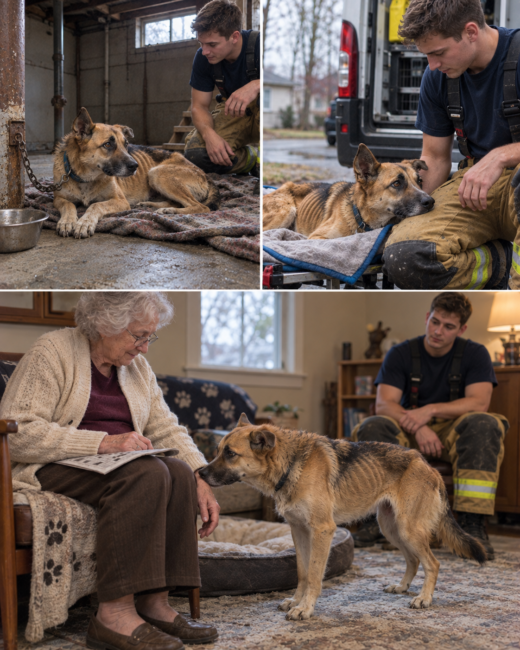
That movement has stayed with me: a small lift, followed by a long look toward the stairs. She seemed to be listening for what might happen next. I could not know whether footsteps had ever brought food or comfort. I knew only that she noticed them, even when she appeared too weak to notice much else.
The officer, Martin, crouched outside the short radius of her chain. He spoke before moving and watched her mouth, ears, and weight. When his gloved hand came closer, she drew her head back. He stopped reaching. There was no need to turn her fear into a struggle before we had a safe way to support her.
I spread the blanket across the stretcher. It had a blue border and a small stitched repair near one corner. Those ordinary details became very clear to me while Martin checked the puppies. I stared at the repair because I understood what his silence meant before he said anything. Captain Alvarez rested a hand on my shoulder, briefly, then asked whether the stretcher straps were ready.
They were. Having a task helped.
Nell rose halfway when Martin shifted away from the bedding. Her front paws slid, and she dropped back into the same hollow in the blanket. Her eyes remained on the corner. He told us not to move her until the receiving clinic and transport were ready. The puppies would also be handled respectfully and assessed separately; they would not be left in that basement after their mother was gone.
Nobody tried to make the moment into a farewell that might comfort us. We gave Nell time to investigate while keeping her safe, and we followed Martin’s handling plan. Her condition made delay a risk, too. The balance was difficult to watch: enough patience to avoid frightening her, enough urgency to get her out.
Once Martin had her secured, the captain freed the tether at its anchor. I kept the loose length from scraping across the floor. The collar would be removed in a controlled setting where the veterinary team could examine her neck. The chain went into a bag with the other documented items. Its purpose had ended even though its effects had not.
We moved Nell onto the padded stretcher with her body supported. She turned her nose toward the bedding once more. I did not tell her to stop, and I did not promise that her puppies were following her somewhere warm. There are sentences people say because they cannot bear their own helplessness. I tried not to put mine on her.
The climb was slow. Sam, another firefighter, watched the upper end while I carried behind the captain. Each adjustment was called out before it happened. At the landing, daylight reached Nell’s face, and she narrowed her eyes. Her nose moved toward the air from the open door. I had the strange, painful thought that a breeze should never feel like equipment we had finally managed to provide.
Outside, Martin checked her again while Sam prepared the vehicle. I knelt, straightened the blanket, and stayed. That was when her head found my knee. She did not seek my eyes. She simply put down a weight she could no longer hold comfortably by herself.
Captain Alvarez saw it and moved the equipment bag out of our way. He did not tell anyone to take a photograph. For a minute, my job was to remain still enough for an exhausted dog to rest. When transport was ready, I helped lift her, stepped back, and watched the vehicle leave with the blue border of the blanket visible through the rear window.
Part 3 — The Number I Kept Calling
At the station, I cleaned the stretcher straps twice. The first time was necessary. The second time was something to do while I waited for an update. Captain Alvarez found me checking a buckle that was already clean and asked whether I had eaten. I said I was not hungry. He brought me half a sandwich anyway.
He did not ask for a speech about how I felt. He told me that certain calls followed people home, and that the department had support if I needed help carrying one. Then he reminded me that Martin had my number and would call when there was information to share. I put the buckle down. I ate because the captain sat nearby until I did.
The first update was cautious. Nell was severely dehydrated and malnourished, and the veterinary team was checking for complications of prolonged deprivation. They estimated she was around four years old. I had assumed she was much older because of the way she moved. There was an entire span of ordinary dog life missing from the body we had carried upstairs.
The veterinarian, Dr. Mercer, explained more when I visited two days later. Nell was receiving treatment and measured meals suited to her condition. Her weakness did not mean a large dinner and an afternoon of rest would fix everything. The team needed to follow her response over time. They were also assessing the irritation beneath her collar and the condition of her skin and feet.
I listened without asking for an exact recovery date. At the station we were used to handing a patient into someone else’s care. This time I wanted to remain attached to every next step, as though attention alone could prevent anything else from going wrong. Dr. Mercer answered the questions she could and left the uncertain ones uncertain.
Nell lay on clean bedding in a quiet enclosure. Her brown coat still looked too large around her shoulders and too tight over her ribs. When I entered, she raised her head, watched me, and lowered it again. I felt a ridiculous flicker of disappointment. Some part of me had expected that moment outside the house to mean she would know me forever.
Then I was ashamed of wanting anything from her.
The technician brought a chair. I sat sideways to the enclosure and read the back of an old magazine from the waiting room. After a while Nell turned her nose toward my shoes. She did not move closer. I kept reading, badly pronouncing the name of a town in an advertisement, until a staff member smiled and corrected me.
That was our first visit. It was enough to arrange another.
My mother, Della, heard about Nell that evening. She was sixty-nine, retired from a school office, and lived fifteen minutes from me. I told her about the puppies without describing the room. She let me finish, then asked whether the mother dog was somewhere warm. When I said yes, she closed her eyes for a moment and nodded.
“All right,” she said. “Start there.”
Over the next week, the news came in small units. Nell ate her planned meals. She could stand longer. She tolerated a short examination without retreating as far. The findings from the puppies were consistent with prolonged deprivation, but the investigation belonged to animal control. I was not given a complete history, and I stopped asking questions that belonged to a case rather than to Nell’s care.
She moved into medical foster care when her veterinary team considered it appropriate. The caregiver, Marcie, had a quiet room and experience with dogs who needed time before they could tolerate ordinary household activity. She warned me not to arrive expecting the animal from the stretcher. As Nell gained energy, she might also show preferences and fear more clearly.
On my first visit there, Nell barked when I set my keys on a table. Then she backed away and watched me from beside her bed. I put the keys in my pocket and sat down. A few minutes later she approached, smelled my trousers, and returned to the blanket.
I was beginning to understand that getting stronger did not mean becoming easier for me. It meant Nell had more of herself available to tell us what she needed.
Part 4 — A Home Needed More Than One Person
For several weeks, my visits followed Marcie’s routine. I arrived after Nell had rested, kept my movements unhurried, and left before the room became busy. Sometimes I read. Sometimes I folded clean bedding while Marcie prepared meals. Nell watched from her bed, gradually learning that my hands did ordinary things besides carrying equipment.
The first time she rested against my knee again, I had almost stopped waiting for it. I was sitting on the floor sorting towels when she came over, smelled the stack, and lowered herself beside me. Her shoulder touched my leg. A few minutes later her chin followed. I kept folding with one hand until Marcie quietly took the towels away.
“You can just sit,” she said.
I did. Nell slept for nearly half an hour, and my foot went numb. I stayed longer than was sensible, then shifted slowly and learned that she could move her head without being harmed by my need to adjust. Caring for her was not going to mean never moving again. It was going to mean making my movements understandable.
Her recovery had limits we could measure and others we were still learning. She gained weight gradually. Short walks became easier. Her coat began to look less dull. She still startled when something metal struck the floor, and she preferred rooms with a clear view of the entrance. None of that allowed us to reconstruct every bad thing she had experienced.
When I mentioned adoption, the rescue coordinator asked about my shifts before asking about my yard. A firefighter could love a dog deeply and still be gone too long to meet that dog’s needs alone. I told her my mother wanted to help. She asked whether that was a vague offer or a real arrangement. We made it real before any papers were signed.
Mom began visiting Nell without me. The first afternoon, she sat in the chair with a crossword puzzle and spoke softly while thinking through clues. Nell remained near her bed. The next time, Mom brought the same cardigan and sat in the same place. By the fourth visit, Nell approached and sniffed her sleeve before settling nearby.
Mom did not call that winning her over. She said Nell was learning her schedule.
We discussed walks, feeding, veterinary appointments, and what would happen if Mom became ill or I was held beyond my usual shift. A professional sitter recommended by the rescue joined several visits. We put phone numbers and care instructions in one folder. I bought a second set of bowls for Mom’s house, then waited to see whether Nell could comfortably spend time there.
Meanwhile, animal control and the rescue completed the process that made adoption possible. I did not assume that finding her gave me ownership. Nor did I want an unresolved case to turn my hope into another abrupt move for her. Marcie kept Nell’s days steady while the adults handled the decisions around her.
The home visit took longer than I expected. We checked the fence, the gate latch, the slippery section of kitchen floor, and the side entrance. I showed the coordinator a bed beside the television. She looked at the narrow space around it and suggested a quieter location with an easier route out. I moved it without defending my first idea.
Nell visited twice before she stayed overnight. On the first visit, she inspected the kitchen and refused to cross into the living room. On the second, she smelled the rug, took a treat that Marcie offered, and lay near the hallway. We did not tour the whole house. A home could be introduced in pieces.
By the eighth week after the rescue, her team agreed that a move could be considered. The evening she arrived, Mom waited in the kitchen while I opened the side door. Nell stepped onto a nonslip runner, looked toward the familiar cardigan, and went over to smell Mom’s hand.
After supper, she settled on the bed we had moved. Her body no longer shook from the effort of standing, although she was still rebuilding strength. I sat on the floor nearby, relieved in a way that made me careless. I thought we had reached the simple part. The laundry basket beside the basement door looked like nothing more than a chore I had postponed.
Part 5 — Before the First Step
I lifted the basket, turned the handle, and opened the basement door. The hinges gave their usual dry complaint. A strip of yellow light fell across the top tread when I reached for the switch. I had not put a foot on the stairs when Nell got up behind me.
Her nails moved quickly across the runner, then stopped. I turned and found her several feet from the doorway, head low, body rigid. She looked past my legs into the opening. I said her name and shifted aside, thinking she wanted to see what I was doing. She moved backward so abruptly that her hip struck the wall.
The basket tilted in my hands. A towel fell onto the floor. Nell flattened herself beside it, her front legs stretched forward while the rest of her body seemed unable to choose between approaching and retreating. She made a low sound I had not heard during any of our visits.
Mom stood up from the table. She did not hurry toward Nell. She asked me to put the basket down and close the door.
I did. I left the laundry on the floor and sat several feet away. Nell watched the latch. For a long time, nothing I said changed that. Her breathing remained fast, and when I shifted my weight she flinched toward the hallway. The dog who had crossed my kitchen so carefully now looked as though the room had lost its familiar edges.
Eventually, she moved to Mom’s chair. Mom lowered one hand beside her knee without reaching over Nell’s head. Nell smelled the fingers, stood there, then leaned her shoulder against the chair leg. I wanted to go to her. Instead, I stayed where she could see me and let her choose the distance.
We contacted the rescue and arranged guidance from a qualified behavior professional. I also told the veterinarian what had happened, because a sudden reaction deserved more attention than my private theory about its cause. We reviewed Nell’s comfort and her transition into the house. Nothing in that conversation gave me permission to say I understood her memories exactly.
What we could see was clear enough. The open basement doorway frightened her. Watching me disappear toward it was not an experience she needed in order to eat, sleep, walk, or enjoy the house. We kept access closed and worked on her sense of security elsewhere, with professional support and steps she could manage without becoming distressed.
The next morning, I took the laundry to a laundromat. Mom stayed with Nell. I sat beside a turning dryer in my station sweatshirt, watching towels tumble past the glass. My neighbor later joked that the dog had already taken over my house. I told him I had needed clean clothes and found another way to wash them.
There was more to arrange than laundry. My tools were downstairs. So were storage boxes, the furnace, and the water heater. I bought a small toolbox for the kitchen cupboard. A contractor assessed how to move the washer and dryer into an upstairs utility space. Maintenance workers used the exterior basement entrance while Nell was comfortably away with Mom or her sitter.
I paid bills for those choices. I gave up closet space. None of it felt like a vow made under dramatic music. It was a collection of practical decisions repeated until they became the way the house worked.
Nell did not relax because I announced that the basement was off-limits. For several days she watched me when I passed the door. I kept our routine predictable and followed the behavior plan. If she needed more distance, she got it. We did not use her fear as something to demonstrate to visitors.
The first time she ate while I walked past that wall, I nearly stopped to praise her. Then I kept going to the refrigerator, took out the milk, and returned to the table. She finished the food in her bowl.
The basement door remained closed. I had not descended a single step. I did not know then that six years later I would still be washing clothes upstairs, or that the arrangement would eventually feel too ordinary to explain.
Part 6 — The Life That Grew Around Her
Nell’s first year in my house was built from events too small for a rescue photograph. She learned which cupboard held her food. She discovered that Mom put on reading glasses before sitting down for a long time. She began bringing a soft toy into the kitchen, dropping it near my chair, and watching to see whether I noticed.
The first toy she chose was a fabric duck with one uneven wing. She did not mother it, hide it, or offer us any neat symbol of the puppies she had lost. She carried it, shook it once, and lay down with it between her paws. I was grateful to let a dog have a toy without asking it to explain her past.
By the end of that first year, her body had changed. The sharp outline of her hips softened. Her coat developed a healthy shine, and she could enjoy walks that had once been too tiring. Her veterinary care continued, and we adjusted meals and exercise according to how she was doing. The photographs from the basement were kept in records, not displayed above her bed.
There were setbacks. During a windstorm, a loose gate struck its frame repeatedly while I was on shift. Nell paced and would not settle in her usual spot. Mom moved with her to the quieter living room, contacted the sitter who could help secure the gate, and followed the plan we had discussed with the professional guiding us. When I came home, Nell was asleep near Mom’s slippers.
I wanted to believe my arrival was always the thing that made her safe. That morning corrected me. Mom had kept her company. The sitter had stopped the noise. Nell had found somewhere she could rest. The best home I could give her did not require me to be its only useful person.
Our shift routine became familiar. Before work, I packed my bag at the kitchen table instead of rushing from room to room. Mom or the sitter arrived before I left. Nell usually came over to smell my hand, then returned to whoever was staying. Some mornings were harder, especially after disrupted sleep or a noisy night. We adjusted rather than treating each difficult day as the loss of all our progress.
In the second summer, Nell began taking her afternoon nap beside Mom’s chair instead of watching the hallway. Mom would rest a hand near the dog’s shoulder while she read. Sometimes Nell pressed her forehead into the cardigan sleeve and stayed there. The woman who had first said, “Start there,” had become one of the places Nell could rest.
People asked about the puppies. I answered simply: they had died before we reached them. I did not know whether Nell remembered them in the way those people meant. I would not call every whine grief or every toy a substitute. She deserved to be noticed in the present, where she disliked rain, loved the smell of toast, and occasionally stole my warm place on the sofa.
Captain Alvarez visited after my third year with her. He stood quietly inside the gate and let her approach at her own pace. Nell smelled his shoes, circled once, and returned to me. Later she lay in the grass while we talked. He looked at her full coat and the relaxed angle of her front legs for a long time before saying anything.
“She gets to be ordinary here,” he said.
That was the most accurate thing anyone had said about my house.
The basement still needed servicing. I scheduled it, paid for it, and took Nell out with Mom while the work was done. I never stepped down those stairs. It was not a treatment I would prescribe to another family, and it did not mean Nell could never learn anything difficult. It was simply a part of the house we did not need to share.
By year five, friends stopped asking about the door. They asked whether Nell wanted to join us in the yard, whether Mom was bringing lunch, whether the duck had finally lost its other wing. The life around her had become larger than the room where we found her.
Part 7 — Six Years Upstairs
Nell is around ten now. I am thirty, old enough to have new firefighters on the crew looking to me for reassurance, young enough to remember how desperately I once wanted every rescue to end at the moment someone reached daylight. I know better because of a brown dog who needed months to sleep through an ordinary household noise.
Mom is seventy-five. We review our care arrangements as her own energy changes, and the sitter who met Nell during foster visits still helps with longer stretches. Nell walks more slowly than she did a few years ago. Her veterinarian keeps an eye on that, and our routes have shortened without becoming less interesting to her. There is a particular hedge she still believes deserves a thorough investigation every morning.
Last month, a new firefighter named Eli came by after helping me with a station project. He noticed the upstairs washer when I went to get coffee. I told him the house used to have its laundry in the basement. When he asked why I moved it, I gave him the short version of Nell’s story.
He looked toward the closed door at the end of the hall.
“You really haven’t gone down there in six years?”
I shook my head. He was quiet for a moment, then said it must remind me of the rescue every day. I looked at Nell, who was trying to convince Mom that an empty lunch plate might still contain something worth inspecting. Most days, I told him, I barely thought about the basement at all.
The changes had stopped feeling like changes. The toolbox belonged upstairs. The washer belonged in its closet. The closed door belonged to a space used by people who came to maintain the house, with Nell comfortably elsewhere. Our attention had moved on to weather, appointments, groceries, and whether the dog had already been fed by somebody else.
Eli sat on the floor when Nell approached. He offered his hand low and let her investigate. She smelled his sleeve, stood beside him for a while, then returned to Mom. He smiled without trying to call her back. Watching that, I remembered my own knee outside the neglected house, and how frightened I had been of moving it.
Nell had not been choosing a rescuer for the next six years. She had been exhausted. I had been there. Everything afterward had been built through decisions neither of us could have understood in that first minute.
When Eli left, Mom put on her cardigan and waited while Nell accompanied her to the side entrance. I walked them to the car for their usual afternoon together. Nell needed a little more time getting settled than she once had. Mom waited, talking about a road repair she intended to avoid, and Nell turned her head toward the familiar voice.
There are still things I cannot give that dog. I cannot return the puppies. I cannot tell her why nobody came before we did, or promise that age will never make her uncomfortable. I can keep her appointments, notice when a route becomes too much, and arrange for a familiar person to be there when my job takes me away.
That evening, after Mom brought her home, Nell found me on the living-room floor sorting clean towels. She smelled the stack, stepped around it, and lowered herself beside my leg. Her chin came to rest against my knee.
This time her body was warm and well fed. Her breathing was easy. The street outside was quiet, and there was nowhere urgent we needed to go.
I folded the last towel, set it on the sofa, and moved my hand to her shoulder. Nell sighed without lifting her head. Down the hall, the basement door stayed closed. Beside me, she stretched one front paw across the rug and went to sleep.
Follow our page for more dog rescue stories about patient care, second chances, and the ordinary choices that help a frightened animal feel at home.