Part 2: A Teen in a Juvenile Facility Spent Ten Weeks With the Shelter’s Most Feared Dog—Then the Woman Who Came to Adopt Him Made the Boy Forget His Speech
Part 2, The First Thing Amos Did on His Own
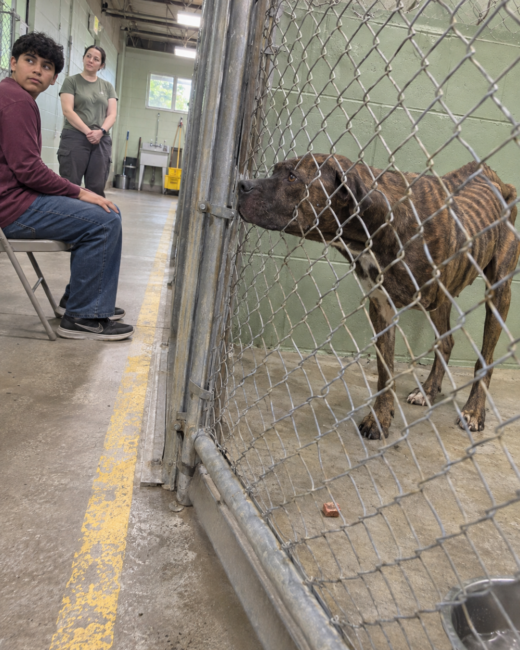
When the session ended, Amos still hadn’t touched the food. Eli stood slowly and followed Darryl toward the exit. From the end of the aisle, he looked back and saw Amos lower his nose to the kennel floor, now that everyone had given him room.
On the ride back, Darryl asked how it had gone. Eli said he’d sat there for twenty minutes, and that seemed like a generous account of his contribution. Darryl asked if he planned to come back Wednesday.
“Is it up to me?” Eli said.
Darryl told him the placement at the facility was part of his sentence. The shelter program was something he’d volunteered for. If he wanted to stay in it, he’d have to show up and follow Rena’s directions, including when she ended a session before he felt he’d accomplished anything.
Eli had been sent to the facility after breaking into a hardware store while on probation. He’d broken the door and taken tools he thought he could sell. The owner had described coming in before opening and finding glass scattered over the floor where customers usually stood.
Eli remembered the glass. He also remembered telling the judge that anything he said at that point would sound like an excuse. She had waited a long time before answering him, long enough that he’d started looking for somewhere else to put his eyes.
On Wednesday, he returned to Cedar Run. Rena told him Amos had arrived thin and wary of people approaching his kennel. Visitors often passed his kennel after hearing him bark. The veterinary team was helping him regain weight, and the old loss of his leg meant they would pay attention to how comfortably he moved. For now, Eli could help by being predictable.
The word annoyed him. He had wanted a useful assignment, something he could finish and point to. He sat behind the yellow line again. If Amos stayed on his bed the whole time, Eli would still be there when Darryl came to collect him.
That second visit, Amos ate while Eli was still in the aisle. Eli saw it without turning his head, then waited until they were outside to tell Darryl. He tried to sound casual and asked if he could come on Friday too.
By the end of the first week, Eli knew which bucket made Amos jump and which kennel door could be shut quietly if someone lifted it slightly. He began getting to the aisle before the volunteer with the bucket so he could move it out of her way.
Rena still kept the gate closed during his sessions. On Friday, she wrote “ate with Eli present” on the clipboard. This time, she let him see it. He read it twice, then put the clipboard back on her desk with its edges lined up neatly against the corner.
Part 3, One Word and Time to Answer
The first time Amos sat on cue, Eli nearly missed it. They were in a quiet exercise pen by then, with Rena handling the leash and deciding when each session began and ended. Eli had been practicing the word quietly. Amos shifted his weight, lowered himself, and looked toward the pocket where Rena kept his food.
Eli grinned. “You saw that, right?”
“I did,” she said. “Give him a minute.”
Some days, a brief session was enough. On others, Amos had enough energy to walk a short circuit of the pen and settle on a mat. Eli began to notice when the dog shifted his weight and looked toward his bed. He learned to put the mat away while Amos was still comfortable.
By week five, Amos could lie down when Eli asked. Getting up took him longer, and the boy had a habit of repeating himself before the dog had time to move. Rena asked him to say the word once and wait. Eli tried it, counting to himself instead of filling the silence.
At the youth facility that evening, he nearly walked out of a meeting when Darryl brought up restitution. The number looked enormous to somebody with almost nothing in his account. He pushed his chair back, then stopped and asked Darryl to help him work out what he could actually pay once he had a job.
They worked out a possible schedule on scrap paper. Eli took it back to his room and asked for another copy after spilling water on the first. Darryl put the request in his notes because he’d spent months watching Eli go quiet whenever he couldn’t see a way through a problem.
Amos still barked if unfamiliar people crowded the kennel. He had begun approaching some staff in the yard, and he could watch someone pass the gate without getting up every time. He was putting on weight, though the white patch on his chest still looked narrow beneath his collar.
One rainy morning, Eli arrived expecting to practice lying down. Amos stayed on the far side of the pen and turned away when they brought out the mat. Rena suggested giving him the morning off. Eli put everything away, sat nearby for a few minutes, and told the dog he would come back Wednesday.
By the tenth week, Rena had found an approved adopter who had spent time getting to know Amos on other days. Eli listened while she explained that the woman had experience with an older dog who needed help getting around. He asked whether she knew about the gate.
“Yes,” Rena said. “She’s spent time with him here.”
Eli went back to the youth facility and wrote a few lines for the graduation. He wanted to thank Amos for something, but every version sounded odd when he read it aloud. In the end, he wrote down what had happened the first day and stopped there.
Part 4, The Woman at the Side Door
On July 15, ten weeks after the first session, the shelter set out folding chairs in a room normally used for staff training. There were paper cups, cookies from a grocery store, and a crooked banner made by the participants. Eli’s mother had traded shifts to be there. He spotted her near the back, still wearing the shoes she used at work.
Amos rested on a mat beside Rena. He’d walked a short loop before the guests came in, and she’d left room around him so nobody would have to step over him. Eli stood with his page folded into quarters and began describing his first morning.
“I thought they’d given me the wrong dog,” he said. Several people smiled. “Then I thought if I could get him to do one thing, I could go back and say I’d done what they—”
The side door opened. A woman in a light blue shirt came in holding a packet from the adoption desk. Eli recognized her before she’d taken two steps. He looked down at the page, but the next words were gone.
It was Judge Marian Hale, the woman who had sent him to the youth facility.
She paused when she saw him looking. Rena told the room that Amos’s adopter had arrived. Eli glanced from the woman to the packet in her hands and said the first thing he could think of.
“You’re taking him?”
“Yes,” she said. “If he’ll have me.”
Amos lifted his head at her voice. When she sat, he got up and approached her at a pace Eli knew well. She had already been meeting with him under Rena’s supervision. She’d applied after a friend mentioned him, and she had learned who his student handler was as the shelter prepared for graduation.
After the others went for cookies, Rena showed her the first entry in Amos’s training record. She asked Eli if he wanted to read it. He did, holding the clipboard flat against his knees.
“Moved off bed while Eli sat quietly,” the entry said. Beneath that was a line he’d never seen. “Eli noticed the chair was bothering him and asked to move.”
Judge Hale looked up from the page. “I’ve seen what you’ve done for him,” she said. “I believe you can do it for yourself, too.”
Eli looked at Amos, who had lowered himself beside her chair. He had expected giving the dog up to feel like another decision made in a room he couldn’t leave. Now he found himself leaning toward her, worried she might hurry Amos the first time she asked him to stand.
“He gets up slow,” Eli said. “Give him time after you ask.”
“I will,” she said.
Part 5, Six Months Early
That evening, Eli returned to the youth facility with his graduation paper in one pocket and a photograph of Amos in the other. He showed the picture to Darryl and asked whether he’d be allowed to keep it near his bed. Then he asked about the next shelter session.
He had completed the program. Darryl could have arranged another activity, and there was no longer a dog assigned to him. Eli said he’d like to go back anyway. The shelter needed help with laundry, and he knew how to close the kennel door that rattled.
He kept going through August. At the facility, he finished the schoolwork he’d fallen behind on, kept his appointments, and began preparing for the review that would determine when he could return home. He and his mother worked with his case team on a schedule they could both manage.
The court had been told that Judge Hale had adopted Amos. A different judge handled the release review, using reports from the facility, the school, and the case team. The program was part of the record. So were the months Eli had put into classes, following through on commitments, and working out what he could do about the harm he’d caused.
Cedar Run had an opening for a part-time kennel assistant. Rena told Eli he could apply if his release plan allowed it. He filled out the application himself, asked Darryl to check that he’d included the right contact information, and interviewed with the shelter manager.
When the manager asked what he did when a dog refused to cooperate, Eli thought about the rainy morning Amos had stayed at the far side of the pen. He said he’d tell the trainer what he was seeing and ask what the dog needed. Then he added that he was getting better at stopping when a session had gone far enough.
The offer came before his release review. He could start if he was cleared to return home, with hours that left room for school and his other obligations. Eli brought the letter to Darryl and asked to put it with the plan they had drawn up together.
On September 20, Eli left the facility six months ahead of his scheduled release, after the court reviewed his record of good conduct and approved his plan for continued supervision. His mother was waiting in the parking lot. They drove home together with the radio turned down.
Once he was inside, Eli put the photograph of Amos on the shelf above his desk. He had a new alarm to set for Monday. The shelter manager had told him to come through the staff door.
Part 6, His Name on the Schedule
On his first paid shift, Eli arrived early enough to find the staff door locked. He waited with his lunch bag on the step. When Rena came around the corner, she looked at the time and said he had five minutes to finish the breakfast he was holding.
The job started with towels, buckets, and a checklist for each aisle. Eli learned what to log, where to take damaged bedding, and which questions needed a staff member with more experience. He liked seeing his name on the schedule. He also liked having somebody expect him at the same time the next day.
Amos’s first weeks in his new home had brought their own adjustments. Judge Hale sent updates to the shelter. She had put runners over the slippery parts of her floor and moved his bed so he could see her from the kitchen. Some visitors still made him uneasy, and she worked with Rena on making those encounters easier for him.
She brought him in for a scheduled follow-up that fall. Eli was taking a load of towels to the laundry when he heard her say Amos’s name. The dog turned at the sound of his shoes and stood looking at him, tail making a slow sweep behind him.
Eli set the towels down and waited. Amos came close, sniffed his hands, then leaned briefly into his leg. His ribs were harder to see now. His coat looked brighter, and the missing leg was the same familiar space Eli remembered from the first morning.
“How’s he doing at your house?” Eli asked.
“He sleeps through the dishwasher now,” she said. “The doorbell is taking longer.”
Eli laughed. He’d heard Amos bark at a bucket, a zipper, and a paper bag being opened too quickly. He asked whether Amos had picked a spot to sleep while she was at home. She said he usually took the rug beneath her desk and made her move her feet around him.
A coworker called from the laundry room. Eli picked up his towels, told Amos he’d see him later, and went back to work. The dog watched him leave, then turned toward the woman holding his leash.
When his first paycheck came, Eli sat at the kitchen table with his mother and the schedule he and Darryl had started on scrap paper. Some of the money went toward restitution. He put aside enough for bus fare and a pair of shoes he could wear through a wet shift.
His mother offered to help him check the numbers. Months earlier, he would have folded the paper and said he had it handled. This time, he slid it across the table and asked her to look at the second line.
Part 7, The Day He Was Supposed to Come Home
March 20, 2025, had once been the date Eli expected to come home. By the time it arrived, it was a Thursday with rain in the forecast and two new volunteers on the shelter schedule. He noticed the date when he wrote it on a kennel sheet.
One of the volunteers, a teenager about the age he’d been in May, hung back near a kennel where a dog was barking. She held a clean towel she’d been sent to deliver and kept looking from the gate to the staff desk. Eli walked over and asked whether she wanted him to get Rena.
“Do I have to go closer?” she asked.
“You can wait out here,” he said. He moved the towel to a shelf and pulled a folding chair out of the walkway. When Rena came, he told her where the girl had been standing and what the dog had done. Then he went to finish his aisle.
Amos had a follow-up visit that afternoon. He came in with Judge Hale, paused on the entry mat, and shook the rain off his coat. Eli was refilling a water bowl when he saw them. He washed his hands, then sat on a bench while she brought Amos over.
The dog waited beside him for a minute. Eli said “down” once, as quietly as he used to in the exercise pen. Amos lowered himself onto the mat and rested his chin against Eli’s shoe.
Eli told Judge Hale about the new volunteer. He said he used to think everybody in the room was waiting for him to get something wrong. That morning, he’d been able to hear the girl asking for help before she’d found the words for it.
“Did she stay?” the judge asked.
“She stayed until she was ready to go get another towel.”
Amos sighed against his shoe. Eli reached down and rested a hand lightly on his shoulder. Across the room, Rena was explaining how to write a note on a kennel sheet so the next person would know what had happened.
Before he left, Eli went back to the aisle and checked the water he had put down. The volunteer was at the far end, carrying two towels this time. She asked him where he wanted the clean ones, and he showed her the shelf.
Then he asked if she could help him with the last basket. There was enough work left for two people, and he knew he could ask.
Follow this page for more dog stories about patient care, second chances, and the people who learn to trust each other.