Part 2: A Tiny Puppy Slept Inside a Torn Shoe at the Dump — Years Later That Same Shoe Proved What Home Had Really Become
Part 2
Sole spent four days at the clinic before Dr. Whitaker let me bring her home.
I had told myself from the start that I was only helping her get stable. I had said the word temporary three different times to Dr. Whitaker, twice to the receptionist, and once out loud to myself in the truck. It sounded respectable. Reasonable. Like the kind of thing a man says when he knows his life is already too full of grief and habit to let in one more living creature.
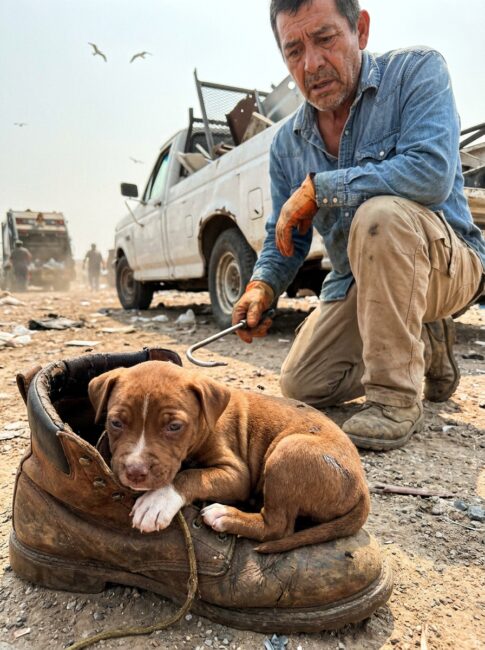
But by the time I carried her through my front door in a borrowed pet crate with the old shoe tucked beside her blanket, I knew I was lying.
My house on Bowie Street had not held anything small in a long time. No children. No pets. No second toothbrush in the bathroom. Elena and I had once talked about getting a dog when things “settled down,” which turned out to be one of those phrases people waste on the future because they assume the future owes them time. After she died, I could not even walk past the pet aisle at the grocery store without feeling something in my chest go tight.
Now I had a puppy the size of a loaf of bread staring up at me from inside a crate.
The first night, I set her up in a laundry basket beside my bed because I was afraid I might roll over and crush her if she slept too close. I lined the basket with old towels, a flannel shirt, and the shoe. She ignored the towels. Ignored the shirt. She dragged herself forward, pressed her whole tiny body against the inside curve of that cracked leather, and fell asleep with her nose buried beneath the loose lace.
That was the first sign.
The shoe was not a random object to her.
It was memory, safety, and proof that she had once made it through a night.
I bottle-fed her every four hours for the first week. Dr. Whitaker had me mix canned puppy food with warm water until it turned to mush, then slowly thicken it as Sole gained strength. I learned how to measure her hydration by her gums, how to clean her ears, how to trim a belly swollen from worms and still call her beautiful. Every morning before my route, I sat on the kitchen floor with a towel over my knee and let her climb my leg like a mountain, all knees and paws and stubborn breath.
Sole was not graceful.
She was all determination.
By the second week, she had figured out how to follow me from room to room carrying the shoe by its lace. The boot was almost as long as her body, so she dragged it in halting little bursts, panting after every few feet, then starting again. If I went to the bathroom, the shoe appeared outside the door. If I sat on the porch drinking coffee, Sole dragged it onto the boards and collapsed beside it like a miner guarding a gold sack. If thunder rolled over Amarillo at night, I would wake to hear the scrape-scrape of leather on wood as she hauled it all the way to my bedroom.
I should have thrown it away a dozen times.
I never even considered it once.
There were other small changes too. The kind a dog makes before you notice the size of them. I stopped leaving the radio on just to cover silence, because Sole made enough sound on her own—little sneezes, sleepy grunts, nails tapping across linoleum, the wet smack of puppy food. I started coming home faster after work. I washed my kitchen floor more often. I bought a cheap throw rug because her paws slipped on the tile. Then I bought a better one because the cheap one bunched up. By October, I had a dog bed, two stainless bowls, a red collar, and a drawer full of chew toys in a house that used to contain only practical things.
My daughter Marisol noticed before I said anything.
We had not been close since Elena died. Grief makes some people talk more. It made me shut down. Marisol lived across town with her husband and my granddaughter Lily, and though she still called on birthdays and holidays, there had been a cold carefulness between us for years, like we were both afraid to touch the wrong memory and break something for good.
One Saturday she stopped by unannounced with Lily in tow.
Sole was three months old then, still round-bellied and clumsy, asleep inside the shoe beside the couch.
Lily gasped.
“Grandpa, there’s a dog in a boot!”
Marisol looked from the puppy to me. “You got a dog?”
“I found her,” I said. “At the dump.”
Lily dropped to the floor immediately. Sole woke, blinked, and instead of hiding, she crawled out of the shoe and licked strawberry jam off my granddaughter’s wrist. Marisol covered her mouth to laugh, and that laugh did something to the room. It made it feel less like a place I passed through and more like a place people might want to stay in.
Lily asked the dog’s name.
“Sole,” I said.
“Like shoe sole?”
I nodded.
She thought about that with grave eight-year-old seriousness, then smiled. “Also like soul.”
Marisol looked at me then. Really looked. And for the first time in years, her expression softened without caution in it.
From then on, Sole became part of the bridge back.
Marisol began texting for puppy photos. Lily started asking to come by after school. On Sundays, if I hauled junk in the morning, I would come home to find a drawing on my porch from Lily—a dog in a shoe, a dog on a couch, a dog with a huge smiling face and paws too big for the paper.
Sole grew fast. Strong chest, wide paws, warm brown eyes that lost their baby haze and settled into something steadier. She rode in my truck, met my regular customers, and greeted old Mrs. Bell next door by sitting politely beside the fence until a biscuit appeared. Yet for all the ways she changed, one habit never left her.
At the end of every day, no matter where she had been, she went back to the shoe.
Not just the bed.
The shoe.
She slept with one paw on it.
And when she was frightened, uncertain, or trying to tell me something mattered, she picked it up and brought it straight to me.
I thought it was sweet.
I did not yet understand it was a language.
Part 3
The first time I nearly lost Sole was not to sickness or a loose gate or some cruelty from outside. It was to my own fear that loving her might be something I could not afford.
That winter, my truck transmission gave out on Interstate 40 with a load of old fencing in the back and no warning except a cough in the engine and a scream from the gears. Repairs on an aging work truck are not like repairs on normal things. They come with the smug certainty that more bad news is waiting behind the first estimate. By the time the mechanic was finished talking, I owed more money than I had sitting in the bank.
I stopped eating lunch out. Canceled the satellite package. Told Marisol I was fine when she asked if I needed help. Men like me can drag pride around long after it stops being useful.
Then Dr. Whitaker found a small hernia near Sole’s abdomen during a routine visit. It was fixable, not urgent, but it would need surgery in a few months before it got worse. I stood in the clinic lobby with the quote in my hand and a cold wave of shame running through me.
A decent dog deserved medical care.
A decent dog deserved stability.
A decent dog probably deserved more than a junk-hauler with a broken truck and a stack of bills clipped to the refrigerator.
That night, I called Cynthia Polk, a rescue coordinator Dr. Whitaker knew. Cynthia helped place dogs with foster families and adopters when people hit hard times. She came by two days later, sat at my kitchen table, and asked careful questions in a soft voice designed not to corner anybody.
Sole sat at my feet with the shoe resting against my boot.
“I’m not saying I want to give her away,” I told Cynthia.
“You’re asking if there are options,” she said.
“Yes.”
She nodded. “There are always options.”
She told me about a family in Canyon, outside Amarillo. Nice people. A big fenced yard. Two middle-school kids. A mother who worked from home. Experience with pit bulls. Enough money for care without blinking at surgery bills. On paper it sounded exactly like what a man should want if he loved a dog more than he loved being the one she belonged to.
We arranged a meeting at a local adoption event hosted in the parking lot of a feed store.
I brought Sole.
And I brought the shoe.
The Canyon family was kind. That made it harder. Their kids sat on the ground and offered Sole treats. The mother spoke gently and knew how to let a dog approach on her own terms. The father had that competent calm of a man who could build a fence on Saturday and still be cheerful by lunch.
Sole, however, was not charmed.
She did not bark.
She did not growl.
She simply stood stiff beside me, then slowly backed up until the old shoe touched her hind paws. After that, she lowered herself right into it—or as much into it as a half-grown pit bull could manage—and pressed her chest against the cracked leather with a look I had never seen on her face before.
Not fear exactly.
Not stubbornness.
Something closer to decision.
Cynthia tried again. The family stayed patient. One of the kids tossed a tennis ball. Sole ignored it. The mother extended her hand. Sole glanced once, then turned and rested her chin on my boot.
The father smiled sadly. “I think she made up her mind.”
I should have felt relieved.
Instead, I felt exposed.
Because in that instant everybody there could see what I had been trying not to say: that the dog from the shoe had not merely gotten used to my house. She had built her entire idea of home around me. And I, against my better judgment and all common sense, had done the same around her.
I apologized to the family. They were gracious. Cynthia squeezed my arm on the way out and said, “Sometimes the right home is the one already hurting over the question.”
The surgery still had to be paid for. The truck still had to run. The bills still had my name on them. Nothing practical had changed.
Except everything had.
On the drive home, Sole rode in the passenger seat with the shoe tucked under one paw, staring out the window like a dog who had just survived another kind of abandonment.
At a red light on Bell Street, I looked over and said it out loud.
“You’re staying.”
Sole did not wag.
She just shifted closer to the shoe and let her head lean against my arm.
That should have been the end of the story.
A man keeps the dog he loves. The dog stays with the man she chose. A family in Canyon finds another rescue. Everybody goes home with their feelings sorted out in time for dinner.
That is the kind of ending people think they want.
Life almost never stops where it first makes sense.
Part 4
Three months after I decided to keep Sole, the old shoe saved my life.
It happened on a Tuesday in April, in the narrow space between ordinary chores. That is how trouble usually arrives. Never with enough courtesy to announce itself properly.
I had spent the morning hauling scrap fencing from a storm-damaged property on the far side of town. By afternoon the wind had picked up, pushing red dust through the yard in thin sheets. Sole and I had settled into our routine by then. When I got home, she ran the fence line once, drank from her bowl, then carried the shoe onto the porch while I sat in the metal chair Elena used to hate because it squeaked every time I leaned back.
I remember the light.
Late and yellow.
I remember Sole chewing absentmindedly on the lace.
And I remember standing up too fast, feeling the world tip sideways, and thinking for one absurd second that maybe I had simply not eaten enough lunch.
Then the pain hit.
Not the movie kind. No dramatic clutching, no shouted plea. Just a crushing pressure in the center of my chest, then a wave of weakness down my left arm and a cold, hard certainty that something was very wrong. I tried to reach the back door for my phone. I made it two steps before my knee buckled and I went down hard beside the porch.
Sole was on me instantly.
She barked in a way I had never heard before—short, sharp, furious. She licked my face, pushed at my shoulder, then ran to the back door and back again. I tried to tell her to stop. Tried to say “phone.” What came out sounded like gravel in a pipe.
My nearest neighbor, Mrs. Jean Bell, lived one house over, but her hearing was poor and her windows stayed shut against the wind. There were no people on the street. No one to wave down.
Sole barked once more.
Then she ran inside.
I remember lying there in the dirt, half under the shadow of the porch, tasting metal and dust. I remember thinking, stupidly, that I had not fed the dog dinner yet. Then the screen door banged.
Sole came back out carrying the shoe.
Not dragging it.
Carrying it high by the lace.
She bolted off the porch, across the patchy grass, and through the side opening in the fence I sometimes left unlatched for hauling. I heard her nails hit pavement. Then nothing for several seconds that felt like a mile.
When Jean Bell told me the rest later, her voice shook.
She had been standing in her kitchen when she heard frantic scratching at the screen. When she opened the back door, Sole stood there panting, the old torn shoe hanging from her mouth. Sole never took that shoe off our property. Jean knew that. Everyone around me knew that. The dog guarded it like a sacred object.
Jean said Sole dropped the shoe on her linoleum floor, barked once, picked it back up, and ran a few feet toward the yard. Then she came back and grabbed the hem of Jean’s house dress.
“Ray,” Jean whispered, understanding all at once. “Something’s wrong with Ray.”
She followed the dog.
Sole did not wander. Did not circle. She led Jean straight through my side gate, across the yard, and to where I was half conscious in the dirt. Jean called 911. Then Marisol. Then stood over me talking in a firm voice until the ambulance came, one hand on my shoulder and the other gripping that ridiculous cracked shoe like evidence from a miracle.
The paramedics told me later I was lucky.
Not blessed. Not charmed. Not spared by some invisible plan. Just lucky in the brutal medical sense that the event was caught early and the blockage could be treated fast. Had I been alone much longer, things might have turned out differently.
When I woke in the hospital, Marisol was asleep in a chair by the window. Her mascara had smudged beneath both eyes. Lily had left a drawing on the tray table: me in a bed, Sole on a chair, and the shoe floating between us like a superhero cape.
Marisol woke when I moved.
She cried before she said a word.
Then she laughed through it. “You idiot,” she whispered, squeezing my hand. “Your dog brought the shoe to Jean.”
I blinked at her.
“The shoe,” she repeated. “That old dump shoe. She carried it to get help.”
That was the twist nobody sees coming when they first hear a story about a puppy in a discarded boot.
I had thought I rescued Sole from the shoe.
The truth was harder and stranger and better.
Sole had turned that shoe into a signal, and one day it became the reason help found me in time.
Part 5
Recovery rearranged my life in ways the heart event itself only began.
For the first few weeks after I came home from the hospital, Marisol moved into my spare room with Lily on weekends, and Jean Bell came by each morning even when there was nothing to check. Dr. Whitaker insisted Sole stay with me during recovery because separating us would raise both our stress levels, which struck me as a medical opinion unusually close to common sense.
The first night back in my own bed, I woke at two in the morning certain I had heard something wrong in my chest.
Before panic could get a grip, Sole stood up from her bed, picked up the shoe, and laid it against my mattress. Then she rested her head on the side of the bed and watched me until my breathing slowed.
That was when it finally clicked.
The shoe had never been a toy.
Never just a keepsake.
It was her first map of safety. When she was tiny, it was the place where she hid from wind, hunger, noise, and whatever had left her alone. When she came to my house, dragging it to me became her way of saying this matters, I’m scared, stay here, pay attention, come with me, I trust you. She had spent her whole puppyhood building a language from the only shelter she understood.
And when I collapsed, she used the clearest word she had.
Marisol understood it too, maybe because grief had made us both miss so much that was plain in front of us. One afternoon while Lily colored at the kitchen table, Marisol ran a hand over the torn leather and said, “You know what gets me?”
“What?”
“That she didn’t go grab a toy. She didn’t just bark and run. She brought the one thing that meant home. Like she was telling Jean, ‘Come. This is about my person.’”
There are sentences that heal by cutting clean through denial.
That was one of them.
I started cardiac rehab in May. Sole came with me to the clinic lobby sometimes if weather allowed, charming nurses who pretended not to be charmed by anything. At home, she became my self-appointed supervisor. If I stood too quickly, she stood. If I lingered outside too long in the heat, she nudged my leg. If I dozed off in the porch chair, she slept with one ear lifted. At first I thought I was imagining extra vigilance because near-miss stories make people dramatic. Then even Dr. Whitaker noticed it.
“She’s watching your breathing,” the doctor said during a visit.
“Can dogs do that?”
“Dogs do many things we only explain after the fact.”
Lily became obsessed with the legend of the shoe. Not in a childish way that made it silly. In a reverent way. She asked me to tell the story each Sunday: the dump, the puppy, the ride to the clinic, the adoption event, the day Jean followed Sole home. On her ninth birthday, she made a cardboard sign and set it beside Sole’s bed.
FIRST HOME.
Marisol laughed when she saw it, but she left it there.
That summer I cut back my hauling route. Not because I wanted to stop working entirely, but because surviving something serious makes even stubborn men reconsider what counts as enough. I sold two of my least profitable contracts, kept my regular residential pickups, and started spending Fridays fixing old furniture from the junk route instead of throwing every usable piece away. Marisol helped me set up a small corner of the garage as a refurbishing shop. Lily painted a wooden plaque for it that read Ray & Sole Salvage in crooked blue letters.
The name stuck.
People in Amarillo like a story they can point to. Soon customers started asking if the dog in the yard was “the shoe puppy.” Some brought old blankets for shelters. One man donated a stack of dog beds. A local reporter did a short feature on our little operation, focusing more on reclaimed furniture than my health scare, which was fine by me. But the picture they used showed Sole lying beside the shoe under the porch swing, and after that, folks began dropping off unwanted pet supplies with notes tucked inside.
For the dogs still looking for their first home.
There was one more piece to the revelation, though, and it had less to do with rescue work than with family. During my recovery, Marisol admitted something I had suspected but never heard clearly.
“When Mom died,” she told me one evening while we washed dishes together, “I felt like I lost both of you. She died, and you disappeared into work.”
I dried a plate and did not answer right away.
She went on. “I kept waiting for you to let us in. Then I got tired of knocking.”
I wanted to defend myself. Grief gives a thousand ready-made excuses. But Sole was asleep in the doorway with the shoe tucked beneath her chin, and looking at her made lying feel impossible.
“I know,” I said finally. “I’m sorry I made my hurt bigger than yours.”
Marisol stared down at the soap bubbles in the sink and nodded. “I think the dog helped.”
“She did.”
“You saved her.”
I looked toward the doorway.
“No,” I said. “Not all the way. We saved each other in shifts.”
That, more than anything, was the truth of Sole. She had begun as an abandoned puppy in a discarded shoe. She became the force that pulled a stubborn man back toward his daughter, his granddaughter, his neighbors, and a version of home that included more than memory.
The shoe stayed beside her bed.
Not because she needed it every night now.
But because some histories deserve a place where everybody can see them.
Part 6
By the time Sole turned three, the old shoe had become part of the architecture of the house.
It sat on a little woven mat beside her bed in the living room, cracked and soft with age, one lace replaced twice because Sole still liked to carry it now and then. I had cleaned it only once, lightly, enough to keep it from falling apart entirely. Too much scrubbing would have erased the story from it, and that felt wrong. Some scars do not need polish. They need witness.
We settled into rituals.
Every morning I made coffee, opened the back door, and Sole trotted into the yard for her patrol lap. Then she came back in, touched the shoe with her nose, and waited for breakfast. Every evening, after I locked up the garage shop, I straightened the blanket in her bed and nudged the shoe back into place if she had moved it. Lily, who was now old enough to pretend she was too grown for sentiment, still crouched to pat the leather whenever she came over.
“Still here,” she would whisper.
Sole’s world grew wider without losing its center. She came to the garage with me and slept beneath worktables while I sanded dressers and repaired chairs. She greeted customers with that broad-chested pit bull smile that made nervous people laugh at themselves. Once a month, I volunteered at a rescue fundraiser with Cynthia Polk, the very coordinator I had nearly handed Sole over to. We displayed restored furniture, sold enough to help cover foster supplies, and let Sole act as unofficial ambassador.
People loved the story.
But what mattered to me was the quiet part after the telling.
The way Sole leaned against my leg when crowds got loud.
The way Marisol stopped by after work just to sit on the porch.
The way Jean Bell claimed visiting rights and brought dog biscuits in her apron pocket.
The way Lily curled up on the floor beside Sole’s bed and did homework while the shoe sat there like an old photograph nobody needed to explain anymore.
Once, on a cool October evening, I asked Lily if she knew why I kept the shoe out instead of storing it away in a memory box.
She thought for a moment before answering.
“Because it’s not just before,” she said. “It’s part of now.”
That was exactly right.
Part 7
Sole is older now.
Her muzzle has silver around it. Her steps are slower in the mornings, and sometimes she makes a soft grunt before lying down as if announcing her complaints to the furniture. The shoe is older too—its leather nearly gone smooth, its shape softened from years of being carried, guarded, and understood.
It still sits beside her bed.
Not as a sad reminder.
Not as proof of pity.
As evidence of distance traveled.
Sometimes I stand in the living room at night after everyone has gone home and look at the two of them—the sturdy dog asleep under a roof, the torn shoe beside her like a witness that stayed for the whole story. And I think about the dump lot, the heat, the flies, the ridiculous smallness of that first shelter. I think about how close a life can come to being overlooked just because it fits inside something broken.
Then I think about what came after.
A bottle-fed puppy.
A kitchen made louder by nails on tile.
A granddaughter’s drawings.
A daughter returning to the table.
A neighbor following a desperate dog with a shoe in her mouth.
A man who thought he was rescuing an orphan and discovered, years later, that he had been the one pulled back into family.
Sole’s first home was a discarded shoe.
Now she has a bed, a yard, a porch, a family, and more voices calling her name than I can count without smiling.
That is what I keep coming back to.
Not the dump.
Not the loss.
Not even the rescue itself.
The enlargement.
The way a life can start in almost nothing and still grow large enough to hold everybody inside it.
If this story stayed with you, follow the page for more dog stories about rescue, loyalty, and the strange beautiful ways animals turn discarded things—and discarded people—into family.