Part 2: A Woman in a Wheelchair Met the Shelter Dog Everyone Was Afraid to Touch — Then Realized Healing Began at Eye Level
Part 2 — Why River Looked Up With Fear
Shelter stories usually begin with labels.
Bite risk.
Fear aggressive.
Resource guarding.
Not good with strangers.
Special needs.
Labels can be useful when they protect people and animals, but they can also shrink a whole life into the worst thing a frightened body has done. River’s file was thick with careful notes: snapped when handler bent over, retreated from raised hand, urinated when approached by tall male, refused leash pressure, accepts food only when person seated or turned sideways. The notes were not cruel. They were accurate. But I remember sitting in the shelter office later, reading them, and thinking that they sounded less like warnings and more like a map of how humans had once become dangerous to him.
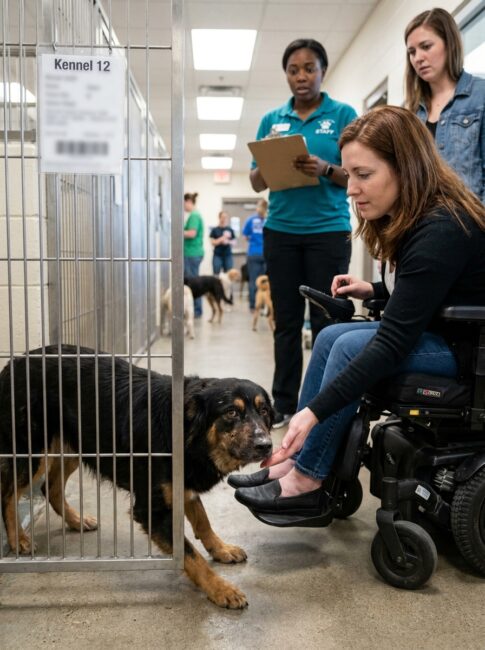
Tasha told me what they knew.
River had been removed from a property outside town along with three other dogs. The house belonged to a man who had since been charged with multiple counts of animal neglect and cruelty. The other dogs, though nervous, improved quickly after intake. River did not. He had been chained separately behind a shed, close enough to hear human voices but far enough that no one from the street had seen him clearly for months. The chain had left a scar around the lower part of his neck. His muzzle bore older marks, not fresh but visible if you knew where to look. His body flinched at the sound of belt buckles, metal gates, and boots on concrete.
“He reacts most when people loom,” Tasha said. “Even kind people. Especially kind people who try too hard.”
I understood that more than I wanted to.
After my injury, I had learned how easily kindness becomes uncomfortable when it forgets the other person’s dignity. Strangers grabbed my chair handles without asking. People bent at the waist and spoke to me in exaggerated softness. Men I had never met announced that I was “amazing” because I bought groceries. Others avoided eye contact entirely, as if my seated height made me disappear.
Different pain, different body, different species.
Still, something inside me recognized the math of being approached wrong.
River’s fear was not random. It was architectural. It had been built from angles: people over him, hands above him, doors closing, collars tightened, shadows crossing his face before touch came. He had learned that humans arrived downward.
That first day, the shelter allowed me to sit by his kennel for twenty minutes. No touching except what he initiated through the bars. No treats pushed at him. No door opened. Tasha said it was the calmest she had seen him with a stranger. Megan stood behind me, quiet for once, which I appreciated because sisters are often worse than puppies about impulse control.
When we left, River did not bark.
He watched my chair roll away.
That night, I could not stop thinking about him.
I told myself practical things. He was not ready. My apartment was small. My shoulders tired easily. Fearful dogs need careful management. I had no fenced yard. I was still grieving Rosie. I did not owe every wounded animal a home just because I saw myself in one.
All true.
None useful.
The next morning, I called Brookside and asked whether volunteers were allowed to sit with dogs who were not yet adoptable. Tasha paused only long enough to pretend she was considering policy.
“For River,” she said, “I think we can make a plan.”
So I began visiting.
Tuesdays and Thursdays after lunch. Saturdays when transportation worked. I brought a book, water bottle, and a patience I did not always have for humans but somehow had for him. At first, I sat outside the kennel while River watched me from the back. Then he began coming forward sooner. Then he lay down near the front instead of retreating. Then, one Thursday, he fell asleep with his nose resting against the bottom bar.
No one celebrated out loud.
That was important.
Big reactions can ruin small trust.
Tasha only lifted her eyebrows at me from across the aisle and mouthed, that’s huge.
The first time we entered a private meet room together, Tasha brought River in before me and let him settle. The room was simple: rubber floor, low bench, water bowl, toys nobody expected him to use. When I rolled in, he startled at the sound of my wheels on the floor but did not retreat. I stopped near the wall, angled my chair sideways, and rested my hands in my lap.
River stood across from me, breathing fast.
Then he lowered his body and crawled.
Inches at a time.
When he reached my footplate, he sniffed it, then placed one paw lightly on the metal as if testing whether this strange seated human had any hidden height.
I whispered, “You don’t have to be brave all at once.”
He looked at me then.
And I wondered which one of us needed that sentence more.
Part 3 — The First Touch
The first real touch happened on the fifth visit in the meet room.
It was not dramatic. It did not look like a rescue video. No music would have known where to swell. River did not leap into my lap or bury his face against my chest. He simply came close enough that the side of his shoulder brushed my shoe, then froze as if he had surprised himself by making contact.
I kept still.
The shelter’s behavior specialist, Caleb Monroe, watched from a chair near the door. He was a white American man in his fifties with a gray ponytail, soft voice, and the patience of a person who had been bitten enough times to stop taking fear personally. He had been working with River since intake and was the first to explain the concept that changed how I understood him.
“He’s not afraid of people exactly,” Caleb said later. “He’s afraid of human height combined with human intention.”
That sentence stayed with me.
Human height combined with human intention.
In other words, River had no reason to believe that a person standing over him meant anything good. Even a hand holding a treat could become terrifying if it descended from above. Even a leash could feel like a threat if the person attached to it loomed. The wheelchair changed the geometry of the encounter. It did not magically heal him. It simply removed one of the shapes his fear knew best.
During that fifth visit, River leaned his shoulder against my shoe for three seconds.
Then he backed away.
I did not follow.
He came back six minutes later and did it again.
By the end of the session, he let me touch the side of his neck with two fingers, low and slow, where he could see my hand the entire time. His skin twitched under my touch, but he did not snap. He did not retreat. He closed his eyes for one breath, then opened them quickly as if embarrassed by pleasure.
That small breath broke me in a quiet way.
On the drive home, Megan asked, “Are you going to adopt him?”
“No.”
She laughed.
“I’m serious.”
“No, you’re scared.”
“I’m practical.”
“You have never been practical about dogs.”
I looked out the van window and hated how sisters can sometimes tell the truth with no manners.
The adoption conversation started formally two weeks later. Tasha and Caleb were careful, which I respected. They did not romanticize the match. River still had triggers. He could not be rushed into crowded spaces. He would need a predictable routine, controlled introductions, a harness system that avoided collar pressure, and careful management around standing strangers. My wheelchair was not a cure. It was an opening.
I appreciated that distinction.
Too many people want rescue stories to mean love solves everything.
Love does not solve everything.
But it can create the conditions where work becomes possible.
Brookside required several trial visits and a home assessment. They measured my apartment doorways, discussed leash handling from a wheelchair, identified where River’s bed could go, and helped install a low baby gate that would give him a safe room without making him feel trapped. We practiced turning my chair while holding a leash. We tested whether the sound of my ramp startled him. We taught him that moving wheels were not chasing him. He learned faster when nobody hovered.
My neighbors were another consideration. Mrs. Albright across the hall, a seventy-two-year-old Black American retired librarian, promised to sit on a chair instead of standing when she met him. My upstairs neighbor, Jules, offered dog walking backup but agreed to training first. Everyone who wanted to help had to learn the same rule: no leaning over River, no reaching from above, no crowding him with goodness.
The day I signed the foster-to-adopt paperwork, River watched from under the shelter office desk.
“Do you want to come home?” I asked him.
He blinked.
That was not consent, exactly.
But when Tasha clipped his harness and opened the office door, River walked toward my chair instead of hers.
Caleb smiled. “That’s about as close as he gets to a yes.”
On the way out, a tall man entered the lobby too quickly. River froze. His body flattened, eyes wide, breath fast. I stopped my chair immediately and turned sideways between them, not blocking like a wall, but lowering the pressure. The man apologized and backed away. River pressed against my wheel, shaking.
I looked down at him.
“We’ll do this at your height,” I whispered.
He did not understand the words.
But his breathing slowed anyway.
Part 4 — Home at Eye Level
River spent the first hour in my apartment standing under the kitchen table.
Not lying.
Standing.
It was as if his body did not yet believe any room was safe enough to put his belly down. He sniffed the air, the chair legs, the water bowl, the rug, the low bed I had bought after rejecting seven others online because they looked too tall, too enclosed, or too much like something a frightened dog might not trust.
I did not try to coax him out.
I made tea. Badly. My hands shook more than usual. I rolled through my own apartment as if visiting someone else’s life. River watched the wheels, not with panic exactly, but intense study. Wheels made sound. Wheels changed direction. Wheels did not tower. He needed to catalogue all of that before deciding whether this place could be survived.
By evening, he came out for water.
By night, he ate half his dinner.
At 2:14 in the morning, I woke to the sound of tags moving. River stood beside my bed, facing me. I had placed his bed across the room to give him space, but he had crossed that space silently and stopped at my side. His ears were half-back, his eyes uncertain.
I lowered my hand, palm up, over the side of the mattress.
He sniffed once.
Then he lay down on the floor beside the bed with his back touching the wheel of my chair.
I did not sleep for another hour.
I just listened to him breathe.
The first weeks were full of small negotiations. River learned that delivery knocks did not mean danger. I learned to announce myself before turning corners too quickly. He learned that my chair could roll past him without trapping him. I learned not to drop the metal footplate carelessly because the clang made him vanish into the bathroom. He learned that Mrs. Albright was safe because she met him sitting in a dining chair with a paperback in her lap. I learned that he preferred being touched along the side of his shoulder, never the top of the head.
We built trust as if assembling furniture without instructions.
Awkwardly.
Slowly.
With occasional mistakes.
One afternoon, I dropped my keys near him. He startled and snapped at the air, not at me exactly, but close enough that the old fear flashed across both our faces. He retreated under the desk. I sat in the middle of the room and cried quietly, partly from shock, partly from shame, partly because love does not prevent regression and I hated being reminded.
After ten minutes, River crawled out.
He stopped an arm’s length away and lowered his head.
Not apologizing, because dogs do not use guilt the way humans do, but reconnecting.
I held my palm open on my knee.
He touched it with his nose.
That became the whole lesson of us: something scares you, you move away, you come back when ready, and the door to trust remains open.
At the end of the foster period, Brookside asked if I wanted to proceed with adoption.
I laughed because River was asleep under my desk with his chin on my wheelchair footrest while Tasha asked the question by phone.
“Yes,” I said. “Obviously.”
The adoption photo is not the sort of picture that usually wins hearts online. I am seated in my chair outside the shelter, wearing a navy sweater and looking like I might cry. River sits beside my wheel, not leaning dramatically, not smiling at the camera, just present. His body is angled toward me, eyes soft but cautious. His leash hangs loose. My hand rests low beside him, where he can see it.
Tasha posted it with permission.
The caption read: “River found the first human who did not stand over him.”
That was when the story spread.
Comments came from other wheelchair users, trauma survivors, dog trainers, shelter workers, and people who said they had never considered how height could feel threatening to an animal. Some called me an angel. I ignored those. Angels do not swear when ramps are blocked by delivery scooters. Some called River lucky. Maybe. But I was beginning to understand that luck had gone both ways.
He gave me something too.
He made my apartment less quiet.
He made my days less centered around what I had lost.
And without meaning to, he showed me that my seated height, the thing strangers often treated as limitation, was the very thing that made him feel safe enough to begin again.
Part 5 — The Standing World
The hardest part of loving River was not loving him inside my apartment.
It was teaching him the standing world would not always hurt him.
Inside our home, he blossomed cautiously but beautifully. He slept on his side. He carried socks to his bed. He developed a deep suspicion of the blender and a passionate love for string cheese. He learned that my morning routine meant breakfast after coffee, though he believed this order was morally questionable. He touched my hand with his nose when he wanted attention and learned to rest his head on my knee when I worked at the computer.
Outside, the world still had height.
Tall bodies.
Fast children.
People leaning down with happy voices.
Hands appearing from above before I could say, “Please don’t.”
We trained carefully. Caleb Monroe came to my apartment twice a month at first, then met us in quiet parks. River wore a yellow bandana that said PLEASE GIVE ME SPACE, which worked on about half of people and confused the rest. We practiced watching standing people from a distance. Then closer. Then standing people sitting down before offering treats. Then standing people turning sideways. The goal was not to make River love everyone. The goal was to give him more choices before fear chose for him.
One day at the park, a little boy ran toward us shouting, “Doggy!”
River froze.
The boy’s mother grabbed him just in time and apologized. She was embarrassed, maybe expecting me to be angry. I surprised us both by asking if she would help with training. She sat on a bench. Her son sat beside her. I rolled River in a wide arc at his comfort distance. After a few minutes, River looked at the boy without panic. After five more, he took a treat tossed gently onto the ground between them.
Not from the child’s hand.
That would have been too much.
But from the space they shared.
The boy whispered, “He’s brave.”
I said, “He’s trying.”
The boy nodded like that was a category he understood.
River’s progress made people want a clean miracle. I could see it in their faces. They wanted him to become the dog who once feared humans and now loved everyone. But River did not owe the world that kind of transformation. Some wounds heal into boundaries, not friendliness. He was allowed to have preferences. He was allowed to say no. Trust mattered more because it remained specific.
He trusted me.
He trusted Mrs. Albright.
He trusted Tasha.
He trusted Caleb Monroe if Caleb sat before speaking.
He tolerated Megan because she brought chicken and had learned to sit on the floor without making it dramatic.
Then one day, he surprised all of us.
It happened during a shelter fundraiser six months after adoption. Brookside invited us to attend but promised we could leave at any time. I almost declined because crowds are hard for both of us. But the event had a quiet room for reactive dogs and nervous humans, which is the sort of accommodation that makes participation possible instead of symbolic.
River did well for twenty minutes.
Then a microphone squealed.
He startled hard, spun toward my chair, and pressed himself between my footrests. I turned us toward the quiet room, but before we reached it, a volunteer dropped a metal water bowl nearby. The clang cracked through the hallway.
River bolted.
The leash stayed in my hand, but he pulled hard enough to angle my chair. Caleb Monroe moved to help, then stopped himself from standing over him. Tasha dropped to a kneel. Megan sat on the floor. People backed away.
River crouched under a table, shaking.
I could not kneel.
I could not crawl to him.
For one awful second, I felt my disability as failure, sharp and immediate.
Then I rolled as close as the table allowed and lowered my body forward, not reaching, just bringing my face near the opening.
“River,” I said softly.
His eyes found mine.
Same height.
Same old doorway.
He crawled out.
Past Tasha.
Past Megan.
Past Caleb.
Straight to me.
He pressed his head against my knee and stood there shaking while I held my hand low against his shoulder.
People later called it beautiful.
It was.
It was also proof that healing is not a straight path away from fear.
Sometimes healing is knowing where to return when fear arrives.
Part 6 — What We Taught Each Other
A year after River came home, Brookside asked if I would speak at a training workshop for volunteers about working with fearful dogs.
I said no three times.
Then Tasha told me, “You don’t have to be inspiring. Just be useful.”
That was the magic sentence.
Useful I could do.
The workshop took place in the shelter education room. River came with me but was not required to perform. He lay on a mat beside my chair with a chew, occasionally lifting his head to judge the room. I spoke to a group of volunteers about what I had learned, though I made it clear I was not a certified trainer. I was simply a person who had become safe to one dog partly because of circumstances I had not chosen.
I told them height matters.
Approach matters.
Hands matter.
Silence matters.
Permission matters.
I told them that sitting down can change a fearful dog’s nervous system before any treat ever appears. Turning sideways can be kinder than leaning in. Letting a dog retreat can build more trust than pushing for contact. I told them that wheelchair users are not automatically better with dogs, and fearful dogs are not magically healed by lowered height. But geometry can either increase fear or reduce it. The body believes shapes before it believes intentions.
Caleb Monroe added the professional language afterward. Trigger stacking. Thresholds. Consent-based handling. Cooperative care. Choice points. Predictability. He made it sound like training theory. River made it look like survival.
Then a new volunteer raised her hand and asked the question I had been avoiding in myself.
“Do you think he helped you too?”
River was asleep, one paw over my wheel.
“Yes,” I said.
The room waited.
I took a breath.
“People often talk about disability as if it only takes things away. And some days, yes, it does. It takes time, ease, privacy, access. But with River, the very thing the world often framed as my limitation became part of why he could trust me. I wasn’t above him. I didn’t have to remember to sit down. I was already there.”
No one spoke for a moment.
Then River sighed so loudly that the room laughed, which saved me from crying.
After the workshop, the shelter began adding a simple practice to fearful-dog volunteer training: before reaching, sit. Before touching, lower pressure. Before expecting trust, examine the angle from which you are asking for it. They called it eye-level handling, though Tasha joked that River should receive licensing royalties in string cheese.
River became something of a quiet ambassador, but only on his terms. He attended small sessions, never crowded events unless he chose. He modeled what trust could look like when not rushed. He did not wag at everyone. He did not need to. Sometimes his greatest teaching was simply lying beside my wheelchair in a room full of people who had learned not to tower over him.
At home, our life grew wonderfully ordinary.
Morning coffee.
River pretending he had never eaten.
Work transcripts.
Afternoon walks.
Mrs. Albright reading aloud in the hallway while River rested near her chair.
Megan visiting with takeout and too many opinions.
River learning to place his chin on my lap when he sensed my pain days before I admitted them.
I had thought I was adopting a dog because he needed a home.
That was true.
But River also gave me a new relationship with my own body. Not perfect acceptance. I do not believe in perfect acceptance. More like peace with unexpected usefulness. My wheelchair was not only a sign of injury, not only equipment, not only access and limitation. To River, it was the reason my hands arrived from the side instead of the sky.
It was the shape of safety.
I had spent years wishing the world would meet me at eye level.
River was the first creature who needed exactly that from me.
Part 7 — Eye Level
River is seven now, maybe eight.
Shelter estimates are never exact, and he refuses to produce documents no matter how often I ask. His muzzle has grayed. His bent ear has gone softer at the tip. He still startles at dropped metal bowls, though he recovers faster. He still dislikes tall men who walk straight toward him, though he can now watch them from across a park without shaking. He still prefers people seated, sideways, patient, and aware of where their hands are.
In other words, he is still River.
Not fixed into someone easier.
Not transformed into a friendly mascot for human redemption.
Just safer.
More able to choose.
More willing to believe that some people come gently.
On good days, he trots beside my chair with a loose leash and the confidence of a dog who knows the sidewalk belongs partly to him. On hard days, we take the shorter route and he sleeps under my desk while I work. He has learned the ramp at my van, the sound of my wheels on different surfaces, the lift button, the click of my brakes, the exact cabinet where treats live, and which neighbors are worth greeting.
He still does not like strangers leaning down.
Honestly, neither do I.
We are a matched set that way.
Every year on his adoption day, we visit Brookside. Tasha meets us in the lobby if she is working. Caleb Monroe, now mostly retired, comes if he can. New staff have heard the story by then: the frightened dog who trusted the woman in the wheelchair because she did not stand over him. River accepts their admiration from a safe distance and then demands to inspect the treat jar, because humility has never been his strongest trait.
Sometimes we sit outside Kennel 12.
The kennel is not his anymore. Other dogs have passed through it. Some scared. Some loud. Some hopeful. Some adopted quickly, some still waiting longer than anyone likes. River always sniffs the bars, then leans against my wheel. I wonder whether he remembers the first day clearly. Dogs live in the present, but the body keeps old weather.
I remember.
I remember his nose touching my fingers through the bars.
I remember Tasha whispering, “Oh my God.”
I remember realizing that for once, my seated height was not something to overcome or explain.
It was the gift that opened the door.
People still share River’s adoption photo sometimes. The caption changes from page to page, but the quote that stayed came from something I said during a shelter interview and almost forgot afterward:
“I was the first human who didn’t stand over him. Sometimes healing is just meeting someone at eye level.”
That line belongs to both of us.
Because River taught me that healing is not always about fixing what is broken. Sometimes it is about changing the approach. Lowering the pressure. Removing the shadow. Letting trust happen from a place where no one has to look up in fear or look down in pity.
Eye level is not only physical.
It is respect.
It is patience.
It is the refusal to make another living being smaller so you can feel helpful.
River and I found each other because the world had placed us both outside its preferred height. He had learned to fear what came from above. I had learned to endure being treated as if below meant less. Together, somehow, we built a life where neither of those lessons got the final word.
He is asleep beside my chair as I write this, head on my footplate, one paw twitching in a dream. When he wakes, he will look up at me only slightly, not because I tower, but because we are close. I will lower my hand where he can see it. He will touch his nose to my palm, as he does every morning.
A small ritual.
A shared level.
A beginning that never stopped saving us.
Follow this page for more unforgettable dog stories about rescue, healing, loyalty, and the quiet moments when animals remind us that kindness works best when it meets another heart where it is.