Part 2: A Woman Went to a Shelter to Adopt a New Dog After Seven Years of Regret, Then Found the Old Dog She Had Never Stopped Loving
Part 2 – The Dog I Had to Leave Behind
Seven years earlier, I did not surrender Charlie because I stopped loving him.
I surrendered him because love, by itself, could not buy dog food, pay a motel deposit, or convince landlords to rent to a woman who had lost her job, her car, and nearly every piece of stability she once thought made her safe. People love to believe that losing everything happens all at once, like a storm breaking a window. For me, it happened in small ordinary failures that stacked quietly until my life had nowhere left to stand.
I had been twenty-nine when the call center where I worked closed with three weeks’ notice. My savings were thin because my mother’s medical bills had already eaten most of them. My boyfriend at the time left three months after the layoff, not cruelly, not dramatically, just tired of being around someone whose life had become a list of problems. The apartment lease ended. My credit was damaged. A friend let me sleep on her couch for a while, but her landlord found out. After that, I stayed in a cheap motel when I could, in my car when I could not, and eventually in a women’s shelter that did not allow animals.
Through all of it, Charlie stayed with me.
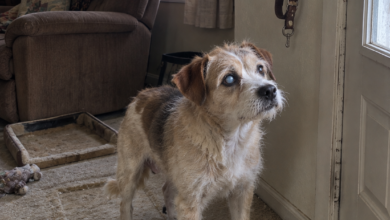
He was three years old then, a golden-brown shepherd and retriever mix with a white crescent on his chest, a ridiculous feathered tail, and the kind of eyes that made strangers forgive him for being too excited. I had adopted him as a puppy from a rescue event in a grocery store parking lot. He had chewed shoes, stolen sandwiches, slept with his head on my stomach, and once dragged a full bag of laundry down two flights of stairs because he thought I needed help.
When life got hard, Charlie became the only thing that still greeted me like I was worth seeing.
He slept curled against me in the back seat of my old Honda during the nights I parked behind a closed pharmacy. He rested his head on my knee while I filled out job applications using library computers. He leaned into me when I cried in public bathrooms because I did not want anyone in the shelter to hear. He ate before I did more times than I admitted to anyone.
That is what people do not understand about loving a dog while poor.
It is not that you love them less.
It is that every day becomes a math problem with a heartbeat attached.
Food or gas.
Medicine or motel.
A safe place for him or a safe place for you.
I kept telling myself I could hold on a little longer. Then Charlie got sick with a stomach infection, and the emergency clinic bill was more than I had left in the world. A veterinarian named Dr. Emily Hart, a white American woman in her forties with gentle eyes and a voice that made bad news sound less sharp, treated him and then sat with me in the small consultation room while I cried into my hands.
“He needs stability,” she said softly. “So do you.”
“I know.”
“I am not telling you to give him up.”
“I know.”
“But if you decide you need help, there are rescues that can place him safely.”
Safely.
That word haunted me.
Because what I had was not safe. Not anymore. I was keeping him with me because I could not survive the thought of losing him, but he was beginning to pay for my fear. He had lost weight. He startled at every knock on the car window. He ate too fast because meals had become uncertain. He watched me with worry that no dog should have to carry.
Three days later, I took him to HopeBridge Rescue, a small foster-based group outside Dayton.
I still remember the room. Pale blue walls. A plastic chair. A water bowl. A woman named Linda Perez, a Latina American rescue coordinator in her fifties, kneeling on the floor while Charlie placed his head in her lap as if trying to make the meeting easier for me.
I signed the surrender form with my hand shaking so hard the letters barely looked like mine.
Reason for surrender: housing instability.
That was what the form said.
The truth was uglier and more loving at the same time.
I was homeless.
I was scared.
I wanted my dog to eat every day.
When I hugged him goodbye, Charlie licked my cheek, then tried to follow me out the door. Linda held his leash gently. I walked to my car without turning around because I knew if I saw his face, I would take him back and call it love, even if love was no longer enough.
I heard him bark once behind the glass.
One bark.
Then a whine.
That sound lived inside me for seven years.
Part 3 – The Life Between Losing and Finding
After Charlie, my life did not become better quickly.
That is another thing people like to imagine. A painful sacrifice should unlock something. A door should open. A job should call. A miracle should arrive to justify the wound. But real life is rarely that polite. For months after I surrendered Charlie, I still slept in shelters, borrowed shower tokens from outreach centers, and folded my grief into whatever corner of myself had not already been taken by survival.
I carried his old blue collar in my backpack.
Not because I thought I would need it.
Because I could not throw it away.
Sometimes, when the shelter room was too loud, I held the collar under my blanket and pressed the fabric tag between my fingers. It still smelled faintly like him at first. Grass. Dust. dog shampoo. Warm fur. Eventually that smell faded, and somehow the fading hurt almost as much as the goodbye.
HopeBridge Rescue sent one update two months later. Charlie had been adopted by a retired couple in Dayton. They had a fenced yard, another older dog, and a sunny back porch. They sent a photo of him sitting beside a man in a baseball cap, smiling that open-mouthed Charlie smile I knew by heart.
I saved the photo on an old phone until the phone broke.
For years, I told myself that picture was enough.
He was safe.
He was loved.
He had what I could not give him then.
That should have comforted me.
Sometimes it did.
Mostly, it made me miss him more responsibly.
I rebuilt my life slowly. A church outreach program helped me get into transitional housing. A woman named Carolyn Mills, a Black American caseworker with the patience of a saint and the organizational skills of a general, helped me apply for jobs, replace documents, and stop apologizing for needing help. I found part-time work at a medical billing office, then full-time work. I moved from a rented room to a studio, then eventually to a one-bedroom apartment with windows that faced a maple tree.
Each step forward made me proud.
Each step forward also made me think, Charlie should be here.
When I bought my first real couch after homelessness, I cried in the furniture store parking lot because I imagined Charlie jumping on it before I could stop him. When I cooked chicken in my own kitchen, I thought about how he used to sit politely with one paw raised, pretending he had never been fed in his life. When rain hit my apartment window, I remembered him shaking in the back seat of my car during storms and pressing his body against me until both of us felt less alone.
People told me I should get another dog.
For a long time, I could not.
It felt like replacing him, and replacement was an insult to the love I had lost. Then, around the seventh year, something changed. Not the grief exactly. Grief did not disappear. It settled. It became less like an open wound and more like a room inside me that I could finally enter without falling apart.
My therapist, Dr. Hannah Reed, a white American woman in her early forties with silver glasses and a habit of asking the questions I tried hardest to avoid, said, “Maybe adopting again is not replacing Charlie. Maybe it is honoring what he taught you about love.”
I hated that because it sounded true.
So I researched shelters.
I chose Maple Ridge Animal Shelter because it had a good senior dog program and weekend adoption hours. I told myself I would adopt an older dog. Not a puppy. Not a dog who needed endless energy. A dog who needed a second chance and a soft place to land.
On the morning I went, I put Charlie’s old blue collar in my coat pocket.
I do not know why.
I had not carried it in years.
Maybe I wanted courage.
Maybe I wanted permission.
Maybe some part of me, deeper than reason, already knew that the past was not finished with me.
At the shelter desk, Tasha Monroe asked what kind of dog I was hoping to meet.
I said, “Someone older. Someone people keep walking past.”
She smiled sadly. “We have a few like that.”
I followed her down the kennel hall with my hands in my pockets, one finger hooked through the old collar, telling myself I was ready for a new beginning.
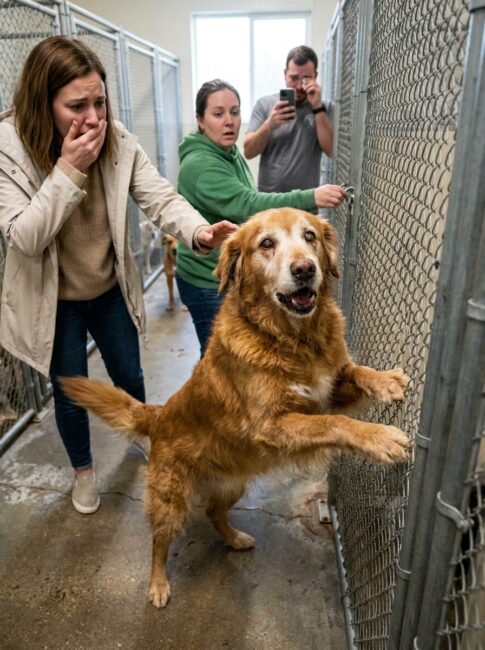
Then the last kennel began to shake.
And the dog inside started barking like my name had been trapped in his chest for seven years.
Part 4 – When the Door Opened
Tasha opened the kennel slowly.
She had done this work long enough to move with care, even when emotion was flooding the hallway. She asked me to stand back at first because a senior dog throwing himself against a gate can hurt himself, and because a reunion that feels like destiny still has to happen safely. I nodded, though my whole body leaned toward him.
Charlie could not wait.
The moment the latch clicked, he pushed through the opening with a sound halfway between a bark and a sob. His paws slipped on the polished shelter floor. He tried to run, stumbled because his old legs were not as quick as his heart, then launched himself into me with enough force to knock me backward onto the floor.
I fell sitting down.
He fell on top of me.
Then the world disappeared under fur, breath, paws, and tears.
Charlie licked my face like he was trying to erase seven years from my skin. He whined against my neck. He pressed his head under my chin. His tail thumped against my leg so hard it echoed down the hallway. I wrapped both arms around him and could not speak. Not because I had nothing to say, but because everything I had ever wanted to say to him arrived at once and jammed itself behind my ribs.
I am sorry.
I loved you.
I did not forget.
I wanted to come back.
I hope you were safe.
I hope you were happy.
I thought I lost you forever.
All I managed was his name, over and over.
“Charlie. Charlie. Charlie.”
Tasha stood a few feet away with her hand over her mouth. Another staff member, Ben Carter, a white American man in his thirties with a shaved head and a shelter radio clipped to his belt, had pulled out his phone when the barking started because staff often recorded unusual dog behavior for training and social posts. He did not know he was capturing the moment my life folded in half and opened again.
The video showed what I barely remember clearly.
Charlie climbing into my lap though he was far too large.
Me sobbing into his neck.
Tasha whispering, “He knows her.”
A volunteer down the hall crying.
Charlie pulling back just enough to look at my face, then licking my tears so frantically that I laughed and cried at the same time.
At one point, he made a sound that still breaks me when I rewatch it. A long high whine, almost like a puppy, though he was ten years old by then. His eyes were wet, the fur below them darkened. People later argued online about whether dogs can cry from emotion. I do not need that argument. I know what I saw. His whole body was crying.
So was mine.
After several minutes, Tasha knelt beside us.
“Megan,” she said gently, “you said his name is Charlie?”
I wiped my face with my sleeve and nodded.
“That is not the name we have for him.”
“What name do you have?”
“Buddy.”
I almost laughed because Charlie would have accepted any name attached to food and kindness, but Charlie was who he had been with me. Charlie was the puppy who had chewed my slippers, the young dog who had slept in my car, the companion I had surrendered with a signature that felt like cutting off my own hand.
“His name was Charlie,” I said. “When he was mine.”
Tasha looked at him. “I think he agrees.”
Charlie had not taken his eyes off me.
Not once.
He kept touching me with one paw, as if checking that I was solid. Every time I shifted, he leaned closer. When Ben stepped forward to offer tissues, Charlie placed himself half across my lap and watched him with gentle suspicion, not aggression, just the possessive concern of a dog who had found something lost and did not intend to lose it again.
Tasha asked if I had proof.
I said yes before knowing if I did.
My old photos were scattered across broken phones, lost accounts, and memory. But then I remembered the collar in my pocket. My hand shook as I pulled it out. Faded blue nylon. Tiny scratches on the metal ring. A tag with no phone number anymore, because that number had been disconnected years ago.
Charlie saw the collar.
His ears lifted.
Then he pressed his nose to it and gave one soft, broken sigh.
Tasha started crying then.
So did Ben.
I held the collar against Charlie’s chest and felt his heart racing under my hand.
“I came here to adopt a dog,” I whispered to him.
He licked my chin.
“I did not know I was coming back for you.”
Part 5 – The Seven Years He Carried
The shelter records told the story in fragments, and fragments can hurt more than one clean truth.
After I surrendered Charlie to HopeBridge Rescue, he was adopted by the retired couple from Dayton, Harold and June Patterson. Their notes were beautiful. Fenced yard. Daily walks. Loved children. Afraid of fireworks. Slept on porch. Likes scrambled eggs. For almost four years, Charlie had what I had prayed he would have: stability, comfort, and people who loved him.
Then Harold died.
Six months later, June moved into assisted living after a fall. Her daughter took Charlie, but she already had two dogs and a rental restriction. Charlie was rehomed privately to a family outside Columbus. That family kept him for nearly a year, then surrendered him to another rescue after a divorce. From there, he was adopted by a man who traveled for work and later gave him to a cousin. Somewhere in that chain, his name changed from Charlie to Buddy.
Tasha read the notes carefully, her voice soft.
I sat in a small adoption room with Charlie pressed against my legs, listening to the years I had missed.
I had imagined his life many times. Sometimes I imagined him happy every day, because I needed that to survive. Sometimes, on bad nights, I feared he had been confused forever, waiting for a woman who never came back. The truth was more complicated. He had been loved, then moved. Loved again, then moved. Fed, then surrendered. Named, renamed, photographed, transferred, adopted, returned, and finally brought to Maple Ridge after his last caretaker died suddenly and no family member could keep him.
He had arrived at the shelter three weeks before I walked in.
Three weeks.
Seven years gone, and we missed each other by only twenty-one days.
“Why didn’t his microchip lead back to me?” I asked.
Ben checked the file. “The chip was updated after the first adoption. Then updated again. Your information probably got removed when ownership changed.”
That made sense.
It still hurt.
Tasha looked at the old collar on the table. “Do you have any old pictures?”
I pulled out my phone and opened a cloud account I had not checked in years. Most folders were empty or corrupted, but after several minutes of searching, there he was.
Charlie at one year old, sleeping upside down on my old couch.
Charlie at two, wearing a red bandana at a park.
Charlie at three, sitting in the passenger seat of my Honda with his tongue out and the same white crescent on his chest.
I placed the phone beside his face.
Older Charlie sniffed younger Charlie.
Then he looked at me.
That was proof enough for the heart.
The shelter still had procedures. They had to verify my application, contact my landlord, check that I could care for a senior dog, and make sure no legal hold existed. I understood. I appreciated it, even through my panic. Love does not remove responsibility. If anything, love demands more of it.
But Charlie did not understand paperwork.
When staff led him back to his kennel for processing, he planted his feet.
The look he gave me nearly split me open.
“I’m not leaving,” I promised. “I swear I am not leaving.”
He whined.
Tasha said, “You can stay in the visitation room while we process as much as we can.”
So I did.
For four hours.
I canceled work. I called my landlord. I called my friend Naomi Brooks, a Black American nurse and the first person who had ever known the whole truth about Charlie. When I told her, she thought I had misunderstood.
“Megan,” she said slowly, “your Charlie?”
“Yes.”
“The Charlie?”
“Yes.”
There was a silence.
Then she started crying so hard I could hear her drop something in her kitchen.
By evening, the shelter had approved a foster-to-adopt release pending final review. Tasha brought Charlie into the lobby wearing a new leash and his old blue collar, clipped gently beside the shelter collar for safety. When he saw me, he did not bark this time.
He walked straight to me.
Then leaned his whole body against my legs.
Like he had done after every hard day, seven years earlier.
The body was older.
The love knew the route.
Part 6 – Coming Home Twice
Bringing Charlie home was not the joyful chaos I had once imagined when I dreamed of second chances.
It was quieter than that.
More careful.
He stepped into my apartment slowly, sniffing the doorway, the rug, the couch, the kitchen, the water bowl I had bought that morning with trembling hands after the shelter told me release was possible. My apartment was small but warm, with a blue couch, a maple tree outside the window, and no one who would ever ask me to choose between shelter and him again.
Still, Charlie did not relax right away.
He followed me from room to room, not with puppy excitement, but with old fear. If I closed the bathroom door, he whined. If I picked up my keys, he stood up too fast. If I moved toward the front door, he came between me and it, tail low, eyes worried. The first night, he refused the dog bed and slept with his head across my shoes.
I understood.
Seven years had brought us back together, but they had not erased what separation had taught him.
People can leave.
Homes can change.
Names can change.
Love can vanish behind a door.
So I began teaching him the sentence I wished I could have taught him seven years earlier.
“I come back.”
I said it when I stepped into the hallway to take out trash.
I said it when I went to work and Naomi came to sit with him for the first few days.
I said it when I returned from the grocery store.
I said it when I walked to the mailbox.
“I come back, Charlie.”
At first, he greeted every return with frantic relief, whining, circling, pressing his head into my knees. Slowly, the panic softened. He began to sleep on the rug while I cooked. He learned the sound of my car in the parking lot. He learned that the blue couch was his, despite my weak early attempts at rules. He learned that breakfast happened every morning, dinner every evening, and scrambled eggs sometimes on Sundays because Harold and June’s notes said he liked them.
I kept those notes.
All of them.
They were pieces of his life I had not been there to witness, and I decided not to be jealous of them. That was not easy. Part of me wanted to believe he had only loved me, remembered only me, waited only for me. But that would have made his life smaller. The better truth was this: other people had loved him too. Some had failed him. Some had done their best. Some had carried him for a while. I was not the only love in Charlie’s life.
But I was the first.
And somehow, after everything, I got to be the last.
The video from the shelter went online three days after the reunion, with my permission. Tasha wrote the caption carefully, not as cheap heartbreak, but as a story about poverty, surrender, senior dogs, and the strange mercy of second chances. She wrote that I had given Charlie up seven years earlier when I was homeless and unable to care for him, and that I had come to adopt a senior dog without knowing he was there.
The video showed Charlie recognizing me before I recognized him.
That was the part people could not stop watching.
The barking.
The pause.
Me whispering his name.
The kennel opening.
The collision.
The face licking.
The way his old body seemed to become young for a few minutes because love had walked back into the room.
By the end of the first day, the video had one million views.
By the end of the week, it had passed thirty million.
Thirty million strangers watched my most private wound become public.
At first, that frightened me.
Then the messages came.
A woman who had surrendered her cat during a hospital crisis and still cried every December.
A man who had lost his dog during eviction and never forgave himself.
A family who adopted a senior dog after seeing Charlie’s white muzzle.
A shelter worker who said, “Thank you for showing that surrender is not always abandonment.”
That message made me sob.
Because for seven years, I had called myself the person who abandoned Charlie.
But when I looked at him sleeping on my couch, old paws twitching, white muzzle relaxed, I began to understand a kinder truth.
I had let him go so he could live.
And somehow, life had brought him back.
Part 7 – The Dog Who Never Forgot
Charlie is eleven now.
He moves slower than he did in the video, though the internet will always remember him as the old dog who knocked me down in a shelter hallway and licked my face like he was trying to restart time. His hips are stiff in the morning. His eyes are cloudier. His hearing comes and goes unless the refrigerator opens, in which case his medical condition appears to resolve instantly.
He sleeps on the blue couch more than any dog bed I buy.
He still carries his old collar sometimes, not wearing it every day because the nylon is fragile now, but keeping it in a small basket beside his leash. The shelter collar is gone. His new tag says Charlie Ellis on one side and I came back home on the other. Naomi says the tag is too emotional. Naomi also cries every time she reads it, so her opinion has been recorded and dismissed.
We have routines now.
Morning walks around the apartment courtyard.
Medication with peanut butter.
Breakfast while I make coffee.
A nap by the window where the maple tree moves in the wind.
Short evening walks, slower now, with more sniffing than distance.
Sunday scrambled eggs, because the Pattersons loved him too and I want that love to remain part of his story.
Sometimes people recognize him.
At the park, strangers will stop and say, “Is that the dog from the video?” They say it gently most of the time. I always look at Charlie first. If he is tired, I say yes but we are walking. If he is curious, he accepts a careful hello. He enjoys admiration when it comes with snacks and respectful hands.
The viral moment changed more than our lives.
Maple Ridge Animal Shelter received adoption applications for senior dogs from across the state. HopeBridge Rescue, the first rescue that took Charlie when I surrendered him, started a fund for temporary boarding and pet support for people facing homelessness, so fewer people would have to make the decision I made alone. Tasha told me the shelter used our story in training volunteers, reminding them that every surrender form holds a human story they may not understand.
Reason for surrender: housing instability.
Now, when I see those words, I do not see failure.
I see a woman crying over a form because she loved her dog enough to want him fed.
I see a dog who lived seven more years because somebody helped him when she could not.
I see the terrible beauty of a goodbye that was not the end.
Charlie does not know he is famous.
Thank God.
He knows the important things.
He knows the sound of my keys and no longer panics every time I pick them up. He knows I come back. He knows the couch is his. He knows the park route that leads past the bakery, where a worker named Sam sometimes brings him a plain biscuit. He knows that when I sit on the floor and say, “Come here, old man,” I am ready for the full weight of his head in my lap.
And he knows, somehow, that I still carry guilt.
Dogs are unfair that way. They forgive faster than humans can accept being forgiven.
There are evenings when I sit beside him, hand resting on his white muzzle, and whisper the apology I have said a thousand times.
“I am sorry I left you.”
He usually sighs.
Sometimes he licks my wrist.
Once, Naomi heard me say it and told me, “Megan, you did not leave him. You saved him the only way you could at the time.”
I am trying to believe that.
Charlie already does.
The reunion video ends with me on the shelter floor, Charlie half in my lap, Tasha crying behind the camera, and Ben saying, “I don’t think he forgot her.”
He did not.
Seven years.
Different homes.
Different names.
Different hands.
Different beds.
Different doors.
And still, when I walked past his kennel, he knew me before I knew him.
People ask how that is possible.
I do not have a scientific answer. I know dogs remember scent, voice, rhythm, body language, and love in ways humans are only beginning to understand. But the truth I live with is simpler than research and larger than logic.
Love leaves a mark.
Not always where people can see it.
But somewhere deep.
Somewhere a locked kennel door cannot reach.
I went to Maple Ridge Animal Shelter looking for a new dog because I thought finding someone else to love might help me stop grieving the dog I lost. Instead, I found Charlie. Older, grayer, renamed, returned, and waiting behind a gate I almost walked past.
I came to forget.
He remembered.
And between those two things, fate opened a kennel door.
The internet saw a dog knocking a woman down and licking her face. What it really witnessed was seven years of regret meeting seven years of loyalty, and both discovering that love, if given even the smallest chance, can find its way through paperwork, distance, poverty, time, and locked doors.
I do not know how much time Charlie and I have left.
No one gets to know that.
But I know this: he will not wonder where I went again. He will not sleep through another night waiting for my car to return and not hear it. He will not carry another name without mine beside it. He will not leave this world as a dog who was once given up and never reclaimed.
He is home.
So am I.
And every morning, when his old tail thumps against the couch because I have opened my eyes, I understand the sentence that changed everything.
I went looking for a dog to fill the empty place Charlie left.
I found Charlie.
Destiny brought him back.
If this story touched your heart, follow this page for more unforgettable dog stories about rescue, loyalty, second chances, and the quiet miracles that prove some bonds are never truly broken.