Part 2: An 80-Year-Old Widower Heard Scratching at His Door During a Blizzard — The Frozen Dog Outside Was Carrying the Last Secret My Wife Kept From Me
Rising Action
Before Mabel, the house had learned to echo.
That is the best way I can explain it.
Every small sound came back larger after Ruth died. The refrigerator clicked, and the kitchen answered. My spoon touched a bowl, and the dining room seemed to notice. My boots crossed the hallway, and the bedroom returned the sound as if another person might be walking there too.
But no one was.
Ruth and I had been married fifty-six years. We met at a church picnic in 1966, when I knocked over a pitcher of lemonade and she handed me a towel before laughing. I told people later it was love at first sight. Ruth said it was pity with good timing.
She was a school secretary for thirty-two years, the kind who remembered which children needed mittens and which parents needed grace. I delivered mail through Minneapolis winters and learned every dog on my route by bark, fence, and cookie preference. Ruth said that was my second career: being judged by terriers.
We had owned one dog together.
A mutt named Charlie with long legs, one brown ear, and no respect for screen doors. He came to us when our children were small and stayed long enough to see both of them leave for college. When Charlie died, Ruth cried into his old collar and said, “No more for a while.”
The while became twenty years.
Not because she stopped loving dogs.
Because love gets cautious after enough goodbyes.
After Ruth’s stroke, the world became appointments. Speech therapy. Blood pressure logs. Pill organizers with letters too small for my eyes. She recovered some speech but tired easily. Her left hand never worked the same, and she hated that more than she admitted.
Still, she kept a small life.
Coffee by the window.
Crosswords in pencil.
Phone calls to our daughter, Emily.
And on Thursdays, when I thought she was at her senior center book club, she was somewhere else.
That was the first seed I missed.
Every Thursday afternoon, Ruth came home smelling faintly of dog shampoo.
I noticed it once while helping her out of her coat.
“You smell like a kennel,” I said.
She smiled.
“Maybe you smell like stamps.”
That was Ruth’s way of closing a door without slamming it.
I let it go.
The second seed sat in the kitchen drawer. A roll of blue yarn. Ruth used it to mend mittens, tie gift bags, mark jars of jam, and wrap anything she wanted me to notice. After her death, I kept finding little blue loops around the house. One on the extra key. One around the recipe card for lemon cake. One tied to the handle of the snow shovel because she knew I would forget where I put it.
When Mabel came through the door with blue yarn tied to her collar, I should have understood faster.
But grief slows recognition.
For four months after Ruth’s funeral, my children tried to help without making me feel helpless. Emily called every evening at seven. My son, Paul, offered to install cameras, smart lights, and a doorbell that would show his phone if I so much as sneezed on the porch. I told him a man did not need an audience for getting the mail.
They worried.
I got stubborn.
The storm arrived on Ruth’s birthday.
That mattered later too.
I had not told anyone I was spending it alone. I bought lemon cake, lit one candle, and did not sing. I sat across from her empty chair until the flame burned low and wax pooled on the plate.
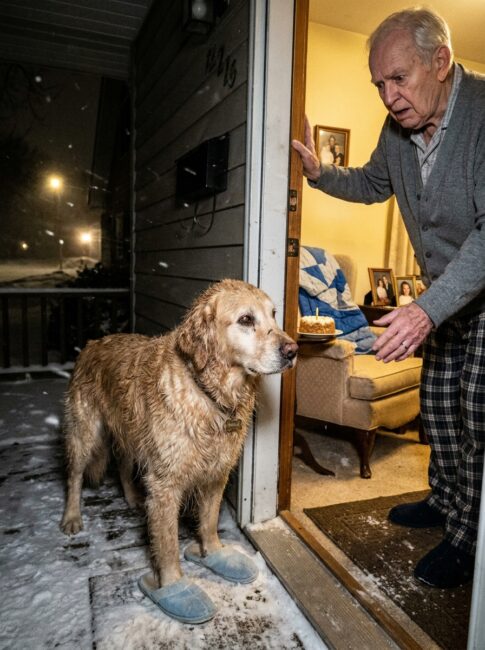
Then the scratching came.
Three taps.
Pause.
Three taps.
The sound Ruth used when she wanted me to open up.
False Climax
I did not sleep much that first night.
Mabel lay wrapped in Ruth’s quilt on the living room rug while the storm pressed against the house. I sat on the floor beside her with my back against the couch, a space heater humming near my feet and a towel under her paws.
I had not sat on the floor in years.
My knees filed a complaint.
Mabel did not care.
She shook for nearly an hour. Every few minutes, I warmed another towel in the dryer and traded it for the cold one. I gave her water from a spoon. She drank slowly, tongue rough against the metal, eyes closing between swallows.
At two in the morning, she tried to stand.
Her back legs wobbled.
“Easy,” I said.
She looked toward my voice but not quite at me, and I realized her eyes were cloudier than I had first noticed. Not blind, but old. The storm had blurred the rest of her.
She took three steps, slipped, and leaned against my shin.
That small weight almost undid me.
I put one hand on her shoulder. Her fur was warmer now. Beneath the wet-dog smell was something softer: cedar, clean soap, and the faint scent of the quilt that had lived over Ruth’s knees for years.
“You picked a bad night,” I told her.
Her tail moved once.
By morning, the snow had buried the front steps. My street was a white tunnel. The power had stayed on by some mercy, and Mabel was breathing easier. She lifted her head when I made oatmeal, then stared at my bowl with the serious attention of a dog not too sick to consider breakfast.
That was a good sign.
I scrambled one egg.
Ruth would have said not too much.
I gave Mabel half.
Ruth would have given her the other half when my back was turned.
At eight-thirty, I called Emily.
She answered before the first ring finished, because daughters of old widowers sleep with worry beside them.
“Dad?”
“I’m fine.”
“You always start that way when you’re not.”
“There’s a dog.”
Silence.
Then, “In your house?”
“On my rug.”
“Why is there a dog on your rug?”
“Storm.”
Emily arrived two hours later with her husband, my grandson, and a bag from the pet store large enough to suggest she had been waiting her whole life for me to say there was a dog. Mabel lifted her head toward their voices but did not rise. My grandson, twelve years old and too tall for his age, knelt carefully and held out his hand.
Mabel sniffed.
Then licked his fingers.
“She likes me,” he whispered.
“Don’t get attached,” I said.
Everyone looked at me.
Even the dog.
The emergency vet clinic reopened after the plows cleared the main roads. Emily drove because she said my truck tires were older than her marriage. Mabel lay across the back seat on Ruth’s quilt, nose tucked near my hand.
Dr. Anita Patel examined her gently.
Senior Golden Retriever. Around ten or eleven. Mild arthritis. Frostbite beginning on two paw pads, but not severe. Dehydration. Exhaustion. No major injuries.
“She’s lucky,” Dr. Patel said.
I looked at Mabel.
“No,” I said. “I opened a door.”
The vet smiled as if old men often confused the first step with the whole rescue.
She scanned for a microchip.
The machine beeped.
Mabel lifted her head.
Dr. Patel read the screen, then looked at me.
“Mr. Bennett,” she said slowly, “do you know a Ruth Bennett?”
The room went quiet.
For one clean second, I thought my heart had stopped.
That should have been impossible.
Ruth had been gone four months.
And yet her name sat there, glowing on a vet clinic screen, attached to the half-frozen dog sleeping against my hand.
The Twist
I said the first foolish thing that came to mind.
“My wife is dead.”
Dr. Patel lowered the scanner.
“I’m sorry.”
Emily reached for my shoulder, but I stepped away because I could not decide which part of the room was real. The exam table. The dog. The machine. My daughter’s hand. Ruth’s name where no living thing should have carried it.
Dr. Patel turned the screen gently so we could see.
Registered contact: Ruth Bennett.
Secondary contact: North Star Senior Paws.
Dog name: Mabel.
I stared at the name.
Mabel.
It fit her before I knew why. Old-fashioned. Sturdy. A name that sounded like flour on an apron and church basements and someone who knew how to wait out weather.
Emily whispered, “Mom knew her?”
The clinic called the rescue while we sat in a small room that smelled like antiseptic and dog treats. Mabel slept at my feet, wrapped in Ruth’s quilt, unaware she had cracked open the last sealed room of my life.
The woman from North Star Senior Paws arrived forty minutes later in snow boots and a red parka.
Her name was Carol DeVries. Seventy-two. White American. Short gray hair. Sharp blue eyes. The kind of woman who could run a rescue, a church bake sale, and a small government if someone gave her keys.
She took one look at Mabel and pressed both hands to her mouth.
“Oh, sweetheart.”
Mabel’s tail moved.
Carol knelt.
“Mabel, honey. You made it.”
That sentence bothered me.
Made it from where?
Carol looked at me.
“You must be Harold.”
I did not like hearing my name from a stranger who had known my wife’s secret.
“Yes.”
“Ruth talked about you.”
“She never talked about you.”
Carol winced, not from offense.
From truth.
Then she opened a folder.
The first twist was that Ruth had not been going to book club on Thursdays.
She had been volunteering at North Star Senior Paws, a small rescue that took old dogs from shelters when adopters wanted puppies and families “couldn’t handle the care anymore.” She answered phones, folded towels, made intake cards, and sat with frightened dogs after vet appointments.
After her stroke, when she could not drive, Carol picked her up.
Ruth made Carol promise not to tell me because she said I would worry about germs, lifting, sidewalks, ice, and all the ways the world might break her again.
She was correct.
The second twist was Mabel.
Mabel had arrived at the rescue six months before Ruth died, surrendered after her owner went into assisted living. She was ten, gentle, slow, fond of lemon cookies she was not supposed to have, and terrified of thunderstorms. Ruth sat with her every Thursday. Sometimes she read to her. Sometimes she said nothing. Sometimes, Carol told us, Ruth cried quietly into Mabel’s fur.
Mabel became Ruth’s dog in every way except paperwork.
“Why didn’t she bring her home?” I asked.
Carol’s eyes softened.
“She wanted to.”
That landed harder than I expected.
Ruth had asked about fostering Mabel twice. Both times, she changed her mind because she worried the work would fall on me. Walking. Vet bills. Stairs. Hair on the rugs. An old dog’s needs inside an old man’s routine.
“She said Harold already carries too much,” Carol said.
I almost laughed.
Ruth had been the weight and the wings of my life. I had carried nothing alone until she left.
The third twist came from the blue yarn.
Carol reached into the folder and pulled out a folded note.
“She wrote this three weeks before the stroke that took her,” she said. “She asked me to keep it with Mabel’s file.”
The paper was Ruth’s stationery, the kind with tiny sparrows along the top.
Harold will say no if you ask him while I am still alive. He thinks refusal protects him from another goodbye. It does not. If Mabel ever needs a home after I am gone, try him once. Only once. If he says no, forgive him for me.
I could not read the next line.
Emily read it for me.
He has always opened doors in storms.
That was when I had to sit down.
Carol explained the final piece. Mabel had been placed with a temporary foster across town after Ruth died. During the blizzard, a tree fell against the foster’s fence. Mabel, terrified by thunder, slipped through the gap. Search posts went out, but the snow buried tracks almost at once.
The foster lived nearly two miles away.
Mabel was old, cold, half-blind, and afraid of storms.
Somehow, she came to my porch.
Not by magic.
Not exactly.
Carol said Ruth had once brought one of my old flannel shirts to the rescue because Mabel trembled less when wrapped in it. I had blamed the missing shirt on my own memory.
Mabel had known my scent before I opened the door.
Ruth had introduced us without me standing in the room.
Revelation
After Carol left, I stayed in the clinic room with Mabel and Ruth’s letter in my hands.
Emily sat beside me.
Neither of us spoke for a while.
There are moments when words feel like tools too heavy to lift.
Mabel snored softly under the quilt. Her paws twitched, running through whatever dreams old dogs keep. A blue thread from her collar rested against the white fur of her neck.
The little signs lined up one by one.
Ruth smelling like dog shampoo on Thursdays.
The blue yarn in the drawer.
The missing flannel shirt.
The sparrow charm tied to Mabel’s collar.
The three scratches at the door.
Even the lemon cake on the table that night felt less like a coincidence once Carol told us Mabel had loved sniffing Ruth’s lemon cookies at the rescue. Ruth must have smelled like lemon, wool, and home to that dog. My porch, on her birthday, in the storm, might have been the closest living scent Mabel could follow.
I do not say Ruth sent her.
That is too neat for me.
I say Ruth loved her.
I say Mabel remembered.
I say grief and scent and weather sometimes make a path we cannot see until muddy paws are standing at the end of it.
Dr. Patel returned with medication, care instructions, and that careful look professionals give old men when they are about to ask if we can handle more than we think we can.
“Mr. Bennett, North Star can take her back once she’s stable.”
Mabel lifted her head at Carol’s voice in the hallway, then turned toward me instead.
That was unfair.
That was clear.
Emily said, “Dad.”
“I know.”
“You don’t have to decide today.”
“Yes, I do.”
Mabel placed her chin on my shoe.
I looked at Ruth’s letter again.
Try him once.
Only once.
I had spent four months pretending the house did not need anything alive inside it. No plants I had to water. No radio unless the silence got too sharp. No guests after dinner because guests eventually leave and make the quiet louder.
Mabel was not a cure.
That mattered.
I did not want to make her into a symbol she had not applied to become.
She was an old dog with sore feet, cloudy eyes, bad storm fear, and probably a habit of shedding on black pants. She needed medicine, patience, warm floors, and someone willing to get up at night when her bladder did not care about sleep.
I was eighty.
I was stiff.
I was lonely.
I was also still here.
“I’ll foster her,” I said.
Emily smiled.
I held up one finger.
“Do not make that face.”
“What face?”
“The face your mother made when she already knew I would lose.”
We brought Mabel home that afternoon.
I carried Ruth’s quilt. Emily carried the medication. My grandson carried a bag of senior dog food and looked proud enough to be transporting treasure.
At the house, Mabel paused at the doorway.
Snow had stopped. The porch light glowed against the early evening. The blue slippers still sat where she had stepped into one the night before.
I did not move them.
Mabel sniffed the threshold, then walked in slowly. She went first to Ruth’s chair. Not to sit. Not to claim it. Only to touch her nose to the cushion.
Then she turned and looked at me.
Or near me.
Her cloudy eyes could not quite focus, but her tail moved once.
I put Ruth’s letter on the mantel.
Beside the lemon cake plate.
Then I said the first honest sentence I had spoken to that house in four months.
“All right, Ruth. I hear you.”
Echo
Our ritual began the first Thursday Mabel felt strong enough to walk to the corner.
I had not left the house on Thursdays since Ruth died. Not for any reason worth naming. That was her old day, her secret rescue day, though I did not know it then. After Mabel came, Thursdays became ours.
At ten in the morning, I warmed my truck, helped Mabel down the porch steps, and drove her to North Star Senior Paws.
Not to return her.
To visit.
Carol set a chair for me in the front room, near the heater, where old dogs slept in donated beds and volunteers moved carefully around stiff legs and cloudy eyes. Mabel greeted everyone like a quiet queen. She walked to Ruth’s old folding chair, the one Carol had kept in the corner, and lowered herself beside it.
The first time, I could not sit there.
The second time, I did.
Carol handed me a stack of clean towels and said, “Ruth folded them this way.”
I tried.
Mine looked worse.
No one complained.
Every Thursday, I folded towels badly, filled water bowls, and sat with dogs waiting for someone to notice they were still here. Mabel lay beside my shoes, close enough that her back touched my ankle. If a storm rolled in, she pressed against my leg. If a new frightened dog arrived, she lifted her head and gave one slow tail thump.
At home, life changed in small, stubborn ways.
I bought rugs so Mabel would not slip on the hallway floor. I moved the coffee table Ruth had always hated because Mabel bumped into it twice. I set alarms for medicine. I learned which grocery store carried the soft food she liked and which cashier kept biscuits in her drawer.
Emily stopped calling every evening in panic.
She still called.
But sometimes she asked, “What did Mabel do today?” instead of “Are you okay?”
That was easier to answer.
Mabel stole one sock.
Mabel barked at the snow shovel.
Mabel slept through the mailman but woke for cheese.
On Ruth’s next birthday, I bought lemon cake again.
Two forks.
One plate.
One dog bowl.
I lit one candle and did not sing. Mabel sat beside me with her chin on my knee, breathing softly, the way old dogs do when they have decided your grief is not too heavy to share.
I gave her one crumb of cake.
Ruth would have given two.
So I did.
Ending
Mabel stayed.
That is the simplest way to say it.
The foster papers became adoption papers after thirty days, though everyone in the room knew the truth had happened the night she stepped into Ruth’s slipper.
She stayed through that winter.
Then spring.
Then another winter, softer than the first.
She never learned to like storms. When thunder rolled over Minneapolis, she still found me. But after a while, I noticed I was no longer waiting out storms alone either.
We sat together in Ruth’s chair sometimes.
Not often.
Enough.
Mabel would rest her head on the armrest where Ruth’s hand used to lie, and I would read aloud from the paperback left on page 112. It turned out Ruth had stopped right before the detective found the missing brooch.
She would have hated leaving that unsolved.
So I finished it for both of us.
Mabel grew slower. So did I.
We made a good pair.
On quiet nights, I still hear scratching in my sleep sometimes.
Three taps.
Pause.
Three taps.
I wake and look toward the door.
The house is dark.
The dog is breathing.
The chair is not empty anymore.
Maybe Ruth sent her.
Maybe Mabel found me.
Maybe love has more than one way to knock.
I opened the door.
She came in.
We stayed.
Follow this page for more unforgettable dog stories about loyalty, healing, rescue, and the quiet animals who arrive exactly when someone needs them most.