Part 2: An 85-Year-Old Widower Found a Dog Trapped Beneath a Fallen Fence After the Storm, Then Spent One Painful Hour Digging Until Both of Them Were Saved
Part 2 – One Board at a Time
The first ten minutes taught me something I did not want to admit.
I could not simply lift the fence.
When you are young, effort feels like a key. Push harder. Pull harder. Try again. When you are eighty-five, effort becomes a negotiation with the body. My hands cramped around the wet wood. My knees burned against the kneeling pad. My breath came too loud in my ears. Every time I tried to move a board quickly, the dog flinched, and the boards pressed tighter around him.
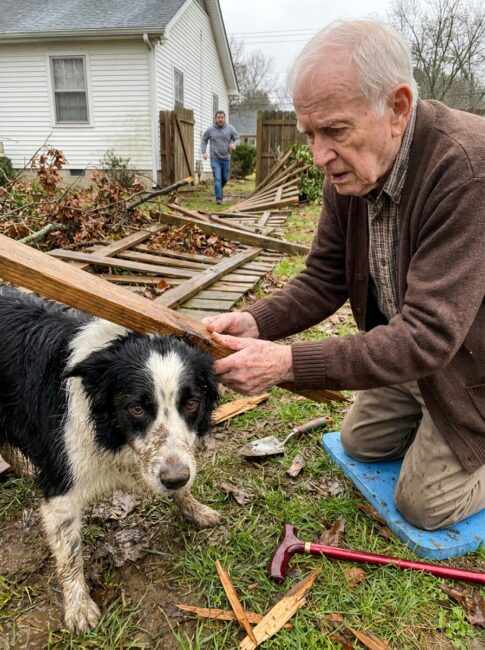
So I stopped trying to be strong.
I decided to be patient instead.
That was something age had left me.
I studied the wreckage the way I used to study broken furniture in my workshop years ago. One rail had fallen across the dog’s ribs. Another board pinned the back half of his body. A vine had wrapped through two pickets like rope. The ground beneath him had softened during the storm, and his own struggling had pushed him slightly lower into the mud. If I lifted the wrong piece first, I might hurt him more.
“Alright,” I said, mostly to myself. “We go slow.”
His eyes moved toward my voice.
There was a collar around his neck, but no tag I could see. His fur was hidden under mud, though I could tell he was not a small dog. Maybe a brown-and-white spaniel mix, maybe something else entirely. His muzzle had silver around it, not young but not old either. A dog in the middle of his life, trapped under a fence in the middle of a ruined yard, waiting for a man near the end of his to hurry up and matter.
That thought stung.
I used the trowel first, scraping wet dirt away from the lower rail. The mud came up in heavy clumps and packed under my fingernails. Rainwater soaked through the knees of my pants. The dog trembled when I worked near his shoulder, so I talked to him the whole time.
“My wife planted those tulips over there,” I told him. “They come up every March, whether I deserve them or not.”
He blinked.
“She used to say I did everything too fast. Drove too fast. Ate too fast. Spoke too fast when I should have listened.”
I sawed through the vine, slowly, because the old hand saw had gone dull. The sound was rough and wet. The dog’s ears twitched.
“She would like you,” I said. “She liked anything that looked half-lost.”
That made my throat tighten.
For a few seconds, I had to stop working and press my muddy hand against the fence to steady myself. Grief is a strange visitor. It does not always enter when you expect it. Sometimes it waits until you are kneeling in the rain beside a trapped dog, and then it pulls up a chair like it owns the place.
The dog gave a soft breath.
Not a whine.
Not a cry.
Just a breath.
It brought me back.
I worked my fingers under the first loose board and lifted just enough to wedge the trowel handle beneath it. Not enough to free him, but enough to take pressure off his shoulder. His eyes widened, then softened. His front paw moved slightly under the mud.
“That’s it,” I whispered. “I see you.”
I did not see all of him yet.
But I saw enough.
The next board was worse. It had splintered where the post broke and left jagged ends angled toward his side. I could not pull it free without shifting the whole section. I needed help. I knew that. But my phone was inside the house, and standing up meant leaving him for several minutes. Maybe that would have been fine. Maybe it would have been wiser. But the dog’s breathing was still too shallow, and every old fear in me said that if I left, I might come back to silence.
So I stayed.
I dug a trench beside his body instead, hoping to make room to slide him out once enough pressure came off. The mud sucked at my fingers. Small roots tangled under the surface. Twice my hand seized with cramps so badly I had to curl it against my chest until the pain passed.
I thought about Margaret then, how she had held my hand during my first heart procedure twelve years earlier and said, “Arthur, you are allowed to need help, but you are not allowed to quit.”
I repeated that out loud.
“You hear that, boy? We are allowed to need help. We are not allowed to quit.”
The dog’s tail was still trapped, but something behind the boards thumped once.
I froze.
Then laughed, a broken wet laugh that surprised me.
“Was that a wag?”
His eyes looked less empty.
I dug faster, though not carelessly. Twenty minutes became thirty. Thirty became forty. My back screamed. My shoulders shook. The old fence gave way in fractions. A rail loosened. A clump of mud slid free. His front leg emerged, muddy, stiff, but whole.
“Good boy,” I said. “Good, good boy.”
At fifty minutes, a neighbor’s voice called from the side yard.
“Mr. Whitaker? You alright?”
It was Daniel Price, a thirty-three-year-old Black American father of two who had moved into the house behind mine the previous summer. I had waved to him many times, spoken to him only a few. That was the sort of neighbor I had become, polite at a distance, present but not involved.
“I need help,” I called.
The words felt heavier than they should have.
Daniel came through the broken side gate and stopped when he saw the dog. “Oh, my God.”
“Careful,” I said. “The fence is on him.”
Daniel dropped to his knees without hesitation. Younger hands. Stronger arms. But he listened when I told him which board to lift, where not to pull, how the rail was angled. Together, we moved the broken fence one piece at a time.
The last board came free with a wet crack.
The dog did not move.
For one terrible moment, I thought we had been too late.
Then his head lifted.
And he crawled forward, inch by inch, until his muddy body rested across Margaret’s blue kneeling pad.
Part 3 – The Dog Who Followed
Daniel wanted to call animal control.
He was right to suggest it. A dog trapped under a fence after a storm might have belonged to someone. He might have been frightened enough to bite. He might have needed emergency care I could not provide. He might have had injuries hidden under all that mud.
But the dog had other ideas.
When Daniel stood and jogged toward his house to get his phone, the dog lifted his head and watched him go. Then he looked at me. His whole body shook. Mud slid off his coat in thick pieces. His back legs trembled when he tried to rise, and for a second I thought he would collapse again.
“Easy,” I said. “You do not have to stand.”
He stood anyway.
Not fully. Not proudly. More like a folding chair trying to remember its shape. But he got all four paws under him, staggered once, and leaned his entire muddy side against my shoulder.
I was still kneeling.
That was the only reason he did not knock me over.
His weight pressed into me, warm under the mud, alive, breathing. I put one arm around his neck and felt his fur clumped with wet dirt. He smelled like rain, fence rot, and fear. His collar was worn brown leather, cracked at the buckle, without a tag. There was no leash, no phone number, no way to tell where the storm had carried him from.
Daniel came back with his phone. “Should I call the shelter?”
“Yes,” I said.
Then the dog took one step toward me as if shelter was not a place he intended to go.
Daniel noticed. “Looks like he found his person.”
“I’m not his person,” I said automatically.
The dog leaned harder against me.
Daniel smiled, but kindly. “Somebody should tell him.”
We did call. The county shelter told us the storm had triggered dozens of animal calls. They asked if he was aggressive. No. Bleeding heavily. No. Able to walk. Barely. They said a field officer could come, but there might be a delay. They advised a vet check if I could transport him safely.
Daniel offered his truck.
I wanted to refuse because old men are foolish about favors. Then I looked at the dog’s shaking legs and said yes.
That was the second hard word of the morning.
Need.
Then yes.
Daniel helped me stand. It took longer than I wanted. My knees had stiffened so badly that straightening them felt like opening rusty hinges. The dog watched every movement, then followed when Daniel and I walked toward the driveway.
He followed slowly.
Past the broken fence.
Past the fallen branches.
Past the garden bed where Margaret’s tulips leaned under rain.
At the back steps, he stopped because the steps were too much. Daniel lifted him carefully into the truck bed on a tarp, and I climbed into the passenger seat with less dignity than I prefer to remember. The dog did not lie down until I reached back and rested my hand on his muddy head.
At Harpeth Valley Animal Clinic, the staff took him in immediately. A veterinarian named Dr. Elaine Porter, a white American woman in her fifties with silver-streaked hair and a no-nonsense kindness, examined him while I sat in the waiting room with mud drying on my shoes and hands.
Daniel stayed.
He did not have to.
That mattered.
After forty minutes, Dr. Porter came out.
“He’s lucky,” she said.
I almost laughed. “He did not look lucky.”
“He is sore, bruised, dehydrated, and exhausted, but nothing appears broken. We’ll do X-rays to be certain. He has pressure bruising from the fence and some cuts from splinters, but you got him out in time.”
Those words moved through me slowly.
In time.
At eighty-five, a man hears that phrase differently. So many things in life are not in time. Apologies. Phone calls. Visits. Chances taken. Love spoken plainly. But this, somehow, had been.
“Does he have a chip?” I asked.
“Not that we found.”
“Collar?”
“No tag.”
She hesitated. “Do you want us to list him as found under your contact?”
I should have said Daniel’s number. He was younger. Faster. Better with phones.
Instead I said, “Mine.”
The dog slept at the clinic that night. They cleaned him, treated the cuts, gave fluids, and sent his description to the shelter. I went home to a house that smelled faintly of mud because I had tracked it everywhere. My clothes were ruined. My back hurt. My knees throbbed so badly I had to take medicine and sit in Margaret’s chair, the one I rarely used because it still felt like hers.
The house was quiet again.
But not the same quiet.
This quiet had a question inside it.
By morning, the vet called and said the dog was awake, eating, and anxious whenever someone left the room.
“Would you like to visit?” Dr. Porter asked.
I said yes before she finished.
When Daniel drove me back, the dog was in a recovery kennel with a clean blanket under him. Without mud, he looked like a black-and-white border collie mix, older than I first thought, maybe seven, with a white chest, black ears, and brown patches above his eyes that made him look permanently concerned.
The moment he heard my cane tap the floor, he stood.
His tail began to move.
Slow at first.
Then faster.
When the kennel door opened, he walked straight past Dr. Porter and pressed his head into my knees.
Daniel cleared his throat.
Dr. Porter smiled.
I put one shaking hand on the dog’s clean head and said the first name that came to me.
“Hello, Henry.”
He wagged harder.
And just like that, a dog pulled from a storm-broken fence began pulling something loose in me too.
Part 4 – The House That Had Forgotten Noise
Henry came home with me four days later as a foster.
That is what the paperwork said.
Temporary foster, pending stray hold and owner search.
It was a sensible phrase, neat enough to fool nobody.
Daniel helped carry the supplies inside, dog bed, food, medication, a leash, bowls, and a pack of absorbent pads I insisted we would not need. Henry walked through my front door carefully, sniffing each room with the seriousness of an inspector. He paused in the living room beside Margaret’s piano, then sneezed at the dust under the bench.
“I know,” I told him. “She would be ashamed of me for that.”
He looked up as if he believed I might fix it.
So I did.
That first evening, after he ate and slept for two hours, I dusted the piano for the first time in months. Not well. My fingers were stiff. The cloth caught on the edges. But I did it because Henry kept sitting beside it like he had discovered a neglected duty.
That was how it started.
Small things.
I moved the shoes away from the hallway so he would not trip. Then I swept the hallway because the shoes had hidden dust. Then I cleaned the kitchen because the shelter volunteer was coming by for a foster check, and I did not want some twenty-eight-year-old with a clipboard thinking I had surrendered to old age. Then I opened the windows because Henry liked smelling the yard.
Within a week, my house had noise again.
The click of nails on hardwood.
The lapping of water.
The groan Henry made when lying down, as if he were an old man too.
The tags on his collar chiming when he followed me from room to room.
At first, I thought he followed because he was anxious. Dr. Porter said that was likely. Being trapped under a fence, abandoned or lost in a storm, then moved to a clinic, then brought into a stranger’s house, all of it would unsettle any dog. But there was something else in it too. Henry watched me the way I had watched him under the fence.
Carefully.
As if I might also get stuck somewhere if left alone.
He learned my routine and improved it without asking permission. I used to stay in bed too long because mornings had no urgency. Henry disagreed. At 6:40 every morning, he placed his chin on the mattress and breathed dramatically into my face until I got up. I used to skip breakfast and call coffee a meal. Henry considered this poor leadership, so I began making toast because he sat beside the toaster expecting crumbs. I used to watch television until the noise blurred into company. Henry preferred walks.
Short walks, at first.
My knees did not allow much. We went to the mailbox and back. Then to Daniel’s driveway. Then halfway down the block. Henry never pulled. He seemed to understand that my steps were slow. He walked beside me with his shoulder near my leg, pausing when I paused, looking back when I stopped to catch my breath.
Neighbors began talking to me because of him.
Mrs. Alvarez from across the street, a seventy-year-old Mexican American widow with bright scarves and a sharper tongue than mine, came over with a bag of homemade biscuits for me and a separate bag of dog treats for Henry. She said, “I have lived across from you six years, Arthur, and this is the first time you look like you are expecting tomorrow.”
I told her she was being dramatic.
She told me I was being old.
Both were true.
The county shelter posted Henry’s photo. No one claimed him. Dr. Porter checked lost-dog pages. Daniel shared his picture online. A woman messaged saying he looked like a dog she had seen near a flooded access road two miles away, but she did not know an owner. Another person thought he might have belonged to a family that moved away months earlier. Nothing certain. No proof. No one came with photos, vet records, or the kind of panic that belongs to someone missing family.
The more days passed, the more Henry relaxed.
He discovered the sunny square in the kitchen.
He decided Margaret’s chair was forbidden to everyone except himself.
He learned that the pantry door squeaked before treats appeared.
But storms troubled him.
The first heavy rain after he came home, Henry crawled under the dining table and shook. His breath came fast. His eyes went far away, back under the fence, back under wood and mud and the sound of wind breaking things. I lowered myself into the chair beside the table and spoke softly for nearly an hour.
“I know,” I said. “I know what it is to have something fall on your life and make you think you won’t get out.”
My wife’s death had been quiet, not violent like a storm. But grief can pin a person just as surely as broken boards. It can leave only the head above the mud, still breathing, not sure why.
Henry crawled out slowly and rested his head on my shoe.
I bent, touched his ear, and understood that maybe neither of us had been fully free until the other came along.
Part 5 – The Hour That Changed the Years
The adoption became official on the thirtieth day.
The shelter worker, Maya Bennett, brought the final paperwork to my house because Daniel told her driving tired me out, which annoyed me until it helped. She sat at my kitchen table with forms spread neatly before her. Henry sat beside my chair, leaning against my leg as if worried someone might read the fine print and change their mind.
“Are you sure?” Maya asked gently.
I looked at Henry.
He looked back.
At eighty-five, people ask if you are sure about many things. Are you sure you should still live alone? Are you sure you can manage the stairs? Are you sure you should drive? Are you sure you need another responsibility?
Some questions are concern.
Some are fear wearing polite shoes.
This one deserved an honest answer.
“No,” I said.
Maya blinked.
“I am not sure I can do everything perfectly,” I continued. “I am not sure my knees will get better. I am not sure what happens two years from now. But I am sure he followed me home after I dug him out of the fence. I am sure my house has been less empty since he entered it. And I am sure I would rather arrange help than send him away.”
Maya smiled then.
“That is a better answer than perfect confidence.”
I signed.
Arthur Whitaker, adopter.
Henry Whitaker, dog.
Daniel came over that evening with his two children, Noah, age seven, and Lily, age five. They brought a blue bandana for Henry that said GOOD BOY in white letters. Henry tolerated the dressing ceremony with noble patience because both children smelled faintly of peanut butter.
Noah asked, “Mr. Arthur, did you really dig for a whole hour?”
“Close to it.”
“Were you scared?”
“Yes.”
“Did your hands hurt?”
“Yes.”
“Why didn’t you stop?”
I looked at Henry, who had rolled onto his back while Lily rubbed his belly.
“Because he was still breathing.”
Noah considered this with solemn respect.
Later, after they left, I sat on the porch with Henry at my feet. The repaired fence stood along the back yard, new posts, stronger rails, Daniel’s handiwork mostly, though I had held tools and offered unsolicited advice. Margaret’s tulips had survived the storm. Their red heads tilted toward the evening light.
I thought about the hour under the fence.
At the time, it had felt like rescue moving too slowly. Every handful of mud had seemed too little. Every board had seemed too heavy. My body had felt like an obstacle. But now, looking back, I understood the hour differently. It had been the first hour in years when I had not been thinking about my own age, my own loneliness, my own losses, my own slow decline.
For one whole hour, I had been needed.
Needed completely.
Needed urgently.
Needed by a living creature whose life depended not on my strength, but on my refusal to stop.
That kind of need can frighten an old man.
It can also wake him.
The weeks after adoption became a series of small awakenings. I called my daughter Rebecca more often because Henry did something funny and I wanted someone to tell. She began calling me first. My son Paul, who lived in Ohio and never knew what to say after his mother died, mailed Henry a ridiculous squeaky squirrel and then stayed on the phone for forty minutes while I described how much Henry hated it. Sophie, my granddaughter, came for a weekend and took photos of Henry in Margaret’s garden. She said, “Grandpa, you look happy.”
I almost corrected her.
Then I did not.
Because I was.
Not every minute. Not in the bright, simple way people imagine happiness. But happiness had returned as something quieter, something that sat beside me while I drank coffee, walked slowly to the mailbox, or listened to rain from inside a safe room.
Henry gave me reasons.
Reasons to get up.
Reasons to open the curtains.
Reasons to walk farther.
Reasons to answer the phone.
Reasons to buy chicken.
Reasons to make it to another spring, then another.
One afternoon, Dr. Porter called to check on him and asked how I was managing.
I said the sentence that later became the heart of the story, though at the time I was only telling the truth.
“It took me an hour to save him,” I said. “But he gave me a reason to live for years.”
There was silence on the other end.
Then Dr. Porter said softly, “Arthur, I think that is what rescue is supposed to do.”
Part 6 – The Storm We Stopped Fearing
A year after the fence collapsed, another storm came through Franklin.
The weather radio warned of high winds. The sky turned the color of old bruises. Rain began tapping the windows before supper. Henry heard the first low roll of thunder and came to stand beside my chair.
He did not hide.
Not yet.
I put one hand on his head.
“We are inside,” I told him. “Fence is strong now.”
He leaned against my leg.
I had prepared more than I wanted to admit. Flashlights on the counter. Phone charged. Bottled water. Shoes by the bed. Henry’s leash hanging on the back door. At eighty-six, I had no interest in pretending storms could not still knock things down. But fear was different now. Less empty. Shared fear, I had learned, becomes easier to carry because someone else’s breathing gives yours a rhythm.
The wind rose after dark.
Branches scraped the roof. Rain slapped the windows. The power flickered once, then held. Henry trembled when thunder cracked close enough to shake the floor. I expected him to crawl under the dining table like before.
Instead, he climbed onto the couch beside me.
This was against the old house rules, which Margaret had enforced for thirty-eight years and Henry had ignored since week two.
He pressed his body along my side, heavy and warm. I rested my hand on his back and felt his heart beating fast. Mine was not much slower.
“We made it once,” I said. “We can make it again.”
He sighed.
Not calm exactly.
But present.
The next morning, the yard was wet and scattered with branches, but the new fence stood. Henry and I walked the perimeter slowly. He sniffed the repaired post where he had been trapped the year before. I watched him carefully, wondering if memory would pull him under.
He lifted his leg and peed on it.
I laughed so hard I had to sit down on the porch steps.
That was when I knew something had changed.
The place where he had almost died had become, in his mind, ordinary enough to insult.
I told Daniel, and he laughed harder than I did. Then he said he wanted to help me build raised beds for Margaret’s tulips so I would not have to kneel as much. Mrs. Alvarez brought coffee. Noah and Lily came over after school to inspect storm damage with Henry as official supervisor. The yard that had once held only wreckage became full of people.
That was Henry’s doing too.
Dogs open doors humans leave closed.
They make neighbors into visitors, visitors into friends, and quiet old men into hosts without anyone formally announcing the change.
By the second year, Henry and I were known on the street. Children waved. Mail carriers carried treats. Daniel’s kids called him “Uncle Henry,” which made no sense and somehow fit. My daughter visited more often, partly to check on me, partly because Henry greeted her like she had returned from war every time she entered the house. Paul came down for Thanksgiving and fixed the loose porch rail without me asking. Sophie made a framed photo of the day Henry’s adoption was final, him in the blue bandana, me trying not to cry.
I placed it on the mantel beside Margaret’s picture.
That felt right.
Not replacement.
Continuation.
There is a difference.
Margaret had been the love of my life. Henry became the reason the life after her still had love moving through it. He did not fill her absence. Nothing could. But he changed the shape of the rooms around it. The chair where I used to sit alone now had a dog bed beside it. The kitchen where I used to eat toast over the sink now had a bowl on the floor and biscuits in a jar. The yard where the fence had fallen now had a bench where Daniel and I sat sometimes while the children threw a ball for Henry.
One rescue became a neighborhood habit.
Every spring, after storm season, Daniel and I checked fences for older neighbors. Noah and Lily made flyers reminding people to look under fallen debris for trapped animals. Mrs. Alvarez organized a small supply box on her porch with spare leashes, towels, gloves, and the shelter number. She called it Henry’s Box, though Henry contributed nothing but fur.
The local paper wrote about it after a reporter heard the story from Dr. Porter. They sent a photographer. Henry wore his blue bandana and behaved beautifully until he tried to eat the reporter’s sandwich. The article called me a hero, which made me uncomfortable.
I was not a hero.
I was an old man who happened to hear a dog at the right time and decided not to stop digging.
That is different.
And maybe better.
Because heroism sounds rare.
Not stopping is something more people can do.
Part 7 – More Years
I am eighty-nine now.
Henry is slower too. His muzzle has gone mostly white, and the brown patches above his eyes make him look like a worried professor. His hips are stiff in cold weather. Mine are worse. We have become two old creatures moving through the house with a symphony of grunts, sighs, clicking nails, and the occasional complaint from my knees.
He still wakes me at 6:40.
Not because he needs to go out urgently.
Because he believes breakfast is the moral foundation of society.
We still walk to the mailbox, though sometimes only that far. On good days, we go past Daniel’s house. Noah is eleven now and nearly as tall as his father. Lily reads books on my porch and insists Henry understands every word. Mrs. Alvarez still brings biscuits, though she says they are for me and winks badly. The fence still stands.
Stronger than before.
So do I, in the ways that matter.
People sometimes ask how long Henry has.
They ask kindly.
I answer kindly too.
“I do not know. None of us are issued that information.”
What I do know is that I have had four more springs with tulips because of him. Four more Christmas mornings with someone tearing wrapping paper. Four more summers of porch shade and slow walks. Four more years of hearing paws in the hallway and remembering that the house is not empty.
Four years is not small at my age.
It is a country.
It is a gift large enough to live inside.
The day I found Henry, I thought I was saving a dog from a fence. That was true. His body was trapped under broken boards, mud, vines, and the careless aftermath of a storm. But I did not understand that I had been trapped too. Not visibly. Not in a way a neighbor could point to and shout for help. I had been pinned under quiet, routine, grief, and the slow belief that my useful years had passed.
Henry heard me before I heard myself.
Or maybe we heard each other.
His need gave my hands purpose. His trust gave my house sound. His following me home gave me a future I had stopped asking for.
Sometimes, when younger people talk about rescue, they imagine it as one dramatic moment. A dog pulled from danger. A door opened. A leash clipped. A before-and-after photograph bright enough to make everyone feel good. I understand that. I like those pictures too. But the truth is deeper and more ordinary.
Rescue is the hour after the first hour.
And the morning after that.
And the medication hidden in cheese.
And the walk taken when your legs ache.
And the call you answer because someone wants to know how the dog is doing.
And the way a lonely house slowly becomes a place where people knock again.
I still keep Margaret’s blue kneeling pad in the shed. It never came clean. Mud stained one corner permanently. I tried once to scrub it, then stopped because some stains deserve to remain. That pad held my knees during the hour I needed to remember I was not finished.
The old broken boards are gone.
Daniel hauled them away after building the new fence. But I kept one small piece, a splintered length of cedar about twelve inches long. It sits on the shelf in my workshop beside Henry’s first collar and a photograph of him asleep in Margaret’s chair. On hard days, I touch that piece of wood and remember the sound it made when it finally lifted.
A wet crack.
A release.
A life coming free.
Henry is asleep at my feet as I write this. Rain is tapping the roof. Not a storm, just rain. He hears it, opens one eye, and looks at me. I place my hand on his head.
“We are alright,” I tell him.
His tail moves once against the rug.
Not weakly like that first day.
Slowly.
Confidently.
Enough.
It took me one hour to save him from beneath a fallen fence.
He has spent years saving me from the kind of loneliness nobody sees from the road.
If this story touched your heart, follow this page for more unforgettable dog stories about rescue, loyalty, healing, and the quiet moments when one small life gives another life a reason to keep going.