Part 2: An Old Pit Bull at Our Shelter Was Returned Seven Times — “Too Old, Too Scary,” Every Family Said. The Night We Lost Him, More Than Forty Families Drove Back to the Shelter, and One of Them Said the Sentence I Will Never Forget.
Part 2
I want to tell you about the seven returns, briefly, because the seven returns are the wound this story heals.
The first family kept Wendell three weeks. They brought him back because, they said, he was “too big for the apartment.” That one I could almost understand.
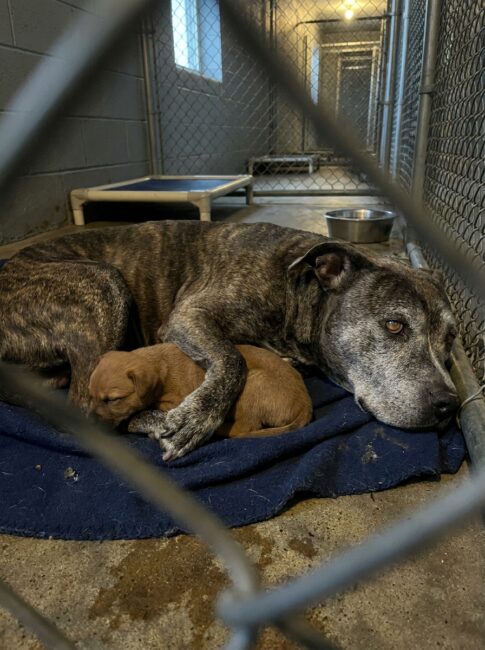
The second family kept him nine days. They said he was “too old” — they had not, apparently, fully absorbed that the eight-year-old dog on the kennel card was eight years old.
The third return was the one that hurt. A family kept him four months — long enough that we had all stopped worrying, long enough that I had taken his card down off the “available” board — and then they brought him back because they were having a baby and they had read something online about the breed, and no amount of conversation, and I tried, would move them.
The fourth family kept him a weekend. The fifth kept him two months and then moved out of state and “couldn’t take him.” The sixth brought him back after eleven days and used the word that I heard, in some version, every single time.
The word was “scary.”
He looks scary. He’s a scary-looking dog. The kids’ friends are scared of him.
Wendell never, in six years and seven homes and twenty-six kennels’ worth of other dogs, showed one second of aggression toward a person or an animal. Not one. We had his whole behavioral history. He was not a scary dog. He was a dog with a scary-looking face, which is a different thing, and which is not his fault, and which the world held against him for six years anyway.
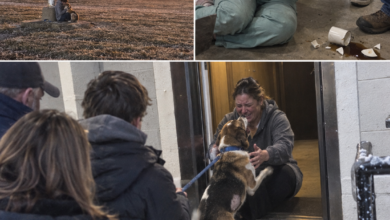
The seventh family kept him five weeks and brought him back in the fall of 2021. The woman cried at the front desk when she did it. She said her husband had “just never gotten comfortable with the way he looks.” She was not a cruel woman. She hugged Wendell before she left. And then she left, and Wendell walked back down the aisle to a kennel, and that was the seventh time, and after the seventh time something in all of us — me, the other staff — quietly shifted.
We stopped, after the seventh return, really trying to adopt Wendell out.
I am not proud of that and I am not going to pretend otherwise. But by the seventh return Wendell was eleven years old, and every adoption and every return was hard on him in a way we could see, and we made a quiet, unspoken, collective decision that Wendell was ours now. That he would live out his life at Salt Fork. That we would stop sending him out to be sent back.
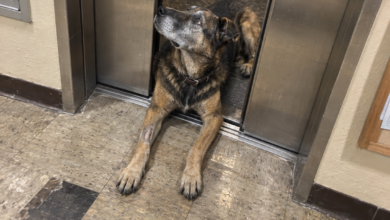
He moved into kennel one, the first kennel inside the door.
And he settled into the life that this story is actually about — the life he had quietly been living all along, in between the seven homes, that none of us had been paying enough attention to.
Part 3
Here is what Wendell did. I am going to tell it plainly, because for six years we watched it happen and did not see it, and I do not want you to be able to miss it the way we did.
A rural county shelter takes in a lot of puppies. People do not spay and neuter the way they should out here, and so we get litters — found in barns, found in ditches, surrendered by the boxful — and a frightened newly-arrived puppy is one of the hardest things in any shelter, because a puppy that has just lost its mother and its littermates and been put in a concrete kennel does not understand what has happened to it, and at night, when the building empties and the lights go off, that puppy cries.
We are not staffed overnight. No small rural shelter is. For fourteen hours a night, our animals are alone in that building together.
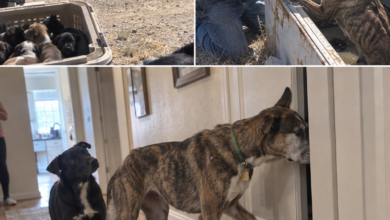
What Wendell did — and we knew he did this; this part was not a secret — was this. On any night that there was a new puppy in the building, Wendell would not settle in his own kennel. He would stand at the front of kennel one and he would whine, low, until whichever staff member was closing up came down to see what he wanted.
And what he wanted, every time, was to be let into the puppy’s kennel.
We learned, over the years, to just do it. Wendell was gentle, the puppies were never in any danger from him, and the alternative was a puppy crying alone all night and Wendell distressed in kennel one all night. So whoever closed up would open the puppy’s kennel and let Wendell walk in, and Wendell would lie down next to the puppy — curl his big brindle body around it, the way the puppy’s own mother would have — and he would stay there until morning.
And the puppy would stop crying.
This part we saw. We saw it for years. We thought it was a sweet quirk. We called Wendell “the babysitter.” Volunteers took pictures. We thought we understood it.
What we did not see — what it took his death to show us — was the scale of it. We saw each night as one night. We never added the nights up.
Wendell did this for six years.
He did it through the seven adoptions, in the gaps between them — and he did it, the staff later confirmed, even during some of the short adoptions, because two of the seven families lived close enough that they had brought him back to “visit,” not knowing that on those visits Wendell would walk straight down the aisle to whatever kennel had the newest puppy in it.
Six years. Every new puppy. Every cold night.
We did the math, afterward. We will never have an exact number. But across six years, going by our own intake logs, the number of frightened puppies who spent their first shelter night curled against the body of an old brindle Pit Bull named Wendell is somewhere well past two hundred.
Two hundred puppies.
Every one of whom went on to be adopted.
By the families who would, in October of last year, come back.
Part 4
Wendell died on a Sunday morning in October of last year.
He was fourteen years old. He had been slowing down for the better part of a year — the vet, Dr. Pruitt, had him on medication for his joints and was watching a heart that had been getting tired. He died the way the kindest version of it goes: in kennel one, in his own bed, in his sleep, sometime in the overnight hours. Our morning kennel tech, a young man named Cole, found him when he opened the building at seven, and Cole sat down on the concrete floor of the aisle outside kennel one and did not get up for a while.
We were all of us a wreck. Nineteen years I have done this work, and Wendell undid me.
We decided, that Sunday, to hold a small memorial. Nothing large. We thought — and I want you to hold onto how small we thought it would be — we thought it would be the five staff, and maybe a dozen of our regular volunteers, the people who had known Wendell across six years. We planned it for the following Saturday afternoon, in the gravel lot, weather permitting. I wrote a short post about it on the shelter’s Facebook page on Sunday night, mostly so our volunteers would see it.
I wrote four sentences. I wrote that Wendell, our longest resident, had passed. I wrote that he had been adopted and returned seven times and that we had been honored to be his home in the end. I wrote that he had spent his life comforting our most frightened puppies. I wrote that there would be a small gathering Saturday for anyone who had loved him.
I did not expect the post to do anything.
The post did something.
By Monday night it had been shared more than four thousand times. And the comments — the comments were the part that began, slowly, to show us what we had not understood.
Because the comments were from families.
We adopted our Daisy from Salt Fork in 2020. We always wondered why she was so calm her first night home. Was it him?
Our Boomer came from Salt Fork as a pup in 2019. There’s a photo in his file of an old Pit Bull lying next to him in the kennel. Is that Wendell?
We have that same photo. We have the photo of the old dog with our puppy.
We have that photo too.
I sat at the shelter’s front desk on Monday night reading those comments, and I started to understand, for the first time in six years, what the photographs in our adoption files actually were.
Part 5
I need to explain the photographs, because the photographs are the twist, and they had been sitting in our own filing cabinets the entire time.
At Salt Fork, when a dog is adopted, we send the family home with a small folder. It has the medical records, the spay or neuter certificate, the microchip paperwork — and, since about 2015, a photo. A volunteer named Sandra started the tradition. She would take a picture of each dog in its kennel before it went home, and tuck a printed copy into the folder, so the family would have a picture of their dog’s “before.”
For six years, a great many of those “before” photos — the ones taken of puppies — had an old brindle Pit Bull in them.
Of course they did. We took the photos in the kennels. The puppies, on the morning of their adoption, were very often curled up asleep next to Wendell, because Wendell had spent the night with them. So Sandra would take the picture, and there would be the puppy, and there, in the frame, would be Wendell — the big gray-muzzled dog lying with one heavy paw resting over the sleeping puppy.
We had handed those photographs to families for six years.
And the families had taken them home, and framed some of them, and stuck others on refrigerators, and they had all of them wondered — idly, the way you wonder a small thing — who the old dog in the picture was. The old dog with their puppy. The old dog with the gray face and the paw over their puppy’s back.
Nobody had ever told them.
Because we had never thought it was a thing that needed telling. We thought it was just Wendell. We thought it was just the babysitter. We had never once stood back far enough to see that the same dog was in two hundred families’ photographs, that the same dog was the reason two hundred puppies had been calm and well and ready to be loved on their first day in a new home.
Wendell had been in those houses the whole time.
On the refrigerators. In the frames. In the “before” pictures. An old Pit Bull that seven families had called too scary to keep was, at that very moment, sitting in a photograph on the wall of forty homes that had no idea they were connected to each other by him.
Until I wrote four sentences on a Facebook page, and the families found each other in the comments, and started, on a Monday night in October, to realize they had all been loved by the same dog.
Part 6
We held the memorial on Saturday.
We had set out a dozen folding chairs in the gravel lot. We had to stop counting cars at around forty.
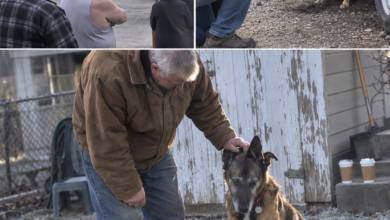
They came from all over Guernsey County and from three counties past it. They came with their dogs — that was the thing none of us was ready for, that was the thing that broke every staff member at Salt Fork in half — they came with the dogs. They brought the grown-up puppies. They brought the Daisies and the Boomers and all the others, the dogs who were five and six years old now, big and healthy and adored, the dogs who had spent their very first frightened night in this world curled against an old brindle Pit Bull, and who had then gone home, and grown up, and been happy.
More than forty families. I counted, later, the photographs people brought — the framed “before” pictures, held up so we could all see — and there were thirty-eight of them, thirty-eight different puppies, thirty-eight different families, and Wendell was in every single frame.
People spoke. We had not planned for people to speak, but people spoke anyway, the way they do.
A woman named Carol, who had adopted a shepherd-mix puppy from us in 2019, stood up near the end. She had her dog with her — a big calm five-year-old now — and she had the framed photo in her hand, the photo from the folder, the puppy and the old gray dog.
She said she wanted to say something, and she got most of the way through it, and then she had to stop, and then she finished it.
She said: “I came here today thinking I was coming to a funeral for a dog I never met.”
She said: “But I have been living with him for five years. He’s on my refrigerator. He’s the reason my Sadie wasn’t scared. I just didn’t know his name until Monday.”
And then she said the sentence. She said the sentence that one of the volunteers wrote down, that ended up on the shelter’s Facebook page, that has been shared, at last count, over a hundred thousand times.
She said: “The dog that nobody wanted turned out to be the reason that so many other dogs got to be wanted.”
Nobody in that gravel lot said anything for a moment.
And then about forty dogs, and forty families, and five shelter staff, and a couple dozen volunteers, all stood together in the cold October sun, next to a small wooden marker, and were quiet, for an old brindle Pit Bull who had been told seven times that he was not good enough to keep.
Part 7
We did something with what we learned.
The Salt Fork Animal Shelter now has a program. We did not invent it. Wendell ran it for six years before any of us thought to give it a name or a structure. We just finally noticed it, and named it, and made sure it would not end when he did.
It is called Wendell’s Watch.
It is simple, and it costs nothing. When a frightened new puppy comes into our building, it is no longer left to cry alone through its first night. We have a roster now — volunteers who have signed up, and there is a waiting list to sign up, which is a sentence I did not expect to ever write — and on a new puppy’s first night, a volunteer comes and sits in the shelter, in the quiet, with that puppy. Not all night, the way Wendell did; we are people, not Wendell. But for the hard early hours.
And we have one older, gentle, calm resident dog at a time who is designated, the way Wendell was, as the one who is allowed to go into the puppy kennels.
The dog who holds that role right now is a nine-year-old hound mix named Gus, who was himself returned to us twice for being “too old,” and who took to the job, the first night we tried him, as though he had been waiting his whole life for someone to ask.
And the adoption folders have changed.
Every puppy that leaves Salt Fork now still goes home with a “before” photo. But now there is a second card in the folder, and the card tells the family who the old dog in the photo’s tradition was. It tells them about Wendell. It tells them that their puppy’s calm first night was a gift, handed down, from a brindle Pit Bull who was returned seven times and who spent his life making sure the frightened ones were not alone.
The families know now.
That is the change. The families finally know whose paw that was.
Part 8
Wendell is buried at the back of the Salt Fork property, under a hawthorn tree, inside the fence line of the exercise yard, where the dogs he spent his life calming can run past him every day.
Cole, our kennel tech, made the marker. It is a flat stone, and it has Wendell’s name, and his years — 2010 to 2024 — and below that, the sentence. Carol’s sentence. We asked her if we could use it and she cried and said yes.
The stone says:
WENDELL. THE DOG NOBODY WANTED. THE REASON SO MANY OTHER DOGS GOT TO BE WANTED.
I have worked at this shelter for nineteen years. I have handed a great many dogs across the front counter to a great many families, and I have learned, slowly, the hard central thing about this work, which is that the world is very fast to decide what a creature is worth based on the first thing it sees.
The world looked at Wendell — at his gray muzzle and his blocky head and his heavy build and his breed — and the world decided, seven separate times, that he was too old and too big and too scary to be loved.
The world was wrong about him seven times.
And he spent every night of being wrongly judged lying in the dark next to whoever was the most frightened, asking nothing, keeping watch.
Forty families came back for him.
They came back because of forty puppies.
There were two hundred.
Good boy, Wendell.
We see it now.
We are sorry it took us so long, and we see it now.
Follow this page for more stories about the ones the world walked past — and was wrong about.