Part 2: An Old Veteran With PTSD Sat Facing the Shelter Wall Beside a Broken Rescue Dog, Then One Quiet Hour Changed Both Their Lives Forever
Part 2 – The Dog Who Would Not Perform
Denise told me later that most visitors lasted less than five minutes with Milo.
I did not blame them. People come to shelters hoping to be chosen in a way they can feel right away. They want a wagging tail, a bright face, a paw through the gate, a dog who says, “Yes, you, take me home.” There is nothing wrong with that. Hope is hard enough without being asked to sit beside silence. But Milo did not know how to offer the kind of hope people recognized.
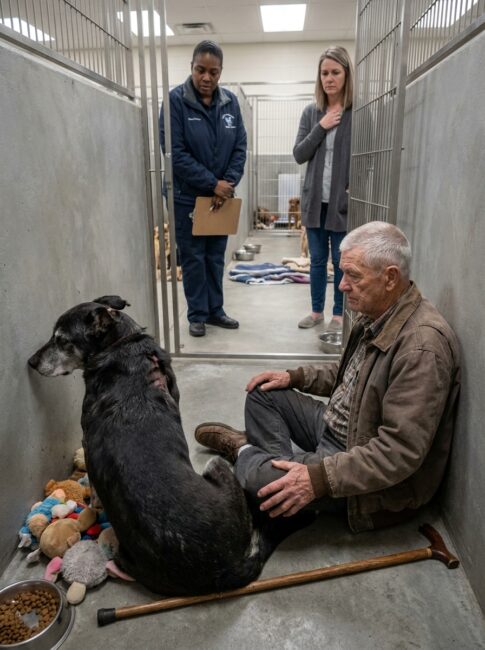
He did not perform.
He did not brighten.
He did not sell himself.
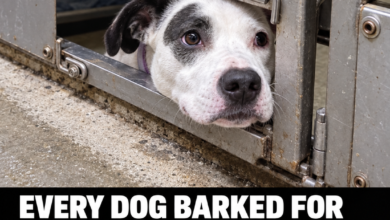
He simply sat with his face toward the wall, as if the world behind him had already proven too much.
When he turned his head toward me that first day, I did not reach for him. That was important. Every instinct in Laura’s face wanted me to move, to make the moment into something visible and easy to understand. Denise knew better. She raised one hand slightly, not to stop me, but to remind the room not to rush what had taken an hour to appear.
Milo looked at my shoes first.
Old brown work shoes, polished out of habit, laces tied tight. Then he looked at my cane lying beside my knee. Then he looked at my hands, resting open on my thighs. His eyes were dark, tired, and careful. Not empty. Never empty. I have learned that stillness is often mistaken for emptiness by people who need movement to believe life remains inside something.
“Hello, Milo,” I said softly.
His ears moved.
That was all.
But it was not nothing.
Denise knelt outside the kennel, her voice barely above a whisper. “That is the first time he has looked at a visitor in weeks.”
Laura wiped under one eye. “Dad, he looked at you.”
“I saw.”
Milo turned back to the wall.
Some people might have felt rejected. I felt relieved. He had done what he could, then stopped. I respected that. A person, or a dog, should be allowed to stop when their courage runs out.
I stayed another ten minutes.
Not because I wanted more from him. Because leaving too quickly after he offered that small turn felt wrong. So I sat beside him and looked at the wall again, letting the quiet stretch long enough to tell him that his glance had not been a mistake I intended to punish with expectation.
When I finally stood, my knee cracked loudly. Milo flinched. I froze.
“Sorry,” I said.
He did not look back.
Denise walked us to the lobby. The shelter smelled of disinfectant, dog food, damp blankets, and old fear. Laura held my arm, not because I needed it, though I did, but because she was trying not to ask too many questions at once.
In the parking lot, she finally said, “What did you think?”
I looked back at the shelter building.
“I think people keep asking that dog to come out of a place they have never sat in.”
Laura’s face changed.
She knew I was not only talking about Milo.
The drive home was quiet. Rain had begun, the soft kind that beads on the windshield and turns headlights into halos. For most people, rain is weather. For me, rain sometimes becomes memory, and memory sometimes becomes a room with no exits. I counted mailboxes. I named colors. I kept my breathing steady.
Laura did not turn on the radio.
That was one of the ways she loved me.
At my house, she helped me carry in groceries, then lingered near the kitchen doorway. The walls were lined with old photographs, my wife Ellen, gone six years, smiling beside a Christmas tree, Laura at twelve holding a softball trophy, my unit photo from 1969 that I rarely looked at directly. On the small table near my chair sat a stack of books I pretended to read and a pill organizer that kept me more honest than pride ever did.
“Are you going back?” Laura asked.
I took off my cap and set it on the counter.
“Yes.”
“Tomorrow?”
“Yes.”
She nodded like she had expected it.
“Dad,” she said carefully, “you know you do not have to save him.”
I looked at the rain moving down the window.
“I know.”
But that was not the whole truth.
The whole truth was this: I did not want to save Milo in the way people use that word when they think love is a hammer and another creature is something broken to fix. I knew too well what it felt like when people came at your pain with tools, plans, cheerful voices, and bright rooms you had not asked for.
I did not want to fix Milo.
I wanted to go back to the wall.
Part 3 – The Veteran Who Knew the Corner
For the next eleven days, I visited Milo every afternoon at two.
Denise arranged it quietly. She did not announce it to the whole shelter. She did not turn it into a project. She simply led me to the last kennel, opened the gate, placed a folded towel on the floor for my bad knee, and left me enough space to be useful by doing almost nothing.
Milo stayed in the back corner.
I sat beside him.
Sometimes facing the wall.
Sometimes sideways.
Never closer than he allowed.
I brought no treats at first. Food can become pressure when fear is stronger than hunger. I brought no toys. Joy can feel suspicious to the exhausted. I brought only myself, my cane, my old jacket, and the same sentence each day.
“Hello, Milo. I came back.”
The first three visits, he did not look at me.
The fourth, his ear turned.
The fifth, he sniffed once toward my sleeve.
The sixth, he shifted his body half an inch away from the wall.
Denise noticed everything but celebrated nothing too loudly. Good shelter workers understand that some victories must be held gently or they disappear.
On the seventh visit, Laura came with me. She stood outside the kennel with a paper cup of coffee, watching her father sit on concrete beside a dog who would not greet him. I could feel her worry like a draft in the room. She had spent years trying to get me to come to family dinners, birthday parties, Fourth of July cookouts, anywhere people gathered and expected me to be normal on command. I had disappointed her more times than I could count.
That day, she watched Milo refuse the world, and I think some part of her forgave me more deeply.
Not all at once.
Forgiveness rarely comes all at once.
But her voice was softer when she said, “He really does remind me of you.”
I smiled without looking back. “Poor dog.”
Milo’s ear moved.
Laura laughed, and the sound startled him, but he did not retreat fully. Instead, he looked at her for one brief second, then at me. It was as if he was asking whether this person belonged to the quiet we were building.
“She is safe,” I told him. “She worries too much, but she is safe.”
Laura pressed her lips together.
The shelter file said Milo had been removed from a property where eight dogs lived chained behind a trailer. Some had fought over food. Some had scars. Milo had not been the loudest, nor the sickest, nor the one people noticed first. He had survived by becoming still. When rescuers came, he did not run to them. He did not growl. He turned toward the back wall of the enclosure and refused to move, as if his mind had gone somewhere his body could not follow.
That detail stayed with me.
I knew something about leaving the body behind.
There were nights when fireworks took me out of Tennessee and dropped me back into a jungle I had not seen in more than fifty years. There were mornings when I found myself standing in the hallway with no memory of getting out of bed. There were family gatherings where one dropped pan could make me grip the table until my knuckles hurt. My body was old. My memories were not.
Some wounds do not obey calendars.
On the ninth visit, I brought a small square of roast chicken wrapped in foil. I placed it between us, closer to me than to him, so he did not have to choose before he was ready. Milo stared at it for twenty minutes. Then he leaned forward, took it, and retreated to the wall.
Denise saw from the hallway and turned away fast.
I pretended not to notice her crying.
On the eleventh visit, Milo did something that changed everything. I lowered myself onto the towel with the usual slow awkwardness, and before I finished settling, he turned his head. Not all the way. Not eagerly. But enough to watch me arrive.
“Hello, Milo,” I said. “I came back.”
He looked at me for a long moment.
Then he placed his chin on the floor, facing sideways instead of the wall.
For Milo, that was almost a welcome.
For me, it felt like a door opening in a house I thought had burned down.
Part 4 – Adoption Papers and Old Fears
When Denise asked if I wanted to consider adopting Milo, I almost said no.
Not because I did not want him.
Because wanting him frightened me.
At seventy-four, a man becomes very aware of what he can and cannot promise. My knee hurt. My hearing had thinned. My sleep was uneven. My hands shook some mornings before coffee. I had lost my wife, lost friends, lost parts of myself in ways that no one could see from the outside. A dog like Milo did not need another unstable thing in his life.
“I am old,” I told Denise.
“So is fear,” she said. “But you both seem to keep showing up.”
That sounded like something a person says when they work around animals long enough to become wiser than they admit.
The adoption process was careful. Denise and the shelter director, Mark Feldman, a fifty-eight-year-old white American man with gray hair, wire-frame glasses, and a voice trained by years of calming worried people, sat with me in a small office. They did not hide the challenges. Milo was shut down. Milo might never enjoy busy places. Milo might fear men, loud noises, raised voices, leashes, doorways, sudden movement, storms, fireworks, visitors, and being touched too quickly. Milo might bond slowly, or not in the way I hoped. Milo might always carry some part of the wall with him.
I appreciated the honesty.
People had often tried to comfort me with promises they could not keep.
“He will get over it.”
“You are home now.”
“That was a long time ago.”
“Try not to think about it.”
As if memory were a drawer I had forgotten to close.
I signed the foster-to-adopt papers because no one promised Milo would become easy. They only asked whether I could offer patience.
Patience, I had.
A quiet house, I had.
A dislike of fireworks, I definitely had.
Laura helped prepare my home. She removed loose cords, bought non-slip rugs, set up a bed in the living room corner, and placed another in my bedroom, though I told her not to overdo it. She overdid it anyway. She bought bowls with rubber bottoms, a soft harness, two leashes, plain chicken treats, calming chews approved by the vet, and a blanket so plush I suspected it cost more than my first car.
“Laura,” I said, looking at the pile.
“What?”
“He is a dog, not a visiting senator.”
“He is a traumatized dog coming to live with my traumatized father. I am buying the blanket.”
There was no arguing with that.
On the day Milo came home, Denise drove him herself. He wore a soft gray harness and moved like every step might become a mistake. He hesitated at my front walk. He sniffed the porch steps. He looked at the door, then at the yard, then at me.
I stood aside.
“Your choice,” I said.
It took twelve minutes for him to enter the house.
Twelve minutes on my porch while Denise held the leash loose and Laura watched from the driveway, chewing her thumbnail like a teenager. Milo placed one paw inside, pulled it back, stepped sideways, sniffed the threshold, then finally walked into the living room.
He went straight to the far corner and faced the wall.
Laura’s face fell.
Denise looked at me with concern.
I took off my cap, hung it by the door, and nodded.
“Well,” I said, “at least he found the place.”
Then I lowered myself to the floor a few feet away and faced the same wall.
Denise stayed another hour to review feeding, medication, decompression, and safety. Laura made tea no one drank. Milo did not move. I did not ask him to. When everyone finally left, the house became quiet in a new way. Not empty. Waiting.
That night, I slept in my recliner because Milo had chosen the living room corner and I did not want him to wake alone in a strange house. Around 2:30 in the morning, thunder rolled somewhere far off. My body reacted before my mind did. I sat upright, heart hammering, breath locked high in my chest.
Milo lifted his head from the corner.
For several seconds, we stared at each other in the dark.
Then he turned back to the wall.
I almost laughed.
Not because it was funny.
Because for once, someone in the room knew exactly what not to say.
Part 5 – The Quiet Rules of Healing
Milo taught me the rules of our house by breaking none of them.
He did not climb on furniture. He did not beg. He did not bark at the mailman. He did not chew shoes, chase squirrels, or steal food from counters. In another dog, people might have called that perfect behavior. In Milo, it was not perfection. It was caution so deep it looked like obedience.
The first week, he ate only after I left the room.
The second week, he ate while I sat at the kitchen table reading the newspaper.
By the third week, he took chicken from my hand, but only if my palm stayed open and low.
He did not like doorways, so I stopped standing in them. He did not like overhead reaching, so I touched his shoulder from the side only after he leaned first. He did not like the television loud, which suited me because I did not either. He did not like fireworks, storms, or the backfiring engine of Mr. Callahan’s old pickup across the street. When those sounds came, Milo went to the living room corner, and I often found myself joining him before I had made the conscious decision.
We became two creatures sitting in the dark, not fixed, not cured, simply not alone.
Laura visited every Sunday. At first, Milo hid behind my chair when she came in. She sat on the couch and ignored him politely, which is harder than it sounds for people who love dogs. By the fifth Sunday, he sniffed her shoe. By the seventh, he accepted chicken from her hand. By the tenth, he placed his chin on her knee for three seconds, then retreated as if embarrassed by his own bravery.
Laura cried in her car afterward.
She thought I did not see.
I saw.
My granddaughter, Emily, was sixteen and gentler than most adults. She came one afternoon with sketchbooks and sat on the living room rug drawing birds. She did not ask to pet Milo. She did not even look at him directly. After an hour, Milo crossed the room and sat near her shoulder.
Emily whispered, “Hi.”
Milo blinked.
That became their greeting.
I began walking him at dawn because the neighborhood was quiet then. At first, Milo’s tail stayed low, and he scanned every porch, mailbox, and parked car. We did not go far. Some mornings, we made it only to the end of the driveway. Some mornings, a trash truck groaned two streets over, and we turned back immediately. I learned not to measure walks in distance.
We measured them in return.
Did he come back calmer than he left?
Did he sniff one tree?
Did he look at me when startled?
Did he choose to keep going?
Those were our milestones.
Mine were quieter, but they came too. I started sleeping four hours in a row. Then five. My therapist noticed. Laura noticed. I pretended not to notice until she caught me buying a second dog bed for the bedroom.
“He sleeping in there now?” she asked.
“Sometimes.”
“And you?”
“Sometimes.”
She smiled. “That is good, Dad.”
It was good.
Not miraculous.
Not like those stories where a dog arrives and all the old pain becomes music. Real healing is less dramatic and more stubborn. It is taking medicine. It is calling the therapist back. It is sitting on the porch even when the sky is too wide. It is letting your daughter bring soup. It is telling a dog, “That noise is not here to hurt us,” and realizing you are speaking to both of you.
Three months after Milo came home, the shelter posted a photo Denise had taken during one of her follow-up visits. In it, I sat on the living room floor facing the wall, and Milo sat beside me, his shoulder touching mine. The caption did not use the word rescue lightly. It said: Some creatures do not need someone to fix them. They need someone willing to sit in the dark with them.
People shared it thousands of times.
Veterans commented.
Shelter workers commented.
People with anxiety, grief, trauma, and old invisible wounds commented.
One woman wrote, “I have been looking for someone to stop telling me to turn around.”
I read that line three times.
Then I looked at Milo.
He was asleep, facing the room.
Not the wall.
The room.
Part 6 – The Night of Fireworks
The real test came on the Fourth of July.
I had dreaded it for weeks.
In my town, fireworks did not wait politely for evening. They began three days early and continued whenever someone with a folding chair, a cooler, and poor judgment felt patriotic. For a man with combat memories and a dog with fear stitched into his bones, it was not a holiday. It was weather we had to survive.
Laura offered to take us to her basement, which was quieter.
My therapist suggested noise-canceling headphones for me and a covered safe space for Milo.
Denise recommended trazodone prescribed by the vet, a white noise machine, frozen treats, and keeping lights low.
I accepted all help.
That alone was progress.
The old version of me would have said I was fine, then spent the night pacing with my heart trying to punch through my ribs. The old version of Milo would have faced a wall and disappeared into himself. We were still old creatures, but we had learned a few new tricks.
By six in the evening, I had Milo’s bed set up in the hallway, away from windows. I had my headphones ready. I had a weighted blanket across my recliner, a bowl of water nearby, medication taken on time, and Laura on the phone checking in every hour whether I wanted her to or not.
The first boom came at 7:14.
Milo lifted his head.
I felt the sound in my teeth.
“Not here,” I said.
The second boom came closer.
Milo stood and moved toward the wall.
I followed, slowly, not crowding him. He reached the hallway corner and sat with his face toward it. I lowered myself beside him, my back aching, my breath already turning shallow. The house smelled like lavender from the diffuser Laura had bought, chicken broth from Milo’s frozen treat, and old wood warmed by summer heat.
Outside, people cheered.
Inside, Milo trembled.
So did I.
For a while, neither of us helped the other. That is the truth. We were two frightened bodies in a hallway while the sky cracked open. I tried breathing exercises. Lost them. Found them again. Milo pressed his nose to the corner. I pressed my palm to the floor.
Then something shifted.
Milo turned his head.
Not all the way. Just enough to see me.
I was breathing too fast. My hand shook on the floor. My eyes must have been somewhere far away because Milo did what I had done for him at the shelter.
He moved closer and sat beside me.
Facing the wall.
Shoulder to shoulder.
I put one hand on the floor between us, palm open. He lowered his chin onto my wrist.
The next boom came.
We both flinched.
But we stayed.
I do not know how long we sat like that. Time changes shape during panic. Minutes become rooms. Rooms become years. But somewhere around 9:30, when the fireworks were still happening but no longer owning every inch of my body, I realized my breathing had slowed because I was matching Milo’s.
Inhale.
Pause.
Exhale.
His chin stayed on my wrist.
Mine was not the only life in the hallway anymore, and that changed the size of fear.
At 10:05, Laura arrived without calling first. She found us in the hallway, Milo beside me, both of us facing the wall, both of us still there. She started to speak, then stopped.
Sometimes love is knowing when not to interrupt survival.
She sat on the floor behind us and stayed until midnight.
The next morning, I woke in my recliner with Milo sleeping beside it, his head on my slipper. Sunlight came through the curtains. The neighborhood was littered with burned paper, plastic tubes, and the damp smell of celebration after fear. I made coffee. Milo followed me to the kitchen. We went outside together, carefully, stepping over the remains of other people’s noise.
At the mailbox, Mrs. Callahan from across the street waved.
“Hope the fireworks did not bother you too much, Sam.”
I looked down at Milo.
He looked up at me.
“We managed,” I said.
And we had.
Not perfectly.
Not bravely in the way movies understand bravery.
But we had stayed in the same room as the fear and did not leave each other there alone.
That day, I called Denise and told her the foster period could end.
“I want to finalize,” I said.
She was quiet for a second.
Then she said, “I was hoping you would.”
The paperwork was simple. The meaning was not. Milo became Milo Whitaker, though I suspect he had belonged to me, and I to him, long before the forms caught up.
When Denise handed me the adoption certificate, she looked at the dog leaning quietly against my leg.
“You saved him,” she said.
I shook my head.
“No. We sit with each other. That is different.”
Denise smiled.
“Yes,” she said. “It is.”
Part 7 – Facing the Room
Milo is nine now, according to our best guess.
His muzzle has gone almost fully white. His torn ear still gives him a lopsided dignity. The scar across his shoulder is hidden under thicker fur because good food and quiet living can do more than people think. He still does not love crowds. He still faces the wall during heavy storms. He still startles if someone drops a pan or raises a voice too quickly. I still wake some nights with my heart racing for reasons no dream fully explains.
We are not cured.
That is not a sad sentence.
It is an honest one.
Cured was never the promise. Companionship was. Patience was. A house where nobody has to pretend every shadow is gone was. Milo and I have built that house day by day, with old bones, soft routines, medication reminders, vet visits, therapy appointments, dawn walks, and an agreement that if one of us needs the wall, the other will not make a speech about turning around.
But Milo faces the room more often now.
That is how I know healing has been visiting, quietly, without bragging.
He lies in the living room with his body angled toward the window. He watches Laura bring groceries. He lets Emily, now in college, sit beside him and read aloud from textbooks he does not understand but seems to respect. He sleeps through the dishwasher unless a spoon clatters too hard. He takes treats from Denise when she visits and pretends not to remember how worried she once was about him.
He has become famous in a small, gentle way.
Not celebrity famous. Not the kind where people chase him with cameras. The shelter’s post about us still circulates whenever people talk about senior dogs, traumatized rescues, and veterans who need companionship that does not demand explanation. Sometimes I receive letters through the shelter. Denise brings them in a folder labeled Milo Mail, which I pretend to find ridiculous and secretly keep in my desk.
A retired firefighter wrote, “I adopted the dog who hid under the bench because of your story.”
A widow wrote, “I stopped trying to make my grief cheerful.”
A veteran from Arizona wrote, “I sat with my dog facing the garage wall during a storm, and for the first time I did not feel crazy.”
That last letter made me put on my cap and walk outside for a while.
Some stories do not heal only the people inside them.
They give other people permission to stop performing.
Milo and I volunteer now, in our limited way. Once a month, we go to Cedar Hollow Animal Shelter before public hours, when the building is quieter. I do not train dogs. I do not advise adopters. I do not pretend to be an expert. I sit outside the kennels of the dogs who will not come forward, the ones with cards that say fearful, shut down, needs patience, no young children, no loud homes, slow introductions.
Sometimes I read the newspaper aloud.
Sometimes I say nothing.
Milo lies beside me, calm but watchful. He does not approach the frightened dogs directly. He simply exists nearby as proof that a wall is not the end of the story. I have seen dogs glance at him. I have seen one old hound turn around after twenty minutes because Milo sighed in his sleep. I have seen adopters slow down when Denise tells them, “That man and his dog understand quiet.”
One morning, a young couple came in looking for a playful puppy and left considering a seven-year-old dog who hid under a cot. Not because I convinced them. I said almost nothing. They watched Milo lean against my knee. They watched the hidden dog peek out. The woman whispered, “Maybe he just needs time.”
Yes.
Maybe he just needs time.
Maybe we all do.
On the anniversary of Milo’s adoption, Laura brought a cake for humans and a special turkey dinner for Milo. Denise came by after work. Emily video-called from college. We sat in my living room, the same room where Milo had once gone straight to the corner and faced the wall. He now lay in the center of the rug, head on his paws, eyes half closed, accepting the gathering with mild suspicion and considerable dignity.
Laura raised a paper cup of lemonade.
“To Dad and Milo,” she said. “The two most stubborn old men I know.”
“Milo is not old,” I said.
Milo groaned without opening his eyes.
Everyone laughed softly.
The sound did not scare him.
That was another milestone.
Later, after they left, I sat beside him on the floor. My knee complained. My back joined in. Milo lifted his head and looked at me as if to say I should have stayed in the chair.
“You remember that shelter wall?” I asked him.
He blinked.
“I do too.”
I ran my hand along his shoulder, where he allowed touch now, where the scar no longer felt like the first thing about him. Outside, evening settled over the yard. A truck passed. A dog barked somewhere down the street. The world went on being loud in places, unpredictable in others, but inside our small house, the quiet had become safe instead of empty.
Milo stood slowly, stretched, and walked to the corner where he had faced the wall on his first day home.
For a moment, I wondered if something had frightened him.
Then he turned around, came back, and lay down facing me.
Facing the room.
Facing the life that had waited patiently for him to arrive.
I thought of the first day at Cedar Hollow, the kennel card, the cold concrete, the words no response to visitors, the hour of silence, the tiny scrape of nails when he turned his head. People had called him broken because he did not respond in the way they needed. People had called me distant because I did not heal in the way they expected. Maybe both of us had been answering all along, just in a language quieter than most rooms were willing to hear.
Some creatures do not need someone to fix them.
They need someone willing to sit in the dark with them.
Milo taught me that.
Or maybe he reminded me.
Now, when thunder comes, sometimes he still goes to the wall. Sometimes I do too. But more often, he looks for me first, and I look for him, and together we decide whether the wall is needed. That choice is its own kind of freedom.
If we face the wall, we face it together.
If we face the room, we face it together too.
And every morning, when I open my eyes and hear Milo’s slow old tail thump once against the floor, I understand that I did not go to the shelter to rescue a dog nobody wanted.
I went there to meet the one soul in the building who knew that silence is not emptiness, stillness is not surrender, and love does not always enter loudly.
Sometimes love sits down beside you, faces the same wall, and waits until you are ready to turn around.
If this story touched your heart, follow this page for more unforgettable dog stories about rescue, loyalty, healing, and the quiet bonds that help broken hearts feel less alone.