Part 2: A Starving Homeless Man Broke His Last Piece of Bread and Gave the Bigger Half to His Dog — Then Refused Everything Strangers Offered Him.
Part 2
His name was Earl. He was fifty-eight years old.
The dog’s name was Sergeant.
I know these things because I was one of the people in that small crowd on Thursday morning. I work for the outreach group that recognized the shelter. My job, most days, is to convince people to accept help they have every reason not to trust.
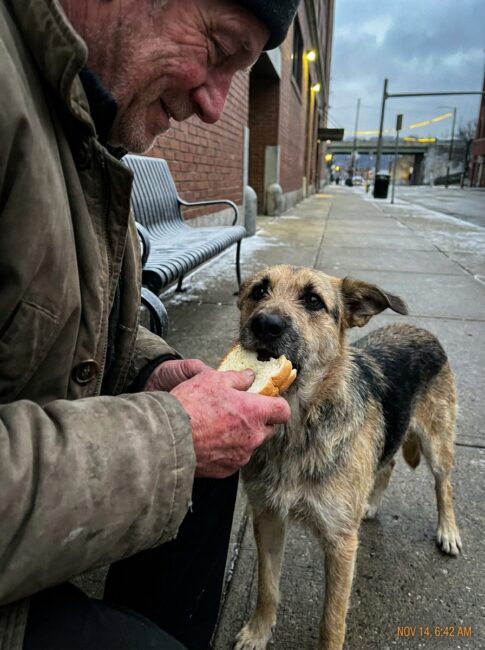
I am good at my job. Earl was the first person in eleven years who completely defeated me.
Let me tell you about Sergeant first, because Earl would want it that way. Sergeant was a shepherd mix, somewhere around six years old, maybe sixty pounds when he was healthy — though that November he was not healthy, and neither was Earl, and that turned out to matter more than any of us understood.
His coat was the brown of a paper bag left out in the rain, with a black saddle across the back and one ear that stood up and one that flopped. There was a notch missing from the flopped ear. He had eyes the color of strong coffee and a way of looking at Earl — checking on him, constantly, a glance every few seconds — that I’d never quite seen in a dog before.
Earl himself was hard to read. Quiet. Watchful. He had the particular stillness of a man who has learned that the wrong word gets you moved along. He had been a long-haul trucker once, he told me later, much later. He’d had a wife. He’d had a house in McKeesport with a garage he was proud of.
He didn’t volunteer how he’d lost all of it. I didn’t ask. That’s not how this works.
Here is the small thing I noticed that first Thursday, the thing I filed away and didn’t understand.
When we laid out the offer — the apartment, the job, the money — Earl didn’t even seem tempted. He listened politely. He nodded. And the whole time, his hand never stopped moving on the dog’s back. Slow. Steady. Like he was the one being comforted.
And when he finally spoke, he didn’t ask about the apartment.
His first question — his only real question — was whether there was a vet anywhere who would look at Sergeant.
I thought it was deflection. A man overwhelmed, latching onto something small.
It would be months before I understood it was the most important thing he’d ever said to anyone.
Part 3
We didn’t give up after that first no. That’s not how this works either.
Over the next two weeks, I came back to the bus shelter on Smithfield Street six times. I brought coffee. I brought a bag of real dog food, the good kind, and the way Earl’s face changed when I handed it over told me more than any conversation could have.
He fed Sergeant first. Every time. Before he touched his own coffee, before anything, he poured out a measure of food for the dog and waited until Sergeant started eating before he’d take a sip.
I started to learn the shape of their days.
They slept behind a loading dock off the Boulevard of the Allies, in a spot Earl had scouted for its wind protection. Earl slept on the outside, between Sergeant and the open lot. When I asked why, he said, “So if something comes, it comes to me first.”
They walked the same loop every morning. Earl knew which restaurants put out food at which times, which church van came on Tuesdays, which security guards would look the other way and which ones wouldn’t.
He had built an entire functioning life out of almost nothing, and the whole architecture of it was organized around one thing: keeping the dog fed, and warm, and safe.
I asked him once how long they’d been together.
“Four years,” he said. He scratched Sergeant’s good ear. “Found him under the same loading dock. Somebody dumped him. He was about this big.” He held his hands a foot apart. “Wouldn’t let anybody near him. Took me three weeks to touch him.”
“Why’d you keep trying?” I asked.
Earl was quiet for a moment.
“Because somebody’d thrown him away,” he said. “And I knew what that felt like.”
I want to tell you about the offers, because they kept coming and he kept refusing, and the longer it went on, the less it made sense to the people watching online.
The apartment offer was real. Furnished. A year paid. He said no.
The job was real. A man named DeShawn, who owned a warehouse in the Strip District, had seen the video and said he’d take Earl on, no questions, full-time. Earl said no.
The eleven thousand dollars sat in an account nobody could give him because he wouldn’t take it.
People online started to get frustrated. Why won’t he just accept the help? You could feel it turning. The same internet that had cried over the bread was starting to mutter that maybe the man was difficult, ungrateful, beyond reach.
They didn’t understand. I’m not sure I fully understood yet either.
But I noticed the thing again — the same thing from the first Thursday. Every time someone offered Earl something for himself, his hand went to the dog. And every time the conversation turned to Sergeant, Earl leaned in.
The vet question kept coming up. He asked it almost every time I saw him. Was there a vet. Could someone look at Sergeant. The dog had started slowing down on their morning loop. Eating less. Earl had noticed before any of us.
So we finally arranged it. A mobile vet clinic that worked with the outreach group agreed to see Sergeant for free.
I drove Earl and Sergeant there myself, on a cold morning in early December.
I thought we were going to get a dog his shots.
I was wrong about what that appointment was.
Part 4
The vet’s name was Dr. Halloran. She was kind and fast and she liked Sergeant immediately, the way good vets like the dogs that lean into them instead of away.
She examined him on a steel table in the back of the clinic van while Earl stood with both hands on the dog’s shoulders, murmuring to him, keeping him calm.
I watched Dr. Halloran’s face change.
She found the mass when she palpated his abdomen. I saw her hands stop. I saw her go still in that way medical people go still when they’ve found the thing they were hoping not to find.
She did an ultrasound. She was very gentle about all of it. And then she stepped back and took off her gloves and asked Earl if she could speak with him.
The tumor was on the spleen. It was large. At Sergeant’s age, with no money for surgery, the prognosis she gave was the prognosis you give when you are trying to be kind and honest at the same time.
Months, maybe. If they were lucky.
Earl didn’t say anything for a long moment. His hands stayed on the dog. Sergeant looked up at him, did that checking glance, the one I’d noticed from the start.
And then Earl asked the only thing he ever asked for himself, which wasn’t for himself at all.
“Can you fix it?” he said. “If there was money. Could it be fixed?”
Dr. Halloran said that with surgery, at a real hospital, there was a real chance. Not a guarantee. But a chance.
Earl nodded slowly.
And then he turned to me, this man who had refused an apartment and a job and eleven thousand dollars, this man who slept on the outside so the cold would reach him first, and he said the sentence that broke the whole thing open.
“That money people raised,” he said. “For me. The eleven thousand.” He swallowed. “Can it go to him instead?”
I told him yes. Of course. It was his.
“Then I don’t need anything else,” Earl said. “Just fix the dog.”
I thought, standing in that van, that I finally understood him. A man who loved his dog more than himself. A sad, simple, beautiful thing.
I had it almost completely backwards.
Part 5
It was DeShawn — the warehouse owner — who figured it out before I did.
He’d come along to the surgery consultation a week later, because by then a lot of us were involved, and he sat across from Earl in the hospital waiting room while Sergeant was being prepped, and he asked Earl a blunt question that none of the rest of us had the nerve to ask.
He asked Earl why he’d say yes to everything for the dog and no to everything for himself.
And Earl told him.
He said that four years ago, the winter he found Sergeant under that loading dock, he had not been planning to see the spring.
He said it plainly, without drama, the way you say a thing you’ve made peace with. He had lost the wife and the house and the truck and the version of himself that he could stand to be, and he had decided, that winter, that he was done. He had a plan and a date and a quiet kind of relief about it.
And then there was this dog. Thrown away. Starving. Wouldn’t let anyone near him.
“I figured I’d get him through the winter,” Earl said. “Get him strong enough that somebody else’d want him. Then I’d—” He stopped. “Then I’d do what I was gonna do.”
But the dog needed feeding every morning. So Earl got up every morning.
The dog needed walking. So Earl walked.
The dog needed him to not freeze to death in the night, because if Earl froze, the dog would too. So Earl stayed alive. One more day. And then one more. Every single day, for a reason that had nothing to do with himself.
“He gave me a job,” Earl said. “Keeping him alive. And a man with a job has got to get up in the morning.”
That was the twist none of us saw. We thought we were watching a man sacrifice his last meal for a dog.
We were watching a dog who had spent four years keeping a man alive — one breakfast at a time.
Part 6
I sat in that waiting room and felt every small thing I’d misread turn over in the light.
He slept on the outside, between the dog and the lot. I’d thought it was just love. It was. But it was also the literal arrangement of a man who had made himself the shield because protecting the dog was the thing that kept him here.
He fed the dog before he touched his own coffee, every single time. I’d thought it was selflessness. It was. But it was also a ritual — the morning task, the reason to open his eyes, performed in the exact same order every day because the order was the thing holding him together.
He gave the bigger half. Forty million people thought they were watching a man go hungry for love. And they were. But they didn’t know that the dog eating was the entire point of Earl’s morning — that feeding Sergeant was, quietly, the thing that fed Earl too.
And the offers. The apartment, the job, the money. He’d said no to all of it because none of it was for the dog, and the dog was the only thing he’d organized himself around staying alive for. An apartment doesn’t need you to get up in the morning. A job, back then, felt like something for a version of himself he’d already let go of.
But the dog needed him.
So when DeShawn leaned forward in that waiting room and said the thing that finally landed — “Earl, that dog’s been keeping you going for four years. He’s gonna need you a lot more after this surgery. You can’t take care of a sick dog from a loading dock. You take the apartment, you take the job — for him. So he’s got somewhere warm to heal.”
Earl was quiet for a long time.
And then he said okay.
Not for himself. He made that clear. He would never have done it for himself.
He did it because the dog needed him to.
Part 7
Sergeant came through the surgery.
They got the whole mass. It was the kind that, once it’s out, is just out. Dr. Halloran called it the best possible result, and she said it like she’d been holding her breath.
Earl took the apartment. A one-bedroom in Bloomfield, second floor, with a window that got the afternoon sun. He took the job at DeShawn’s warehouse, started on the loading dock — which he found funny, in a quiet way, given where he and Sergeant had met.
Here’s the small thing he does now. The thing he told me about, almost shyly, a few months in.
Every morning, before he eats anything himself — before coffee, before his own breakfast — Earl pours out Sergeant’s food and waits until the dog starts eating before he takes a single bite of his own.
He’s got a kitchen now. A table. A real bag of food in a real cupboard. He doesn’t have to ration anything anymore.
He still feeds the dog first. Same order. Every morning.
“Don’t see a reason to change it,” he told me. “It worked when I had nothing. No sense fixing it now that I don’t.”
Part 8
I went to see them about a year after the video.
Sergeant’s coat had filled back in, brown as a paper bag, the flopped ear with its little notch. He was healthy. He was old, but he was healthy. He checked on Earl every few seconds, same as always.
I asked Earl how it felt, knowing that millions of people had wanted to save him.
He thought about it for a while.
Then he reached down and put his cracked hand on the dog’s good ear, and he said the thing I drove home thinking about, and have thought about most days since.
“Everybody out there saved me,” he said. “I know that. I’m grateful.”
He scratched the dog’s ear.
“But he saved me first.”
He looked at Sergeant.
“He gave me a reason to be worth saving.”
CTA: Follow this page for more stories about the animals who keep someone alive long before anyone else thinks to try.