The Officer Saw One Paw Above the Frozen Lake—Then the Rope Below Revealed Who the German Shepherd Was Trying to Save
Part 2, The Rope That Went Straight Down
I cut the rope from the German Shepherd’s leg at 6:24 a.m. The outer fibers separated easily, but the inner strands had frozen into a hard green cable. My knife slipped twice because my fingers had begun losing pressure inside the gloves.
The moment the rope parted, Tasha pulled the dog onto the rescue sled. The Shepherd’s body cleared the water, but she twisted so sharply that one rear paw struck me across the mouth.
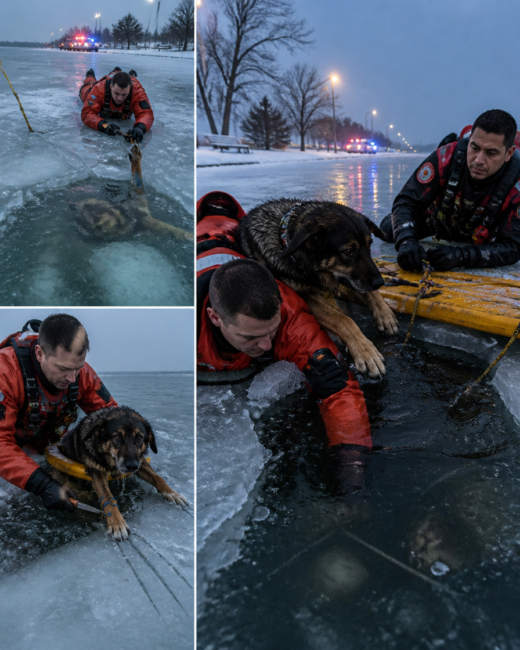
She tried to return to the opening.
“Keep her there,” I told Tasha.
The dog crawled to the front edge of the sled and pushed her nose against my shoulder. Water ran from her coat into the collar of my suit. Her breathing came in short, rough pulls, yet her eyes remained fixed on the rope disappearing beneath the ice.
I clipped a locking carabiner around the loose end.
The line tightened immediately.
Something heavy hung below us.
Fire Rescue reached the shoreline at 6:27. Captain Luis Ortega sent two divers onto the lake with a second sled, thermal blankets and a battery-powered ice saw. We widened the opening to thirty inches, enough for one diver to enter without breaking the entire edge.
Ortega ordered me back to shore.
He was right. My lips had gone numb. My hands shook when I tried to close the buckle on my harness, and the dog had already been pulled clear.
Then metal struck the underside of the ice.
Clang.
The Shepherd raised her head.
Clang.
She crawled off the blankets and struck the surface with her paw.
Three scratches.
Pause.
Two scratches.
Ortega looked at me. “What is she doing?”
“Marking.”
“For what?”
“I don’t know yet.”
That was true, but only partly. I had worked around K9 units long enough to recognize trained behavior. Dogs searching snow sometimes dug or barked when they located human scent. Cadaver dogs offered a different final response. Tracking dogs returned to handlers, sat or held position.
This dog had no handler.
She had no command.
She had freezing water in her lungs and rope burns around her leg, yet she kept indicating the same point.
I passed the loose line to Ortega, removed the frozen outer layer of my gloves and entered the water.
Cold does not arrive as a single feeling. First came pressure around my chest. Then needles beneath my arms. By the time my shoulders went under, the water seemed to disappear because my skin could no longer separate wet from pain.
I followed the rope.
Three feet down, my hand found the top corner of a wire crate. The cage hung vertically with one end lower than the other. Its door had been secured with two plastic cable ties, and a concrete landscaping block had been wired beneath it.
The block had carried everything down.
My flashlight crossed the bars.
A small cream-colored muzzle floated near the top corner.
Then another shape moved behind it.
I surfaced too fast and hit my head against the edge of the hole.
“There are puppies,” I said.
Ortega leaned closer. “How many?”
“At least two.”
The German Shepherd heard the word or caught the change in our voices. She pushed to her feet on the sled. Her rear legs folded, but she rose again before Tasha could touch her.
She moved toward the opening.
“Mother,” Tasha said.
The dog lowered her chest and scratched.
The cage was too heavy to raise by rope alone. The concrete block had settled through a layer of soft sediment, and pulling twisted the crate until its door faced downward. If we forced it, the puppies could be trapped against the bars.
Ortega sent a diver named Sam Liu below me with bolt cutters. I held the rope while Sam followed it to the cage.
He returned after thirty-one seconds.
“The block’s wired in four places,” he said. “I cut one. Visibility’s gone.”
Sediment had risen around the cage, turning the water brown beneath the ice. Our lights reflected against our masks and showed us nothing beyond our own hands.
Sam descended a second time.
The Shepherd scratched twice, stopped and placed her nose over the opening.
“Back,” I told her.
She did not move.
Tasha wrapped both arms around the dog’s chest and pulled her away just as Sam surfaced.
“Two wires left.”
His breathing had changed. Short. Controlled. Close to the point where control becomes something else.
My hands could no longer close around the rope. Ortega told me again to leave the water. I started toward the sled.
Then something struck the cage below us.
Once.
A small sound followed through the water—not a bark, but the vibration of metal moving against teeth or claws.
The mother heard it.
Her ears rose.
She put one paw onto my forearm.
I do not know whether she understood the equipment, the rope or what a diver could do. I know only what she had observed: when my body entered the hole, hands came closer to the cage.
She pressed her paw down.
I looked at Ortega. “One more descent.”
“No.”
“Sam needs someone to hold the crate level.”
“Your hands are done.”
“Then clip me to it.”
Ortega’s jaw moved once. He checked the clock on his wrist and swore beneath his breath.
“Ninety seconds,” he said. “You miss my pull signal, I bring you up.”
Sam and I descended together.
He followed the wire toward the block. I held the top bars and used my forearm to keep the cage from rotating. A puppy’s body pressed against my wrist through the metal.
No movement.
Sam cut the third wire.
The cage shifted upward, then stopped. The last wire had twisted beneath the block where his cutters could not reach it.
My lungs began to tighten.
I pulled my rescue knife, followed the wire beneath the concrete and sawed at it without feeling my fingers. The blade struck metal twice. My chest jerked for air my regulator could provide, but panic had already shortened every breath.
The wire separated.
The crate rose against my face.
Above us, four rescuers pulled the rope. I guided one corner past the broken ice and surfaced beneath the cage door.
Hands seized the bars.
The German Shepherd made her first full sound—a hoarse bark that broke halfway through.
The cage came onto the ice at 6:36.
Inside were two puppies no more than five weeks old.
One was moving.
The other was not.
Part 3, Thirty-Two Compressions on the Ice
Tasha cut the cable ties while Ortega removed the wire wrapped around the concrete block. The crate door opened, but the moving puppy stayed inside, pressed against the other one’s neck.
Both were German Shepherd mixes. Their coats had been clipped close in several places, perhaps for injections or blood draws. One had a white patch beneath her chin. The second was mostly black, with tan marks beginning above the eyes.
Tasha lifted the white-chinned puppy first. Water poured from her mouth. Her legs moved without purpose, and a thin sound caught behind her teeth.
Ortega handed her to a paramedic.
I reached for the black puppy.
His body folded across my gloves.
No breath.
I placed him on the rescue sled, lowered his head and cleared water from his mouth. His gums were pale blue. His chest did not move.
The mother dragged herself across the ice.
Someone tried to stop her. I told them not to.
She lay beside the puppy with her wet belly pressed against his back. Her nose touched his ear while I began compressions with two fingers over the widest part of his chest.
One, two, three, four.
The correct pressure on a body that small feels like too much. Every compression seems capable of breaking what you are trying to save. I kept my fingers straight and watched his chest return after each push.
At thirty compressions, I closed my mouth around his muzzle and gave two small breaths.
Nothing.
Again.
The German Shepherd pushed her nose beneath his neck and lifted his head toward me. Her whole body shook, but she held him in place.
I completed the second cycle.
The puppy remained still.
Tasha looked toward the shoreline. “Ambulance is ready.”
“Not yet.”
I gave two more breaths.
A drop of water appeared at one nostril.
Then the puppy’s body tightened.
His mouth opened.
No sound came out, but his front legs pulled once toward his chest.
“Again,” Ortega said.
I returned to compressions. Twelve pushes later, the puppy coughed water across the heel of my hand and drew a breath no louder than paper tearing.
The mother’s ears moved forward.
He breathed again.
This one reached his chest.
The sound the German Shepherd made was not a bark. It began low, held for a second and broke into a rough whine. She placed her chin over the puppy without putting weight on him.
I sat back on my heels.
My hands no longer shook. They had stopped feeling like hands.
We carried all three animals toward shore on two sleds. The mother tried to keep her head raised, but it dropped each time the sled crossed rough ice. Even then, her nose remained pointed toward the crate.
The puppies rode inside a paramedic’s coat with warmed oxygen flowing beneath the zipper. Their bodies were separated by a folded towel so rescuers could monitor each chest.
The black puppy stopped breathing again eighteen yards from shore.
Paramedic Rina Patel began compressions while walking beside the moving sled. The mother heard the counting and tried to stand.
“Stay with me,” I told her.
Her eyes shifted to my face.
It was the first time she looked away from the puppies.
At Nokomis Veterinary Emergency Center, staff placed the mother in one treatment bay and the puppies in another. She had hypothermia, water aspiration, deep rope abrasions and an older injury in her right hip. X-rays showed two healed ribs and a small piece of metal beneath the skin above her left shoulder.
The puppies’ temperatures were too low for the first thermometers to register accurately.
The white-chinned female began breathing without oxygen at 7:14. The black male remained inside a heated chamber with a nasal tube and an IV catheter no wider than fishing line.
I stood outside the glass wearing hospital scrubs someone had found in a cabinet. My uniform lay in a plastic bag. My wedding ring had been removed from my swollen hand and taped inside my wallet.
Tasha brought coffee.
I held the cup with both palms and watched the mother through the next window. The staff had placed her on warming blankets, but each time the puppies made a sound, she tried to lift her head.
At 8:03, veterinarian Dr. Helen Park carried the black puppy into the mother’s treatment room.
“He’s breathing,” she said. “We don’t know what the cold did yet.”
The mother stretched her neck.
Dr. Park placed the puppy beside her chest. He did not crawl, but his nose moved against the wet fur. She turned her body around him, leaving the IV line untouched between her legs.
The white-chinned puppy joined them six minutes later.
For the first time since the lake, the mother stopped looking toward an exit.
She closed her eyes.
A veterinary technician scanned her for a microchip. The first pass found nothing because the chip had migrated from between her shoulders. On the second pass, the scanner sounded near the piece of metal visible on the X-ray.
The number appeared on the screen.
The technician entered it into the national registry.
Her face changed.
“What?” I asked.
She read the record again, then turned the monitor toward Dr. Park.
The name attached to the chip was not the name of a breeder or a private owner.
It belonged to a search-and-rescue organization in northern Minnesota.
Beside the registration number were four words:
Retired operational ice-search K9.
The mother on the warming table had not scratched the ice randomly.
She had been giving a trained indication.
Part 4, Her Name Had Been Sable
The microchip record listed the dog as Sable, an eight-year-old German Shepherd trained by North Star Search and Rescue. Her former handler was Anne Keller, a fifty-four-year-old paramedic living near Duluth.
Dr. Park called the number at 8:26.
Anne answered on the second ring.
When Dr. Park said the chip number, the woman stopped speaking. We heard only a chair scrape across a floor.
“Scan it again,” she said.
The technician did.
Dr. Park read every digit aloud.
Anne took one breath. “Where is she?”
“Minneapolis.”
“No. Where did you find her?”
Dr. Park looked at me.
I told Anne about the lake, the rope and the cage. I left out the resuscitation until she asked whether the puppies were alive.
“One is stable,” I said. “One is still critical.”
Anne remained silent for nine seconds.
“Sable never had puppies with me,” she said.
She arrived at the clinic shortly after noon wearing a red winter coat over navy paramedic pants. She had driven one hundred and fifty miles through blowing snow and entered the treatment room without removing her boots.
Sable was awake.
Anne stopped twelve feet from the table.
She did not call the dog’s name. She raised one gloved fist beside her shoulder and opened it, palm down.
Sable’s ears lifted.
Anne moved her hand toward the floor.
The dog tried to stand.
Her rear legs failed, but she pulled herself forward across the blankets until the IV line tightened. Anne closed the distance, dropped to both knees and placed her forehead against Sable’s forehead.
“You held,” she said. “You held again.”
Sable pressed her muzzle beneath Anne’s chin.
No one in the room spoke.
Anne later explained what the scratching pattern meant. During searches on frozen lakes, Sable had been trained to locate human scent escaping through cracks or thin ice. When she found the strongest point, she scratched three times, paused to check the scent and scratched twice more.
Three. Pause. Two.
The pattern separated a trained indication from nervous digging. Rescuers following behind her knew where to drill, lower a camera or send a diver.
Sable had performed that final response during eleven operations. She helped locate six living people and five bodies. Her last live search happened on February 2, three winters earlier, when she found a seven-year-old boy inside an air pocket beneath a collapsed section of ice near Leech Lake.
A snowmobile had broken through. The boy’s father reached shore, but his son disappeared under the edge.
Sable tracked scent across the ice, stopped thirty feet from the visible hole and scratched.
Divers entered where she indicated.
They found the child beneath an overturned sled.
The small piece of metal near Sable’s shoulder was not debris from abuse. It was the casing of an old tracking transmitter that had broken during that rescue. Surgeons had removed most of it, but a fragment remained.
The healed ribs came from the same day.
Sable had fallen through a weak section while marking the boy’s location. Anne pulled her out by the harness. The injury never healed well enough for field operations, so Sable retired at seven and went home with her handler.
Six months before we found her, she disappeared from Anne’s fenced yard.
Someone cut the padlock from the side gate during a storm. The security camera lost power at 2:11 a.m. A neighbor saw a dark pickup on the road, but snow covered its license plate.
Anne searched for one hundred and eighty-three days.
She placed notices at veterinary clinics, shelters, feed stores and truck stops from Duluth to the Iowa border. She visited rural properties after people reported hearing dogs in sheds. Twice, strangers demanded reward money for animals that were not Sable.
The dog’s retirement record identified her as spayed.
That entry was wrong.
Sable had undergone emergency surgery after her last ice call, but only one damaged ovary had been removed. Anne knew she could still become pregnant, yet she never bred her and had scheduled a second procedure before the abduction.
Someone else had read the record differently.
They saw a titled working dog with a known bloodline.
They stole her to sell puppies.
When the litter became sick and buyers began asking questions, the breeder decided the dogs had become evidence.
He placed the puppies in a cage.
He tied their mother to it.
Then he lowered all three through a fishing hole.
Sable reached the underside of the ice before the cage pulled her down. One front paw found a pressure crack.
She could have used that paw only to fight for air.
Instead, she returned to the job that had once broken her ribs.
She marked the strongest point above the lives below.
Part 5, The Man Who Sold Dogs Without Names
The investigation moved from an animal-cruelty case to felony theft, fraud and destruction of evidence before Anne left the clinic.
Sable’s microchip did more than identify her. It gave detectives an exact theft date, a medical history and a list of people who had contacted Anne while pretending to know where the dog was.
One name appeared three times.
Clifford Rusk, forty-seven, operated a small equipment-repair business from a rented barn outside Shakopee. He had messaged Anne four days after the theft, claiming he had seen a German Shepherd near Interstate 35.
He requested a photograph from Sable’s left side.
Anne sent one.
Rusk then asked whether the dog had been spayed, whether she carried European working lines and whether her hip injury could be inherited.
Anne stopped answering.
Detectives searched public listings connected to his phone number. Under three different accounts, Rusk had advertised “pure working-line protection pups” without showing the mother’s face. One listing included a photograph of a black-and-tan tail beside a plywood wall.
Anne enlarged the image.
A narrow section of fur had been shaved above the left hip.
Sable had the same patch when we pulled her from the lake.
The green rope offered the second link. It was a type sold in two-hundred-foot spools for marine use. A farm-supply receipt recovered from Rusk’s trash showed that he bought one spool, a wire crate and four concrete landscaping blocks two days before the rescue.
The cage supplied the third.
Its upper bar had been repaired with an unusual brass weld. A former employee identified it as a crate kept behind Rusk’s barn. He had seen Sable inside that crate in November with six puppies.
Six.
We had recovered two.
Detectives found sale messages for three others. Those puppies were seized from buyers in Wisconsin and Iowa, examined and eventually returned under court supervision.
The sixth had died at the barn.
Rusk had wrapped the body in a feed sack and buried it behind a broken tractor. Sable had dug at that section of floor for three nights until he moved her into another pen.
When officers entered the barn on January 19, they found cut microchip scanners, counterfeit vaccination stickers, veterinary sedatives and eighteen empty collars without identification tags.
Names made animals traceable.
Rusk sold numbers.
Sable had been listed as “Female 8A.” Her puppies were “A1” through “A6.”
A calendar on the wall recorded breeding dates and deposits. Beside Sable’s final entry, Rusk had written, “Bad hip. No more value.”
Detectives arrested him at 4:52 that afternoon while he attempted to leave through the rear of the property. His truck contained another coil of green rope and the bolt cutters used on Anne’s gate.
He first claimed Sable had wandered onto his land. Then he said a stranger sold her to him. Finally, he said the lake cage held scrap metal and that someone else must have placed the dogs inside.
His own phone ended those stories.
Location records placed him at Lake Nokomis from 4:38 to 5:11 on the morning we found Sable. A photograph taken at 4:49 showed the wire crate on the ice. The puppies were visible behind the bars.
Sable stood beside it wearing a rope around her hind leg.
She was looking at the camera.
The photograph became Evidence Image Twenty-Seven.
I saw it during a meeting with the county attorney. The dog’s ears were low, but her body leaned toward the cage. One paw rested over the rope, as though she had already begun testing what connected her to the puppies.
The prosecutor asked whether I could testify about the knot and the dog’s behavior.
“Yes.”
“Can you say she knew what was happening?”
“No,” I said. “I can say what she did.”
That mattered.
We could not turn Sable into a human witness. We could not claim she understood a crime, a court or the reason someone had lowered her into freezing water.
We could document the sequence.
She found a crack.
She created an air opening.
She repeated a trained indication above the cage.
She redirected me when I tried to remove her.
She stayed beside the hole until the puppies came up.
Rusk accepted a plea agreement eleven months later after veterinarians, digital analysts, Anne and six first responders submitted evidence. The judge imposed a prison sentence, restitution and a lifetime prohibition on possessing or selling animals.
During sentencing, the prosecutor placed Evidence Image Twenty-Seven beside a photograph from Sable’s final operational search.
In both images, one paw pointed downward.
The first time, she was wearing an orange rescue harness.
The second time, she was tied to the lives she was trying to mark.
Part 6, The Dog Who Returned to the Training Line
Sable stayed at the veterinary hospital for nine days. The puppies remained for seventeen.
The white-chinned female recovered first. Staff called her Ember because she slept closest to the warming vent. The black male became Finn after a technician wrote “fighter in number nine” on his chart and another technician shortened the phrase.
Finn developed pneumonia and needed oxygen for four days. His front paws shook when he stood, but every morning he crawled over the folded towel separating him from his sister.
Sable watched him do it.
When he reached her chest, she washed the top of his head until he slept.
Anne expected Sable to return to Duluth with her. The court, however, held all three dogs as living evidence until ownership could be resolved. Anne could visit, but she could not remove them from Hennepin County.
She came every Thursday.
Sable began recognizing the sound of Anne’s ambulance boots in the hallway. Before the door opened, her ears moved and her body shifted toward the floor.
Anne never asked her to stand.
She sat beside the bed and placed one hand near Sable’s shoulder. The dog chose the final distance.
I visited on Saturdays.
My involvement should have ended after the reports, photographs and medical statements. Instead, I brought plain chicken, washed blankets and a rubber ball Sable ignored for six weeks.
She noticed my winter gloves.
The first time I placed them beside her bed, she pressed her paw over the left glove—the one that had held the cage level underwater. She did not chew it or carry it away.
She kept it beneath her paw until I left.
By March, Sable could walk twelve minutes without her rear leg folding. Dr. Park ruled out returning her to field searches. Her damaged hip, scar tissue and cold-related nerve pain made uneven terrain unsafe.
Anne found another role.
North Star Search and Rescue operated a training site beside an abandoned quarry forty miles north of Minneapolis. New dogs learned search patterns there using buried scent tubes, snow trenches and mock debris.
Sable returned on April 8.
Nobody put a working harness on her. Anne opened the vehicle door and let her choose.
Sable stepped onto the gravel, smelled the air and walked directly toward the equipment shed. Three handlers stood beside the training field with young dogs pulling against their leads.
She ignored them.
Near a patch of artificial snow, a ten-month-old Labrador named Otis searched for a scent tube hidden beneath a plywood platform. He passed the correct location four times. His handler shortened the lead and repeated the command.
Otis became faster and less careful.
Sable stopped outside the training line.
She watched.
Anne unclipped her leash.
Sable walked to the platform, paused over one corner and lowered her nose. Then she stepped back without scratching.
Otis followed her path.
He stopped.
His breathing changed. He checked the corner twice and gave his trained bark.
The handler opened the platform and removed the scent tube.
Sable returned to Anne and lay at her feet.
She could no longer perform the work.
She could still show another dog how to slow down.
The team created a new training role for her. Sable walked practice grids before younger dogs entered. She demonstrated calm searches, scent checks and safe movement near unstable surfaces. She never worked longer than twenty minutes, and she wore a gray support brace over her right hip.
On frozen-water drills, Anne did not allow her onto the lake.
Sable remained behind a portable barrier near shore.
The first time a trainee found the hidden scent source beneath a sheet of practice ice, the young dog barked wildly and pulled toward the hole.
Sable stood.
She scratched the packed snow three times.
Paused.
Then scratched twice.
The trainee stopped pulling and looked at her.
By June, handlers had begun calling it “Sable’s count.” They used the rhythm to teach new teams that finding a scent was not the end. A working dog had to mark one place clearly enough for humans to act.
Ember and Finn attended their first puppy assessment at six months. Both showed strong search drive, low fear around unfamiliar surfaces and an unusual response to metal beneath snow.
They did not receive special treatment because of their mother. Trainers tested them separately and recorded every result.
Ember searched slowly and stayed close to people. Finn moved fast, overshot scent and returned in wide circles. Their working styles were different, but both stopped when Sable gave her five-scratch pattern from outside the field.
Anne looked at me after the second test.
“They’re watching her.”
“So am I.”
The court released Sable and the surviving puppies after sentencing. Anne legally owned Sable, but her apartment had steep stairs, and her paramedic shifts had changed after a back injury.
She asked me to adopt all three.
I did not answer immediately.
Three German Shepherds were not a small decision. Ember and Finn would grow into active working dogs. Sable needed physical therapy, medication and a home without stairs.
I had a fenced yard and an empty first floor.
I also had no plan to hear three dogs breathing in the house where I had lived alone since my divorce.
Anne waited.
Sable crossed the room and placed one paw over my left winter glove.
“I suppose that’s her report,” Anne said.
I signed the papers on July 2.
Part 7, Three Scratches at the Back Door
Sable came home with me at 4:12 on a Tuesday afternoon. She inspected the kitchen, the laundry room and the rug beside my bed, then returned to the glass back door.
She scratched three times.
Paused.
Scratched twice.
I opened it.
Ember and Finn ran past her into the yard. Sable remained on the threshold until both puppies crossed the grass and looked back.
Only then did she step outside.
That became our household ritual. Every morning at 6:17, Sable tapped the back door three times, waited and tapped twice. I opened it, but she never went first.
Ember crossed before her.
Finn crossed second.
Sable followed.
The puppies entered formal search training when they were fourteen months old. Ember qualified for wilderness live-find work. Finn entered an ice-rescue support program, where he learned to locate human scent near snow-covered shorelines and indicate safe access points for divers.
They did not become copies of their mother.
Ember gave one quiet bark at a find.
Finn sat and pressed both front paws into the snow.
Sable watched their training from beside Anne, wearing her gray hip brace and no operational harness. When either puppy rushed, she stood. They slowed without being called.
North Star restored Sable’s original records and added a final entry beneath her eleven missions:
January 12—Lake Nokomis. Two live canine finds under ice while restrained and hypothermic. No assigned handler. Successful indication maintained until recovery.
The team held a small retirement ceremony that fall. No crowd gathered. Six handlers stood beside the training field while Anne clipped Sable’s old brass identification disk to a plain red collar.
The disk had been stored in Anne’s desk since the abduction.
Sable smelled it once.
Then she walked to me.
At home, the three dogs sleep in different places. Finn prefers the cool tile beside the front door. Ember curls beneath the kitchen table. Sable lies in the hallway where she can see both of them.
She still wakes when ice shifts on the lake two blocks away.
Her ears rise.
She listens.
Then she counts the house with her eyes—Finn near the door, Ember beneath the table, me in the chair.
Her head returns to the floor.
Last January, two years after the rescue, we visited Lake Nokomis during a controlled training exercise. Sable stayed on shore behind a safety barrier. Finn worked the frozen edge with a county search team while Ember waited inside the transport vehicle.
Finn found the hidden scent tube thirty-seven yards from shore.
He sat.
Both paws pressed into the snow.
Sable stood beside me.
Three scratches.
A pause.
Two scratches.
Finn looked back at her.
The divers entered where he had marked and lifted the practice mannequin through the ice. The team clapped once, then returned to work.
Sable leaned against my left leg.
The person who threw her into that lake believed she had no value left.
He was wrong before the cage touched the water.
Sable’s final act beneath the ice was not the work of a dog trying to prove she was useful. She did not know about medals, records or retirement ceremonies.
She knew two smaller bodies were below her.
She knew where help needed to enter.
She marked the place.
Then she held it.
That evening, we returned home at 6:17. Sable walked to the back door and tapped three times. I opened it, but she waited.
Ember crossed.
Finn crossed.
Sable looked up at me.
“Your turn,” I said.
She stepped into the snow.
Nothing followed her except us.
Follow this page for more gripping dog stories about rescue, quiet courage, second chances, and the animals who keep choosing to save others.