Doctors Gave the Tiny Black Puppy With the Swollen Head Only Three Weeks to Live, So a 15-Year-Old Girl Asked to Take Him Home and Started Writing Everything Down
Part 2: The Green Notebook
Dana Brandt came running down the hall in her pajamas and stopped in the doorway.
Ellie wasn’t screaming anymore.
She was kneeling beside the laundry basket with her phone in one hand, the flashlight on, and her other hand resting very lightly on Moon’s side. Her lips were moving. Counting.
“Ellie?”
“It’s a seizure,” Ellie said without looking up. Her voice was shaking, but her hands were steady. “I read about it. You don’t hold them down. You don’t put anything in their mouth. You keep them from hitting anything and you time it.” She kept counting under her breath. “Forty-one. Forty-two. Forty-three.”
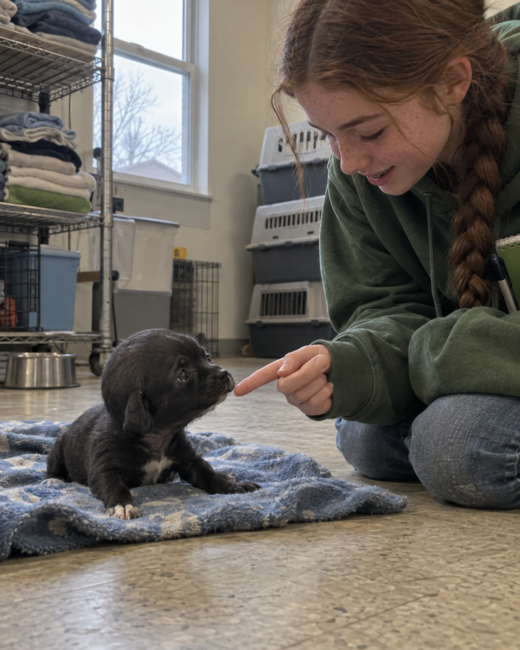
Dana stared at her fifteen-year-old daughter.
“Fifty-eight. Fifty-nine. Sixty.”
At seventy-three seconds, Moon’s legs relaxed. His body went soft. His head sagged sideways onto the blanket. He let out a small, shaky sigh.
Then he opened his eyes.
Ellie leaned over him. “Hey, buddy,” she whispered. “Hey, Moon. I’m here.”
The puppy blinked at her. Slowly, wobbling, he lifted that heavy head a few inches toward her voice.
And licked the tip of her nose.
Ellie burst into tears.
Dana sat down on the floor beside her daughter. Ellie pulled the green spiral notebook out from under her pillow and, still crying, wrote in it by the light of her phone.
Night 1. 2:14 a.m. Seizure. 73 seconds. Stiff legs, head back. Recovered. Licked my nose after. Breathing normal by 2:20.
“Where did you learn all that?” Dana asked quietly.
Ellie wiped her face with her sleeve.
“I’ve been reading,” she said. “Everything. Vet school websites. Articles from veterinary journals. A whole PDF from Cornell about puppies with neurological problems.” She sniffed. “I didn’t want to just sit there and watch him die. I wanted to know what to do.”
That was night one.
Ellie wrote in the notebook every single day after that.
She wrote down every feeding. Every ounce of puppy formula, through a tiny bottle, every three hours. She wrote down how many times he lifted his head. How long he slept. Whether his eyes followed her finger. How many wet diapers. Every seizure, timed to the second.
She learned how to prop his heavy head on a rolled-up washcloth so it wouldn’t pull on his neck while he ate. She learned to keep the house quiet and the lights low, because loud noises and bright lights set off seizures. She learned to tell when one was coming, a certain stillness in his eyes, a twitch in his right front paw, the one with the white tip.
She read to him at night from her English textbook.
Day 12. Only one seizure today. Short. 31 seconds. Ate 2 full bottles. Lifted his head 9 times.
Day 19. He rolled over by himself today!!! Onto his stomach. Mom saw it.
Day 21.
Ellie sat on her bedroom floor and stared at that number for a long time.
Three weeks. The day Dr. Ostrander had said would probably be the end.
Moon was sitting in the laundry basket, propped up against a rolled towel, chewing on the corner of his blanket.
Day 21, Ellie wrote. He’s still here.
Day 30. Moon crawled across the bedroom carpet, dragging his big head, to Ellie’s slippers.
Day 44. He stood up on all four legs for the first time. Wobbled. Fell. Stood up again.
Day 58. He took four steps in a row.
The seizures didn’t stop. But they got shorter. Further apart. His eyes still looked downward. His head was still enormous for his body. But he was eating. Growing. Getting stronger.
He was alive.
On day sixty-two, Ellie carried him into the Hall County Animal Rescue in a little fleece-lined dog bed, with her green notebook under her arm.
Dr. Ostrander looked at the puppy. Then at the girl. Then back at the puppy.
“Ellie,” he said slowly. “What on earth have you been doing?”
She handed him the notebook.
He read it standing in the hallway. Page after page. Every feeding. Every seizure, timed to the second. Every head lift. Every step.
When he got to the end, he took off his glasses and rubbed his eyes.
Then he took new X-rays.
He stood in front of the light box for a very long time.
“His skull’s still full of fluid,” he said finally. “But the pressure hasn’t gotten worse. And his brain’s still developing. That’s not supposed to happen.”
He turned around.
“Ellie,” he said carefully. “There might be something we can try.”
Part 3: Six Thousand Dollars
“It’s called a shunt,” Dr. Ostrander said.
He drew it for her on the back of an intake form. A thin, flexible tube. One end placed inside the fluid-filled space in the brain. The tube running under the skin, behind the ear, down the neck, all the way to the belly. A tiny valve in the middle.
“It drains the extra fluid out of the brain and into the belly, where the body can absorb it,” he said. “Relieves the pressure. They do it in human babies all the time.” He hesitated. “In dogs, it’s rare. Very rare. Only a handful of veterinary neurosurgeons in the country really do it. And it’s risky. The tube can block. It can get infected. And the dog has to be strong enough to survive the surgery.”
“Is Moon strong enough?” Ellie asked.
Dr. Ostrander looked at the puppy, sitting up in his fleece bed, his big round head tilted, chewing on Ellie’s hoodie string.
“I wouldn’t have said so two months ago,” he said. “But now? Maybe.”
“How much does it cost?”
The vet was quiet for a moment.
“I called the university hospital in Kansas,” he said. “With the scans, the surgery, the hospital stay, the follow-up…” He sighed. “About six thousand dollars.”
Ellie stared at him.
Six thousand dollars.
Her mother was a certified nursing assistant at Lakeview Senior Living. She made fifteen dollars an hour. Ellie’s father had been a truck driver. He’d died fourteen months ago, in a crash on Interstate 80 in a snowstorm. There’d been a little life insurance. It had gone to the funeral and the mortgage.
Ellie babysat on weekends. She had two hundred and eleven dollars in a coffee can under her bed.
That night, she sat on her bedroom floor with Moon asleep in her lap and the green notebook open in front of her.
“Mom,” she said, when Dana came in to say goodnight. “Can I put my notebook online?”
Dana sat down on the edge of the bed. “Your notebook?”
“Moon’s journal. Every day. Everything I’ve written down.” Ellie looked up. “Maybe if people saw it, somebody would want to help.”
Dana looked at her daughter for a long moment. At the puppy with the swollen head asleep in her lap.
Ellie hadn’t talked much since her dad died. Not at school. Not at dinner. Her grades had fallen apart last year. Her counselor had called home three times. Then, in the spring, the counselor had suggested volunteering at the animal rescue. Something to get her out of the house.
Dana hadn’t heard her daughter talk this much in fourteen months.
“Okay, baby,” she said quietly. “Go ahead.”
Ellie called the page Moon’s Days.
She posted a photo of the very first page of the green notebook, in her own handwriting. Day 1. The vet says he has 2-3 weeks. I’m taking him home so he doesn’t have to die in a cage.
Then a picture of Moon on day one. Tiny. On a faded blue blanket. Straining to lift his huge head.
Then she started posting every day. A photo of the notebook page. A photo or video of Moon.
Day 63. Walked 11 steps to his food bowl. Didn’t fall once.
Day 64. Short seizure this morning. 22 seconds. Then he ate a whole bowl and fell asleep on my math homework.
Day 65. He barked for the first time!! It sounded like a squeaky toy.
At first, a few dozen people followed. Then a few hundred. Then a local TV station in Grand Island did a story. Then somebody in Texas shared it. Then a big animal rescue page with four million followers.
By day ninety, Moon’s Days had sixty-three thousand followers.
People from all over the country commented every single day. Good morning, Moon! Day 90 and still kicking! This girl is a hero. People sent five dollars. Ten dollars. Twenty. Ellie set up a fundraiser for the surgery.
By day ninety-seven, it had raised two thousand, nine hundred dollars.
Not enough. Not even half.
And Moon’s seizures were starting to come closer together again.
Dr. Ostrander checked him on day ninety-eight. His face was serious.
“The pressure’s starting to climb,” he said quietly. “His head’s growing again. If he’s going to have the surgery, it needs to be soon. Weeks, not months.”
Ellie went home and sat on her bed with Moon in her lap and the laptop open in front of her, staring at the fundraiser.
$2,900 of $6,000.
Then a message popped up in her inbox. From an account she didn’t recognize.
Dr. Richard Haldane, DVM, DACVIM (Neurology). Front Range Veterinary Specialty Hospital, Fort Collins, Colorado.
She opened it.
Dear Ellie,
I’m a veterinary neurosurgeon. I’ve been following Moon’s Days since day 41. My daughter reads it to me every night.
I would like to do Moon’s shunt surgery. At no cost to you.
There’s a reason I’m offering this. It’s personal. Can I call you and your mother tomorrow?
Part 4: Clare
Dr. Richard Haldane called at seven o’clock the next evening.
Ellie and her mother sat at the kitchen table with the phone on speaker between them. Moon was asleep in his fleece bed under the table, his big round head resting on Ellie’s sock.
Dr. Haldane had a deep, slow, careful voice. He told them about the surgery. The risks. Infection. Blockage. Anesthesia in a puppy with a fragile brain.
“I’ll be honest with you both,” he said. “I’ve done eleven shunts in dogs over twenty years. Eight of them did well. Three didn’t.” He paused. “But I’ve read every page of Ellie’s notebook. Every single one. And I’ve never seen a puppy with this level of hydrocephalus survive past six weeks without surgery. That tells me two things. Moon is a fighter. And the care he’s getting is extraordinary.”
Ellie’s face turned bright red.
“Dr. Haldane,” Dana said slowly. “Why are you doing this for free? You said it was personal.”
The line was quiet for a moment.
“Twenty-nine years ago,” Dr. Haldane said, “my wife and I had a baby girl. She was born with hydrocephalus. A severe case. Her head was so swollen the nurses wouldn’t let my wife see her right away.”
Ellie put her hand over her mouth.
“The doctors at the hospital in Denver told us she’d probably live a few weeks,” he said. His voice had gone rough. “They told us to prepare. My wife sat by her incubator every night and wrote everything down in a notebook. Every feeding. Every seizure. Every time she opened her eyes.”
He stopped for a moment.
“When she was six weeks old, a pediatric neurosurgeon named Dr. Elena Ruiz put a shunt in. A tube, behind her ear, down into her belly. Just like the one I’d give Moon.” He took a breath. “And she lived.”
Dana was crying. Ellie was crying.
“Her name is Clare,” Dr. Haldane said. “She’s twenty-nine. She still has the shunt. And two years ago, she graduated from veterinary school.”
Ellie couldn’t speak.
“She’s finishing her residency in neurology,” he said. “At my hospital. In Fort Collins.” His voice broke completely. “Clare’s the one who found Moon’s Days. She read the first page to me at dinner. ‘The vet says he has two to three weeks. I’m taking him home so he doesn’t have to die in a cage.’ And she put down her fork and she said, ‘Dad. Mom wrote a notebook just like that.'”
There was a soft sound on the other end of the line. Another voice. A young woman’s.
“Hi, Ellie,” she said gently. “It’s Clare.”
Ellie wiped her eyes. “Hi.”
“Can we switch to video?” Clare asked.
A moment later, a face appeared on Ellie’s phone. A young woman with short, dark curly hair, in navy blue surgical scrubs, sitting next to a gray-haired man with glasses.
Clare Haldane smiled. Then she turned her head to the side and pulled back her curls.
Behind her right ear, there was a small, smooth bump under the skin. And a thin, faded white scar.
“That’s mine,” she said softly. “I’ve had it my whole life. My mom used to tell me I was her little moon. Because my head was so round when I was born.”
Ellie made a sound that was half a laugh and half a sob.
Then she reached under the table and lifted Moon up to the phone screen.
The puppy blinked at the screen. Then he lifted his big round head, wobbled forward, and licked the glass. Right where Clare’s face was.
Clare started crying.
“Ellie,” she said, wiping her eyes. “I’m going to assist my dad in Moon’s surgery. I’ll be right there the whole time. I promise you I’ll take care of him like he was me.”
Two weeks later, on a cold gray morning in January, Dana and Ellie drove four hundred miles west across Nebraska and into Colorado, with Moon asleep in his fleece bed in Ellie’s lap and the green notebook on the dashboard.
The Front Range Veterinary Specialty Hospital was a big glass building at the edge of Fort Collins, with the Rocky Mountains white with snow behind it.
Dr. Richard Haldane met them in the lobby. He was tall and quiet and gentle. Clare was beside him, in her navy scrubs.
Ellie handed her the puppy.
Clare held Moon against her chest. She touched his round head with her fingertips. Then, very gently, she touched the spot behind his right ear, the same spot where her own scar was.
“Hey, little moon,” she whispered. “We match.”
At 8:15 a.m., they carried him back to surgery.
Ellie sat in the waiting room with her mother and the green notebook in her lap. She opened it to a new page.
Day 117. Fort Collins, Colorado. Surgery day.
She didn’t write anything else.
She just sat there and waited.
Part 5: Day 119
The surgery took three hours and twenty minutes.
When Dr. Haldane came out into the waiting room, he was smiling. Tired, but smiling.
“The shunt’s in,” he said. “Everything went exactly the way we wanted. Clare did the abdominal part herself. Beautiful work.” He sat down next to Ellie. “He’s waking up in recovery now. You can see him in an hour.”
Ellie threw her arms around her mother and sobbed.
That evening, she sat beside Moon’s little kennel in the recovery ward. He was groggy and sore, a shaved patch on the side of his round head, a small bandage behind his right ear, another on his belly. But he was awake.
When he saw Ellie, he lifted his head. Higher than he’d ever lifted it before. Easily.
Ellie wrote in the notebook that night, her hand shaking with happiness.
Day 117. Surgery done. He lifted his head and it didn’t even look heavy!!
Day 118 was good. Moon ate a little. Slept a lot. Clare checked on him every two hours.
On day 119, everything went wrong.
At six in the morning, Moon wouldn’t wake up.
Clare found him in his kennel, limp, his breathing shallow, his body burning with fever. When she lifted his head, his eyes didn’t focus.
She called her father. Then she called Ellie at the motel.
By the time Ellie and Dana got to the hospital, Moon was in the ICU in an oxygen box, an IV in his tiny leg.
Dr. Haldane’s face was gray.
“The shunt’s blocked,” he said quietly. “It happens sometimes. Tissue or protein clogs the tube. The fluid can’t drain.” He swallowed. “And there’s an infection starting. Around the valve.”
“Can you fix it?” Ellie whispered.
“I can go back in. Replace the blocked section. Clean out the infection.” He hesitated. “But he’s very weak, Ellie. He’s barely four months old. His body’s already been through one major surgery. Putting him under anesthesia again, with a fever, with this much pressure on his brain…”
He didn’t finish.
“What are his chances?” Dana asked.
Dr. Haldane looked at the floor.
“Maybe one in three,” he said. “Maybe less.”
Ellie sat down hard on the floor of the ICU hallway.
“And if you don’t operate?”
“The pressure will keep building,” he said gently. “Within a day or two, he’ll have seizures he can’t come out of.”
Nobody said anything.
Clare was standing at the oxygen box with her hand pressed flat against the clear plastic. Moon lay inside on a heated blanket, his round head limp, his chest barely moving.
At eleven that night, Moon had a seizure.
Then another.
The third one didn’t stop.
Ellie watched through the glass while Clare and two technicians worked over him. Clare was pushing medicine into the IV. Counting. Her lips moving.
Ellie found herself counting too. The way she had on the very first night.
Ninety. Ninety-one. Ninety-two.
She’d never seen one go past seventy-three seconds.
One hundred fifty. One hundred fifty-one.
It wouldn’t stop.
Three hundred.
Five minutes.
Dr. Haldane came running down the hallway, pulling on his surgical cap.
Clare looked up through the glass. Her face was white.
Then she came out into the hallway and knelt down on the floor in front of Ellie.
“Ellie,” she said. Her voice was trembling. “The seizure’s finally stopping. But the pressure is so high now. If we operate tonight, he might not survive the anesthesia. If we wait until morning, he might not survive the night.”
She took Ellie’s hands in hers.
“My dad and I can’t decide this for you,” Clare whispered. “He’s yours. You have to choose.”
Ellie Brandt, fifteen years old, sat on the floor of a hospital hallway four hundred miles from home, her green notebook in her lap, and stared through the glass at a puppy who had already lived ninety-eight days longer than anyone said he would.
And she didn’t know what to say.
Part 6: The Last Page
Ellie opened the green notebook.
She flipped back to the very first page. Day 1. The vet says he has 2-3 weeks.
Then she flipped through all of it. Every page. Every seizure, timed to the second. Every bottle. Every head lift. Every step.
Day 21. He’s still here.
Day 44. He stood up.
Day 65. He barked for the first time.
She closed the notebook and looked up at Clare.
“Every time somebody said it was the end,” Ellie said quietly, “he kept going. He was supposed to die in three weeks. He was supposed to never walk.” Her voice shook. “He never once gave up. Not one time.”
She stood up.
“So I’m not going to give up on him either,” she said. “Operate. Tonight.”
Clare squeezed her hands. Then she stood and ran back through the double doors.
The second surgery started at 11:52 p.m.
Ellie and her mother sat in the empty waiting room, under the dim lights, with the Rocky Mountains black outside the windows. Ellie held the green notebook against her chest.
At 1:30 in the morning, she opened it to a blank page. And she started writing.
Not about Moon. About herself.
I never told anybody this. Not even Mom.
After Dad died, I stopped wanting to do anything. I stopped talking at school. I stopped doing homework. I’d come home and lie in bed with the lights off. I didn’t care about anything. Mrs. Okonkwo at school said I should volunteer somewhere. So I picked the animal rescue because nobody there would ask me about Dad.
Then Moon came in. Everybody said he was going to die. Just like everybody said about Dad at the hospital. “We’re so sorry. There’s nothing we can do.”
I couldn’t do anything for Dad. I was at school when it happened. I didn’t even get to say goodbye.
So when they said Moon had three weeks, I thought: this time, I’m going to be there. Every day. I’m going to write everything down so I don’t forget a single minute.
I thought I was taking him home to help him die.
But every day I had to wake up for his 2 a.m. feeding. Every day I had to read about seizures and brains and medicine. Every day I had to get out of bed because he needed me.
He’s the reason I started talking again. He’s the reason I started doing my homework. He’s the reason I want to be a vet.
Everybody on the internet says I saved Moon.
But Moon saved me first.
Dana was reading over her shoulder. When Ellie looked up, her mother’s face was wet.
“Baby,” Dana whispered. “Why didn’t you ever tell me?”
“I didn’t know how,” Ellie said.
Her mother pulled her into her arms and held her.
At 3:18 a.m., the double doors swung open.
Clare Haldane walked out in her surgical scrubs, her cap still on, her mask pulled down around her neck. Her father was right behind her.
She was crying.
Ellie stood up so fast the notebook fell on the floor.
“He made it,” Clare said. “The new shunt’s in. The infection’s cleaned out. The fluid’s draining. He made it, Ellie.”
Ellie collapsed against her mother.
At six in the morning, they let her into the ICU.
Moon was lying on a heated blanket in his oxygen box, a fresh bandage behind his right ear. His eyes were closed. His breathing was slow and steady.
Ellie knelt down beside the box. Clare opened the little door.
Ellie held out one finger.
Moon’s eyes opened.
He looked at her. Then, slowly, he lifted his round head off the blanket. Not shaking. Not straining. Just lifted it, the way any puppy would.
And licked her finger.
Clare knelt down beside Ellie on the floor and put her arm around her shoulders.
“My mom kept her notebook,” Clare said softly. “When I was a baby. I still have it. She wrote on the last page, after my surgery: They said you’d have weeks. You gave me a whole life.”
She looked at the puppy licking Ellie’s finger.
“He gave you one too,” Clare whispered. “Didn’t he?”
Ellie nodded. She couldn’t speak.
Part 7: Moon’s Days
That was five years ago.
Moon is five years old now. He weighs eleven pounds. His head is still a little rounder than most dogs’ heads, and his eyes still tip slightly downward, like he’s always looking at something just below the sky. There’s a small bump behind his right ear where the shunt is.
He hasn’t had a seizure in four years.
He chases tennis balls. He sleeps on Ellie’s pillow. He barks like a squeaky toy at the mailman.
Ellie Brandt is twenty years old. She’s a junior at Colorado State University in Fort Collins, in the pre-veterinary program. She wants to be a veterinary neurologist.
She does her summer internships at the Front Range Veterinary Specialty Hospital. Under Dr. Richard Haldane. And Dr. Clare Haldane.
The green notebook is on a shelf in her dorm room. All three hundred and sixty-five days of it.
Two years ago, a small publisher in Denver turned it into a book. Moon’s Days: A Puppy Who Wasn’t Supposed to Live, and the Girl Who Wrote It All Down. It has the photos. The handwritten pages. The seizures timed to the second.
And the last page. The one Ellie wrote at 1:30 in the morning in the hospital waiting room.
Every dollar from the book goes into the Moon Fund. It pays for surgeries for puppies and kittens born with conditions like his. Hydrocephalus. Heart defects. Cleft palates. Animals everybody says have only weeks.
So far, the Moon Fund has paid for forty-one surgeries.
Last fall, a tiny brown puppy came into the Front Range hospital. Five weeks old. Swollen head. Eyes tilted down. A rescue group in Wyoming had found her alone under a porch.
Ellie was on her internship rotation. She knelt down beside the little blanket on the floor of the exam room and held out one finger.
The puppy strained. Her neck trembled. Slowly, wobbling, she tried to lift her heavy head.
Then Moon trotted across the exam room floor.
He lay down on the blanket beside her, his own round head right next to hers. He sniffed her. Then he leaned over and licked the top of her swollen little head, gently, the way a mother would.
The tiny puppy lifted her head a little higher.
Once, a girl knelt beside a blanket and held out her finger to a puppy who could barely lift his head to reach it.
Now that puppy is the one who leans down first.
Ellie pulled a brand-new notebook out of her backpack. A green spiral one.
She opened it to the first page and wrote:
Day 1.
Doctors gave him three weeks. I was fifteen, and I asked to take him home so he wouldn’t have to die in a cage. He lived past the third week, then the third month. And the surgeon who saved him had a daughter who was born with the exact same disease.
If this story touched your heart, follow our page for more stories that remind us why dogs are the best of us. ❤️