Every Monday, Wednesday and Friday at Dawn, a Scruffy Little Dog Sat Outside the Dialysis Center Window for Four Hours Without Moving, Staring at the Old Man Crying in Chair Nine
Part 2: Pepper
“Pepper,” Clarence whispered. “It’s okay, Pepper. I’m okay.”
Outside the window, the little dog stopped barking.
He stood there with his nose against the glass, panting, his crooked ear twitching. Then, slowly, he sat back down in space four.
Tamika looked at Clarence.
Clarence looked at the ceiling.
“Never seen that dog in your life, huh?” Tamika said quietly.
The old man closed his eyes. He didn’t answer for a long time. When he finally did, his voice was rough.
“Please don’t call animal control on him,” he said. “Please.”
Tamika pulled a stool up beside Chair 9 and sat down.
“Mr. Moody,” she said. “Tell me.”
Clarence turned his wedding ring around his finger.
“I live at Cypress Gardens,” he said. “The senior apartments over on Line Avenue. Government housing. No pets allowed.” He swallowed. “If they find out about him, they’ll put me out. Or take him. I’ve got nowhere else to go.”
“So you hide him.”
“Two years now.” Clarence almost smiled. “He’s quiet. Never barks. Never made a peep in that apartment. Not once.” He looked at the window. “Until today.”
“How does he get here?”
“He walks.” Clarence’s voice cracked. “Three miles. The medical van picks me up at 5:30 in the morning. He follows it. I don’t know how he does it in the dark. Down Line Avenue, across Kings Highway, all the way here.” He shook his head. “I tried locking him in. He scratched the door raw. So I gave up. Now I just leave the window cracked, and he goes. And when the van takes me home, he’s back on my porch before I am.”
Tamika stared at the little dog sitting in the rain.
“He’s not a stray,” she said. “He’s been coming to dialysis with you.”
“Every session,” Clarence whispered. “Two years. Never missed one.”
That afternoon, after her shift, Tamika did something she’d never done in fourteen years of nursing.
She got in her car and followed the medical van.
She drove slowly behind it down Line Avenue in the drizzle, and there he was. A little salt-and-pepper dog trotting along the sidewalk, half a block behind the van. Stopping at every corner. Looking both ways. Crossing. Trotting on.
Three miles.
When the van pulled up in front of a low brick building with a sign that said Cypress Gardens Senior Living, the dog slipped around the side of the building. A minute later, Tamika saw him squeeze through a gap under a ground-floor window that had been propped open with a paperback book.
She sat in her car for a long time.
The next Monday, she came in at 5:45 with a folded beach towel and a plastic bowl.
She set the towel down in space four under the clinic’s little overhang, where the rain didn’t reach. She filled the bowl with water.
At 6:14, the little dog came trotting across the parking lot. He stopped. He sniffed the towel. He looked up at Tamika.
Then he sat down on it, exactly in the middle of space four, and faced the window.
“Good boy, Pepper,” Tamika whispered.
She went back inside. She didn’t tell the clinic manager. She told Clarence.
He was quiet for a long time. Then he reached out and squeezed her hand.
But there was something else Tamika couldn’t stop thinking about.
On the day Clarence’s blood pressure crashed, the alarm on his machine had gone off at 8:42.
She’d checked the security camera footage from the parking lot.
The dog had started barking at 8:41. A full minute before the alarm.
Before any of the nurses had noticed anything. Before the machine itself had noticed.
Pepper had been watching Clarence’s face through the glass the entire time. And he’d seen him start to fade.
Tamika stood at the window that afternoon, staring at the little dog sitting in space four.
Bernice came up and stood beside her.
“You want to know why he sits in that exact spot?” Bernice said quietly. “Space four. Not three. Not five.”
Tamika turned.
“Because that’s Loretta’s spot,” Bernice said.
Part 3: Space Four
“Loretta was his wife,” Bernice said.
They were sitting in the break room. Bernice had a cup of coffee she wasn’t drinking.
“Married fifty-one years. Clarence started dialysis here about five years ago. And for the first three years, Loretta drove him in every session. Monday, Wednesday, Friday. In this big old blue Buick she’d had since the eighties.”
She smiled faintly.
“She’d park in space four. Right under his window. Every single time. If somebody else was in it, she’d circle the lot until they left.” Bernice shook her head. “She said she wanted to be able to see him.”
Tamika looked out the break room door toward the window.
“She’d sit in that Buick for four hours,” Bernice said. “Knitting. Doing crosswords. Listening to gospel radio. And that little dog sat in the passenger seat the whole time with his nose pressed against the car window, watching Clarence through the clinic glass.”
“Pepper,” Tamika said.
“Pepper.” Bernice nodded. “Loretta made him that red bandana out of her old kitchen curtains.”
Tamika’s throat tightened.
“And every session,” Bernice went on, “right around 8:30, about halfway through, Loretta would get out of the car. She’d walk up to the window. And she’d put her hand flat on the glass.” Bernice demonstrated, pressing her palm against the air. “And Clarence would put his hand on the glass on the other side. Right against hers. They’d stay like that for a minute. Then she’d blow him a kiss and go back to the car.”
Tamika put her hand over her mouth.
8:30.
The exact time Clarence started crying behind his newspaper. Every single session.
“What happened to her?” Tamika whispered.
“Stroke,” Bernice said quietly. “Two years ago. In January. She went to bed one night and didn’t wake up.” She turned her coffee cup slowly. “After that, Clarence started taking the medical van. And the first session after her funeral…”
She stopped.
“Pepper was sitting in space four,” Tamika said.
Bernice nodded. Her eyes were wet.
“Sitting right where the Buick used to be. Facing Clarence’s window.” She wiped her eyes. “He’s never missed one since. Not one. Two years.”
Tamika sat very still.
“Does Clarence know? That you know?”
“We’ve never talked about it,” Bernice said. “I don’t think he wants to. I think it hurts too much.” She hesitated. “And Tamika, there’s something else. Something you should know.”
“What?”
“Dr. Broussard told me last week,” Bernice said, her voice dropping. “Clarence asked her about stopping dialysis.”
Tamika felt the floor tilt.
She knew what that meant. Every dialysis nurse does. Patients have the right to stop. It’s a choice some of them make, especially the old ones, the tired ones, the ones who are alone. Without dialysis, the kidneys can’t clean the blood. Within a week or two, they’re gone.
“He’s not sick enough for that,” Tamika said. “He’s stable. He could do this for years.”
“It’s not about his body,” Bernice said softly. “It’s about his heart. He told Dr. Broussard he’s tired of sitting in that chair four hours at a time with nobody to wait for him.”
Tamika found Clarence at the end of his session that afternoon, buttoning his cardigan while the van driver waited.
She sat down next to him.
“Mr. Moody,” she said gently. “Bernice told me about Loretta.”
Clarence stopped buttoning.
“She told me about the window,” Tamika said. “About the hand on the glass.”
Clarence looked down at his gold wedding ring for a long time.
“And she told me what you asked Dr. Broussard.”
The old man didn’t say anything.
Then he looked out the window at the little dog sitting on the beach towel in space four.
“I’ve made up my mind,” he said quietly. “After Christmas. I’m done. I’m not coming back to this chair.”
“Mr. Moody, please…”
“I’m seventy-eight years old, Miss Greene. I’ve lived a good life. I had fifty-one years with the best woman in Louisiana.” His voice trembled. “I’m just so tired of being the only one left.”
Tamika looked out at the window.
“And Pepper?” she whispered. “What happens to him?”
Clarence didn’t answer.
He stood up slowly, took his cane, and walked out to the van.
And out in space four, the little dog stood up, shook the rain off his gingham bandana, and trotted off down Line Avenue after it.
Part 4: The Man with the Broom
At 5:20 the next Wednesday morning, Tamika pulled into the clinic parking lot early.
It was still dark. Cold. A light rain falling.
And someone was already in space four.
It was Leon Hayes. The security guard. In his gray uniform shirt and a rain jacket, kneeling on the wet asphalt.
He was building something.
Tamika got out of her car and walked over quietly.
Leon had dragged a wooden shipping pallet up against the wall under the window, beneath the little overhang. He’d stretched a blue tarp over the top of it and tied it down with twine. Inside, on the dry concrete, he’d put a folded moving blanket and a bowl of dog food.
A little shelter. A tiny house. Right in space four.
Leon looked up and saw her.
He froze, like a kid caught with his hand in the cookie jar.
“Leon,” Tamika said slowly. “What are you doing?”
He stood up, brushing off his knees. He didn’t meet her eyes.
“Weather’s turning cold,” he muttered. “Supposed to drop to thirty-five Friday.”
“You chase that dog with a broom twice a week.”
“Only when Ms. Carter’s watching.” Leon rubbed the back of his neck. “She told me if I didn’t keep that dog away from the building, I’d be out of a job. So when she’s looking out the window, I go out and wave my broom around.” He shrugged his big shoulders. “I never once hit him. I’d never hit him.”
“And when she’s not looking?”
Leon looked at the little pallet house.
“I’ve been feeding him every session for about a year,” he said quietly. “Leave a can of food behind the dumpster on my way in.”
Tamika stared at him. “Why?”
Leon didn’t answer for a long time. The rain pattered on the blue tarp.
“My daddy did dialysis here,” he said finally. “Six years ago. Chair 12. Otis Hayes.”
He looked through the dark window at the empty chairs inside.
“I was working double shifts back then. Security at the casino on the riverfront, nights. Here, days. Saving up for my girl’s college.” His voice dropped. “I never once came and sat with him. Not one session. Two years. I kept telling myself next week. Next month.” He swallowed hard. “He passed in the spring. Right there in Chair 12. By himself.”
Tamika put her hand on his arm.
“When I saw that little dog sitting out here in the rain, staring at that old man through the glass, hour after hour,” Leon said, his voice breaking, “I thought, that dog’s doing what I should’ve done for my daddy.” He wiped his eyes with his sleeve. “I couldn’t sit with my father. But I can make sure this one doesn’t freeze.”
At 6:14, Pepper came trotting across the parking lot in the rain.
He stopped. Sniffed the blue tarp. Looked at Leon.
Then he walked into the little pallet house, turned around once on the moving blanket, and sat down. Facing the window.
Leon laughed, a big, broken, wet laugh.
At 6:30, the medical van pulled up. Clarence Moody climbed out with his cane. He saw the pallet house. He saw Pepper inside it. He saw Leon standing in the rain beside it.
The old man stopped walking.
He squinted at Leon’s face for a long moment through the drizzle.
“Leon?” he said slowly. “Leon Hayes? Otis Hayes’s boy?”
Leon stared at him.
“Mr. Clarence?” he said. “From the barbershop?”
Clarence’s face broke open into the biggest smile Tamika had ever seen on it.
“Moody’s Barbershop, Texas Avenue, forty-two years,” Clarence said. “Your daddy came in every other Saturday since 1979. I gave you your very first haircut, boy. You screamed the whole time. Your daddy had to hold you in his lap.”
Leon Hayes, all six-foot-three of him, put his hand over his face and started to cry.
Clarence walked over and put his thin arms around him.
“Otis was a good man,” Clarence said quietly into his shoulder. “He used to talk about you all the time in that chair. Bragging. ‘My Leon’s working two jobs to put his baby through college.’ He was so proud of you.”
Leon couldn’t speak.
That morning, Tamika moved Clarence permanently to Chair 9 by the window. The manager didn’t notice. Leon took his breaks sitting on an upturned bucket outside beside Pepper’s pallet house, under the overhang, drinking coffee.
And at 8:30, when Clarence’s shoulders began to shake behind his newspaper, Leon stood up outside. And he put his big hand flat against the window glass.
Clarence stared at it.
Slowly, he lifted his own hand, the one without the needles in it, and pressed it against the glass on the other side.
Right against Leon’s.
Pepper sat between Leon’s boots, looking up at both of them, his tail sweeping the wet concrete.
Bernice had to go into the supply closet so the patients wouldn’t see her crying.
For a week, everything was good. Clarence started talking during sessions. Telling stories about the barbershop. He even laughed.
Then on Friday afternoon, when the van dropped Clarence off at Cypress Gardens, the building manager was waiting at his apartment door.
She was holding a white envelope.
Part 5: The Empty Space
NOTICE OF LEASE VIOLATION. Unauthorized animal on premises. Remove the animal within seven (7) days or your lease will be terminated.
A neighbor had seen Pepper squeezing in through the propped window. They’d reported it.
Patrice Dupree, the building manager, wasn’t cruel. She was tired and overworked and had rules from the federal housing office she had to follow. She stood in Clarence’s doorway and said she was sorry.
“Seven days, Mr. Moody,” she said. “I can’t do anything else.”
Clarence called his nephrologist’s office. He called a legal aid number on a flyer. He was on hold for an hour. Nobody called back before the weekend.
He had no family left. His only brother had died years ago. He and Loretta had never had children. He had nowhere else to go.
That night, he sat in his recliner in the dark with Pepper in his lap, stroking the faded gingham bandana.
On Monday morning, Tamika came in at 5:45 and walked to the window.
Space four was empty.
The pallet house was still there. The moving blanket. The bowl.
No Pepper.
At 6:30, the van pulled up, and Clarence came inside slowly on his cane. He looked a hundred years old.
“Where is he?” Tamika whispered.
Clarence sat down in Chair 9 without a word. He held out his arm for Bernice to put in the needles.
“Caddo Parish Animal Services,” he said quietly. “Saturday. I took him myself. On the bus.” He stared straight ahead. “Better than being thrown out on the street together. He’s a good dog. Somebody’ll take him. Somebody young.”
Tamika felt like the floor had dropped away.
“Mr. Moody…”
“And I talked to Dr. Broussard this morning,” Clarence said. “On the phone. I told her I don’t want to wait until after Christmas.”
He turned his wedding ring around his finger.
“Friday,” he said. “Friday’s my last session. Then I’m going home, and I’m not coming back.”
The machine began to hum. His blood began to flow through the clear tubes.
Clarence picked up his newspaper and held it in front of his face.
He didn’t read it. Tamika could see that. He just held it there.
At 8:30, his shoulders began to shake.
But there was nobody outside the window to stand up.
Nobody at the glass.
Space four was empty, the beach towel soaking up the rain.
Outside, Leon Hayes stood under the overhang staring at the empty pallet house, his big hands hanging at his sides.
Bernice came out and stood next to him.
“Two years,” she said quietly. “That dog never missed one session.”
Leon didn’t answer. He just stared at the empty space.
On Wednesday, Clarence didn’t say a word for four hours. He didn’t hold up his newspaper. He just sat with his eyes closed and his hands folded in his lap.
On Thursday, Dr. Helen Broussard came to see him at home. She sat with him for an hour. She explained everything again, gently. What would happen when he stopped. How long it would take. Hospice. Comfort.
Clarence listened. Then he signed the papers.
Patient elects to discontinue dialysis treatment.
His signature was shaky. But it was clear.
On Friday morning, at 5:30, the medical van picked Clarence Moody up at Cypress Gardens for the last time.
It was raining hard. Cold. Thirty-five degrees, just like the forecast had said.
The van drove down Line Avenue in the dark.
There was no little dog trotting half a block behind it.
At 6:30, Clarence walked into the Red River Dialysis Center on his cane, sat down in Chair 9 for his final session, and turned his face away from the window.
He couldn’t bear to look at the empty parking space.
Part 6: The Promise
“Mr. Moody,” Tamika said at 6:15. “Look out the window.”
“I don’t want to.”
“Please,” she said. Her voice was shaking. “Just look.”
Clarence turned his head slowly.
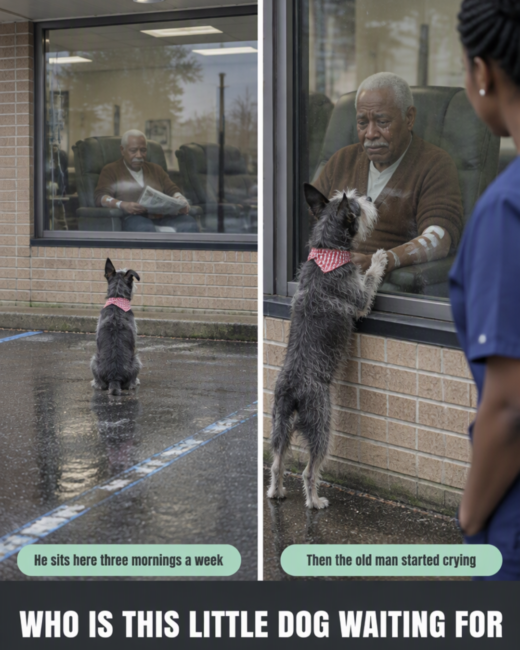
Outside, in the pouring rain, in space four, in front of the little pallet house, sat a scruffy salt-and-pepper dog with a white beard, a crooked ear, and a faded red gingham bandana.
Sitting exactly in the middle of the space.
Facing the window.
Clarence made a sound Tamika had never heard a human being make.
Beside the dog, under the overhang, stood Leon Hayes. Soaking wet. Holding a leash.
“Leon drove to the shelter Saturday afternoon, right after you dropped him off,” Tamika said, tears running down her face. “He adopted him himself. Paid the fee. Pepper’s been sleeping at Leon’s house all week.”
Clarence pressed his hand over his mouth.
“And Dr. Broussard wrote you a letter,” Tamika said. She pulled a folded page from her scrub pocket. “Did you know the Fair Housing Act says even no-pet housing has to make an exception for an emotional support animal, if your doctor writes that you need one?” She held it out. “She wrote it last night. Bernice and I drove it to Ms. Dupree’s office this morning. Ms. Dupree read it and cried. Pepper can come home.”
Clarence couldn’t speak.
Outside, Leon unclipped the leash.
Pepper stood up. He walked to the window. He put his front paws up on the ledge and pressed his whiskery nose flat against the glass, right in front of Chair 9.
And Clarence Moody reached out with his free hand, shaking, and pressed his palm against the glass. Right against the spot where Pepper’s nose was.
The way he used to press it against Loretta’s hand.
He started to cry. Not silently this time. Out loud. Great, heaving sobs that shook his whole body.
Bernice held one of his hands. Tamika held his shoulders. Through the glass, Leon was crying too, in the rain.
When Clarence could finally breathe again, he looked up at Tamika.
“You want to know why I cried every session?” he said, his voice shredded. “Every time? At 8:30?”
Tamika nodded.
“It wasn’t just because I missed her,” Clarence said. “It was because of what she made me promise.”
He looked through the glass at the little dog.
“When Loretta had her stroke, she lived about four hours in the hospital. She couldn’t talk much. But she squeezed my hand, and she said, ‘Clarence. You keep going to that chair. As long as there’s somebody waiting for you outside that window, you keep going.'”
His voice broke.
“And I promised her. And then she died. And I thought, well, that’s it, then. Nobody’s waiting anymore.” He shook his head slowly. “I went to my first session after the funeral planning to tell Dr. Broussard I was done. That day. And I sat down in that chair and looked out the window…”
He pressed his hand harder against the glass.
“And there he was. Sitting in her spot. In the rain. Waiting for me.”
Tamika couldn’t breathe.
“I hadn’t brought him. I hadn’t taught him anything. He just came.” Clarence’s lips trembled. “Every time I sat in that chair, I’d see him out there and think, I promised her. As long as somebody’s waiting. And I’d cry. Because I was so tired. And I didn’t want to keep that promise. And that little dog wouldn’t let me break it.”
He looked at the shaky signature on the papers sitting on the tray table beside him. Patient elects to discontinue dialysis.
“Two years,” Clarence whispered. “Everybody thinks I took care of him. Hid him. Fed him. Kept him.” He laughed through his tears. “That dog walked three miles in the dark, three times a week, for two years, to keep an old man alive.”
He picked up the papers.
And tore them in half.
Then in half again.
“Tell Dr. Broussard I changed my mind,” he said. “Somebody’s waiting.”
Outside the window, Pepper’s crooked ear perked up, and his stubby tail began to wag.
Part 7: Beside Him
Pepper went home to Cypress Gardens that afternoon with a letter from Dr. Broussard and a new tag on his collar that said EMOTIONAL SUPPORT ANIMAL. Patrice Dupree met them at the door and scratched his whiskery chin.
“Welcome home, little man,” she said.
Clarence came back to Chair 9 on Monday. And Wednesday. And Friday.
And in the spring, Tamika came to him with an idea.
“Home dialysis,” she said. “Home hemodialysis. You’d do it in your own living room. In your own recliner. I’d train you and a care partner for six weeks. Then you’d never have to ride that van again.”
“Who’d be my care partner?” Clarence asked. “I don’t have anybody.”
Leon Hayes, standing behind Tamika, cleared his throat.
“Yeah, you do,” he said.
So Leon learned. Six weeks of training. How to set up the machine. How to check the lines. How to watch the blood pressure. He’d come by Cypress Gardens before his shift three mornings a week.
And Clarence cut his hair every other Saturday in the kitchen with a pair of clippers he’d kept from the old barbershop. Same as he’d done for Leon’s daddy.
Bernice visits on Sundays with sweet potato pie.
Tamika comes by every couple of weeks. She says it’s to check on the machine. Everybody knows it’s to check on Clarence.
The first morning Clarence did dialysis at home, he sat in his brown recliner by the living room window at 6:15 a.m., a plaid blanket over his knees, his arm resting on a pillow, the clear tubes running into the humming machine.
Outside, it was gray and raining. Water ran down the glass.
Pepper walked across the living room.
He looked up at Clarence. Then he sat down right beside the recliner, on the carpet, and laid his whiskery white chin on the old man’s knee.
And he didn’t move again for four hours.
Not to drink. Not to sleep. Not to look out the window.
He just sat there, perfectly still, right on time, beside him.
At 8:30, Clarence’s hand came down and rested on Pepper’s head, on the faded red gingham bandana Loretta made from her kitchen curtains.
He didn’t cry anymore.
For two years, a little dog had sat outside in the rain, looking in through the glass at an old man crying alone.
Now he sat inside, beside him, while the rain stayed out where it belonged.
He cried silently every time the machine started. And that little dog learned to sit perfectly still beside him at exactly the same time, three days a week, because somebody had to be waiting.
If this story touched your heart, follow our page for more stories that remind us why dogs are the best of us. ❤️