Every Morning a Scruffy Stray Dog Walked a Little Girl to School and Vanished Without a Trace, While a Stranger in an Old Blue Pickup Watched Them From Across the Street, Until the Day the Dog Refused to Leave
Part 2: The Gift on the Bench
The man’s hands were shaking so hard the paper bag rattled.
He looked from the dog to the little girl behind the gate. Maisie had backed up against the fence, clutching the straps of her purple backpack, her face pale. A stranger was walking toward her, and every grown-up around her had gone quiet and scared.
The man saw her face.
Something in his own face crumpled.
He didn’t step around the dog. He didn’t say a word. Very slowly, he set the little paper bag down on the wooden bench beside the school sign. Then he backed away, one step at a time, turned, and walked quickly back across the street to the blue pickup.
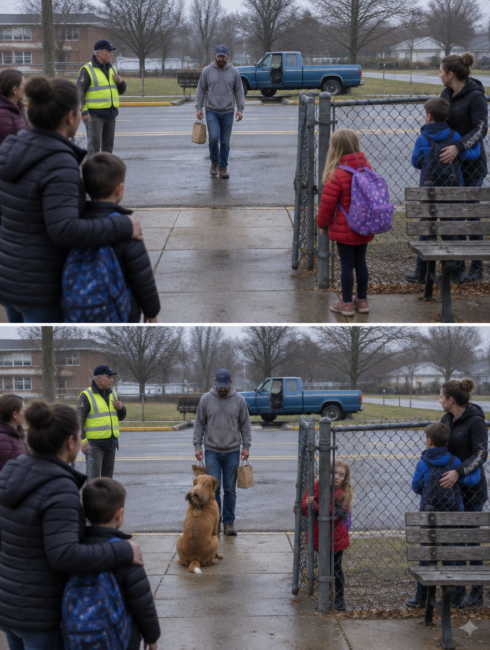
The engine coughed. The truck pulled away from the curb and disappeared down Elm.
Sunny watched it go. Then he stood up, looked back at Maisie one last time, and trotted off around the corner.
Gone. Same as always.
Mr. Earl was already on the radio. Within twenty minutes, a police cruiser was parked outside the school, and Jenna was standing in the principal’s office still wearing her Waffle House apron, her heart slamming against her ribs.
“He just walked right up to her?” she said. “In front of everyone?”
“He didn’t touch her,” Officer Dana Price said calmly. “He didn’t speak to her. He left this.”
She set the paper gift bag on the desk.
Inside, wrapped in white tissue paper, was a small hand-carved wooden dog. Smooth and careful, sanded soft, with a curled tail and floppy ears. And a little card, in plain blocky handwriting.
Happy 7th birthday.
No name.
Jenna stared at the carving. It was the same size as the little wooden dog on Maisie’s backpack. The same shape. The same careful knife strokes.
The color drained from her face.
“Ma’am?” Officer Price asked. “Do you know who might have sent this?”
Jenna hesitated a moment too long.
“No,” she said.
The officer looked at her carefully, then wrote something down. “We’ll run the plates if we can get them. In the meantime, keep her close.”
That afternoon, Jenna left work early and stood outside the school gate at dismissal for the first time all year. Mr. Earl walked over, stop sign tucked under his arm.
“I’ve been thinking about that dog,” he said quietly. “Everybody assumed he was a stray after her snacks. Or a nuisance. But you saw it this morning. That dog put himself right between your girl and that man.”
Jenna nodded slowly.
“He walks on the street side,” Mr. Earl said. “He keeps her away from traffic. And today, when a stranger came at her, he sat down in the man’s path and didn’t move.” He shook his head. “That’s not a stray tagging along. That’s a dog on duty.”
Jenna looked down the street where Sunny always disappeared.
For two months, she had seen a dirty stray following her daughter. She had been afraid of him. She’d told Maisie not to touch him.
And all along, he had been guarding her.
The next morning, Jenna called in late to work. When Sunny appeared on the corner of Maple and Third, she was waiting for him with a strip of bacon in her hand.
He looked at the bacon. He looked at her. Then, cautiously, he took it.
“Thank you,” she whispered. “Thank you for watching her.”
She walked them both to school that day. And when Sunny tried to leave at the gate, Jenna knelt down.
“Hey. Come here, buddy. Let me see that collar.”
To her surprise, he let her. The brass tag was rubbed completely smooth. But there was a small raised bump under the skin between his shoulders.
A microchip.
On her lunch break, she called the vet clinic on Main. That afternoon, Sunny let Jenna lead him in on a borrowed leash. The vet, a kind young woman named Dr. Collins, ran the scanner over his shoulders.
It beeped.
Dr. Collins looked at the screen and smiled. “Oh, good. He’s registered. His real name is Copper.”
Then she read the owner’s name out loud, and Jenna’s coffee cup slipped from her hand and hit the floor.
Part 3: Mamaw’s Dog
“Ruth Ann Turner,” Dr. Collins repeated, looking up from the screen. “Pike Road. Do you know her?”
Jenna sank into one of the plastic chairs in the waiting room.
“She was my daughter’s grandmother,” she said. “She died in August.”
The dog, Copper, came over and laid his chin on Jenna’s knee.
Ruth Turner. Maisie’s Mamaw. The father’s mother. A tough, kind, white-haired farm widow who lived alone on forty acres out on Pike Road, four miles outside town, and who had loved her granddaughter more than anything on this earth.
And Jenna had kept them apart.
Not completely. Christmas. Maisie’s birthday. A few Sunday afternoons a year, always with Jenna sitting stiffly at the kitchen table, watching the clock. Because Ruth was Wade’s mother, and Jenna didn’t want anything connected to Wade anywhere near her daughter.
Jenna remembered Ruth had a dog. A gangly red puppy, the last time she’d visited the farm, years ago. Bouncing around the yard while Maisie, barely three, shrieked with laughter.
She hadn’t paid attention to his eyes.
“Copper,” Jenna whispered. The dog’s tail thumped.
Back at the school that afternoon, she found Mr. Earl and told him.
The old crossing guard went very quiet. Then he took off his cap and turned it in his hands.
“I need to tell you something, Miss Jenna,” he said. “Something I promised not to.”
“What?”
“That blue Ford. The one across the street.” He nodded toward Elm. “Last year, it was Ruth Turner driving it. Every single school morning. She’d park right there, in that same spot, with a red dog in the passenger seat. She’d sit there until your girl went inside, then drive home.”
Jenna stared at him.
“I asked her about it once,” Mr. Earl said. “She said she was watching her granddaughter. Said she didn’t get to see her much, and this was the only way. She asked me not to say anything to you.” He looked down at his shoes. “Said you had your reasons, and she respected them.”
Jenna couldn’t speak.
“Sometimes she’d let that dog out,” Mr. Earl went on, his voice soft. “He’d trot along the sidewalk, real polite, just a few feet behind your girl, until she got to the gate. Then Ruth would whistle and he’d run back to the truck. She’d point at your daughter and tell him, ‘That’s our girl, Copper. You look after our girl.'”
Jenna pressed her hand over her mouth.
Every morning for a year. A grandmother in an old truck, watching from across the street because she wasn’t allowed any closer. And a dog sitting beside her, learning one little girl’s face by heart.
That’s our girl. You look after our girl.
“Then she got sick,” Mr. Earl said. “Stopped coming in the spring. Passed in August. I figured that was the end of it.”
But it wasn’t.
Copper had been left alone at the farm after Ruth died. And two months ago, he had started walking four miles into town every morning, to a corner he knew, to wait for a girl he’d been told to look after.
All on his own.
That night, Jenna sat on the edge of Maisie’s bed and watched her sleep, the little wooden dog keychain clutched in her fist.
Jenna had always assumed Ruth carved it. Ruth had mailed it to Maisie two Christmases ago, in a box with homemade fudge and a card. For my sweet girl. Made with love.
She’d never looked closely.
But one question kept circling in Jenna’s mind, cold and heavy.
If Ruth was gone, who was driving her truck now?
At 9:40 that night, her phone rang. Officer Price.
“Ms. Turner, we got the plates on that blue pickup,” the officer said. “It’s registered to a Ruth Ann Turner. Deceased.” A pause. “Do you have any idea who might be driving your late mother-in-law’s vehicle?”
Jenna closed her eyes.
She knew. Of course she knew. She’d known the moment she saw that carving.
“Ma’am?”
“I think,” Jenna said slowly, “it’s my daughter’s father. Wade Turner.”
Another pause. Keys typing.
“Wade Turner was released from Turney Center Prison in September,” the officer said. “Did you know that?”
Jenna hadn’t.
Part 4: The Man in Mamaw’s Truck
She drove out to Pike Road the next evening while Maisie stayed with the neighbor.
The farmhouse sat at the end of a long gravel drive, white paint peeling, porch light on. The faded blue Ford was parked by the barn, the little string of pink beads still hanging from the mirror.
On the porch steps sat Wade Turner, a carving knife in one hand and a block of pale wood in the other.
Copper was lying at his feet.
When Jenna’s car pulled up, the dog’s head came up. His tail swept the boards. Wade stood slowly, setting the knife down, and pulled off his navy cap.
Five years. He was thinner. The beard was new. But the eyes were the same. Tired and sorry.
“Jenna,” he said.
“You scared her half to death,” Jenna said, her voice shaking. “Walking up to her like that. In front of everyone. Do you know what people are saying? The police came, Wade.”
“I know.” He looked down. “I’m sorry. It was her birthday. I just…” His voice cracked. “I wanted to give her something. One thing. I shouldn’t have. I knew it the second I saw her face.”
“Then why did you stop?”
Wade looked at Copper.
“Because he sat down,” he said quietly. “Mama trained him that way. When she wanted him to wait, she’d say ‘sit, we wait.’ So when he sat down in front of me, I heard her voice. And I saw Maisie’s face, scared of me. A stranger. Her own father.” He wiped his eyes with the back of his wrist. “So I waited. Like Mama would’ve wanted.”
Jenna stood at the bottom of the steps, her arms wrapped around herself.
“Tell me,” she said. “All of it.”
So he did.
Five and a half years ago, Wade had been a sawmill hand with a wrecked back and a prescription for pain pills he couldn’t stop taking. When the prescriptions ran out, he bought them on the street. When the money ran out, he did something stupid. A gas station on the highway. No gun. Just a desperate, high young man shoving a register drawer into a backpack.
Five years.
“I got clean in there,” Wade said. “First time since I was twenty-four. Took every class they had. Got a job in the woodshop.” He nodded at the block of wood beside him. “That’s where I learned to carve.”
Jenna’s breath caught.
“The little dog,” she said. “On Maisie’s backpack.”
“I made it my third year,” Wade said. “Mailed it to Mama. Asked her to give it to Maisie but not to tell her it was from me. I didn’t figure I had the right.” He swallowed. “I carve the initials on the bottom of everything. Habit. W.T.”
Jenna thought of her daughter asleep, clutching that little wooden dog every night.
“Mama passed while I was still inside,” Wade said, his voice going rough. “They wouldn’t let me out for the funeral. The chaplain held up his phone so I could watch. I sat on a concrete floor and watched them bury my mother through a three-inch screen.”
He looked out at the dark fields.
“When I got out, the house was empty. Just Copper on the porch. Skin and bones. The neighbor had been throwing him food.” He reached down and touched the dog’s red ear. “And in the truck, in the glovebox, I found Mama’s notebook.”
He pulled it out of his hoodie pocket. A small spiral notebook, the cover soft with handling. He handed it to Jenna.
Page after page, in shaky, old-lady cursive.
Mon. Saw our girl. Pink coat today.
Wed. She lost a front tooth! Laughing with a friend.
Fri. Raining. She had her hood up. Copper whined the whole time.
Every school morning. For a whole year.
Jenna sat down hard on the bottom step and cried.
“I didn’t know what else to do,” Wade said. “So I started driving her truck to her spot. Every morning. Just to see Maisie. I promised myself I wouldn’t go near her until I’d earned it. Six months clean on the outside. Steady job. A real place to live.” He laughed shakily. “First week, Copper jumped right out the window before I could stop him. Ran across the street and fell in step next to her like he’d done it a hundred times.”
“Because he had,” Jenna whispered.
“He walks her to the gate. Then he comes back and sits in the truck with me until the bell rings. Then we go home.” Wade looked at her. “And he takes her the long way, Jenna. Down Elm. Right past my truck. Every single morning. So I can see her face up close for ten seconds.”
Jenna looked at the red dog lying at his feet.
“He’s not guarding her from you,” she said slowly. “He’s bringing her to you.”
They sat on the steps a long time.
“I’m not ready,” Jenna finally said. “I don’t know if I’ll ever be ready. I need time, Wade.”
“I know,” he said. “I’ll stay away. You have my word.”
The next morning, the spot on Elm Street across from the school was empty.
Copper walked Maisie the long way, past the empty curb. At the gate, he turned and looked across the street. At the place where the blue truck should have been.
He didn’t leave.
He lay down beside the school gate, chin on his paws, and stayed there.
Just as the first drops of freezing rain began to fall.
Part 5: The Day He Stayed
He stayed all day.
Through first period. Through lunch. Through recess, when the teachers kept the kids inside because the rain had turned to sleet and the playground had gone slick and silver.
Mr. Earl brought him an old towel and a bowl of water from the teachers’ lounge. Copper thumped his tail but didn’t eat. He just lay pressed against the gate, his blue eye and his brown eye moving between the school doors and the empty spot across the street.
“Where’s your fella, huh?” Mr. Earl murmured, crouching beside him. “He’s not coming today?”
Copper whined.
By three o’clock, the roads were glazed with ice. Willow Bend sat at the bottom of a long hill, and Elm Street came down that hill at a steep angle before it leveled out in front of the school.
At 3:05, the bell rang.
Kids poured out in hats and hoods and mittens. Parents waited in a line of idling cars. Mr. Earl stepped into the crosswalk with his stop sign raised, his boots sliding a little on the asphalt.
Maisie came out in her red coat and purple backpack, her hood up. She saw Copper by the gate and her face lit up.
“Sunny! You stayed!”
She ran to him. He licked her mittens. Then he stood up, and every hair on his back rose.
He was staring up the hill.
A white delivery van was coming down Elm. Too fast for the ice. Its brake lights flared red. Then the back end slid sideways. The driver jerked the wheel. The van began to spin, slowly, almost gracefully, sliding down the frozen hill with nothing stopping it.
Straight toward the crosswalk.
Where Maisie had just stepped off the curb beside Mr. Earl.
People screamed. Mr. Earl turned, his face going white. Maisie froze in the middle of the road, staring at the huge white shape spinning toward her.
Copper launched.
He hit Maisie square in the chest with his whole body, knocking her backward onto the curb. She landed hard in the slush on her backpack.
The van slammed into him a half second later.
The sound was terrible. A thud and a yelp, then the crunch of metal as the van spun into a parked car and finally stopped.
Copper lay in the gray slush in the middle of the road. He wasn’t moving.
“SUNNY!” Maisie screamed.
Before anyone else could move, a man came running down Elm Street from the far corner. A man in a gray hoodie and a faded navy cap. He’d been parked two blocks away, out of sight, all day. He had promised to stay away. He hadn’t been able to.
Wade dropped to his knees in the slush beside the dog.
“Copper. Copper, buddy, hey. Hey.”
The dog’s eyes fluttered. He was breathing, fast and shallow. His back leg was bent wrong. Blood was spreading pink in the gray ice.
Wade ripped off his hoodie, wrapped the dog in it, and lifted him as gently as he could. He turned toward the blue pickup at the far corner.
Something grabbed the back of his shirt.
Maisie. Her face streaked with tears and slush.
“Don’t take Sunny without me!” she sobbed. “Please! Don’t take him without me!”
Wade froze. He looked at Mr. Earl.
The old crossing guard didn’t hesitate. “Go,” he said. “Take her. I’ll call her mama.”
Maisie rode to the vet clinic in the front seat of her grandmother’s truck, with Copper’s head in her lap, stroking his ears and whispering to him the whole way. Wade drove with both hands locked on the wheel, sliding through every icy turn.
Dr. Collins met them at the door and took Copper straight to the back.
Wade and Maisie were left alone in the waiting room.
The little girl stood there shaking, still in her wet red coat. Then she turned around, walked straight to the bearded stranger, and threw her arms around his waist.
Wade stood completely still.
Then, very slowly, as if he were afraid she might break, he put his arms around his daughter for the first time in five years.
“You’re the man in Mamaw’s truck,” Maisie whispered into his shirt.
Wade couldn’t speak.
The front door of the clinic banged open. Jenna stood there in her apron, soaked, out of breath. She saw her daughter in Wade’s arms and stopped dead.
Before anyone could say a word, Dr. Collins came out of the back, her gloves bloody, her face grim.
“His heart stopped on the table,” she said quietly. “We got it going again. But his pelvis is shattered and he’s bleeding inside.” She looked at the three of them. “I need to know if you want us to keep trying.”
Part 6: The Long Way
Nobody answered for a moment.
Then Maisie let go of Wade, walked over to her mother, and took Jenna’s hand.
“Mama,” she said. “It’s okay. That’s Daddy.”
Jenna knelt down in front of her, stunned. “Baby… how do you know that?”
Maisie reached into her coat pocket and pulled out the little wooden dog on its keychain. She turned it over. On the bottom, carved small and neat, were two letters.
W.T.
“Mamaw told me,” Maisie said. “She said Daddy made it in a faraway place where he was getting better. She said one day he’d come home. But it was a secret, so you wouldn’t be sad.”
Jenna put her hand over her mouth.
“And I know Mamaw’s truck,” Maisie said. She pointed out the clinic window at the old blue Ford, at the string of pink beads hanging from the mirror. “I made that bracelet at Bible school. I gave it to Mamaw. She hung it up in her truck so she’d always have me with her.”
Wade made a broken sound behind them.
“So when Sunny started walking me the long way,” Maisie said, very seriously, “I saw Mamaw’s truck. With my bracelet. And there was a man in it with a beard.” She looked over at Wade. “And Sunny always looked at him. So I figured it out.”
“You knew,” Jenna whispered. “All this time?”
Maisie nodded. “I waved at him every day.” She put her hand behind her back and wiggled her fingers. “Like this. So you wouldn’t see.”
Wade sat down heavily in a plastic chair and put his face in his hands.
He had never seen it. For two months, every single morning, his little girl had been waving at him from behind her back.
Jenna stood up slowly and turned to him.
“You were supposed to stay away today,” she said. Not angry. Just tired.
“I tried,” Wade said, his voice muffled. “I was leaving, Jen.”
“Leaving?”
He lifted his head. His eyes were red.
“I took a job in the oil fields. West Texas. My stuff’s packed in the truck right now. I was going to drive out tonight.” He swallowed hard. “After you said you didn’t know if you’d ever be ready, I figured the best thing I could do for both of you was disappear. Let you two have a clean life.”
“Then why were you on Elm Street?”
“Because Copper didn’t come home this morning,” Wade said. “For the first time since I got out. He walked her to school, and he never came back to the truck. I sat two blocks away all day trying to figure out what was wrong with him. I couldn’t leave without him.”
He looked at the door to the back room, where the dog lay on a steel table.
“He wouldn’t leave that gate,” Wade said quietly. “Because I wasn’t across the street anymore. So he stayed to look after her himself. If he’d come home like always, I’d be halfway to Nashville by now. And that van…”
He couldn’t finish.
Jenna looked at her daughter. Then at the man she had spent five years keeping away. Then at the closed door.
A grandmother’s dog had walked four miles every morning to look after a little girl he’d been told was his. He had walked her past her father’s truck so she could know his face. He had refused to let a lonely man disappear. And today, on a sheet of ice, he had put his own body between that little girl and a spinning van.
He hadn’t just saved Maisie’s life.
He had been stitching a broken family back together, one morning at a time, the long way.
Jenna turned to Dr. Collins.
“Keep trying,” she said. “Whatever it takes.”
“It’ll be expensive,” Dr. Collins said gently. “Thousands.”
“I’ll sell the truck,” Wade said immediately.
“No,” Jenna said. “That’s your mother’s truck. That’s Maisie’s bracelet in it.” She took a breath. “We’ll figure it out. Together.”
Wade looked at her as if she had handed him the moon.
The surgery took four hours. Wade, Jenna and Maisie sat side by side in the waiting room the whole time. Somewhere around nine o’clock, Maisie fell asleep with her head in Wade’s lap and her feet in Jenna’s.
Neither of them moved.
At 11:40 p.m., Dr. Collins came out, pulling off her cap. She looked exhausted.
“He’s alive,” she said.
Jenna started crying. Wade bowed his head.
“There’s a metal plate in his hip now. He’ll limp. He’ll need a long time to heal.” Dr. Collins smiled faintly. “But when he woke up from the anesthesia just now, the first thing he did was lift his head and look around the room.”
“Looking for what?” Jenna asked.
“I think,” the vet said softly, “he was counting heads.”
Part 7: Nobody Vanished
Copper came home three weeks later, to the farmhouse on Pike Road.
Wade didn’t go to Texas. He went back to the sawmill instead, where his old foreman remembered him, believed him, and gave him a job running the planer. He fixed the peeling paint on his mother’s farmhouse. He built a ramp off the porch so a limping red dog could get up and down the steps.
At first, Jenna let Wade see Maisie on Saturday afternoons, at the diner, with Jenna sitting at the next booth.
Then on Saturdays at the farm.
Then Sunday dinners, all three of them, and a red dog under the table hoping for ham.
They weren’t a couple. Not then. Maybe not ever. But they were something. They were a family, in the way that mattered most to a seven-year-old girl.
Maisie kept calling the dog Sunny. Wade kept calling him Copper. The dog answered to both and didn’t seem to mind at all.
In the spring, the doctor finally said Copper’s hip was strong enough for long walks.
So on the first Monday in April, at 7:40 a.m., a little girl in a light pink jacket came out of her apartment building on Maple and Third.
Waiting on the corner was a red dog with one blue eye and one brown eye, a white tip on his tail, and a new brass tag on his old leather collar, engraved clear and deep: COPPER. Loved by the Turners.
And beside him, holding a cup of coffee, stood a man in a gray hoodie and a faded navy cap.
Maisie took her father’s hand.
They walked the long way, down Elm Street, past the spot where a blue truck used to sit and watch. Copper limped along beside them, always on the street side, always between Maisie and the road.
At the school gate, Maisie hugged her dad around the waist and kissed Copper on the top of his head. Then she ran inside.
Mr. Earl lifted his stop sign and grinned at them.
For months, a scruffy red dog had walked a little girl to school and then vanished without a trace. A lonely man had watched from across the street, never daring to get any closer.
That morning, nobody vanished.
The man and the dog sat down together on the wooden bench outside the gate, where a birthday present had once been left behind. They watched until the little pink jacket disappeared through the doors.
Then they walked home together.
And at three o’clock, they were back.
If this story touched your heart, follow our page for more stories that remind us why dogs are the best of us. ❤️