Part 2: Every Morning Our Healthy Dog Carried His Favorite Toy Across the House and Set It Gently in the Sick Dog’s Crate — Then Backed Away.
Part 2
The toy was a blue rabbit. The dogs were Buddy and Bella. I’ve told you that. Now let me tell you the part that took us weeks to understand.
Buddy was two. A yellow mutt, big-pawed, soft-eared, with a perpetually hopeful face and a tail that knocked things off coffee tables. He was not a deep dog, if I’m honest. He was a happy idiot. He chased his own tail into his second year. He was scared of the vacuum and the dishwasher and, inexplicably, balloons.
Bella was nine and dying, and she was the opposite — quiet, watchful, dignified even in her sickness. My husband, Mark, was the one who took it hardest. She’d been his dog through a divorce before I knew him, through the loneliest years of his life. He didn’t say much about it. He just started sleeping on the couch next to her crate, “so she’s not alone if she needs anything,” and I didn’t say anything about that either.
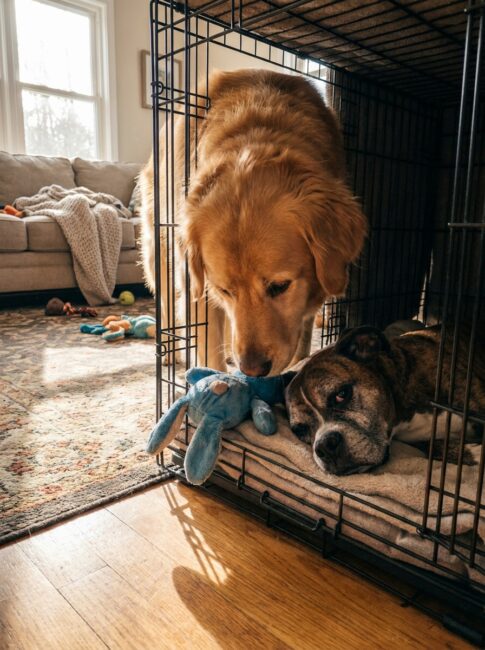
Here’s the small thing about Buddy that I noticed and didn’t understand.
He only brought the rabbit. At first.
We had a whole basket of dog toys. Buddy had access to all of them. But for the first stretch, it was only ever the blue rabbit that made the trip to Bella’s crate — the one toy, of all of them, that meant the most to him. He wasn’t clearing out the toy basket. He was selecting. Every morning, of everything he owned, he chose the single most precious thing, and he gave it to her.
I thought, in those first weeks, that he was confused. That he wanted her to play and didn’t understand she couldn’t. That it was a dog being a dog.
It would take watching him through Bella’s last day, and then the morning after, to understand that Buddy understood far more than I’d given him credit for — and that what he was doing had a logic to it that broke my heart clean in half.
Part 3
The weeks went the way those weeks go. Too fast and not fast enough at the same time.
Bella declined slowly. There were good days, early on, where she’d get up and come sit with us at dinner, and we’d pretend, the way families do, that maybe the vet was wrong. And there were the other days, more and more of them, where she stayed in the crate and we brought the world to her.
Through all of it, Buddy and his offerings.
Every morning, the blue rabbit, carried over and laid in her crate.
And then, as the weeks went on, it became more than the rabbit. Buddy started bringing other things too. A tennis ball he liked. A rope toy. A squeaky hot dog. One at a time, over the days, he carried his treasures across the room and added them to Bella’s crate, building a small pile of everything he loved against the side of a dying dog who couldn’t touch any of it.
He never asked her to play. That’s the thing I keep coming back to. Not once. A younger, dumber dog would have dropped a ball and barked and pawed and tried to start a game. Buddy didn’t. He’d lay the toy down with this unbearable gentleness, and then he’d back off, and he’d lie down where he could see her, and he’d keep watch.
Sometimes he’d rest his chin on the edge of her crate and just look at her.
The kids noticed before I let myself fully see it. My daughter, who was eleven, said one evening, quietly, “Buddy’s giving Bella his stuff because she’s sad.” I told her dogs don’t really think like that. She gave me the look kids give you when they know you’re the one who’s wrong.
There was one detail I’ll never forget. About a week before the end, Bella was very weak, and Buddy brought the blue rabbit over as always and laid it by her head. And Bella — who hadn’t had the strength to move much in days — shifted, just slightly, and laid her chin on top of the rabbit.
On Buddy’s most precious thing.
And Buddy, watching from a few feet away, thumped his tail once against the floor. Just once. Like that was all he’d wanted. Like the whole point had been to give her something soft to rest her head on, and he’d finally gotten it right.
Mark saw it too. He got up and went outside and stood in the yard for a while, and when he came back his eyes were red, and none of us said anything.
Part 4
Bella died on a Sunday morning in late May.
The vet came to the house — we’d arranged it that way, so she could go in her own crate, in her own living room, with all of us around her instead of on a steel table in a cold room. Mark held her head. The kids and I had our hands on her. She went easy, the vet said. As easy as it gets.
Buddy was there. We let him be. He sat a few feet back through all of it, watching, his ears down, that hopeful face gone still in a way I’d never seen on him.
When it was over, when she was gone, Buddy came forward. He sniffed her, very carefully, nose moving over her face, her side, her paws. And then he sat down beside the crate and he didn’t move for a long time.
We buried Bella that afternoon in the back corner of the garden, under the dogwood tree, in the spot where she used to like to lie in the sun. Mark dug the grave. We all stood out there in the May afternoon and said the things you say, and the kids cried, and I cried, and Mark didn’t cry but his jaw was set in a way that was worse.
Buddy watched from the porch.
We came inside, wrung out, the particular hollow exhaustion of a hard grief. The blue rabbit was still in the empty crate where Bella had died. I couldn’t bring myself to move it.
I thought that was the story. A devoted young dog who’d given his sick friend his toys, who’d kept her company at the end. A sad and tender thing. A good story.
Then, the next morning, I looked out the kitchen window into the garden.
And I had to grab the counter.
Part 5
Buddy was at Bella’s grave.
He’d carried his toys out there. All of them. Every single one.
The blue rabbit. The tennis ball. The rope toy. The squeaky hot dog. Every treasure he owned, the whole contents of his life, carried one at a time out the dog door and across the yard and laid in a pile on the fresh dirt of Bella’s grave.
And he was lying next to the pile, chin on his paws, facing the dogwood tree.
I want to be careful here, because the style I trust doesn’t let me tell you what a dog was thinking, and the truth is I don’t know. I can only tell you what he did. He took everything he had ever loved, everything he owned, and he brought it to the place we’d put Bella, and he stacked it there, and he lay down to keep it company.
I got Mark. He came to the window, and he looked, and this man who hadn’t cried through the whole sickness, through the vet, through the burial — this man put his hand over his mouth and his shoulders started to shake.
We went out. Buddy looked up at us and thumped his tail, slow, and then put his head back down by his pile of toys on the grave.
We didn’t take the toys away.
You don’t. You couldn’t. We left every one of them right where he’d put them, on the dirt under the dogwood, and we went back inside and let the dog grieve the way he’d chosen to.
That was the twist none of us saw, though our eleven-year-old had seen it weeks before. We’d thought Buddy was a happy idiot who didn’t understand his friend was dying. He’d understood perfectly. He’d understood from the very beginning. He just had a different language for it than we did.
We say I’m sorry. We bring casseroles. We say let me know if you need anything.
Buddy said it the only way a dog knows how to say the biggest thing there is.
He gave her everything he had.
Part 6
I’ve sat with it since, and let the small things turn over in the light.
He only brought the rabbit, at first. Not a random toy. The most precious one. I’d thought it meant nothing. It meant everything. When you have one treasure and you give it away, that’s not confusion. That’s the entire definition of a gift — the thing it costs you is the thing that makes it mean something.
He never asked her to play. This is what I missed for weeks, the thing that should have told me right away that this wasn’t a dog wanting a game. A dog wanting to play is loud and insistent and selfish in the innocent way dogs are selfish. Buddy was none of that. He laid the toy down and backed away. He gave with no expectation of getting anything back, which is the one kind of giving most people never quite manage and a two-year-old dog did every single morning.
Bella laid her head on the rabbit, and he thumped his tail once. I think about that more than anything. He hadn’t wanted her to throw it or chew it. He’d wanted her to have it. And when she finally used his most precious possession as a pillow for her tired head, that was the whole transaction completing. The gift, received. His tail said: yes. That. That’s what it was for.
And the grave. Taking everything he owned to the grave. We have a word for what humans do at gravesites — we bring flowers, which die, which is the point, a beautiful thing surrendered to mark a loss. Buddy didn’t have flowers. He had toys. So he brought the only offering he had, which happened to be the entire material wealth of his small life, and he laid it down on the dirt over his friend.
The eleven-year-old was right. The grown-up was wrong. Dogs think exactly like that.
Part 7
Here’s the small thing Buddy does now. It’s been a while, and he still does it.
He visits the grave every day.
Every single day, at some point, Buddy goes out the dog door and walks to the back corner of the garden and lies down by the dogwood tree, next to the pile of toys that’s still there, weathered now, the blue rabbit gone gray and stiff from rain and sun. He just lies there for a while. Then he comes back in.
And every so often — not every day, but often — he brings a new one.
We don’t know where he gets them all. We’ve started finding toys we don’t recognize on the grave. I think the kids buy them and slip them to him. I think Mark does too, though he won’t admit it. Somehow Buddy’s supply of treasures to give Bella has never run out, because the people in this house cannot stand the thought of the day he comes to the grave with nothing left to bring.
So we keep him stocked, secretly, all of us, so that our happy yellow dog can keep doing the one profound thing he has ever done — bringing his best things, one at a time, to the friend who can’t play with them anymore.
The pile under the dogwood just keeps growing.
Part 8
Mark said the thing, finally, a few weeks after.
We were watching Buddy out the window, lying by the grave with a brand-new orange toy he’d just carried out.
“He gave her everything he loved,” Mark said. “Even after she couldn’t play with any of it.”
Then he went outside and sat down in the grass next to the dog, by the dogwood tree, by the pile.
I watched the two of them out there. A man and a dog, at a grave, in the evening light.
Buddy leaned against him.
And they kept Bella company together.
Follow this page for more stories about the ones who give everything they love, expecting nothing back.