Part 2: Every Night at 9, the Stray Cat Came to Our Porch — Then an Old Chip Told Me She Had Been There Before
His name was Sunny.
He was a Golden Retriever with honey-colored fur gone pale around the shoulders, velvet-soft ears that still lifted at certain words, and a crescent scar high on his nose from running full speed into a porch swing when he was two and convinced the world should move around him. His eyes were amber-brown and patient, the kind of eyes that made even his silence feel companionable. He smelled like old fur, sun-warmed wood, and the faint clean scent of the oatmeal shampoo my wife bought once and never stopped buying.
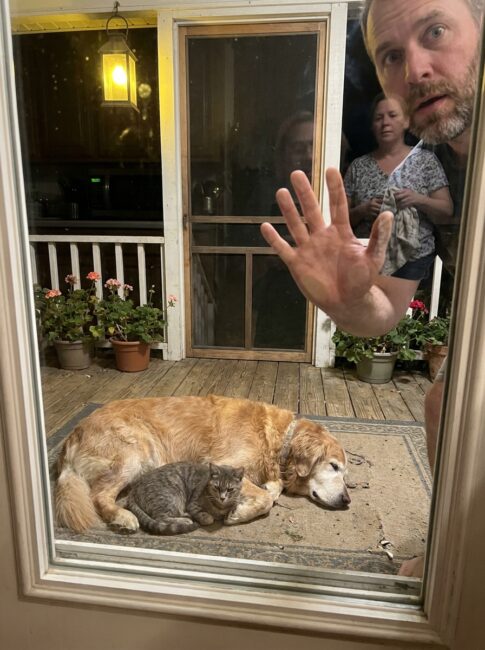
I was forty-two, a high school history teacher in Nashville, living in a white two-story house in Donelson with my wife, our ten-year-old daughter Lucy, and a dog who had outlasted two cars, one move, a layoff, and my father’s funeral.
Sunny had been mine before he was ours.
The year my mother got sick, he slept outside her bedroom door every time we stayed over. The night I came home after the district cut my position for a semester, I sat on the kitchen floor with the lights off and Sunny placed his head on my thigh and left it there until the anger burned down. When Lucy was born and cried at strange hours, Sunny learned to lie outside the nursery without scratching, without pacing, just breathing on the other side of the door like he knew newborn fear belonged to the adults too.
There were small things about him I never understood.
He hated being on the porch after dark unless the porch light was on. Always had. Six years. I never knew why.
And once in a while, when the clock in the kitchen clicked over to exactly 9:00, he would raise his head as if listening for something outside the house.
I used to think it was habit.
I was half right.
The cat came every night for three weeks.
Not early.
Not late.
Never at 8:50.
Never at 9:10.
At 9:00 exactly, she appeared.
She came like someone arriving for a standing appointment.
By the fourth night, Lucy had named her Maybelline because she said her eyes looked like she was wearing makeup. My wife said the name was ridiculous. Then she started using it too.
We left out water first.
Then a shallow dish of canned food near the steps.
The cat never touched the food until Sunny was already lying down.
That detail stayed with me.
She would pause at the edge of the porch, glance once at him, then at us through the back door, and only after he settled his body against the boards would she eat.
Then she’d circle once and climb into the curve of his stomach.
If I opened the door too fast, she vanished.
If Lucy pressed her face to the glass, the cat stiffened but stayed.
If Sunny shifted, she adjusted without waking.
He never licked her.
Never pawed her.
Never made the dumb, eager gestures friendly dogs usually make when they meet a smaller animal.
He simply held still for her.
Like a bed.
Like a promise.
Those weeks, the porch became part of our evenings.
My wife rinsed plates slower.
Lucy brushed her teeth at the kitchen sink so she could keep watch.
I found myself checking the microwave clock before nine like a man waiting on news that had no business belonging to him.
The cat was feral enough to keep distance, but not wild in the chaotic way of true strays. She knew doors. She knew windows. She knew what a porch was for. Once, when rain started just after she arrived, she didn’t panic or run. She simply tucked her head under Sunny’s front leg and waited out the storm.
Lucy said, “I think she loves him.”
Maybe.
But that wasn’t quite it.
Love is a word people reach for when something already seems impossible. This felt older than that. More practiced. More specific.
One Sunday afternoon, while Sunny slept near the baseboard vent, I crouched beside him and scratched behind his ear. “You know her, don’t you?” I asked.
He opened one eye.
Then closed it again.
A few days later, I noticed something else.
At 8:55, Sunny would already be awake.
Not restless.
Not pacing.
Prepared.
He’d lift his heavy old head, glance once toward the kitchen door, then toward the side yard as if some invisible route lay there in his mind. At 8:58, he stood. At 8:59, he was by the back door.
And at 9:00, she appeared.
It didn’t matter if we were eating dinner, helping Lucy with spelling words, or halfway through a baseball game on television.
That porch had become sacred in some small domestic way.
Three weeks is long enough for a strange thing to stop feeling strange and start feeling owned.
That is probably why the first night she didn’t come landed so hard.
Sunny waited until 9:20.
Then 9:35.
Then 10:00.
He did not lie down.
He stood at the edge of the porch, looking toward the side gate, ears lifted, old body held in that tired, stubborn line I hadn’t seen in years.
At 10:15, I had to coax him inside.
The second night, he waited again.
The third night, he scratched once at the back door at 8:58, then stood on the porch until my wife draped a blanket over his back because the air had turned cold.
The fourth night, Lucy asked if the cat had found another family.
I said maybe.
I did not believe it.
At 9:03, she came through the gate.
Only this time she was not alone.
Four kittens followed her up the steps like spilled shadows.
Tiny.
Dust-gray.
Too thin.
Eyes too big.
They stumbled over the threshold boards, climbed into Sunny’s fur, and disappeared against him as if he were the only safe surface they had ever been offered.
Lucy started crying immediately.
My wife pressed both hands over her mouth.
I laughed once, sharp and helpless, because sometimes joy arrives looking so ridiculous your body mistakes it for shock.
The mother cat did not curl into Sunny this time.
She stood.
She watched.
Only after all four kittens had found warmth against his belly did she lower herself beside his front legs and close her eyes.
That was the picture we sent to every relative we had—our thirteen-year-old Golden Retriever on the porch under the yellow porch light, with four half-wild kittens spread across him like he’d been appointed to something without warning.
For the next two weeks, the cat brought them nightly.
Lucy sat cross-legged just inside the doorway whispering names. My wife began leaving a second towel on the porch when the boards turned cold. I repaired the loose screen on the side gate because suddenly it felt like a failure of character to have a yard that did not deserve these visitors.
The kittens grew bolder.
One batted at Sunny’s tail.
One tried to climb his shoulder.
One slept under his chin.
The fourth, the smallest, always stayed nearest the mother.
We ended up keeping two of them.
The bold one Lucy named June.
The smallest one my wife named Walter, which made no sense for a cat and fit him perfectly.
The mother cat allowed it in the quiet way animals sometimes permit human decisions they have already made for themselves. She brought them. She counted them. She stopped bringing those two after the second week as if the paperwork had been handled somewhere outside our understanding.
It would have been enough.
An old dog.
A porch.
A stray cat choosing him.
A family keeping two kittens.
A sweet story people could share and feel better for five minutes.
That should have been the whole thing.
It wasn’t.
One Sunday in late October, after the kittens had started sleeping inside and Lucy had begun referring to them as “the boys,” I decided to clean up the porch corner where the mother cat liked to sit before nine.
There was an old planter there, a rubber doormat, and a torn outdoor cushion Sunny hadn’t used in years. Beneath the cushion, I found a collar.
Thin leather.
Cracked.
Dust-caked.
At first I thought it belonged to some neighborhood pet that had lost it in our yard long before we moved in. Then I turned it over in my hands and saw the metal plate.
The engraving was worn almost flat.
No phone number I could read.
Just one name, faint under the dirt.
Mabel.
I stared at it long enough for Lucy to ask what I was doing.
The mother cat was already on the porch by then, sitting near Sunny with her tail wrapped around her paws, watching me hold the collar as if she recognized it from farther back than memory should reach.
“Maybe she used to belong to someone,” Lucy said.
“Most cats do,” my wife answered from the sink.
But this didn’t feel like a recent loss.
The collar was too old.
Too weathered.
Too kept.
If she had been fully feral, I didn’t think she would have tolerated a collar long enough for the leather to age into that shape.
The next morning, I took her to the vet.
That sentence makes it sound easier than it was.
It took a trap from a neighbor, a towel, one badly scratched forearm, and the full collapse of my dignity in front of a technician who told me, kindly, that people always think they are the first family ever outsmarted by a ten-pound cat.
At the clinic, Mabel went rigid in the carrier.
Sunny rode with us and sat in the backseat, not panting, not pacing, just watching.
The technician scanned Mabel once.
Nothing.
Then again around the neck, lower than expected, near the old collar line.
The scanner beeped.
She looked up.
“Oh,” she said. “Well.”
The chip was old.
The registration had not been updated in years.
But there was still a name attached to it.
Not mine.
Not my wife’s.
My mother’s.
I said, “No.”
Not because I thought the vet was wrong.
Because sometimes the body says no before the mind has even found the past.
My mother had lived three blocks from our house before she died six years earlier. After she passed, the house sold fast. Grief and probate and distance turned everything into boxes, signatures, and whatever could be carried out in one weekend. I remembered Sunny from those years. Of course I did. He had spent long stretches at my mother’s place when I was working late and she still had energy enough to spoil him into arrogance.
What I did not remember was a cat.
Until the technician turned the monitor toward me and I saw the registered name beside the chip.
Mabel.
Then the memory cracked open.
Not a full scene at first.
A flash.
A gray tabby on the back of my mother’s couch.
A tail slipping around the corner of her kitchen.
Sunny as a younger dog lying under her table while a cat slept against his side.
I sat down.
Hard.
The vet printed the record.
Owner: Patricia Hale.
My mother.
Address: the old brick bungalow on Linden Avenue.
The same house we had emptied after her funeral. The same house three blocks away that I had not walked past in years because grief sometimes arranges a city into safe streets and forbidden ones.
I drove home in silence.
My wife read the paper three times in the passenger seat. Lucy, from the back, asked the kind of question only a child can ask without ceremony.
“So the cat knew him before we did?”
That was it.
That was the turn.
Sunny had not adopted a stray.
Sunny had been meeting someone from his first life.
When my mother was alive, Sunny spent four years with her nearly every weekday while I taught classes and coached after school. He knew her kitchen, her porch swing, the exact floorboard that creaked outside her laundry room. If she had owned Mabel then—and apparently she had—Sunny and that cat had once shared a home longer than my daughter had even been alive.
After my mother died, Mabel must have slipped out or been overlooked in the confusion that follows death the way small living things sometimes are. Then the house sold. The neighborhood changed hands. The cat went feral by necessity, not nature.
And somehow, after six years, she had found Sunny again.
Not at random.
Not because he was kind.
Because she knew him.
That night I went into the hall closet and dragged down the box marked MOM—PHOTOS. Dust all over my jeans, cardboard bending at the corners, my wife sitting beside me on the floor while Lucy turned pages too fast and I kept slowing her down.
Then there it was.
My mother’s birthday in 2018.
Cake on the dining room table.
Paper plates.
My mother laughing with one hand half raised.
And in the lower left corner of the photo, almost missed, Sunny lying under the table.
Curled against his belly was a gray tabby cat.
Same torn ear.
Same narrow face.
Same eyes.
My wife touched the photo once and withdrew her hand.
Lucy whispered, “Oh.”
That was all.
Oh.
Because once you see the truth, the whole story rearranges itself so neatly it almost feels rude.
The timing.
The porch.
The exact hour.
Sunny waking before nine.
His refusal to miss a single night.
He wasn’t being generous.
He was keeping an old appointment.
After that, everything I thought was sweet became something deeper and stranger.
Sunny’s hatred of a dark porch unless the porch light was on.
My mother always left her porch light burning until nine when she was alive. Every night. She used to say animals trusted a lit threshold more than a dark one.
The way Sunny seemed to know exactly when to wait.
My mother fed both of them at nine.
Not eight-thirty.
Not “sometime after dinner.”
Nine.
The way Mabel never rushed the porch before he settled.
She was not approaching an unfamiliar dog. She was returning to a shape she already remembered as safety.
Even the route made sense once I stood in my mother’s old driveway and looked back toward our street. Three blocks. Two alleys. One church parking lot. A path a cat could learn and keep.
I started walking it.
First alone.
Then with Sunny.
He moved slowly now, old age plain in the way his back legs hesitated on uneven pavement, but the first time we turned onto Linden Avenue, his whole face changed. Not excitement, exactly. Recognition. He stopped at the old bungalow’s front walk and stood there so still I could hear the wind moving through the dead leaves under the boxwoods.
Mabel appeared from beneath the porch.
No drama.
No surprise.
She just came out, sat in the weak patch of afternoon sun, and looked at Sunny as if the years between them were a clerical error.
He lowered himself down.
She crossed the yard and settled against his side.
I stood there with the leash hanging loose in my hand and understood something I had not wanted to admit about grief.
Sometimes the dead don’t leave cleanly.
They leave schedules.
Light switches.
Routes through neighborhoods.
Two animals who keep finding each other because memory outlived the person who built it.
I began going through more photos after that. In family pictures, Mabel was everywhere once I knew how to look. On the back of my mother’s couch. In the kitchen window. A striped blur at Sunny’s tail during Thanksgiving one year. Sunny beside her armchair, Mabel curled on the rug below. All those old images I had looked at after the funeral and thought were only about my mother had been holding this other story in the corners the whole time.
My reaction to the truth was not dramatic.
No speeches.
No big revelation scene.
Just a set of quiet failures.
Standing too long over the photo box.
Forgetting the kettle was on.
Driving past my mother’s old street twice in one week when I had avoided it for six years.
My wife noticed, of course.
One night after Lucy went to bed, she found me sitting at the kitchen table with the printed microchip record and one of the old photographs.
She said, “You miss her harder when it comes sideways.”
I nodded.
Because that was exactly it.
If grief walks straight at you, sometimes you can brace.
But six years later, when it comes disguised as a cat crossing your porch at nine o’clock and curling up with your old dog under a porch light your mother would have liked, it gets in before you know to lock anything.
For the next two months, Mabel kept coming.
Not every night anymore.
But often enough.
Sunny still woke near nine. He still made his way to the porch. Sometimes she came and slept against him for half an hour. Sometimes she only sat near the steps and watched him. Once she brought a dead field mouse and dropped it beside Lucy’s rain boots, which my daughter took as a personal honor and my wife took as a personal insult.
Then one week, she stopped.
One night.
Two.
Five.
Sunny waited at nine the first three nights, then began standing by the door a little earlier, as if time itself might be bargained with if he started soon enough.
On the sixth day, I went looking.
I knew where to go before I admitted it to myself.
The old bungalow on Linden.
She was under the porch.
Curled into herself against the lattice in the dry leaves, already gone, small as if life had been folding her for weeks. There was no blood. No violence. No sign of fear. Just old age, weather, and a body that had gone back to the last threshold it knew.
I brought a towel.
Then stopped.
Went back for a blanket instead.
I buried Mabel beside my mother.
Small service.
Gray sky.
No preacher.
My wife came. Lucy came holding one of the daisies from our front flowerbed with both hands as if it were glass. Sunny did not come to the graveside. He waited in the car with the windows cracked, lying across the backseat in a line of gold and white and old patience.
I placed the old collar in the ground with her.
Cracked leather.
Worn plate.
Mabel.
When we got home that evening, Sunny walked to the back door at 8:58 out of habit, stood there for a long moment, and looked at me.
Then he turned away.
He never went out to wait at 9:00 again.
That was the part that stayed hardest.
Not because it was dramatic.
Because it wasn’t.
No howl.
No refusal to eat.
No movie scene.
Just an old dog who seemed to understand when an appointment had been kept to the end.
After that, I started a ritual I never told anyone outside the family about. Every Sunday evening, I take a small saucer of water to the porch and set it in the same corner where Mabel used to pause before climbing up beside Sunny. I leave the porch light on until 9:15, even when no one is outside, even when rain moves in, even when my electric bill gives me reason not to.
Lucy notices if I forget.
So does Sunny.
He doesn’t go out.
He only lifts his head from the rug and checks the light.
That is enough.
The two kittens we kept are grown now.
June sleeps on the armchair like she pays the mortgage. Walter still startles at ceiling fans and insists on drinking from Sunny’s water bowl although he has his own. Sometimes they lie together in the den, one on each side of him, and he accepts it with the weary dignity of an old man who has already served one term as a bed for smaller creatures and somehow been elected again.
A few weeks ago, I found myself standing on the porch at 9:00 with the light on and no real reason to stay there.
The neighborhood was quiet.
One car far off.
A screen door closing somewhere down the block.
The soft hum of Nashville traffic in the distance.
Inside, Sunny was asleep on the rug.
His muzzle has gone nearly white now.
His steps are shorter.
He no longer wakes before nine unless thunder is coming.
I looked toward the side gate anyway.
Toward the broken line of brick by the azaleas.
Toward the path where a gray cat used to appear as if called by something older than hunger.
Nothing moved.
Then I looked through the screen door and saw Sunny watching me from inside.
Not getting up.
Not asking to go out.
Just watching.
I thought of my mother’s porch light.
Of a birthday photo I never really saw until I had to.
Of two animals who carried a piece of her back into my house without meaning to, then left it there.
My wife came up behind me and touched my arm.
“She found him,” she said.
Maybe.
Or maybe they found each other.
I turned off the porch light at 9:15, same as always.
Inside, Sunny shifted once in his sleep.
And the porch stayed empty.
Share this with someone who still leaves the porch light on.