A Cloudy-Eyed Little Dog Trembled Inside a Car Packed With His Owner’s Entire Life — Before the Ambulance Left, the Man Asked Only Who Would Stay With Him
Part 2 — The Dog Beneath the Dashboard
The ambulance had been gone twelve minutes when Ruth Bennett arrived carrying a soft-sided crate, a slip lead, and none of the hurried confidence that frightened dogs often mistake for danger. She was sixty-two, silver-haired, and accustomed to animals whose first response to help was withdrawal rather than gratitude.
She looked through the passenger door but did not reach inside.
Bean had wedged himself behind the pedals. Only his white muzzle and one clear brown eye were visible. His cloudy left eye faced the firewall, and his faded red harness had caught on the edge of a rubber floor mat.
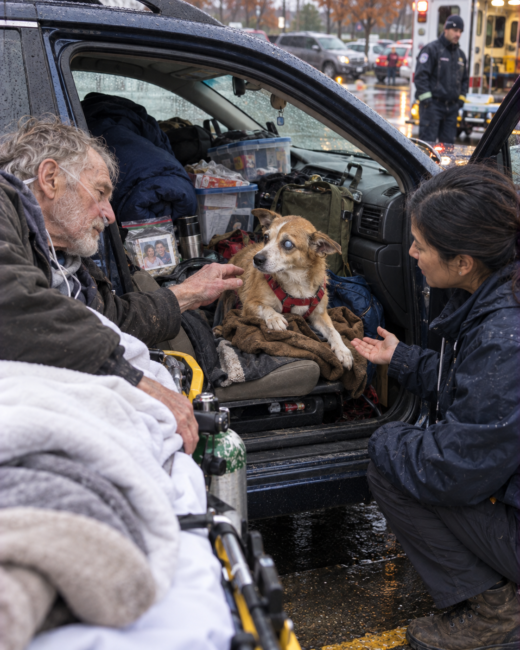
“He’s not choosing the car over us,” Ruth said. “He’s choosing the last place that still smells like Henry.”
The distinction mattered.
We did not drag him out. We did not tighten a catchpole around his neck or turn the removal into another emergency. Luis had left a recording of Henry speaking before the ambulance departed, so I placed my phone near the open door and played it softly.
“Come on, Beans. You’re okay.”
At the sound, Bean’s ears rose. He crept forward two inches, stopped, and smelled the air.
Ruth folded Henry’s brown canvas coat inside the open crate. The cuffs were stained, one pocket had been repaired with dark thread, and the lining carried the combined scent of rain, campfire smoke, laundry soap, and the man Bean trusted.
The dog emerged far enough to place one paw on the coat.
Then headlights swept across the parking lot. Because Bean could not see them approaching from his left, the sudden brightness startled him. He reversed beneath the dashboard and began panting.
That reaction gave us important information. Bean was not merely stubborn or poorly socialized. His cataract created a blind-side vulnerability, and unfamiliar movement appeared without warning unless people approached from his right.
Ruth repositioned herself. She sat several feet away with her right shoulder toward him and looked at the ground. I blocked passing headlights with my body while another outreach worker spoke quietly from behind me.
The next attempt took twenty-three minutes.
Bean smelled Henry’s coat, stepped into the crate, and pressed his chest against the folded fabric. Ruth closed the door only after he lowered his head. There was no triumphant celebration. A frightened dog had accepted the least frightening option available, and we treated that decision gently.
Before Ruth left, we scanned Bean for a microchip. The number connected to an old veterinary clinic outside Salem, where Henry had lived before losing his apartment. The clinic confirmed Bean’s ownership and emailed vaccination records from three years earlier.
The records showed that Bean was ten years old. His cataract had been documented but never treated surgically because the other eye remained functional and Henry could not afford a specialist. The clinic remembered them well. Henry had brought Bean for vaccines, nail trims, and treatment for a dental infection, paying small amounts over several months.
“He always came back,” the receptionist told me. “Sometimes late, but he always came back.”
That night, Ruth placed the crate in her quiet guest room. She arranged water, a shallow food dish, and nonslip mats so Bean would not struggle to navigate the unfamiliar floor. She left the crate door open and kept the furniture exactly where it was.
Bean remained on the coat.
He did not eat. He did not drink while she watched. Every few minutes, he lifted his head at the sound of a car passing outside.
At the hospital, physicians diagnosed Henry with pneumonia, severe dehydration, and an abnormal heart rhythm requiring monitoring. He repeatedly asked a nurse whether anyone had called about his dog.
I phoned his room and told him Bean was safe.
“Did he eat?”
“Not yet.”
“Is he shaking?”
“Some.”
Henry went silent.
I could hear oxygen moving through the tube beneath his nose.
“He thinks I left him,” he said.
I explained that Ruth was sitting near the crate and that Bean had Henry’s coat. I promised to send an update before midnight.
Yet when Ruth checked the room again, Bean was no longer inside the crate. He had dragged the coat behind a narrow bedside table, curled on top of it, and hidden his face beneath one sleeve.
His trembling had stopped, but his body remained folded around Henry’s scent as though guarding the only part of the man we had managed to bring with him.
Part 3 — The Foster Who Did Not Ask Him to Trust Her
Ruth’s first goal was not affection.
It was hydration.
A ten-year-old, twelve-pound dog could become medically unstable if stress kept him from drinking, especially after living in a cold vehicle with an owner who had also been dehydrated. But forcing Bean from hiding would confirm every fear he had about the new room.
Ruth slid a shallow dish near the coat and left.
When she returned twenty minutes later, the water level was lower. Bean had taken only a few laps, but it was the first choice he had made for his own safety since Henry disappeared into the ambulance.
By morning, he had not touched the dry food. Ruth warmed a spoonful of canned chicken-based dog food and placed it at the coat’s edge. Bean smelled it, turned his head, and listened toward the hallway.
His behavior suggested more than ordinary pickiness. He was waiting for a familiar routine: Henry opening a container, tapping the bowl twice, and saying the same phrase he had used in the car.
I called Henry’s hospital room.
“What do you tell him before he eats?”
Henry sounded embarrassed.
“I say, ‘Bean first, then me.’ We share breakfast time.”
Ruth repeated the words without imitating his voice.
Bean lifted his head but did not eat.
That afternoon, we transported him to a veterinary clinic partnered with the safekeeping program. Ruth carried the coat with him, and the veterinarian examined Bean on the floor rather than lifting him onto a stainless-steel table.
The cataract in his left eye was mature, allowing him to detect brightness but little useful detail. His right eye was healthy. He also had mild arthritis in both knees, several missing teeth, and a heart murmur that required later evaluation, but there was no immediate medical crisis.
The veterinarian found no sign that Henry had neglected him. Bean’s body weight was appropriate, his coat was clean beneath the rain smell, and his nails had been clipped recently. Their living conditions were unstable, yet the dog had received consistent care whenever Henry could reach it.
That fact challenged an assumption several people had quietly made after seeing the packed Subaru.
Henry did not keep Bean because he did not care enough to surrender him.
He kept Bean because they were each other’s home.
At Ruth’s house, Bean learned the route from the guest room to the back door. She kept lamps on after sunset so the clear eye could use available light. She spoke before entering from his left and avoided moving chairs.
Still, he remained wary of her hands.
On the second evening, a delivery driver knocked loudly. Bean startled awake, ran toward the hallway, and struck his shoulder against a small side table. He yelped once and spun in confusion.
Ruth removed the table immediately, then sat on the floor without touching him.
Bean retreated to the coat.
For nearly an hour, he panted and stared toward the front door. The accident had transformed the unfamiliar house into a place where objects could appear from his blind side. Ruth worried that the stress would again stop him from drinking.
She recorded a short video for Henry: Bean resting on the brown coat, breathing more slowly while Ruth sat nearby.
A hospital nurse held the phone so Henry could watch.
“He always sleeps inside the sleeve,” Henry said. “Put your hand near the cuff. Don’t touch him. Just leave it there.”
Ruth followed the instruction.
Her hand rested six inches from the worn cuff. Bean smelled her fingers, then moved his nose toward them. He did not allow petting, but he did not retreat.
Later that night, he ate four bites of food from the plate.
Ruth took a photograph after he fell asleep. Bean’s narrow face rested across Henry’s sleeve, his cloudy eye closed, his red harness removed for comfort. One paw held the fabric against his chest.
She sent the picture to me.
I forwarded it to Henry with a message: He is not alone. Your coat is doing its job until you can.
The hospital nurse later told me Henry stared at the photograph for a long time. Then he placed the phone against his chest and agreed to a breathing treatment he had previously resisted.
The image had not solved pneumonia, housing instability, or Bean’s fear.
It had answered one urgent question.
Someone had stayed.
Part 4 — The Photograph Beside the Hospital Bed
Henry printed the photograph through the hospital’s patient-services office.
It was ordinary copy paper, not glossy photo stock. The colors were washed out, and a pale stripe from the printer crossed Bean’s back. Henry still asked the nurse to tape it beside his bed where he could see it without sitting upright.
Every physician who entered the room heard about the dog.
Henry explained the cloudy eye, the correct side from which to approach, the phrase used before breakfast, and the way Bean trembled during heavy rain. He repeated these details because they gave him something useful to do while his own body depended on oxygen, antibiotics, fluids, and cardiac monitoring.
For Bean, the third foster day brought progress.
He followed Ruth into the kitchen.
The journey covered less than twenty feet, but Bean paused at every doorway and turned his head so the clear right eye could examine the next space. Ruth walked slowly, allowing him to map the house by smell and sound.
When she tapped his dish twice and said, “Bean first, then me,” he ate half a meal.
Afterward, he carried one sleeve of Henry’s coat back toward the guest room. The coat was too heavy, so he dragged it across the floor in short, determined pulls.
Ruth did not take it from him.
She lifted the other side and walked at his pace.
Together they moved the coat to a patch of afternoon light beside the window. Bean circled twice, lay down, and rested his chin against the cuff. His body no longer shook continuously, although passing diesel engines still caused his ears to rise.
This was adaptation, not recovery completed.
Meanwhile, our team faced a practical problem. The Subaru could remain in the church lot for only seventy-two hours. Henry’s registration was current, but the vehicle needed a new battery and could not be driven. Towing it to a commercial yard would create fees he could not pay, and losing the car would mean losing the boxes containing his identification, medication records, tools, and family photographs.
The vehicle was not just transportation.
It was the physical container of Henry’s remaining life.
We obtained written permission for a volunteer mechanic to replace the battery. A local medical-respite program agreed to let the car stay temporarily behind its secured facility if Henry qualified for admission after discharge.
Nothing happened with one phone call. Forms required signatures. The hospital social worker needed proof of the dog’s temporary placement. The respite program needed vaccination records and confirmation that Bean could remain crated during medical appointments. Henry had to consent to each step.
His breathing improved, but the heart rhythm remained unstable. On the fourth morning, he expected to be discharged. Instead, his physician recommended at least two more nights of observation.
Henry called me immediately.
“Bean will think I’m not coming.”
I told him dogs do not measure promises by calendars. They measure what happens repeatedly: food arriving, doors opening, voices returning, and people keeping them safe.
Then I called Ruth.
She brought Bean to the clinic courtyard beside the hospital, where pets were permitted during scheduled visits. Henry was too medically fragile to leave the unit, so they could not meet, but a nurse opened a second-floor window slightly while he spoke through the phone.
“Hey, Beans.”
Bean froze.
His cloudy left eye faced the building, so he turned until the clear eye searched the windows. His tail moved once. Then again.
Henry continued talking.
Bean stood with both front paws on Ruth’s knee, listening so intensely that his entire body leaned toward the sound.
They were separated by glass, height, hospital policy, and an illness neither understood. Yet Henry’s voice reached the courtyard.
Bean answered with a single sharp bark.
It was the first sound Ruth had heard him make.
Henry began crying on the other end of the phone, but his voice stayed steady.
“I’m coming back,” he said. “You keep that coat warm.”
That evening, Bean ate his first complete meal in foster care. Afterward, he returned to the guest room but did not hide behind the table.
He slept on top of the coat, his face uncovered and his paws loose.
Part 5 — When Safety Began to Feel Dangerous
Progress did not continue in a straight line.
On Bean’s fifth night with Ruth, a storm reached Portland. Rain hammered the windows, wind moved the branches against the siding, and thunder rolled closely enough to shake the glass.
The sound returned Bean to the Subaru.
He ran toward the front door, slipped on the hallway floor, and scratched at the wood. When Ruth approached, he backed away and barked repeatedly. His body shook harder than it had on the first night.
Ruth dimmed the hallway, laid nonslip towels across the floor, and brought Henry’s coat to the entryway.
Bean climbed onto it but remained upright.
For three hours, he refused to lie down. Each vehicle passing outside made him stare toward the door, perhaps expecting the familiar Subaru or the footsteps of the man who always returned after taking him outside.
Ruth phoned me just after midnight.
“I don’t think he wants to escape,” she said. “I think he’s trying to find the routine that disappeared.”
We contacted the emergency veterinary line because Bean’s heart murmur and rapid breathing made prolonged distress a concern. The veterinarian advised counting his resting breaths, checking gum color, and bringing him in if the rate remained elevated after the storm passed.
Ruth sat beside the coat and played Henry’s recorded voice.
Bean’s breathing gradually slowed. At 2:10 a.m., he lowered his chest but kept his head raised. At 2:37, he finally placed his muzzle on the sleeve.
The setback mattered because it prevented us from turning the story into a simple sequence in which rescue immediately felt good.
For Bean, being removed from the cold vehicle meant warmth, regular meals, and medical attention. It also meant losing every familiar sound, smell, and boundary. Safety had arrived wearing the face of change, and change frightened him.
Henry experienced a setback the same morning.
His oxygen level dropped when he walked a short distance, delaying discharge again. He tried to remove the monitoring leads, insisting he needed to retrieve Bean.
The hospital social worker placed the printed photograph in his hands.
“Your dog is being cared for because you agreed to be cared for,” she told him. “Leaving before you can breathe safely won’t bring him security.”
Henry studied Bean’s paw curled around the coat.
Then he allowed the nurse to replace the leads.
Our team arranged a video call that afternoon. Bean did not appear to understand the image on the screen, but he recognized Henry’s voice. He approached the phone, smelled the case, and looked behind Ruth as if searching for the rest of him.
Henry laughed for the first time since admission.
“That’s my boy. Always checks behind things.”
Ruth showed Henry the mapped pathways through her house, Bean’s shallow water dish, and the mat placed beside each doorway. Henry told her that Bean disliked deep bowls because his cloudy eye made the rim difficult to judge.
That small detail changed his drinking immediately.
Ruth replaced the bowl with a flat ceramic saucer. Bean approached without hesitation and drank for almost a minute.
The solution was inexpensive, but it came from knowledge earned through years of living together. Ruth had veterinary experience; Henry understood this particular dog.
Neither replaced the other.
Two days later, Henry no longer required supplemental oxygen while resting. He could walk the hospital corridor with a nurse, though slowly. The medical-respite facility approved him for a ground-floor room and granted a temporary exception allowing Bean to stay, provided Ruth helped with the transition.
The reunion was scheduled for Friday morning.
On Thursday night, Ruth washed neither the coat nor Bean’s bedding. Familiar scent would help him recognize continuity between the foster home and the new room.
She packed his food, records, harness, bowls, medication notes, and nonslip mats.
Bean watched each item disappear into a bag.
His body began to tremble.
To him, packing had always preceded movement, and movement had often meant losing a place.
Ruth sat beside him and left Henry’s coat unpacked until last.
Bean stepped onto it.
For the first time, he placed one paw voluntarily against her hand.
It was not permission to keep him.
It was trust that she would take him where he belonged.
Part 6 — The Reunion Bean Could Hear Before He Could See
The respite room smelled of disinfectant, clean laundry, and unfamiliar heating vents. It contained a single bed, a chair, a dresser, and enough clear floor space for Henry to move without becoming short of breath.
Henry arrived first.
He wore borrowed sweatpants, a hospital jacket, and a portable monitor beneath his shirt. He looked stronger than he had in the Subaru, but the walk from the entrance left him tired.
We placed his brown coat across the foot of the bed.
When Ruth’s car stopped outside, Henry heard Bean before he saw him. The small dog’s tag tapped against the plastic crate while she carried him down the hallway.
Bean heard Henry at almost the same moment.
“Easy, Beans.”
Inside the crate, the trembling stopped.
Ruth set it on the floor six feet from the bed and opened the door. Nobody reached inside. Henry remained seated because standing quickly could frighten Bean and strain his own balance.
The dog smelled the air.
His cloudy left eye faced Henry, obscuring useful detail, so Bean turned his head. The clear right eye found the familiar shoes, then the hands, then the face.
He stepped out.
At first, he walked slowly. Halfway across the room, recognition overcame caution. Bean hurried forward, nails scraping against the floor, and pressed his chest against Henry’s shins.
Henry bent over him.
The dog made no dramatic howl. He did not leap into the air or perform for the people watching. He pushed his narrow head beneath Henry’s hands and remained there, breathing fast.
Henry repeated the sentence he had spoken before the ambulance closed.
“I came back.”
Bean climbed onto one of his feet and sat.
For several minutes, neither of them tried to move.
Ruth stood near the doorway, holding the empty crate. Her eyes filled, but she did not approach. This was not a transfer between owners. It was the end of a temporary promise.
Henry thanked her by name.
“You stayed with him.”
“He stayed with your coat,” she replied. “I just kept the room quiet.”
Before leaving, Ruth showed Henry the shallow saucer, the nonslip mats, and the veterinary report. Bean’s cataract would remain. A specialist could assess whether surgery was appropriate, but his age, heart murmur, and ability to function with one clear eye meant no immediate procedure was recommended.
The goal was not to make him look undamaged.
It was to help him live confidently with the vision he still possessed.
The first afternoon at respite was difficult. Staff entered frequently to check Henry’s medication and breathing. Each knock sent Bean toward the bed. When someone approached from his left without speaking, he startled and barked.
A sign was placed outside the door: “Small dog with limited vision. Please knock and speak before entering.”
Staff learned to announce themselves. Bean learned that the voices came and went without taking Henry away.
At dinner, Henry tapped the shallow dish twice.
“Bean first, then me.”
Bean ate.
Henry ate afterward.
Their arrangement at the respite center was not permanent. Residents could stay while recovering medically, but longer-term housing still required applications, identification documents, interviews, and openings that did not appear quickly.
Henry worried that every meeting might end with someone telling him Bean could not come.
Our team limited the housing search to pet-friendly placements. It reduced the available options, but separating them would have undermined the stability the program was trying to build.
Bean became part of Henry’s recovery routine. They took three short hallway walks each day. Henry used a cane while Bean walked on his right, where the dog could see him clearly.
Bean was not a trained service animal, and nobody described him as one. He did not monitor oxygen or provide medical alerts.
Yet his need for meals, bathroom breaks, and predictable movement gave Henry a reason to follow the schedule prescribed by his therapists.
Three weeks after the reunion, Henry could walk around the courtyard without stopping. Bean moved beside him in the faded red harness, occasionally brushing Henry’s ankle.
One afternoon, Ruth visited.
Bean approached her, smelled her hand, and returned to Henry. Then he dragged the brown coat halfway across the room and placed one sleeve near her shoe.
Ruth understood the gesture.
The coat no longer represented only absence.
It had become the bridge between the person who left and the people who made sure he returned.
Part 7 — A Coat No Longer Needed for Waiting
Four months passed before a pet-friendly studio became available through a supportive-housing program.
The apartment was small: one main room, a narrow kitchen, and a bathroom with a shower Henry could enter safely. To anyone else, it might have appeared modest. To Henry, the first important detail was the window near the radiator.
“Bean likes warm light,” he said.
The second was the clear route from the bed to the door. Bean could navigate without bumping into boxes, car seats, or furniture that shifted whenever Henry searched for something.
Volunteers helped move the Subaru’s contents. The tools went into a cabinet. Clothing was washed and placed in drawers. Family photographs came out of plastic bags and onto a shelf.
Not everything was kept.
Henry discarded broken appliances, expired food, and blankets damaged by moisture. He made each decision himself. Nobody treated his possessions as trash simply because they had once filled a vehicle.
The Subaru was repaired well enough to drive, though Henry used it rarely. For the first time in almost a year, the car became transportation instead of shelter.
Bean adapted cautiously.
On the first night, he paced between the apartment door and the window. The silence was unfamiliar. There were no tires moving inches from where he slept, no rain drumming directly above his head, and no strangers passing close to the glass.
Henry placed the brown canvas coat beside the bed.
Bean climbed onto it, but he did not immediately sleep. He watched Henry unpack medication, fill the shallow water saucer, and set the food dish against the wall where it would remain.
Henry tapped twice.
“Bean first, then me.”
The dog ate.
Later, Henry lay down while Bean continued watching. At midnight, the little dog walked to the door, returned to the bed, and smelled Henry’s hand.
Only then did he settle.
His left eye remained cloudy. He still startled when someone approached silently from that side, and the veterinarian continued monitoring his right eye and heart murmur. Nonslip runners stayed in the apartment, and Henry kept the furniture in consistent positions.
Rescue had not erased Bean’s cataract.
Housing had not erased Henry’s pneumonia, heart condition, financial limits, or fear of losing stability again.
What changed was the amount of danger surrounding those vulnerabilities.
A disability became manageable when the environment stopped punishing it. A medical crisis became survivable when accepting treatment did not require abandoning family. Temporary foster care worked because it protected ownership rather than quietly replacing it.
Ruth visited twice during the first month. Bean greeted her at the door with one bark, accepted a brief touch beneath his chin, and led her toward the coat.
Henry had washed it at last.
The old smoke and rain smells had faded, but Bean still recognized the shape and fabric. He no longer wrapped himself tightly around it. Sometimes he slept beside it. More often, he chose a padded bed beneath the radiator.
On a cold November evening, nearly one year after the ambulance came, I visited with updated veterinary vouchers and paperwork for Henry’s follow-up appointment.
Bean met me in the hallway.
He was still small, still white around the muzzle, and still visibly cloudy in the left eye. But he did not tremble. He examined my shoes with his clear right eye, smelled my hand, and walked back into the apartment.
Henry sat near the window, repairing the strap on Bean’s red harness.
The brown coat lay folded at the foot of the bed.
I remembered Bean inside the packed Subaru, hidden beneath the dashboard while rain streaked the windows. I remembered Henry lifting the oxygen mask to ask the only question that mattered to him.
Someone had stayed with Bean.
Then Bean had waited for Henry.
Their survival had never depended on one dramatic rescue. It depended on a chain of ordinary people respecting the same bond: a volunteer who called for help, paramedics who paused long enough to listen, a foster who did not demand trust, a nurse who printed a photograph, and housing workers who understood that a dog was not an obstacle to Henry’s recovery.
Before I left, Henry showed me the original picture on his phone.
Bean was asleep on the unwashed coat, one paw gripping the sleeve.
“I looked at that every time I wanted to walk out of the hospital,” he said.
At that moment, the real Bean climbed onto the bed. He turned three times, considered the folded coat, and stepped past it.
Then he curled against Henry’s leg.
The coat remained within reach, but it was no longer the only piece of home Bean had left.
Henry rested one hand on the dog’s back.
“I couldn’t see what was happening to him in that house,” he said. “But that picture told me he believed I might come back.”
Bean raised his head at the sound of his name. His cloudy eye caught the lamplight while the clear one found Henry immediately.
Outside, rain began striking the apartment window.
Bean listened for several seconds.
Then, safe beside the man who had returned, the little dog went back to sleep.
Follow the page for more moving dog-rescue stories about quiet loyalty, second chances, and the people who protect a bond when everything else is uncertain.