Part 2: A Firefighter Rushed Into a Burning House — Then a Pit Bull Blocked a Bedroom Door and Saved His Life Before He Could Save Anyone Else
Part 2 – Reveal
At first it looked like shadow.
That was the dangerous part.
In a burning house, shadow lies.
Cole braced one gloved hand against the hallway wall and angled his light lower. The dog still stood between him and the doorway, body shaking, bark now rougher than before, the sound breaking at the edges from smoke. But there was something different in the animal’s stance now. Not wildness. Not confusion. Direction.
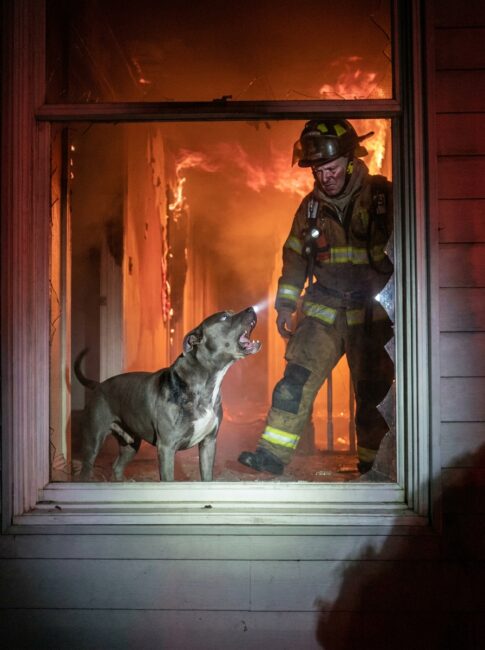
The dog was not attacking the room.
He was guarding the line before it.
Cole dropped his gaze again.
The hardwood floor inside the bedroom had changed color near the threshold. Not black, not yet, but dull and swollen in a way old wood gets just before it gives up. The rug inside the room had sunk oddly at the center. Heat shimmered up through cracks that should not have been there.
He pulled back half an inch and tapped the handle of his tool against the floor just past the doorway.
It broke instantly.
Not with a dramatic crash.
With that sick, splintering surrender of something that had been pretending to hold.
The board snapped through, and a bloom of orange opened beneath it.
Fire below.
A hole already eating the room from under the floorboards.
If Cole had taken one more full step, his weight would have driven him straight through into the fire underneath.
For half a second he forgot the radio, the hose line, the mother screaming outside, all of it.
He only stared.
The Pit Bull barked once more, then grabbed his pant cuff again, not hard, just enough to pull and release. Pull and release. Urgent. Specific. As if the dog had already spent too much time trying the blunt language of warning and was now moving to instruction.
Behind Cole, Lieutenant Vargas shouted through the mask, “What’s your hold-up?”
Cole turned his head just enough to answer. “Floor’s gone in that room.”
The words hit the air differently than the smoke had. Fast. Heavy. Immediate.
Vargas swore and relayed it over the radio. The nozzle team adjusted. Someone downstairs changed the water pattern. Above the crackle in the walls, outside noise pressed faintly through shattered glass—sirens, voices, the thin unraveling sound of a mother begging someone to find her kids.
Cole looked back at the dog.
The Pit Bull had stopped snarling.
That was the next thing that did not fit.
A dog in pain, terrified and cornered in a burning house, should have bolted or stayed defensive. This one held eye contact for one impossible second, then pivoted away from the deadly doorway and ran three steps down the hall before stopping to look back.
Not random.
Not frantic.
Intentional.
“Cole,” Vargas barked. “Move.”
But Cole was already moving, just not the way he had planned.
The dog trotted low under the smoke toward the opposite end of the hallway, claws scratching over old runner carpet. He stopped at a linen closet, barked once, then kept going. Past the bathroom. Past a family photo wall where frames had already curled from heat. At the last door near the back corner, he began pawing hard, then whipping his head toward Cole as if the message should have been obvious by now.
Cole reached the door and grabbed the knob.
Hot.
Too hot for skin, even through gloves.
He signaled Vargas, who moved up with the pike pole. The dog backed away only enough to give them room, then immediately tried to push in again with his shoulder the instant the door cracked.
Inside came the sound every firefighter is trained to search for and dreads hearing too late.
A child’s cough.
Then another.
Small. Weak. Close to the floor.
The room was still intact but filling fast. Smoke had banked down almost to mattress height. Two children were huddled in the far corner between a bed and a dresser, one girl maybe eight, one little boy younger, both wrapped in a blanket the wrong way, as if they had tried to build a wall out of it. The boy was crying without sound now. The girl’s eyes were open too wide, fixed on the dog before they even landed on the men in gear.
“There they are,” Cole said into the radio, and the relief in his voice sounded almost angry.
He dropped low, crossed the room, and lifted the boy into one arm while Vargas took the girl. The Pit Bull circled once, coughing, then shoved his muzzle against the girl’s knee as if counting.
One. Two.
Everyone accounted for.
By then the heat had deepened into the kind that warns you the house is making decisions faster than you are. Cole turned back toward the hall, but the route they had used was beginning to fail. Smoke had thickened. Flame rolled briefly across the upper corner above the stairwell. The dog hesitated there and pulled away.
Again, not toward danger.
Away from it.
Cole felt the first real shift of understanding then, though there was no time yet to name it.
The dog knew this house.
Not like an animal trapped inside it.
Like someone reading a map under pressure.
And every time Cole tried to default back to his own first instinct, the dog contradicted him.
Every time, the dog was right.
Part 3
The rear hallway window had already blown out by the time they got the children moving.
Cold night air cut through the smoke in ragged drafts, feeding the fire but giving the rescuers one small gift: a landmark. Light. Direction. Something to orient toward when the house was becoming less of a structure and more of a sequence of failing decisions.
Cole kept the little boy pinned high against his chest, the child’s face buried into his turnout coat, while Vargas guided the girl ahead of him with one hand at her shoulder. The Pit Bull stayed near their knees, limping now, one front paw landing short, singed fur curling tighter along his flank each time a pocket of heat pushed over them.
At the broken hallway window, Cole made the call.
“Ladder!”
Outside, the truck crew had already thrown one, almost by instinct, after hearing the interior report shift from search to rescue. The ladder clanged into place just below the sill. Below them, a net of helmet lights, shouted commands, and upturned faces waited in the front-side yard.
Vargas lifted the girl first.
She was light. Too light for the amount of fear in her body.
She clung once—hard—to the dog’s neck before the lieutenant peeled her away and passed her through the window opening to the firefighter on the ladder. The Pit Bull tried to follow immediately, but Cole blocked him with a forearm.
“Kids first,” he muttered, absurdly, as if the dog were another man on the crew.
The little boy went next.
He had not spoken a single word, but as Cole handed him through the opening, the child twisted enough to reach one soot-blackened hand toward the dog. His fingers brushed singed fur. The Pit Bull licked the air once, a tiny broken motion that somehow looked more human than anything else in that room.
Then the ceiling over the hallway moaned.
Every firefighter knows that sound.
The long wooden complaint before surrender.
“Move!” Vargas shouted.
Cole shoved the dog toward the window.
The Pit Bull resisted.
Not out of panic.
He turned back toward the room they had just left and barked once.
Cole looked.
Through the smoke, near the bed frame, something small glinted on the floor.
A pink inhaler.
The girl’s.
It should not have mattered.
Not then.
Not with the fire advancing and the ladder right there and the whole second floor beginning to lose its shape. But the dog barked again, sharper, staring not at the firefighters, not at the window, but at that object.
Vargas saw it too. “Leave it!”
Cole would have.
On any other day, under any other roof, he would have.
But the dog had already saved his life once in the last ninety seconds, and in a fire, trust built that fast can feel like instinct disguised as faith. Cole lunged low, snatched the inhaler off the floor, and turned just as part of the doorway behind them dropped in a burst of sparks.
They went out the window together.
First Vargas.
Then the dog, half-lifted, half-thrown toward the waiting hands below.
Then Cole.
When his boots finally hit the ground, the world outside seemed offensively clear. Cool air. Hose spray. The high, panicked cry of a mother running toward children already wrapped in gray station blankets. Neighbors clutching phones they had forgotten to lower. Flashing lights making everything look important and unreal at once.
The mother fell to her knees in the wet grass beside her son and daughter. She touched their faces, their hair, their shoulders, counting them the way parents do when terror has rearranged time. The little girl coughed, pointed weakly, and croaked one word through the oxygen mask a medic was trying to settle over her face.
“Bruno.”
That was the dog’s name.
The Pit Bull had collapsed ten feet away near the curb, chest heaving, soot pasted into the blue-gray of his coat until he looked carved out of ash. One ear was burned. One shoulder blistered. His eyes, though, stayed fixed on the children.
Not on the crowd.
Not on the firefighters.
On them.
Cole pulled off his mask, dropped to one knee beside the dog, and only then noticed that his own pant leg was torn where Bruno had grabbed him. Underneath the rip in the outer layer, a faint pressure mark ran along the fabric where the dog’s teeth had caught and held just long enough to stop him from taking one fatal step.
“Get the dog looked at,” Cole barked to no one in particular.
A medic moved immediately.
The neighbors, who only minutes earlier had been muttering versions of the same ugly thought—dangerous breed, crazy dog, smoke-crazed animal—had gone silent in that embarrassed way crowds do when truth arrives faster than apology. One man lowered his phone. A woman across the street began crying without making any sound.
As the paramedics worked on the children, the girl lifted the oxygen mask enough to speak again.
“He knows the bad floor,” she whispered.
The mother leaned in. “What, honey?”
“Bruno.” The girl coughed. “Daddy said if the old back room ever got soft, don’t go there. Bruno always scratched there when it smelled weird after the pipes leaked.”
Cole looked up sharply.
There it was.
The missing piece.
Not magic. Not instinct alone. Memory.
The family had been meaning to repair the weakened flooring in that old back bedroom after a plumbing problem months earlier. The father had joked, according to the girl later, that Bruno knew every weak board in the house because he was always the first one to avoid them during play. Dogs map homes with their bodies. With vibration. With repetition. Long before humans turn knowledge into language.
So when the fire ate the first floor and the heat gutted what little integrity the old wood had left, Bruno had read the danger not as theory but as fact.
That room was death.
This hallway still held.
The children were farther back.
The firefighters were going the wrong way.
He did not have human language, so he used the body he had. Bark. Block. Bite. Pull. Guide.
And he accepted being hated for every second of it.
Later, after the flames were knocked down and the interviews began in the red-blue wash of dawn, a local reporter caught Cole sitting on the rear bumper of the engine with soot still in the lines around his eyes and his helmet in his lap. His voice was raw from the mask and smoke.
“What happened in there?” she asked.
Cole looked past her toward the ambulance where a veterinary tech from the emergency animal clinic was loading Bruno onto a blanket stretcher while the little girl, now wrapped in a coat too big for her, cried harder for the dog than she had for the fire.
He answered without trying to make it pretty.
“I thought that dog was trying to stop me from doing my job,” he said. “Truth is, he saved my life before I got the chance to save anybody.”
The reporter said nothing.
Cole swallowed once, eyes still on Bruno.
“I went in there ready to be the hero,” he said. “That dog already was one.”
That line would make the local news by noon.
By evening it would be shared everywhere by people who, an hour earlier, would not have trusted a burned Pit Bull in a hallway full of children and smoke.
But the most important part of the story was quieter than that.
It was this:
Bruno never once tried to save his own skin first.
He spent his fear on warning a stranger.
Then he led that stranger to the children who mattered most.
Part 4
Bruno survived.
That mattered more than any headline.
For two days it was unclear. Smoke inhalation. Surface burns. A damaged paw pad. The animal clinic kept him under oxygen and observation while the town passed around updates the way small communities do when they want to feel useful against helplessness. Someone started paying the vet bill before the family even knew how much it would cost. The elementary school collected hand-drawn cards. A hardware store owner offered supplies to help rebuild what could be rebuilt after the fire marshal released the property.
None of that changed what the family had lost.
The house was damaged beyond quick repair. Clothes gone. Photo albums charred. The porch swing blackened into a bent shape that still looked like summer had once touched it. But loss behaves differently when everyone is still alive.
The children stayed with the mother’s sister for a while. The little boy slept badly unless one small condition was met: Bruno had to be visible from the mattress. So the clinic cleared a crate beside the foldout bed in the den, and every night the dog—bandaged, medicated, exhausted—lay where the child could reach two fingers through the bars to touch his fur before sleep.
Cole visited on the third day.
He came out of uniform in jeans and a plain black sweatshirt, carrying a grocery bag he looked mildly embarrassed to be holding. Dog toys, antiseptic wipes, a stuffed firefighter bear someone at the station had picked out for the kids, and a new leash because the old one had been lost in the fire.
The mother answered the door with the bruised, grateful face of someone who had not yet caught up to her own relief. The daughter was at the kitchen table coloring. The boy sat on the floor near Bruno’s crate, solemnly placing animal crackers into a row and offering every third one to the dog, who was under strict instructions not to accept them.
Cole crouched beside the crate first.
Bruno lifted his head slowly.
The burns around the ear made him look older.
Softer too, somehow.
Cole did not reach in immediately. He just sat there for a moment, the way people do around beings they owe more to than language can settle. Then he held up the new leash and said, “Figured you earned an upgrade.”
The girl laughed.
It was the first normal sound in the room.
Later, when coffee had been poured and refused and reheated and forgotten on the counter, the mother told Cole about the house. Not the fire. The house before it. How Bruno always slept at the children’s doors. How he hated fireworks but somehow never panicked during thunderstorms if the kids were in bed. How her husband—away that night on an overnight trucking run two states over—used to joke that Bruno knew the plumbing, wiring, and emotional temperature of the home better than any adult under the roof.
“He’d scratch at that old back room sometimes,” she said quietly. “We thought he was chasing smells in the floorboards.”
Cole looked down into his cup and nodded once.
No one had to say the rest.
Weeks passed. Then months.
The fire damaged the house, but not the center of the story. That stayed lit in different ways. The children recovered. The family moved into a rental two streets over while repairs dragged on. Bruno’s fur grew back patchy at first along the burned shoulder, then softer, fuller, with a streak of white beginning to show near the scar as if the fire had written a signature only up close eyes could read.
People treated him differently after that.
That was the part Cole had trouble with.
At the grocery store, strangers asked to take photos with the hero dog.
At the town fair, someone suggested Bruno lead the Fourth of July parade, which was quickly rejected by everyone who had ever seen what fireworks did to him. On social media, people used words like miracle, angel, legend. Some of them were sincere. Some just liked the shape of a story that let them admire bravery after the danger had passed.
Cole kept thinking about the first thirty seconds in the hallway.
How easy it had been to get Bruno wrong.
How quickly competence, urgency, and fear can wear the face of aggression.
How often human beings punish what is trying to save them because it does not arrive in a gentle form they recognize.
One cool evening in October, the fire department held an open house for the neighborhood. Children climbed through engines. Parents asked about smoke detectors. Plastic helmets were handed out. Cole stayed near the truck bay doors, answering questions, until he noticed a familiar blue-gray shape at the edge of the crowd.
Bruno walked in on a loose leash beside the little girl, who was now less fragile, more talkative, with a pink scar of healing confidence where terror had been. The boy trailed behind them holding a toy engine. When Bruno saw Cole, he paused, tail moving once, slowly.
Cole went down to one knee.
This time he did reach first.
Bruno leaned his heavy head against Cole’s chest as naturally as if the two of them had always belonged to the same team.
The bay grew quieter around them.
Not because anyone had announced anything.
Because some moments ask for less noise.
The little girl said, “He still doesn’t like hallways if they smell like smoke.”
Cole nodded. “Me neither.”
That made her smile.
Before they left, the department captain asked if the family minded one photo by the engine. Not for the news. Just for the station wall. The mother agreed. So they stood there under the open bay lights: the children in front, the parents behind, Bruno seated in the middle with one bandaged memory hidden under thicker fur, and Cole off to the side in uniform, one hand resting lightly on the dog’s back.
The framed photo went up near the lockers a week later.
No plaque. No dramatic caption.
Just a date and a place.
The men at the station didn’t need more than that.
They knew what it meant.
Years from then, recruits would ask about the picture, and somebody would tell the story wrong at first, the way stories often begin: firefighter saves family from house fire. Then an older voice in the room would correct it.
Not exactly.
The dog saved the firefighter first.
That was the truth that stayed.
Not because it was poetic.
Because it was precise.
On winter nights, when the repaired house glowed warm again at the end of Willow Creek Road, neighbors sometimes saw Bruno through the front window lying across the threshold between the children’s rooms, not blocking anyone now, just resting where he could hear both doors. The scar on his shoulder caught lamplight in a pale line. The house held. The floors held. The children slept.
And somewhere in town, on nights when calls came late and smoke turned windows black from the outside in, Cole still remembered a dog in a burning hallway doing the one thing everyone misunderstood until it was almost too late.
If stories like this stay with you, follow the page and come back for the next one.