Every Night at Exactly 2 A.M., an Old Scarred Shelter Dog Stood Up and Howled at the Same Empty Kennel, Until a Young Night Worker Opened a Forgotten Logbook and Realized Someone Used to Come
Part 2: The Visitor Who Stopped Coming
The signature was the same on every page, and it shook a little more with every year.
Maddie stood in the cold hallway with the clipboard in her hands until Tucker finally gave up on the door. He turned, walked back to kennel 14 on his own, and lay down with his nose against the gate.
Facing kennel 9. Facing the door.
She didn’t say a word to Walt when he came back inside at 2:20. He didn’t look at her. He never did after two o’clock. He just poured coffee from his thermos with his scarred hands and stared at nothing.
The next evening, she arrived early.
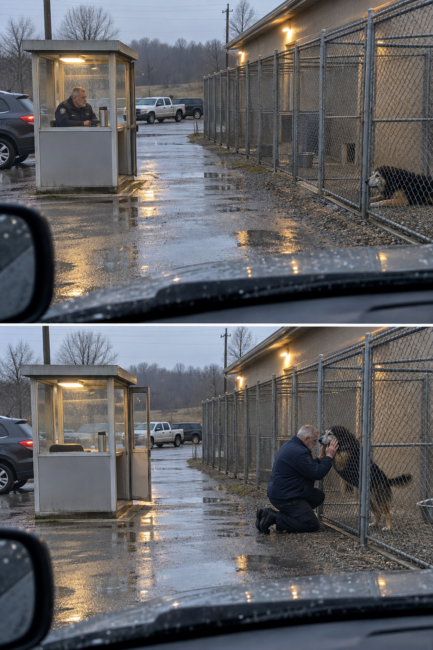
It was dusk, gray and drizzling, and as she crossed the parking lot she noticed something she’d seen every night without really seeing it. Along the side of the building ran the outdoor dog runs, chain-link pens connected to each kennel. In the far corner of run 14, Tucker lay in the wet gravel with his nose pressed through the fence.
Pointed straight at the empty guard booth.
Maddie found Gloria in her office and set the clipboard on her desk.
The director’s face changed instantly. “Where did you find that?”
“By the staff door.” Maddie took a breath. “Tucker isn’t crazy, is he? He’s not howling at kennel 9. He’s calling someone. Someone who used to come at two in the morning.”
Gloria was quiet for a long time. Then she turned to her computer, opened a folder buried inside other folders, and clicked a file.
“I was supposed to delete this,” she said softly. “I never could.”
It was security footage. Grainy, black and white. The timestamp in the corner read 2:00 a.m., three years earlier.
Kennel 9’s gate was open. Sitting cross-legged on the concrete floor inside was a man in a dark jacket and a ball cap, his back to the camera. Across his lap lay a big shepherd mix with a strange bare patch running down her spine, like a map of an old wound. A red bandana was tied around the man’s neck.
Across the aisle, in kennel 14, a younger Tucker pressed his face to the bars, watching them.
The man reached across the aisle and slipped his fingers through Tucker’s gate. Tucker licked them. And the three of them stayed like that, the man rocking slightly, his lips moving, as if he were telling them a story.
The clip ran for forty-one minutes. He never turned around.
“Who is he?” Maddie whispered.
Gloria closed the file. “That’s not my story to tell.”
“Gloria—”
“I mean it, honey.” Her voice cracked. “But you should know something else. Tucker’s stopped eating. Started about a week ago. Doc says at his age, when they stop eating, sometimes they just…” She didn’t finish.
That night at 1:55, Maddie didn’t bring a chair. She sat right on the floor beside kennel 14 with a bowl of wet food and slid her hand through the bars.
At two, Tucker stood and howled.
She didn’t stop him. She just kept her hand there, open and still, and talked to him in a low voice the whole time. When the howl finally faded, he looked down at her hand for a long moment.
Then he lay back down, put his chin in her palm, and ate three bites of food from her fingers.
Maddie cried a little. She didn’t know why.
When she left at dawn, Gloria was standing by the front desk with her coat still on, as if she’d been waiting.
“You’re going to keep digging anyway,” the director said. “So I’ll give you this much. The dog in that video was Tucker’s mother. Her name was Hope.”
The H.
“And she didn’t die of old age, Maddie,” Gloria said. “Ask anybody in this county about the fire on Mill Creek Road.”
Part 3: The Fire on Mill Creek Road
Maddie didn’t have to ask anybody.
The answer had been hanging in the break room the whole time.
It was an old newspaper page in a cheap black frame, yellowed behind the glass, next to the coffee maker. She had stood in front of it every night for a week, waiting for the pot to fill, and never once read it.
Now she read every word.
Nine years ago, on a February night, a farmhouse on Mill Creek Road had caught fire. A woodstove, the fire marshal said. The house belonged to Earl Pruitt, seventy-nine, a widower who lived alone with his shepherd mix and her seven-week-old litter.
The 911 call came in at 2:04 a.m.
By the time the volunteer fire department arrived, the house was fully engulfed. Earl did not survive.
But in the snow beside the porch, firefighters found four puppies huddled together, wet and shivering, alive. Their mother had dragged them out one by one through the dog door. Paw prints and drag marks crossed the snow back and forth, back and forth, four times.
Then she had gone back in for the fifth.
Maddie’s eyes moved to the photograph below the article. It was blurry, shot through smoke and flashing lights. A firefighter in full gear was stumbling out of a burning doorway, his face hidden behind a mask. Over one shoulder he carried a large dog, limp, her back blackened. Against his chest, tucked inside his coat, was a single tiny puppy.
Around the firefighter’s neck, bright even in black and white, was a dark bandana.
The caption read: Hero dog and her last pup carried from the flames.
Maddie sat down hard in a plastic chair.
Gloria filled in the rest when she came in that afternoon, standing in the break room doorway with her arms folded.
The four puppies who made it out on their own were adopted within a month. Everybody wanted a piece of the hero dog story.
Nobody wanted the hero.
Hope survived, but the burns left her back scarred and her hind legs weak. She was six years old, and to most families she looked broken. And the fifth puppy, the little one with the white blaze on his chest and the burn across his nose, refused to leave her.
“We adopted Tucker out three times,” Gloria said. “Three nice families. Every single time, he stopped eating and howled all night until they brought him back. He wanted his mother. That was it. So eventually we gave up. They became our dogs. Kennel 9 and kennel 14. Across from each other, so they could always see each other.”
“For seven years,” Maddie said.
“For seven years.” Gloria swallowed. “Hope died two years ago this March. In her sleep. In kennel 9.”
“And that’s when the howling started.”
Gloria nodded. “The very next night. Two o’clock. Never missed one since.”
Maddie looked at the photograph again. At the firefighter with no face.
“Two o’clock,” she said slowly. “The fire call came at 2:04. And the visitor came at two.”
Gloria said nothing.
“Whoever came to see Hope every night,” Maddie said, “was there that night, wasn’t he? At the fire.”
Gloria turned to leave. At the door, she stopped.
“He’s never once walked into the C-wing since she died,” she said quietly. “Not once in two years. Even though he’s in this building every single night.”
Maddie stared at the bandana in the photo.
Then she thought of the faded red bandana knotted to kennel 9.
And then she thought of a pair of hands, the backs covered in shiny, stretched, burned skin, passing her a ring of keys on her very first night.
She knew exactly whose hands those were.
Part 4: The Man in the Booth
At 1:50 a.m., Maddie walked out into the rain.
The guard booth sat at the edge of the parking lot, a small box of glass and metal with a space heater and a folding chair. Walt was inside, exactly where he always was, his thermos on the counter, the radio off.
He was staring at the building. At the outdoor runs. At kennel 14.
She knocked on the glass. He jumped, then scowled and slid the window open.
“You’re supposed to be doing rounds.”
Maddie didn’t answer. She laid the framed newspaper page on the counter in front of him.
For a long moment, Walt didn’t move. Then his jaw went tight.
“Put that back where you found it.”
“Was it you?”
“I said put it back.”
“Walt.” Her voice was shaking. “He’s calling you. Every night. You know that, don’t you?”
Across the parking lot, through the walls, faint but unmistakable, the howl began.
Walt flinched like he’d been hit.
He looked at his watch. 2:00. He looked at the building. Then something in that big, hard body simply gave way, and he sat down heavily in the folding chair and put his scarred hands over his face.
“Earl Pruitt was my best friend,” he said finally. “Since first grade. We fished that creek behind his house every summer for sixty years.”
The howl rose and fell.
“I was captain of the volunteer company back then. Call came at 2:04. I knew the address before dispatch finished saying it.” His voice was thin. “I went in for Earl. Got as far as the hallway. The ceiling came down. I couldn’t get to him. I couldn’t get to him, Maddie.”
He breathed for a while.
“And then this dog came out of the smoke. Crawling. Her back was on fire. She had a puppy in her mouth. She’d gone back in for the last one. She dropped him at my boots and just lay down.” He turned his palms over and looked at them. “I grabbed them both. Door handle on the way out was red hot. Went right through my gloves. Never fought another fire.”
“You brought them here,” Maddie said.
“Drove them myself. Wrapped in my coat, in the front seat of my truck.” He shook his head. “Earl made me promise once, years ago. If anything happens to me, Walt, you look after my dog. So I tried.”
“Why didn’t you take them home?”
“My wife, Ellen. She was starting chemo. Doctors said no animals in the house. Infection risk.” His voice cracked. “So I came here. Every night. Couldn’t sleep at two o’clock anymore anyway. That’s when the call came. Every night for nine years, two o’clock, I’m wide awake. So I’d come sit with Hope. Gloria gave me a key. Hope would put her head in my lap, and the little guy would reach for me through the bars, and for an hour it didn’t hurt so bad.”
“Seven years,” Maddie said.
“Seven years.” He wiped his face. “Ellen passed three years ago. She left me a letter. I’ve never opened it. Can’t.” He stared at the rain. “Then Hope went. I was sitting right there with her. And after that, I couldn’t walk back into that wing. Couldn’t look at him. He looks just like her.”
“So you took this job.”
“Old guard retired. Gloria asked. I said yes.” He laughed, a terrible sound. “And every night at ten to two I come out here, because I know what’s coming. I sit here, and I listen to that dog call me. And I don’t go.”
“Why?”
Walt looked at her, and his eyes were red.
“Because everything I try to save,” he said, “I lose.”
Maddie reached through the window and took one of his scarred hands in both of hers.
“He’s still here,” she said. “You didn’t lose him. Not yet.”
It took a long time. But Walt stood up.
He limped across the wet parking lot beside her, through the front door, down the long hallway, and stopped in front of the steel door to the C-wing. Behind it, the howl went on and on.
His hand shook on the handle.
Then he pushed it open.
The howl stopped mid-note.
Tucker stood frozen at his gate. Then his whole body began to tremble, his tail swinging so hard it rattled the chain-link. He pressed himself against the bars and made a sound Maddie had never heard a dog make. Not a howl. Not a whine. Something like crying.
Walt dropped to his knees on the concrete and pushed both scarred hands through the bars.
Tucker licked the scars over and over, frantic, as if he could heal them.
“Hey, buddy,” Walt whispered. “Hey. I’m here. I’m sorry. I’m so sorry.”
The next evening, Maddie arrived at dusk and saw Walt already standing at the corner of run 14, kneeling in the gravel. Tucker was up on his hind legs, nose pushed through the chain-link into Walt’s open palm.
She sat in her car and watched them for ten minutes before she went inside.
It felt like the beginning of something.
Then, the next morning, Gloria called an emergency staff meeting.
“The county voted last night,” she said, her face gray. “They’re cutting our funding. We close in thirty days.”
Part 5: Thirty Days
The plan was simple, and it was brutal.
Every adoptable dog would be placed through emergency adoption events. Whatever animals remained would be transferred to the Franklin Regional Shelter, seventy miles away.
“Franklin’s at double capacity,” Gloria told Maddie privately, closing her office door. “They do their best. But a nine-year-old dog with burn scars and a history of being returned three times?” She didn’t finish. She didn’t have to.
They held three adoption events in three weekends. The parking lot filled with minivans and balloons. Puppies went first, then young dogs, then the cats, then the shy ones.
Families walked past kennel 14 all day.
A little girl stopped, pointed at Tucker’s nose and said, “Mommy, what happened to his face?” Her mother pulled her along.
A young couple read the card on his gate. Senior. Special needs. Prefers a quiet home. They smiled politely and moved on.
Tucker stood at his gate for every single person. Tail wagging. Hopeful.
Nobody stopped.
Maddie called her landlord and begged. No pets. No exceptions. She looked at other apartments. Nothing she could afford would take a ninety-pound dog.
So she went to Walt.
He was in the C-wing now every night at two. He’d sit on an overturned bucket inside kennel 14 with Tucker’s big head in his lap, talking to him in a low rumble the way he once talked to Hope. The howling had stopped completely.
“Take him,” Maddie said. “Please. You know you want to.”
Walt didn’t look up. “I can’t.”
“Why not?”
“Because I’m sixty-eight with a bad heart, that’s why. Doc’s been after me two years about it.” He stroked Tucker’s ear. “What happens when I drop dead on my kitchen floor one night? He lies there next to me, waiting. Days, maybe. Nobody comes.” His voice went hoarse. “He’s lost his first home. His brothers and sisters. His mother. He’s not losing me too. Not like that. I won’t do it to him.”
“So you’ll let him go to Franklin instead?”
Walt didn’t answer.
The thirty days burned down like a candle.
On the last night, Walt sat with Tucker in kennel 14 from 1:30 until almost four. Maddie watched from the end of the aisle. She couldn’t hear what Walt was saying. She saw him take the red bandana off kennel 9’s gate, hold it to his face for a long moment, and put it in his pocket.
Then he stood up, kissed the top of Tucker’s head, and walked out without looking back.
His truck pulled out of the parking lot at 4:07 a.m.
The transfer van came at seven.
It was a cold, bright morning. A volunteer named Dennis led Tucker out of the building on a slip lead. Halfway to the van, Tucker stopped.
He planted all four feet on the asphalt and swung his head toward the guard booth.
It was empty. The door hung open. The folding chair sat there with no one in it, for the first time in two years.
Tucker pulled toward it. Hard. Dennis staggered. Tucker threw his head back and howled. Right there in the parking lot, in broad daylight, for the first time in his life not at two in the morning.
He howled at the empty booth until they lifted him into the van.
Maddie stood on the sidewalk with her arms wrapped around herself. Through the back window, she could see his gray muzzle and his white chest, his eyes still fixed on the booth as the van turned onto the highway and disappeared.
She went back inside to sweep out the C-wing one last time.
Kennel 14 was empty now too.
Two empty kennels, facing each other across the aisle.
And no one left to call for.
Part 6: The Silence at Two O’Clock
Maddie didn’t sleep that day. She lay on her bed in her scrubs, staring at the ceiling.
At 10:15 a.m., her phone rang. An unfamiliar number.
“Is this Maddie Cole?” a woman asked. “This is Franklin Regional. Your name’s on Tucker’s transfer paperwork as the contact.”
Maddie sat up. “Is he okay?”
There was a pause.
“Well, that’s the thing,” the woman said. “He hasn’t stopped howling since he came off the van. Three hours now. We’ve never heard anything like it. And there’s an old man sitting on the tailgate of a pickup in our parking lot. He’s been there since before we opened. He won’t come in, and he won’t leave. He just keeps saying he’s here for Tucker.”
Maddie was in her car in four minutes.
She made the seventy-mile drive in under an hour. When she pulled into the Franklin lot, Walt was exactly where the woman said. Sitting on his tailgate in his navy guard jacket, the faded red bandana in his hands, a crumpled envelope beside him.
His eyes were swollen.
“You’re here,” Maddie said.
“I’m here.” He held up the envelope. “Opened it. Ellen’s letter. Five o’clock this morning, at my kitchen table. Three years I couldn’t do it.”
He handed it to her. Most of it was private, and she didn’t read it. But at the bottom, in a looping, careful hand, the last lines stood out.
Walter, you saved those dogs. Let one of them save you.
Maddie looked up at him.
“There’s something I never told you,” Walt said quietly. “Never told anybody but Gloria.”
He turned the bandana over in his scarred fingers.
“After Hope died, I was done. Earl, Ellen, Hope. That was everybody. I stopped answering the phone. Stopped eating much. Sold my tools. Sat in a dark house in Ellen’s chair and waited for my heart to quit, figured it was only fair.” He stared at the asphalt. “I wasn’t going to do anything. I just stopped living. That’s the truth.”
Maddie’s throat closed.
“About a week in, Gloria shows up at my door. Says, ‘Walt, that dog’s been howling every night at two since Hope died. He’s waking up the whole neighborhood. And my night guard just quit. I need you.'” He gave a broken little laugh. “There was no night guard, Maddie. Never had one. She made that job up for me. Out of thin air.”
“And you came.”
“I came. Because that dog was calling, and I couldn’t stand to hear it from my house, and I couldn’t stand to not hear it either.” His voice gave out. “Every night for two years, he called. And every night, I got up out of that chair and drove to work. Some nights it was the only reason I got up at all.”
He looked at her.
“He wasn’t howling at an empty kennel, Maddie. He was howling at me. Every single night. Keeping me alive.”
Maddie couldn’t speak.
“Last night I went home at four and sat there,” Walt said. “And I thought, tomorrow night, two o’clock’s going to come. And for the first time in nine years there’s going to be nothing. No call. No dog. No reason.” He folded Ellen’s letter carefully. “I couldn’t do it. I’m not afraid of my heart quitting anymore. I’m afraid of it quitting while I’m sitting in that chair alone.”
“What about what you said? About him being left alone if something happens?”
Walt looked at her for a long moment.
“That’s why I’m glad you came,” he said. “If my heart gives out, he goes to you. Promise me. By then you’ll have a place that takes dogs.”
Maddie laughed through her tears. “I promise.”
They walked into Franklin Regional together.
The howl hit them the moment the door opened. It echoed off the cinderblock, endless and raw, from somewhere deep in the building. The staff looked exhausted. A tech pointed down a hallway without a word.
Walt limped to the end of it. Tucker was in the last kennel, standing on his hind legs, throat stretched toward the ceiling.
Walt didn’t whistle. He didn’t call.
He just said, quietly, “Tucker. I’m here.”
And the howl stopped.
Part 7: Two O’Clock
Walt Kessler signed the adoption papers at 11:42 that morning with a shaking, scarred hand.
He drove Tucker home to a small white house on the edge of Harlow, with a sagging porch and a yard that hadn’t been mowed in two years. He mowed it that weekend. Tucker supervised from the porch steps.
He tied the faded red bandana around Tucker’s neck. It fit perfectly.
Gloria stopped by on the day the shelter officially closed and handed him something small wrapped in tissue paper. The scrap of old name card from kennel 9, with its single surviving letter. Walt pinned it to his refrigerator with a magnet shaped like a fish. Earl would have liked that.
Maddie took a job at Franklin Regional. She found a duplex that allowed dogs, just in case. Every Sunday, she drove over to Walt’s for pot roast that was always a little burnt, and Tucker lay across both their feet under the table.
Walt saw his cardiologist in May. Then again in August. He started walking Tucker a mile every morning on doctor’s orders. Then two miles.
“He’s in better shape than I am,” the doctor said, nodding at the dog in the waiting room.
“He’s in better shape than all of us,” Walt said.
But the night that mattered most was the very first one.
Walt woke up at 1:59 a.m., the way he had every night for nine years. Wide awake. Heart already pounding. He lay still in the dark, and he waited for it. The memory of the call. The weight of the old dread.
2:00.
No howl.
No sirens in his head.
Only a sound coming from the rug beside his bed. Deep, slow, rumbling, a little ridiculous.
Snoring.
Walt turned his head. In the faint light from the window, he could see Tucker sprawled on his back with all four paws in the air, the red bandana twisted around his neck, his scarred nose twitching as he dreamed.
Walt reached down and rested his hand on the dog’s warm chest. He felt it rise and fall. Rise and fall.
For nine years, two o’clock had been the worst minute of Walt Kessler’s life.
Now it was just the minute he checked to make sure his dog was still snoring.
He was.
Walt closed his eyes, and for the first time since the fire on Mill Creek Road, he slept straight through until morning.
If this story touched your heart, follow our page for more stories that remind us why dogs are the best of us. ❤️