He Was Too Weak to Climb Onto His Kennel Bed—Then Rescuers Gave This Twenty-One-Pound Dog a Different Future
He Was Too Weak to Climb Onto His Kennel Bed—Then Rescuers Gave This Twenty-One-Pound Dog a Different Future
He weighed just twenty-one pounds and was too weak to climb onto the bed in his kennel. But when the people caring for him came close, Chappo still leaned toward their hands.
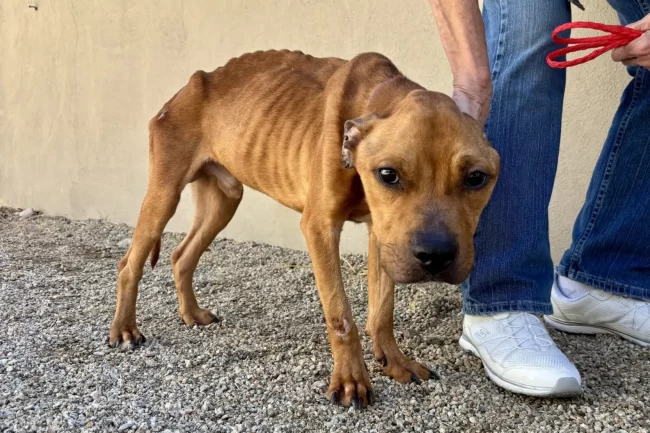
His ribs were sharply visible beneath his brown coat. His spine and hip bones stood out, and the sides of his head looked hollow. There was so little covering his frame that looking at him meant confronting how seriously his body had been depleted.
Chappo had arrived as a stray at The Animal Foundation in Las Vegas during the fall of 2025. His earlier life was largely unknown. There was no complete account explaining how a dog with his broad muzzle, expressive eyes, and gentle manner had reached such a dangerous condition.
The shelter could not recover those missing chapters simply by examining him. Its staff could, however, begin changing what happened next. Chappo needed people who would look closely at the suffering in front of them and keep looking after the first wave of shock had passed.
In an early photograph, he stands beside a caregiver wearing jeans and white shoes. The contrast is difficult to miss. His head appears much larger than the narrow body behind it, and every curve of his rib cage is visible. Yet his face draws the eye as strongly as his condition does.
He looks toward the camera with dark, attentive eyes. There is a whole dog there, someone with a personality the photograph can only begin to show. The image records his urgent need for care, but it also asks the viewer to see beyond the terrible thinness.
Inside his kennel, that need became clear in a smaller, quieter way.
There was a bed for him, but he lacked the strength to lift himself onto it.
That detail makes the extent of his weakness painfully understandable. A dog bed is such an ordinary thing. For a healthy dog, reaching it barely registers as an effort. For Chappo, even that small movement was beyond what his body could manage when he arrived.
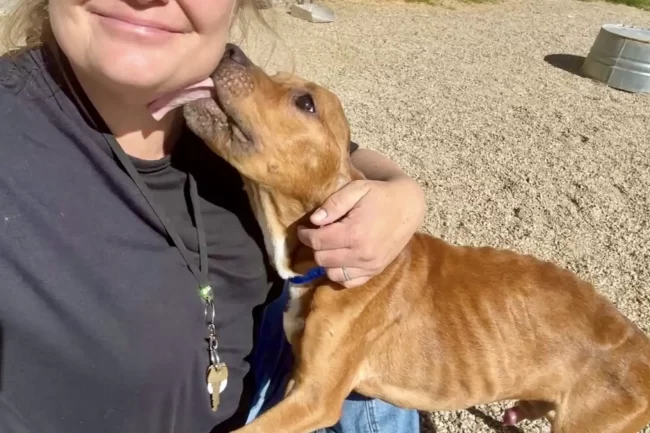
His shelter examination gave the team other reasons for concern. He had lost muscle, had sores on his hips, and was missing hair around his ears. His body condition was assessed at one out of nine, the lowest score on the scale. Bloodwork also showed abnormalities associated with severe malnutrition.
The number on the weight record told its own story: twenty-one pounds, less than half the weight the foundation said a healthy dog of his size should carry. This was a case for sustained veterinary attention, careful monitoring, and a recovery plan tailored to his condition.
The veterinary team began a strict refeeding program designed to help him gain weight safely. His care also required follow-up testing and continued assessment. The foundation described an ongoing commitment, with medical rechecks, nutrition, and the resources necessary to support him while his strength returned.
For those watching his story from outside the shelter, a later photograph would eventually make the improvement look immediate. Place the beginning beside the ending, and a remarkable transformation appears in a single glance. Chappo’s caregivers had to work through the time between those pictures.
They had to care for the dog who existed that day, before there was a healthy dog at home to reassure everyone about the outcome.
And Chappo gave them something tender to notice while they did.
Despite his condition, he welcomed gentle petting. Staff described how he leaned toward them when they approached. His body was struggling, but his interest in human affection was plainly visible. The people helping him were meeting more than an urgent medical case; they were getting to know a sweet dog.
Another early photograph captures that sweetness without needing to explain it. A gray-haired woman in a purple shirt sits on gravel against a wall. Chappo stands beside her, his head resting across her lap, while one of her hands supports the thin body at her side.
His bones are still prominent in that image. His recovery has not conveniently disappeared from view. What changes the feeling of the photograph is the contact between them: a hand beneath him, his head against her legs, a person making herself available to a dog who is willing to lean close.
It is a scene that holds two truths together. He was in terrible condition, and he remained capable of enjoying affection. His caregivers could address the first while making room for the second. Neither his medical needs nor his gentleness had to erase the other.
Then the shelter began sharing encouraging news.
In its October 28 update, The Animal Foundation reported that Chappo had gained seven pounds. He was moving around more. The team also described a milestone that could never be adequately expressed by the number on a scale: his tail had begun wagging.
After seeing him unable to reach his kennel bed, even a small sign of renewed activity carried meaning. There was still treatment ahead, and the foundation made clear that his recovery was ongoing. But the staff now had visible progress to share with the people following his care.
For a reader, a wagging tail may seem like an expected detail in a dog story. In this one, it belongs beside the weight checks and the medical updates. It shows something happening in the present that the earliest description could barely allow the reader to imagine.
Two days later, an October 30 update brought another encouraging figure. Chappo was twelve pounds above his arrival weight. The foundation reported that he was more active and was giving kisses to staff. The same dog whose weakness had been so alarming was becoming increasingly engaged with the people around him.
Those gains did not make the beginning less serious. They made the work of caring for him easier to see. The effort was showing up in his body and his behavior, in fuller contours and more movement, and in affectionate exchanges his caregivers could enjoy with him.
His supporters were part of that effort too. The foundation thanked people who donated toward his treatment and acknowledged a matching gift that helped fund his care. Behind an individual rescue are practical needs that continue after an animal has reached the shelter.
There are meals, examinations, tests, and people who need the means to keep providing them. Chappo’s updates made that connection visible. A contribution became part of a continuing response to the dog in those first photographs, helping the team move from an urgent intake toward a more hopeful future.
As the weeks passed, his story became less dominated by what his body lacked.
There was more room to describe the dog himself.
The photographs showed his willingness to stay close to people. The updates described a gentle, affectionate boy becoming more active. His personality had not been created by the improvement in his weight, but the recovery gave him greater opportunity to express it.
That distinction matters when looking at an animal whose first public introduction is a distressing picture. Chappo was never only a collection of visible ribs or a shocking number on a scale. Those details explained why he needed help. They could not explain everything someone might come to love about him.
By December, his recovery had brought him to the next stage. He was ready for adoption.
The goal now reached beyond keeping him safe during treatment. It extended toward a place in a family, where he could be known through everyday companionship. A shelter had given him the care to recover; a home could give that recovery somewhere to lead.
The welcome news followed. In a December 16 update, The Animal Foundation announced that Chappo had been adopted.
The dog who had arrived in critical condition was now with a family of his own. The organization described him as thriving, playful, intelligent, and energetic. These were the words surrounding the next chapter of his life, a striking change from the account of a dog unable to get onto a bed.
His family gave him a new name: Gumbo.
It was a small, affectionate detail at the end of an enormous change. The name Chappo would remain in the shelter’s early accounts, attached to the records and updates through which people had come to know him. Gumbo belonged to his life with the family who brought him home.
One later photograph offers a particularly lovely view of that life.
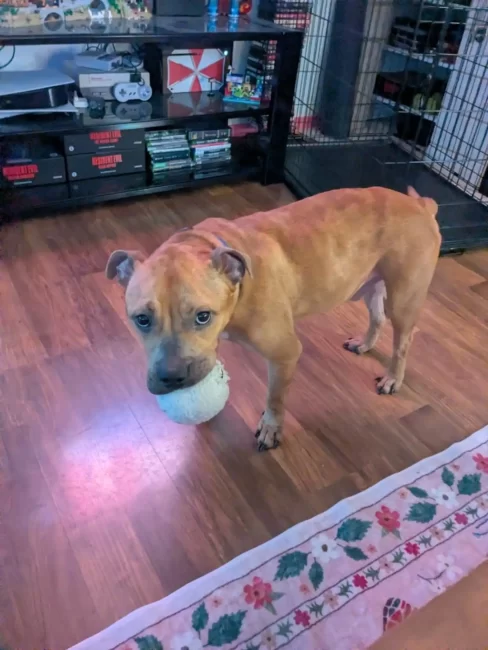
He stands on a wooden floor with a white plush toy held in his mouth. His body is fuller, his legs look sturdy beneath him, and the sharply exposed outlines of the earliest images have softened. An open crate and shelves form the ordinary background of a room.
The toy is what makes the picture especially memorable.
After so much attention to what his body needed, there he is with something to carry around simply because he is a dog. The image needs no dramatic setting. Its power comes from the comfortable ordinariness of a healthy animal standing indoors with a toy.
Someone encountering only that photograph might see a handsome brown dog at home and move on. Anyone who had seen the arrival images would have another picture in mind: the narrow frame, the visible bones, the dog standing beside a caregiver’s shoes.
Both photographs belong to the same life. The later one does not erase the earlier one, but it changes where the story can go.
Nobody can look into Gumbo’s mind and measure what he remembers of the time before the shelter. What the public updates do establish is enough: he survived a severe crisis, recovered under veterinary care, and joined a family who could welcome the playful dog his rescuers were delighted to describe.
The people who helped him could finally look toward a future larger than the next weight check. There would still be the ordinary responsibilities of caring for a dog, but those responsibilities now belonged within a shared life.
At the beginning, the most painful detail was a bed he could not reach.
At the end, the most moving detail may be a toy he could hold.
Between them were weeks of care, gradual improvement, community support, and people willing to stay involved until Chappo had the chance to become Gumbo.
The shelter had first introduced him through the urgency of his condition. His new home allowed another introduction: a brown dog with a fuller body, bright eyes, and a white toy in his mouth.
A dog whose story could finally include the simple pleasure of being somebody’s dog.