Part 2: I Carry My German Shepherd to the Couch Every Night — What She Once Dragged My Wife Through Changed Our Family Forever
Her name is Luna.
I brought her home to Austin when I was twenty-two and too broke for a dog that smart, that large, or that emotionally observant. In the first picture I still keep on my phone, she fits in one hand, all paws and oversized ears and dark eyes too serious for a puppy. In the second, taken eleven years later, she weighs eighty pounds and is lying flat across my chest on our living room floor because apparently personal space is for families without shepherds.
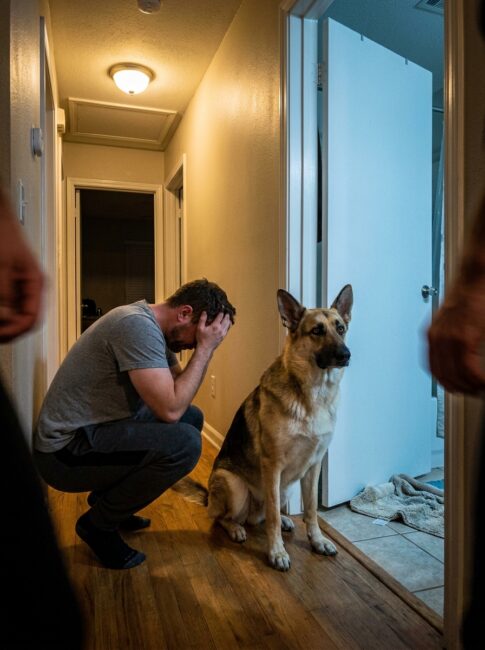
She has sable fur that darkens over her spine, a pale tan chest, one tiny notch in the tip of her left ear, and paws that always smelled faintly of dust and cedar after summer walks. Her eyes are amber-brown and too direct. The kind of eyes that make you answer questions nobody asked.
I was a graduate student when I got her, renting a duplex near North Loop and eating eggs for dinner often enough to become inventive. Luna learned me in my unfinished stage. Before marriage. Before fatherhood. Before the mortgage. Before I understood that adulthood is mostly endurance in nicer clothes.
She was there when I lost my first job and sat on the kitchen floor in the dark because I could not afford to call my father and tell him yet. She was there when I got hired again and ran circles in the yard like I had personally fixed the economy. She was there the first night my wife, Claire, stayed over and woke up to find a six-month-old German Shepherd sleeping across both of our feet like a customs officer.
And early on, even before I knew what mattered, I noticed one thing.
Luna never crossed into a bathroom.
Any bathroom.
Apartment. Rental. Hotel on a road trip. Our current house.
She would wait outside.
Every time.
I thought it was a quirk.
I know better now.
Eleven years is a long time to share a life with a dog.
Long enough for the dog to become the furniture of memory. Not in the boring sense. In the structural one. You don’t notice how much weight something carries until you imagine the room without it.
Luna was there through four jobs.
The first one I lost in eight months because the startup folded in the polished, cheerful language startups use when they run out of money. The second one kept us afloat but made me meaner than I liked. The third took me on the road too often. The fourth is the one I still have, which is less glamorous than stable, and at thirty-three I’ve learned stability is a kind of luxury.
Every time something shifted, Luna adjusted first.
New apartment in South Austin, she learned the stairwell by dark on the first night.
New office schedule, she started waiting by the front window ten minutes before my headlights hit the driveway.
New baby in the house, she moved her whole sleeping position to outside his room without being told.
Claire used to say Luna’s first language was vigilance.
That sounded dramatic then.
Now it sounds precise.
When Claire and I got married, Luna was four and had reached the perfect age for German Shepherds—old enough to be impressive, young enough to still believe every guest had arrived specifically to admire her. In our wedding photos, she is in the background of more frames than some relatives, sitting by the folding chairs with her ears up, watching everybody’s hands.
That was another thing.
Luna watched hands.
When people reached too fast toward the stroller later on, she noticed. When Claire cried quietly while chopping onions after a hard doctor appointment, Luna noticed. When I came home with my fists clenched from work and pretended I was “just tired,” Luna noticed that too.
She wasn’t a dramatic dog.
No jumping.
No frantic barking.
No movie-style heroics.
She’d just get close.
Head on a knee.
Body across a doorway.
That heavy shepherd lean against your thigh that says, in dog language, I know something changed.
There were ordinary years too, which are the ones that hurt most in retrospect because you don’t know you’re in them while they’re happening.
Saturday hardware-store runs with Luna in the backseat, nose split between two windows like she was monitoring both sides of civilization. Claire tossing her pieces of overcooked scrambled egg while our son Henry, still in footed pajamas, laughed from his booster seat. Summer evenings when Luna would lie under the patio table and bark once, insulted, if someone dropped ice into her water bowl too late.
Then came the miscarriage.
We almost never say that word out loud in our house.
Not because we’re ashamed of it.
Because it felt like a room we once barely escaped and then quietly locked.
Henry had been two. We had told no one yet. Claire had bought the test, folded it into a paper towel, and tucked it under the bathroom sink like hope needed a place to stay hidden for a week or two before becoming social.
I was traveling for work the night it happened.
Dallas. One-night client trip.
Hotel with bad coffee and a louder-than-necessary air conditioner.
Claire never called me.
That is part of the story, though I didn’t know it then.
All I knew at the time was that when I got home the next afternoon, the house felt scrubbed too clean. Claire said she’d had a rough night, that the ER doctor wanted her to rest, that everything medical was “handled.” She said the rest with her face turned toward the window. Luna was pressed so close to her on the couch they looked attached by grief or gravity.
I sat down beside them.
Luna put her chin on Claire’s leg.
Claire said, “Let’s not make this a thing people know.”
And because I loved her, and because men sometimes mistake privacy for protection, I agreed.
After that, Luna’s bathroom refusal hardened into law.
She would not cross a bathroom threshold again.
Not ours.
Not anyone’s.
She’d wait outside if Claire showered too long. She’d lie down in the hallway if I brushed my teeth at midnight. If Henry closed the bathroom door too fast, Luna would get up from sleep and come stand outside until he came out.
I noticed.
I did not understand.
Or maybe I understood enough to leave it alone.
Years went on.
We had one child instead of two.
Then no more pregnancies after that.
There are lives that break loudly and lives that change shape in silence. Ours was the second kind. We built around what happened. Claire went back to work. Henry got older. I traveled less. Luna aged the way good dogs do—gradually at first, then all at once in your noticing. She slowed on stairs. She stopped jumping into the car without negotiation. She developed the habit of waiting for me to lift her front half first when getting onto the couch.
Now every evening I hook one arm under her chest and one under her back hips and say, “Okay, old girl.”
She braces.
I lift.
She groans once.
We make it.
Claire always watches.
That matters too.
Because while I thought I was helping Luna onto the couch, another truth was living in the room with us.
Luna had been lifting Claire for years in ways that didn’t involve muscle at all.
This is the part most people would think is the ending.
The aging dog.
The man carrying her.
The wife who strokes the gray around her muzzle every night like gratitude has become a physical habit.
Our son is ten now. He still calls Luna “my sister with fur” when he forgets himself. Claire works from home three days a week and keeps an old quilt folded on the couch because Luna likes the extra traction under her back legs. We know what the X-rays say about her hips. We know the anti-inflammatory helps until it doesn’t. We know the stairs are going to stop being possible before either of us is ready.
Every night around 8:30, Luna gets up from the rug and looks at me.
Not barking.
Not asking.
Just that look.
So I rise from whatever I’m doing, put down the dish towel or the laptop or the half-read article about retirement accounts I never finish, and I go to her.
One arm under her chest.
One behind her hindquarters.
Her weight settling, trusting, absolute.
Then I carry her to the couch.
She turns once.
Claire pats the blanket beside her thigh.
Luna lies down with a groan and drops her head across Claire’s lap.
For a while, none of us talk.
It feels like one of those quiet family scenes people photograph for holiday cards and then crop into meaning later. The old dog. The wife. The husband doing the lifting. The soft domestic mercy of late love.
If I had written this story even a year ago, I might have stopped there.
I might have said the point was loyalty.
Or age.
Or how care circles back if you stay long enough.
That would have been true.
Just not true enough.
Because last fall, Luna slipped on the hallway runner and Claire cried out so sharply that Henry came running from his room and I nearly dropped a bowl in the sink. Luna hadn’t even fallen hard. Just enough to scare herself. Just enough to freeze.
Claire knelt beside her and said, “It’s okay, baby. It’s okay.”
Then, for reasons I didn’t understand in the moment, Claire started shaking.
Not sobbing.
Not loud.
The kind of body-shaking that begins before language arrives.
I helped Luna up first.
Then helped Claire sit down on the floor.
Henry hovered in the doorway.
I sent him to brush his teeth.
When the hallway quieted, Claire said, “We should probably tell him someday.”
I knew exactly what she meant.
I had been waiting for her to bring it up for eight years.
That night, after Henry was asleep and Luna was wedged against Claire on the couch, I asked, “Do you want me to know all of it now?”
Claire looked at Luna for a long time before she answered.
“Yes,” she said. “Before she goes.”
And just like that, the whole story turned over.
Claire told me what happened the night of the miscarriage in pieces.
Not because she was trying to be dramatic.
Because some memories don’t return in paragraphs.
She started bleeding after midnight.
At first she thought she could make it to the bathroom, sit down, breathe through it, become rational before it became dangerous. She did what women do too often when they have been trained to minimize their own emergencies—she tried to handle it privately.
Then the pain changed.
Then the blood changed.
Then she got lightheaded so fast she had to grab the edge of the sink and missed.
She went down hard on the tile.
The next part is what I had never known.
She couldn’t get up.
Not right away.
Not then.
She said the cold of the floor came first. Then the panic of understanding she could not stand. Then the humiliation of being alone in her own house, bleeding, holding onto the bath mat as if friction could solve anything.
Her phone was in the bedroom.
I was in Dallas.
Henry was asleep in the next room, too young to understand anything except that nighttime meant stay in bed unless someone came for you.
And Luna was in the hallway.
Claire said Luna never came into the bathroom.
She stood at the threshold and paced once, whining low in her chest.
Claire tried to call her.
Luna wouldn’t step in.
Instead, she did something else.
She came close enough to catch the sleeve of Claire’s T-shirt in her teeth and started pulling backward.
Not hard enough to hurt.
Hard enough to move.
One pull.
Then another.
Tile to rug.
Rug to hall.
Hall to bedroom door.
Claire said it took forever and no time at all. Luna kept tugging, repositioning, tugging again, until Claire could grab the trim by the bedroom and pull herself the last few feet into the hall.
Then Luna began barking.
Not normal barking.
Not at shadows or trucks.
One single explosive bark, over and over, directed at the front door.
She scratched.
Barked.
Scratched again.
The neighbors across the wall woke up. One of them came over. Then 911.
The doctor later told Claire another twenty minutes of blood loss might have changed everything.
I sat there on the couch while she told me this and felt that strange, useless male grief of discovering the worst night of your marriage happened partly outside your witness.
“She saved you,” I said.
Claire looked down at Luna.
“She got me to the door,” she said. “Then she made sure somebody came.”
That was why Luna never entered a bathroom again.
That was where she had found Claire.
That was the room she would not go back into.
And that was why every night, when Luna dragged her stiff body onto the couch and laid her head in Claire’s lap, I was not simply caring for an old dog.
Luna was still keeping watch over the woman she had once pulled back from the edge of dying.
Once Claire told me, everything rearranged itself so cleanly it made me feel stupid for having missed it.
Luna standing outside bathroom doors for eleven years.
Not fear.
Memory.
Luna watching Claire’s hands more closely after that year.
Not curiosity.
Monitoring.
The way she’d get up if Claire stayed in the shower too long. The way she planted herself in the hallway any time someone in the house was sick behind a closed door. The way Henry once laughed that “Luna thinks bathrooms are suspicious.”
Yes.
That was exactly it.
Suspicious.
Dangerous.
Costly.
A place where a person she loved had disappeared from one kind of life into another in the span of an hour.
There were other details Claire told me that night too.
How Luna had come to sleep pressed against her side for weeks afterward. How she’d stop dead if Claire cried in private. How once, six months later, Claire closed the bathroom door and Luna barked so urgently Henry started crying in his crib because he thought something bad was happening again.
Claire said, “I think I didn’t tell you because if I said it out loud, then what happened would stop being mine.”
I understood that.
Or tried to.
Some pain belongs to the body before it belongs to the story. Some rescues do too.
After that conversation, I started seeing our evenings differently.
Claire on the couch.
Luna’s head on her lap.
My hands under Luna’s old hips.
This was not one-way care.
It was a circle we had entered years ago and only just understood.
There’s a sentence I can’t stop thinking about from what Claire said that night. She told me the most terrifying part was not the blood. Not even the pain. It was the moment on the tile when she realized no one knew where she was.
Then Luna touched her shirt sleeve and started pulling.
That image follows me.
Not because it is cinematic.
Because it is practical.
It is what love looks like when it doesn’t have language and refuses to wait for one.
A few weeks after the conversation, I asked Claire whether she regretted not telling me earlier.
She said, “I needed one thing from that night to stay only between me and her.”
Then she looked at Luna and added, “Until now.”
Luna is slower these days.
She slips sometimes.
She needs help into the SUV.
She no longer chases delivery trucks with moral outrage.
But if Claire cries in the kitchen, Luna still gets up.
If the bathroom door stays closed too long, Luna still waits in the hall.
If Claire lies down on the couch midafternoon and says she’s “just tired,” Luna climbs as much of herself onto the blanket as her hips allow and lays one paw against her thigh like a marker.
Not done.
Still here.
Still watching.
I think there are probably thousands of families with stories like this that never get told because they belong first to pain, then to marriage, then to memory. Maybe that is right. Maybe not every act of rescue needs a witness.
But Luna is near the end now.
And I have reached the age where silence starts feeling less like privacy and more like theft.
Somebody should know what she did.
Now our nights follow a script none of us wrote and all of us depend on.
At 8:30, Luna stands.
I lift her.
Claire clears the blanket.
Henry, if he’s still awake, moves his homework so there’s room.
Then Luna settles.
Always against Claire.
Always with one flank pressed close enough to feel.
Afterward, I do one strange thing that would sound silly to anyone outside this house.
Before I go to bed, I crack the bathroom door open two inches.
Every night.
Not because Luna will walk in. She never does. But because I want her to see the light on the tile and the hall beyond it and know nobody in this house is alone behind a closed door anymore.
Sometimes she glances that way from the couch.
That is enough.
Henry knows more now, though not all of it. He knows Luna “helped Mom when she was very sick once.” He knows old dogs can remember hard things. He knows that when Luna lies against his mother, it is not neediness. It is work.
Claire has started talking more too.
Not about the night itself, not in detail. But about the pregnancy. About names they never picked. About grief that stayed in the shape of a missing sibling our son cannot picture but still somehow counts.
Luna lies with her during those conversations.
As if she recognizes the territory.
Tonight I lifted Luna onto the couch the way I always do.
One arm under her chest.
One under her hips.
That old soft grunt halfway up.
Claire laughed because Luna’s back foot kicked my leg on the way down to the cushion, and for a second the room felt almost ridiculous instead of fragile.
Then Luna turned once and laid her head across Claire’s lap.
Outside, it was raining.
Henry was upstairs.
The dishes were half done.
The bathroom light was on in the hall.
Claire rested her hand between Luna’s ears and kept it there.
There are people who would look at this scene and think they understand it.
Old dog.
Tired family.
Small domestic mercy.
Let them.
I know better now.
I am not carrying Luna to the couch because she used to carry us and now it’s my turn.
That’s too neat.
The truth is messier.
Luna is still carrying Claire.
Still guarding the woman she dragged toward help with her teeth and her body and the stubborn refusal to let a closed door become the end of the story.
And maybe that’s what love becomes if it survives long enough.
Not romance.
Not language.
Not even memory exactly.
A task.
Repeated gently.
For years.
So every night, I lift her.
Every night, Claire makes room.
Every night, Luna keeps watch.
And the bathroom door stays open.
Share this with someone who still owes their dog more than words.