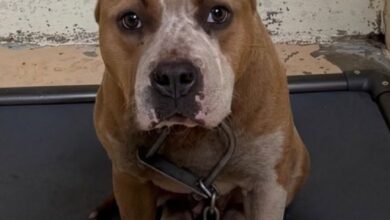
Part 2: The Three-Legged Pit Bull Threw Himself in Front of a Departing Ambulance—Then a Weak Knocking Sound Came From Behind Its Closed Doors
Part 2 — The Name That Stopped Him
The rear doors could not remain open for long. Daniel was stable enough to transfer, but he still required oxygen, monitoring and timely evaluation at the regional cardiac center.
Paramedic Lisa Chen opened the right door only twelve inches while her partner stood inside.
Roscoe pushed his nose toward the gap.
Daniel’s hand appeared from beneath the blanket. His fingers shook as he reached toward the dog, but the stretcher restraints and monitoring leads kept him several feet from the doors.
“Easy, boy,” he whispered.
Roscoe’s front paws slid on the wet step. He tried to climb, placing almost all his weight on his shoulders, but the height was too great for a dog with one remaining hind leg.
I slipped an arm beneath his chest before he fell backward.
He twisted away instantly.
His lips tightened, and his body became rigid, yet he did not bite. The reaction was not directed aggression. Roscoe had spent years balancing without a left hind limb; being lifted removed the three points of contact he depended upon.
I let go.
He returned his muzzle to the opening.
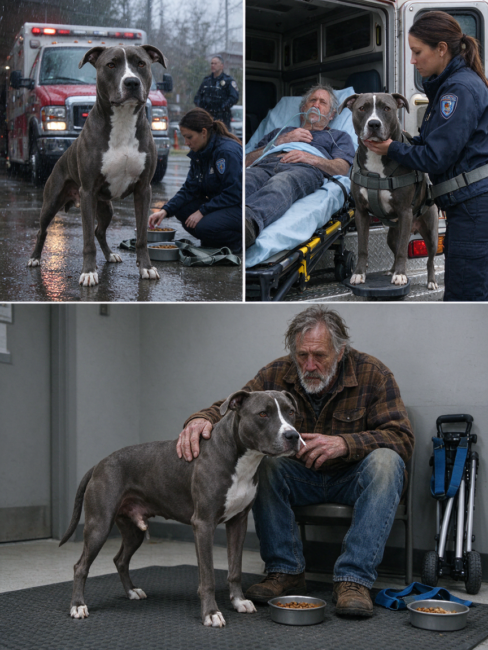
Daniel’s fingertips finally reached the white stripe above Roscoe’s nose. The dog stopped panting. For three seconds, amid idling engines and rain striking the metal canopy, he became completely still.
“He followed me?” Daniel asked.
Lisa explained that nobody knew how Roscoe had reached the hospital. Daniel closed his eyes.
“He always follows the truck sounds.”
That sentence gave us our first piece of the route.
Emergency medical technicians had found Daniel unconscious beneath the Preston Street overpass about two miles away. Roscoe had apparently been nearby when the ambulance left. With no rear left leg and no protection from the rain, he had followed its lights or engine through downtown.
The calluses beneath his front pads suddenly made sense.
Roscoe had not wandered into the ambulance bay and become trapped. He had tracked the vehicle carrying Daniel.
The hospital could not allow him inside the transfer ambulance. The crew had no animal restraint equipment, and an unsecured dog could interfere with patient care.
Daniel understood, but Roscoe did not.
When Lisa began closing the door, the dog inserted his nose into the gap. She stopped before touching him.
I placed the chicken beside his front paw. He ignored it.
Security officer Paul suggested calling animal control. They could transport Roscoe to the municipal shelter, but their morning shift would not reach us for at least forty minutes.
The ambulance needed to leave sooner.
I carried a collapsible rescue crate in my van, along with a ramp designed for dogs with limited mobility. The plan seemed straightforward: position the crate beside the ambulance, let Daniel remain visible while I coaxed Roscoe inside, then transport the dog separately.
But when I unfolded the metal frame, Roscoe recoiled.
He lowered himself so abruptly that his chest struck the pavement. His remaining rear leg kicked backward, searching for traction. He crawled beneath the ambulance before I could close the distance.
Now he was directly behind the rear axle.
The crew could neither move forward nor reverse.
We had mistaken his refusal to enter the crate for stubbornness. His flattened body, rapid blinking and frantic backward motion indicated something more specific: the metal enclosure frightened him.
Daniel tapped weakly on the door again.
“Don’t cage him,” he called.
I moved closer to the viewing panel. “Has he been trapped before?”
Daniel looked toward the floor.
“I met him in one.”
Two years earlier, Roscoe had appeared behind an abandoned tire shop with his missing limb already healed. His body had been caught inside a rusted shopping cart tipped onto its side. Nobody knew whether he had crawled inside seeking food or whether someone had put him there.
Daniel had used a broken broom handle to pry the wire apart.
Roscoe escaped without allowing himself to be touched.
For eleven days, the dog remained near the overpass but would not approach Daniel. Then one night, Daniel divided his only hot meal—a container of rice, chicken and beans—and placed half beneath a concrete pillar.
Roscoe ate after Daniel turned away.
The next evening, Daniel did the same.
He had continued sharing whatever food he received for almost two years.
Daniel had never owned Roscoe in a legal sense. He had no leash, collar, veterinary paperwork or home where the dog slept.
Still, every night, Roscoe returned to the same man.
I folded the crate and moved it out of sight. Then I sat on the wet pavement beside the ambulance, leaving several feet between us.
Roscoe watched Daniel’s hand through the narrow window.
I placed an open transport harness beside me—a broad, soft model that would support his chest and abdomen without enclosing him.
For the first time, Roscoe looked away from the ambulance.
But before he approached the harness, Daniel’s monitor sounded inside.
The paramedics closed the doors fully.
And the instant Roscoe lost sight of him, the dog began throwing his entire three-legged body against the rear step.
Part 3 — Half of Every Meal
Roscoe struck the step twice before I slid between him and the ambulance.
He did not try to pass me. He stopped with his broad forehead pressed against my knee, trembling so hard that the muscles along his shoulders rippled beneath his wet coat.
Inside, the monitor alarm ended quickly. One of Daniel’s leads had loosened when he reached toward the door. His condition had not suddenly deteriorated.
Roscoe could not know that.
All he knew was that Daniel had disappeared behind metal doors.
I laid the open harness flat on the ground and covered its buckles with my scarf so they would not reflect beneath the lights. Then I moved away.
Paul created a wide perimeter around us. The driver switched off the headlights, leaving only the softer canopy lights above the entrance.
The change helped.
Roscoe’s breathing slowed enough for him to sniff the harness.
Daniel spoke through the rear door.
“Find the blue strap, boy.”
Roscoe’s head lifted.
The phrase sounded practiced.
Daniel later explained that he once carried a blue nylon strap found beside the river. It was not a leash. He looped it loosely around Roscoe’s chest whenever they crossed a busy road, allowing the dog to lean into it for balance.
A city sanitation crew had discarded the strap several weeks earlier with unattended belongings near the camp.
Daniel had thought Roscoe no longer needed it.
The dog remembered.
I turned the harness so its padded chest section faced him. Roscoe placed one front paw on it, withdrew and looked toward Daniel’s voice.
“Blue strap,” Daniel repeated.
Roscoe stepped forward.
I did not pull the harness over his head. Instead, I opened every buckle and wrapped the padding gently around his chest and abdomen while all three paws remained on the pavement.
He flinched when my hand passed near his healed left thigh. The limb ended cleanly at mid-thigh, with no redness, open tissue or swelling. The sensitivity seemed related to balance and unfamiliar handling rather than a fresh injury.
Once the buckles were secured, I attached two short leads.
Roscoe remained beside the ambulance.
The harness solved our handling problem, but not our separation problem.
Daniel whispered something to Lisa. She climbed down with a small clear belongings bag containing his rain-soaked coat.
Inside one pocket was a flattened paper napkin wrapped around half a biscuit.
Daniel had saved it from the hospital meal tray.
“Give him that,” he said.
Lisa opened the napkin and placed the biscuit in my palm. Roscoe smelled it from several feet away.
This time, he ate.
He did not take food because his hunger had finally defeated him. He took it because the biscuit carried Daniel’s scent and had been offered through the same familiar ritual: one portion kept, one portion shared.
That discovery changed how we approached him.
I stopped trying to lure Roscoe away from Daniel. Instead, we created a way for him to accompany the transfer.
My organization’s rescue van could follow the ambulance to the regional medical center. Roscoe would ride on a padded platform secured behind the front seats, wearing the supportive harness rather than entering a crate.
Daniel listened while Lisa explained the arrangement.
“You stay behind us?” he asked me.
“The whole way.”
He looked toward the doors. “Tell him.”
I doubted a sentence from a stranger could settle Roscoe, but I knelt anyway.
“We’re following Daniel.”
Roscoe watched my face.
Then Lisa tapped twice from inside the ambulance.
Daniel answered with one weak tap.
Roscoe turned toward the sound and allowed me to guide him toward the ramp.
He placed both front paws on it, but when he tried to push upward, his right hind foot slipped. He fell onto his healed left side and scrambled away.
The wet aluminum surface was too slick.
We covered the ramp with rubber-backed hospital mats and reduced its angle by parking beside a curb. This time Roscoe climbed slowly, pausing after every hop.
At the top, he turned and stared at the ambulance.
I clipped his harness into two vehicle restraints and opened the side window enough for him to hear outside sounds.
The ambulance started first.
Roscoe surged against the straps.
Then the rear lights came on, and Daniel tapped twice from inside.
Roscoe stopped pulling.
During the entire drive, he stood facing the windshield. His front legs absorbed most of the vehicle’s motion, while his single rear leg remained braced wide beneath him.
At every red light, he whined until the ambulance moved again.
We reached the regional medical center seventeen minutes later. Daniel’s vehicle entered the patient bay, but security directed me toward a public parking area.
Roscoe watched the ambulance disappear behind automatic doors.
His body stiffened.
We had kept our promise to follow.
We had not prepared him for the moment Daniel vanished into a building where dogs were not allowed.
Part 4 — The Blanket Outside Room 314
Roscoe refused to leave the van for nearly an hour.
The rain had weakened to a fine mist, but the temperature remained below forty degrees. I opened the side door and sat on the pavement without pulling his leads.
He stood with his chest facing the hospital entrance.
Every time an ambulance arrived, he shifted forward. When the doors opened and another patient emerged, his ears dropped again.
The medical center could not admit him to Daniel’s room. Even trained service animals required specific access considerations, and Roscoe had no vaccination records, identification or established handler capable of managing him.
Leaving him outside was not safe either.
Our rescue had a small veterinary partner four miles away. Roscoe needed an examination, dry bedding and time off his overworked paws.
I expected another struggle.
Instead, when I unfolded the same harness strap toward the clinic van, Roscoe stepped onto the ramp. Daniel’s biscuit wrapper remained tucked inside my coat pocket.
He followed its scent.
Dr. Aisha Grant examined Roscoe on a floor mat rather than lifting him onto a table. She estimated that he was five or six years old.
The missing left hind limb had healed long ago. The skin was intact, and the remaining femur ended well above where a lower-leg prosthetic could be fitted without specialized evaluation. Roscoe had adapted by carrying additional weight through his shoulders and right hind leg.
His disability itself was not an emergency.
The consequences of the two-mile pursuit were.
Both front paw pads were abraded, though not deeply torn. His right hind leg showed muscle fatigue, and the joints of his front limbs were strained from years of compensating for the missing leg.
Dr. Grant prescribed rest, protective dressings for his paws and controlled movement. She also recommended future assessment for a custom mobility cart for longer outings—not because Roscoe could not walk, but because distance and slippery surfaces placed excessive stress on his three remaining limbs.
He accepted the examination only when Daniel’s coat lay beside his head.
Whenever someone moved it, Roscoe followed.
I called the medical center’s social worker, Ellen Price, for an update. Daniel had undergone testing and remained under observation. His condition was serious but stable. The doctors expected to know more within twenty-four hours.
Ellen had also uncovered something we did not anticipate.
Daniel had refused a shelter placement three times during the previous year because the programs available to him could not accept Roscoe.
On paper, it appeared that he had declined housing.
In reality, every offered bed required him to abandon the dog who slept near him, shared his food and alerted other people when he became ill.
Roscoe had not merely followed Daniel’s ambulance.
He was one reason Daniel had remained outside.
Ellen began contacting medical-respite programs that accepted companion animals. The list was short. One had no openings. Another accepted only dogs below forty pounds. Roscoe weighed fifty-seven.
The third facility, Harbor House Respite, agreed to review the case if Roscoe received vaccinations, an identification microchip and a behavioral assessment.
Those were reasonable requirements.
They also took time.
That afternoon, hospital staff allowed one controlled meeting in a covered courtyard accessible from Daniel’s floor. Roscoe could not enter the clinical room, but Daniel’s bed could be rolled to the glass doors.
We covered Roscoe’s paw dressings with protective booties and supported him with the harness. He hopped across the wet courtyard, searching every window.
Then Room 314’s doors opened.
Daniel lay beneath a blue blanket, paler than before but awake.
Roscoe stopped ten feet away.
His tail remained low. His head tilted. He appeared uncertain, perhaps because the hospital gown, oxygen tubing and strong antiseptic odor changed Daniel’s familiar outline.
Daniel lifted his hand.
“Blue strap.”
Roscoe moved.
He reached the bed, placed both front paws carefully on the lower frame and pressed his muzzle into Daniel’s palm.
Daniel could not bend far enough to embrace him. He rested two fingers against the white stripe on Roscoe’s nose.
The dog remained there until his front legs began shaking.
I expected Roscoe to resist when we guided him away. Instead, Daniel pointed toward the blanket we had placed near the doors.
“Down, boy.”
Roscoe lay on it.
That was our next surprise. Daniel had never described Roscoe as trained, yet the dog understood a handful of practical words: strap, wait, road, down.
They were not commands learned in a formal class. They were survival language, built during two years of crossing streets, sharing meals and sleeping beneath concrete.
When the doors closed, Roscoe did not throw himself against them.
He kept his nose against Daniel’s blanket and watched the room.
The obstacle was no longer persuading Roscoe that Daniel still existed.
It was finding a place in the city where both of them would be allowed to recover together.
Part 5 — What the Veterinarian Found
Roscoe spent his first night at the veterinary clinic in a ground-level recovery run.
No metal crate surrounded him. A waist-high barrier formed the front, and a rubber floor protected his remaining limbs from slipping. Daniel’s coat rested beside a thick orthopedic mat.
Roscoe did not use the bed.
He lay on the coat facing the door.
At 2:10 a.m., a technician found that he had pushed his untouched food bowl beneath the blanket. We first assumed stress had eliminated his appetite.
Then Ellen called from the hospital.
Daniel had been served dinner but had eaten very little. Before the tray was removed, he asked staff to save half of a plain turkey sandwich “for the dog.”
The hospital could not transfer patient food directly to an animal, but the request told us what Roscoe was waiting for.
For two years, meals had arrived through Daniel.
Roscoe had learned that eating first meant taking the portion that might belong to his person.
Dr. Grant recreated the pattern safely. She prepared two small bowls, sat on the opposite side of the barrier and pretended to eat from one before sliding the second toward Roscoe.
He watched her.
She took another bite from her own breakfast.
Roscoe lowered his head and ate.
His refusal was not evidence that he was medically declining. It was a ritual of shared survival.
The veterinary assessment brought another reversal. Many people assumed Roscoe had lost his leg while living outside with Daniel.
Radiographs indicated the amputation had probably been performed surgically years earlier. The bone end was smooth, the soft tissue closure was deliberate and there was no sign of a traumatic healed fracture.
At some earlier point, Roscoe had likely received veterinary care.
He may once have belonged to someone.
There was no microchip, however, and searches through local lost-dog reports revealed no reliable match. The old surgery did not tell us why he later appeared inside a rusted shopping cart or how long he had lived without stable care.
We resisted filling the silence with an invented tragedy.
What mattered was visible: Roscoe had adapted well, but years of long-distance hopping had placed chronic strain on his front limbs and right hip. His future required weight management, nonslip flooring, regular veterinary monitoring and shorter walks.
The next day, Daniel received his diagnosis. He had experienced an abnormal heart rhythm complicated by dehydration and exposure. Medication and monitoring stabilized him, but discharge back beneath the overpass would put him at immediate risk.
Harbor House approved his medical-respite application.
They approved Roscoe too.
There was one complication: their only animal-friendly ground-floor room was being repaired after a pipe leak. It would not be available for ten days.
Daniel could remain hospitalized for only part of that period. Roscoe could stay at the clinic, but separation was wearing on both of them.
During their second courtyard visit, Daniel seemed more concerned about Roscoe’s paw bandages than about his own monitor.
“What happened to him?”
“He ran a long way on wet pavement,” I said.
Daniel looked at the dog. “I told him not to follow trucks.”
Roscoe placed his muzzle against the mattress frame.
Daniel’s voice dropped. “He never listened when it mattered.”
The hospital arranged for Daniel to spend the remaining days at a temporary rehabilitation unit. Animals were not permitted inside, but the facility had an enclosed patio where brief daily visits could occur.
Those meetings became Roscoe’s schedule.
At 9:00 each morning, he accepted breakfast.
At 1:30, we fitted his supportive harness.
At 2:00, he waited beside the patio door.
On the fourth visit, Daniel sat in a wheelchair rather than lying in bed. Roscoe paused when he saw the unfamiliar shape.
Daniel tapped the blue padding of the harness.
Roscoe approached.
I placed a rubber mat beside the wheelchair. The dog lay with his white chest patch touching Daniel’s shoe.
Neither of them needed to be fed or coaxed.
For nineteen minutes, they simply stayed there.
Then a therapy aide moved the wheelchair backward. One caster rolled over the edge of Roscoe’s blanket, tugging it suddenly.
Roscoe panicked.
He scrambled upright, slipped on his right hind foot and struck the side of the chair. The aide froze. Daniel leaned down, but the movement frightened Roscoe further.
I guided him onto the nonslip mat and checked his limbs. Nothing appeared broken, but he refused to bear full weight on the right hind leg.
Without that leg, Roscoe had no second rear limb to compensate.
A minor strain for a four-legged dog could temporarily remove a three-legged dog’s independence.
The reunion program stopped immediately.
Dr. Grant ordered strict rest and anti-inflammatory treatment while we waited to learn whether the leg Roscoe depended upon most would recover.
Part 6 — Learning to Accept Four Wheels
The radiographs showed no fracture.
Roscoe had strained the muscles around his right hip while trying to recover from the slip. Dr. Grant expected improvement, but only if we prevented him from repeating the same movement.
That was difficult.
When Roscoe heard the clinic door open, he tried to stand. When a vehicle with a diesel engine passed, he dragged himself toward the window.
His drive to follow Daniel now threatened the only hind leg he had left.
For five days, visits took place by video. Daniel appeared on a tablet outside Roscoe’s recovery pen.
The first time, Roscoe searched behind the screen.
Daniel spoke.
“Blue strap, boy.”
Roscoe turned toward the sound, sniffed the tablet and lay beside it. He did not understand the image as we did, but the familiar voice slowed his breathing.
The setback forced us to introduce the equipment Dr. Grant had recommended sooner than planned: a lightweight mobility cart supporting Roscoe’s rear body during longer movement.
It was not a replacement for his missing leg. It was a tool that could protect the right hind limb while allowing controlled exercise.
Roscoe hated it initially.
The aluminum frame reminded him of the shopping cart where Daniel had found him. When the wheels moved behind him, he flattened his ears and tried to turn in a tight circle.
We stopped after twelve seconds.
The next day, the cart remained across the room while Roscoe ate.
On day three, we placed Daniel’s coat over its frame.
On day four, Roscoe approached and sniffed one wheel.
Nobody strapped him into it.
Progress depended on giving him the ability to retreat.
Daniel recorded several short phrases for us: “Find the strap.” “Easy road.” “Wait.” “I’m right here.”
We played only one at a time. The voice was not used to force Roscoe forward; it connected unfamiliar equipment to movements he already understood.
After a week, he accepted the padded support beneath his abdomen without the wheels attached.
Two days later, Dr. Grant added the frame.
Roscoe stood still.
I placed a piece of turkey three feet ahead. He ignored it.
Then Daniel’s recording said, “Easy road.”
Roscoe stepped forward.
The wheels rolled soundlessly behind him. He stopped after one pace, looked back and tried again.
Three steps.
Then six.
His posture changed as he realized the cart was not trapping him. It carried part of his rear weight and prevented the familiar drop toward his missing left side.
By the end of that session, Roscoe crossed the room without falling.
His right hind leg still touched the ground lightly, but it no longer absorbed every impact. His shoulders relaxed. For the first time since I met him, he moved without the hard side-to-side hop that had marked each stride.
The cart did not make him whole.
Roscoe had already been a complete dog on three legs.
It simply gave his remaining joints another way to endure distance.
When Harbor House’s ground-floor room became available, Daniel arrived first. The space contained two single beds, a small table and a door opening onto a fenced courtyard.
One bed was for Daniel.
The other had been removed to create room for Roscoe’s orthopedic mat, food station and mobility cart.
Roscoe entered the building using his harness, not the cart. His paw pads had healed, and his right hip was improving. He crossed the lobby cautiously, pausing whenever the floor changed from rubber to tile.
Daniel waited in the room.
Roscoe reached the doorway and froze.
He had never followed Daniel into a place with walls, heat and a door that closed behind them.
Daniel sat on the edge of his bed and divided a turkey sandwich onto two paper plates. Roscoe watched him set one portion on the floor.
“Half for me,” Daniel said. “Half for you.”
Roscoe ate.
That night, staff expected him to sleep beside the exit. Instead, he chose the space between Daniel’s bed and the courtyard door.
At 3:00 a.m., a monitor alarm sounded in another room. Roscoe stood and moved toward the hallway, but Daniel called his name.
The dog stopped.
He looked back.
Then he returned to the mat.
For two years, following every urgent sound had helped him keep Daniel in sight. Inside Harbor House, Roscoe began learning a different rule:
Sometimes the person he loved would still be there when the noise ended.
Part 7 — The Meal That Stayed Whole
Daniel remained at Harbor House for twelve weeks.
His recovery was not linear. Some mornings he walked the courtyard twice. On others, dizziness forced him to sit after several steps.
Roscoe’s progress followed a similar rhythm.
He used three legs for short indoor distances and wore the support harness on wet pavement. His mobility cart was reserved for longer walks, protecting his right hind leg and overworked front limbs.
The missing left hind limb remained exactly what it had always been: a permanent part of his body, not a flaw the ending needed to erase.
Harbor House staff learned their signals.
When Roscoe touched his nose to the blue harness, he wanted to go outside. When he sat beside Daniel’s medication drawer, it usually meant the morning routine had been delayed.
Nobody called him a medical-alert dog. He had no formal training, and staff did not rely on him for clinical decisions.
But he knew Daniel’s patterns.
And Daniel knew his.
The most important change involved food.
During their first month indoors, Daniel continued dividing every meal. Even when Roscoe had already eaten veterinary food, Daniel saved bread, meat or potatoes from his own plate.
A nutrition counselor explained that Roscoe needed a controlled diet to protect his joints. Daniel nodded, but the old habit persisted.
Sharing had kept Roscoe alive.
It had also allowed Daniel to feel useful during years when almost everything else had been taken from his control.
The counselor did not tell him simply to stop.
Instead, Harbor House created a new ritual. At mealtime, Daniel measured Roscoe’s approved food into two cups. He poured the first half into the bowl, waited, then added the second.
“Half and half,” he said.
Roscoe accepted it because Daniel still performed the division.
Nothing unsafe came from Daniel’s plate, yet the meaning survived.
By the ninth week, Daniel qualified for a supportive-housing apartment on the ground floor. The building allowed companion animals and stood less than a block from a bus route and community clinic.
Roscoe’s behavioral assessment described him as cautious with confinement, tolerant of respectful handling and strongly bonded to Daniel. The rescue completed his vaccinations, microchip registration and veterinary plan.
The adoption paperwork presented a question nobody had asked clearly before.
Who owned Roscoe?
Daniel stared at the form.
“He stayed because he wanted to,” he said.
“That can still be true,” I told him. “The paperwork means nobody can separate you by calling him unclaimed.”
Daniel signed.
The man once recorded as having no emergency contact listed Roscoe’s microchip number beside his new address.
Moving day came beneath another gray November sky, almost one year after the ambulance bay.
Roscoe wore the same blue support harness. His mobility cart was folded in the rescue van for longer outings, but he crossed the short walkway on three legs.
A medical transport vehicle pulled to the curb behind us.
Roscoe stopped.
His body shifted forward. His ears rose, and his front nails pressed into the wet concrete.
For a moment, I saw the dog who had planted himself beneath an ambulance’s headlights, prepared to spend the last strength in his body preventing Daniel from disappearing.
The vehicle passed without stopping.
Roscoe watched it turn the corner.
Then Daniel called from the apartment doorway.
“Easy road.”
Roscoe looked back and hopped toward him.
Inside, the apartment contained little more than a bed, a chair, two bowls and a donated table. Nonslip runners formed a path from the bedroom to the kitchen. A low platform beside the window gave Roscoe a place to rest without jumping.
Daniel unpacked their first meal.
He prepared Roscoe’s measured food and divided it between the two cups. Then he opened his own sandwich.
For the first time, he did not tear it in half.
Roscoe ate from his bowl without waiting for food from Daniel’s hand.
Nothing had been withheld from him. There was simply enough for both.
Afterward, Daniel sat beside the window. Roscoe approached, turned carefully and lowered himself across the man’s shoes. His healed left thigh rested against the rug; his three paws loosened beneath him.
Daniel placed one hand on the white stripe across his muzzle.
Two years earlier, a man without a home had offered half of one meal to a dog trapped in metal.
A year earlier, that same dog had stopped an ambulance because he refused to let the man vanish behind another metal door.
Now an ordinary front door stood ten feet away.
It was unlocked.
Roscoe did not guard it.
He slept.
Follow our page for more powerful dog rescue stories about loyalty, recovery and the quiet bonds that can return two forgotten lives to safety.