Part 2: Everyone Passed the Scarred Pit Bull Because His Coat Made Them Uncomfortable — Then a Twelve-Year-Old Foster Girl Asked Whether He Was Afraid of Strangers, and the Entire Shelter Went Quiet
Part 2, The Names Written in Red
My name is Claire Benton, and at thirty-nine I had become good at reading the language institutions use when they are afraid of responsibility.
“History unknown” sometimes meant nobody had bothered to ask.
“Placement unsuccessful” could describe anything from aggression to a landlord changing his mind.
“Failed match” often placed equal weight on a powerless animal and the adults who had made every decision around it.
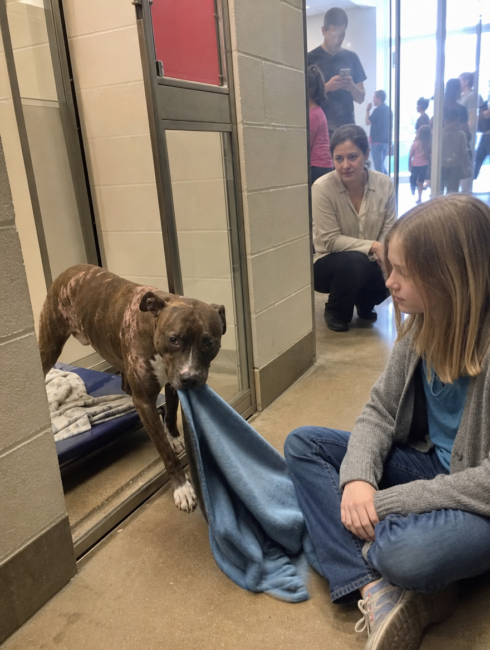
Rowan’s file contained all three phrases.
Animal control had brought him to Riverbend eight months before June arrived. A highway maintenance worker found him tied outside a closed veterinary clinic shortly before sunrise, wearing a wide brown collar without tags. Beside him sat a plastic grocery bag containing antibiotics, burn cream, a child’s blue blanket, and discharge paperwork damaged by rain.
The papers listed only the dog’s first name.
ROWAN.
His microchip had migrated beneath scar tissue and initially escaped detection. The clinic named on the paperwork had closed after its owner retired, and the telephone number led to an empty office. Nobody knew who had treated him or why he had been left.
His scars were already healing.
The largest pale area crossed his right shoulder. Narrower lines traveled along his neck and ribs. Our veterinarian believed some came from heat and others from sharp metal, but none matched the pattern associated with organized dog fighting.
That did not stop people from assuming.
Rowan’s appearance became his history because his real history was missing.
He had peculiar habits. He refused to cross red-painted thresholds. The moment keys rattled behind him, he lowered his body and searched for cover. He slept facing the kennel door but panicked if someone closed it while he watched.
He also collected blankets.
Every morning, he pulled his bedding from the cot and arranged it against the wall. If another frightened dog occupied the neighboring kennel, Rowan pushed one corner beneath the divider until the other animal could reach it.
The behavior was not dramatic enough for social media.
It was simply consistent.
During his fourth month, a couple from Franklin took him home for a trial. They returned him after three days. Their eight-year-old daughter had cried when Rowan entered her bedroom, and the parents said his scarred face made her afraid.
Our follow-up notes recorded something different.
The child had not cried because Rowan approached her. She cried because her parents had told her he might hurt her. Rowan had responded by backing into a laundry room and refusing food.
The family still returned him.
His card acquired the red tab.
June had her own red marks, though hers appeared in a much thicker file.
She entered foster care at six after an unstable home became unsafe. The scar at her temple came from broken glass during an argument between adults. She was not responsible, but children at school asked what she had done. One foster parent insisted she cover it for family photographs because strangers might “get the wrong idea.”
She began covering it everywhere.
June’s first placement lasted fourteen months. The foster mother became ill, and June moved again. Her second family hoped to adopt an infant and no longer had space. The third home dissolved during a divorce. In the fourth, June stopped unpacking.
By the time she met Elena, she kept most belongings in two soft bags.
She did not hang pictures.
She memorized where adults stored their car keys.
She slept facing the bedroom door.
Those details had been described as hypervigilance in her assessments. They sounded almost identical to the behaviors listed in Rowan’s file.
Elena was a forty-six-year-old middle school counselor with a small brick house in East Nashville, a fenced backyard, and the patience to let June keep her bags packed for three months. She never promised adoption in the first week. She did not call herself Mom. She asked before entering June’s room.
Slowly, June began leaving objects behind.
A book on the sofa.
Sneakers beneath the kitchen table.
A blue mug beside the sink.
Elena considered each item an act of trust.
Nine months after June arrived, Elena filed a petition to adopt her. She did not immediately tell June because two earlier families had announced plans before completing the process. One withdrew after a job transfer. Another decided that June was not “bonding fast enough.”
Elena wanted the court date secured before speaking.
It was a careful decision.
It was also a secret.
The shelter visit was meant to give June a voice in forming the household she might soon call permanent. Elena believed choosing a dog together could show June that families were built through shared decisions.
She had expected a senior Beagle or an easygoing Golden Retriever.
She had not expected Rowan.
After the first meeting, June asked to see his medical records. She read slowly, moving one finger beneath each sentence.
When she reached the phrase possible bite involving minor child, she stopped.
“Who wrote this?”
“Animal control copied it from a report attached to his clinic paperwork.”
“Did the child say he bit them?”
“There’s no statement.”
“Did a doctor treat anybody?”
“No record we can find.”
“Then why is it still there?”
Because people protect themselves with uncertain words, I thought.
I told her we needed more information.
June folded the blue blanket around Rowan’s front paws. He had emerged from beneath it but remained pressed against her side.
“Everyone kept saying I had attachment problems,” she said. “Most of those people met me once.”
Elena knelt across from her.
“June—”
“I know this isn’t about me.”
But it was.
Not in the way she feared. In every other way.
I opened the sealed envelope with permission from animal control. Inside was a lined piece of notebook paper and a child’s drawing of a brown dog beside a red door.
The message contained only four sentences:
His name is Rowan. He did not bite me. He came back when everyone else ran outside. Please tell him I did not make them leave him. I promised I would find him.
The child signed one name.
Milo.
Behind the paper lay a scorched brass key threaded onto blue yarn.
When the key touched the desk, Rowan crawled out from the blanket.
He smelled it once.
Then he began crying.
Not barking.
Not whining for attention.
It was a low, breathless sound that seemed to come from somewhere beneath his ribs.
June placed both hands on the floor.
“I think he knows it,” she whispered.
He did.
The question was whether Milo was still looking for him—and whether reopening the case would prove Rowan safe or make him impossible for June to keep.
Part 3, The Afternoon the Door Slammed
The county ordered a seventy-two-hour hold while animal control searched for Milo.
Rowan could not leave the shelter. June could continue supervised visits, but Elena could not submit a final adoption application until the unresolved incident had been reviewed.
June heard the word hold and translated it through six years of experience.
Temporary.
Conditional.
Not chosen yet.
She returned the next afternoon carrying a paperback novel and sat outside Rowan’s kennel. She did not ask to enter.
Rowan watched her through the bars.
“You can go in,” I said.
“What if they move him?”
“We’ll tell you.”
“Before or after?”
The question cut cleanly.
“Before,” I promised.
June studied my face as though checking whether the word had structural support. Then she entered, sat beside Rowan’s cot, and began reading aloud.
The book was about a boy surviving alone in the wilderness. June skipped passages she considered boring and stopped whenever Rowan’s breathing changed. He gradually rested his chin on her shoe.
Elena completed our household questionnaire while they sat together. Her insurance company did not prohibit Pit Bulls. The yard fence met our requirements. She agreed to work with a certified fear-free trainer and to let Rowan approach visitors at his own pace.
Everything appeared manageable.
Then the west lobby door slammed.
A delivery driver had propped it open with a box. Wind caught the metal panel and drove it shut with a crack that echoed through the kennels.
Rowan was asleep.
He woke moving.
The blue blanket tangled around one rear leg. He struck the wall, turned toward the visitation door, and found a volunteer entering with a ring of keys.
Metal rattled.
Rowan lowered his body and ran.
The volunteer froze in the doorway.
June stood directly between them.
What happened next lasted perhaps four seconds, but four seconds are enough to create a story people repeat incorrectly.
Rowan rushed toward June.
Someone screamed.
A phone rose outside the glass.
Rowan reached the girl, caught the cuff of her cardigan gently between his front teeth, and pulled once. June stepped backward.
A rolling supply cart shot through the open hallway door where she had been standing. It struck the wall, spilling stainless-steel bowls across the floor.
The noise became enormous.
Rowan released her sleeve and folded himself over June’s shoes.
He had not dragged her toward danger.
He had moved her out of its path.
The volunteer with the keys began apologizing. Elena entered and dropped beside June. I closed the visitation door while staff secured the cart.
Rowan shook so violently that the blue blanket slid from his back.
June knelt.
“Don’t touch him yet,” she told Elena. “He thinks the loud part isn’t over.”
She was right.
Rowan watched the doorway.
June turned sideways and placed one hand on the floor.
The bowls stopped rolling.
The barking faded.
Only then did Rowan press himself against her.
The video taken outside the glass captured everything from the wrong angle. It showed a scarred Pit Bull lunging, taking a child’s sleeve in his mouth, and pulling.
It did not clearly show the cart until afterward.
By evening, the twelve-second clip had been posted online with a caption asking why a dangerous dog had been placed near a foster child.
The shelter director received seventeen calls.
Three demanded that Rowan be euthanized.
Two came from people offering to “take him somewhere authorities couldn’t find.”
The rest asked whether June had been bitten.
She had not.
There was not even a tooth mark on her cardigan.
Still, the county extended the hold.
A child-welfare supervisor contacted Elena and warned that adopting a dog with an unresolved bite history could affect the safety evaluation attached to her petition for June. The supervisor was not cruel. She was looking at a video, a red tab, an unknown history, and an adoption not yet finalized.
Paper accumulated.
Meaning disappeared.
Elena tried to explain that Rowan had moved June away from the cart. The supervisor asked whether a behaviorist had confirmed that interpretation.
Not yet.
June sat inside my office while adults spoke around her.
She heard Rowan described as a liability.
She heard herself described as a vulnerable child.
Nobody asked either of them what had happened.
Finally, she stood.
“He didn’t bite me.”
“We know,” Elena said.
“No, you believe me now. That’s different.”
She pulled her cardigan cuff over her hand.
“What happens if the court says you can’t keep both of us?”
Elena’s face changed.
June saw it.
“What court?”
The room went still.
Elena had not intended to reveal the adoption petition that way. She wanted a secured hearing date, a quiet dinner, and words she had rehearsed for weeks.
Instead, June learned through a safety review that someone had been discussing whether she could stay.
She stepped backward.
“You filed something without telling me?”
“I filed to adopt you.”
“People did that before.”
“I know.”
“They changed their minds.”
“I haven’t.”
“You don’t know what the court will do.”
“No,” Elena said. “But I know what I will do.”
June looked toward Rowan’s kennel.
“So he’s on a hold. I’m in a petition. Everybody is waiting to see if we’re safe enough.”
“That isn’t what this means.”
“It’s what the papers say.”
She left with her belongings gathered close to her chest.
Rowan heard the lobby door close.
He walked to the front of his kennel, holding the blue blanket in his mouth. He waited for June to return.
Five minutes passed.
Then ten.
He carried the blanket to the wall and lay facing the door.
That night, he refused dinner.
June did the same at Elena’s house.
The next morning, animal control found Milo.
He was fourteen now, living with his aunt seventy miles east of Nashville.
He still had the other brass key.
And he had a video proving that Rowan’s teeth had never been the reason anyone left him behind.
Part 4, The Boy Behind the Red Door
Milo Grant arrived at Riverbend on Monday morning wearing a black sweatshirt and carrying a dented metal lunchbox against his chest.
He was thin, tall for fourteen, and quieter than June.
His aunt, Denise, walked beside him. An animal control officer followed with a sealed evidence drive retrieved from a damaged county archive. A retired firefighter named Ray Dawson came last, leaning on a cane.
Ray had been the first responder whose name appeared on Rowan’s emergency report.
The five of us gathered in the small conference room. June was not there. After the failed revelation about Elena’s petition, she had refused to return to the shelter.
Milo placed the lunchbox on the table.
“Is he alive?” he asked.
“Yes.”
“Does he still hate keys?”
The question told me more than the entire intake file.
Milo explained that Rowan had belonged to his mother before she died. When Milo entered foster care at nine, the Caldwells agreed to take the dog too. Their house stood behind an auto upholstery shop owned by Mr. Caldwell’s brother.
The shop had a red service door.
Milo used to wait there after school until his foster parents finished work. Rowan stayed with him beneath a cutting table, usually on the blue blanket later found outside the veterinary clinic.
The fire began in an electrical panel.
Ray said it spread inside the wall before anyone saw smoke. By the time workers shouted, heat had warped the red service door and filled the rear workroom with dark smoke.
Everyone ran outside.
Milo did not.
He had hidden beneath the cutting table when the alarms began. Sudden noise froze him. Adults assumed he had already exited through the front because Rowan was seen in the parking lot.
Then the dog turned around.
The first security recording showed Rowan outside with the workers.
The second showed him running back toward the red door.
It would not open.
Rowan struck it with both front paws, backed away, and disappeared around the building. Twelve seconds later, he forced himself through a broken lower window beside a bent ventilation panel.
That was where the scars began.
He cut his shoulder on metal and burned patches of fur passing beneath the damaged frame. Once inside, he found Milo under the table.
Ray’s body camera recorded the rest.
The firefighter entered through the front wearing breathing equipment. Visibility was poor. He followed a repeated scraping sound toward the rear room.
Rowan was pulling Milo by the sleeve.
Not biting.
Pulling.
The boy remained conscious but could not make his legs move. Rowan gripped the fabric, released it, moved closer to the door, and returned. When Ray reached them, the dog seized the shoulder strap of Milo’s backpack and helped drag it across the floor.
That action became the “possible bite.”
A worker outside saw Rowan’s mouth near Milo’s arm and shouted that the dog was attacking him. The sentence entered an initial radio report. By the time Ray clarified what happened, the intake record had already been copied into two systems.
Milo unlatched the lunchbox.
Inside lay Rowan’s original collar tag, three photographs, a charred corner of blue fabric, and a red plastic toy truck.
The first picture showed Milo at nine, smiling with both arms around a Pit Bull whose brindle coat had no scars.
The second showed Rowan in a veterinary clinic after the fire. Bandages covered his shoulder and ribs. Milo sat beside the examination table, pressing the brass key against his palm.
The third showed them separated by a car window.
That was the last time Milo saw him.
After the fire, the Caldwells moved into temporary housing. Their insurance would not cover Rowan because the incomplete bite report had flagged him. Their new landlord prohibited Pit Bulls.
They also feared that keeping the dog could complicate their foster license.
They told Milo Rowan needed to remain at the veterinary clinic for treatment.
Then they surrendered him.
“They said I was having nightmares because of his scars,” Milo told us. “I was having nightmares because I thought he died inside.”
The Caldwells used Milo’s fear as the reason.
They never asked what frightened him.
When Rowan’s treatment ended, the clinic tried to contact the foster family. Mr. Caldwell collected the dog but did not bring him home. He tied Rowan outside the clinic before dawn, left the medicine, blanket, and Milo’s letter, and drove away.
Milo was moved to another placement two weeks later after his relationship with the Caldwells collapsed. The envelope disappeared into evidence. His aunt spent months attempting to locate Rowan, but the dog’s chip still listed Milo’s deceased mother.
“Did Rowan ever bite you?” the officer asked.
“No.”
“Did he cause your injury during the fire?”
Milo looked confused.
“He didn’t hurt me. He got hurt because I couldn’t move.”
Ray placed his scarred hand on the table.
“He gave me the boy’s backpack strap,” he said. “Then he went back for the blanket.”
The blue blanket.
Rowan had returned through smoke for the object that covered Milo beneath the table. He carried it outside before collapsing.
That explained why he offered it to frightened dogs.
It was not a possession.
It was a procedure.
Find the frightened child.
Bring the blanket.
Stay near the exit.
Milo opened his hand. A brass key rested in his palm, threaded with blue yarn exactly like the one from the envelope.
“We each had one,” he said. “I told Rowan the keys meant we’d go home together.”
Someone had later used a large ring of metal keys to lock the kennel at the veterinary clinic after Milo left. Rowan’s fear had fused the sound of keys with the moment he lost the boy.
The red doorway meant something different.
It was not merely the place where he had been hurt.
It was the last doorway he had crossed to bring a child out, and the first doorway through which that child disappeared without him.
Milo asked to see Rowan.
We took him to the observation window.
Rowan was asleep with his scarred side against the wall.
Milo lifted the brass key.
It tapped softly against the glass.
The Pit Bull woke.
His nose rose.
For several seconds, he did not move. Then he crossed the kennel so quickly that his paws slipped on the floor.
Milo entered the visitation room and sat where June had sat.
Rowan stopped six feet away.
The boy placed the key on the blue blanket.
“You came back,” he said. “I’m sorry I couldn’t.”
Rowan made the same low sound I had heard in my office. He approached, pressed his muzzle beneath Milo’s chin, and folded his entire body across the boy’s lap.
Milo did not cry loudly.
He held the dog and breathed against his scarred shoulder.
After several minutes, he asked the question I had been dreading.
“Can he come home with me?”
Denise’s apartment did not allow dogs over forty pounds. She was already fighting to obtain permanent guardianship of Milo. Changing housing would take months.
Milo understood before she finished explaining.
He nodded once.
Then he saw the empty space near Rowan’s blue blanket.
“Who’s the girl in the picture?”
I looked at the shelter photograph taped beside the kennel card. June sat on the floor, touching one end of the blanket while Rowan held the other.
“Her name is June.”
“Did he choose her?”
“I think they chose each other.”
Milo rubbed Rowan’s folded ear.
“Then why isn’t she here?”
Because the adults had frightened her with unfinished information.
Because we had repeated the same mistake.
Milo picked up his brass key.
“Call her,” he said. “Don’t decide what she can handle.”
Part 5, What June Heard When We Finally Asked
Elena did not force June to return.
Instead, she asked whether June would agree to watch the body-camera video at home. June said no. Elena accepted the answer.
An hour later, June asked whether the dog had gone back inside the fire by choice.
“Yes.”
“Was the boy scared of his scars?”
“No.”
“Did Rowan bite him?”
“No.”
“Then the file lied.”
“The first report was wrong. Later records repeated it.”
June sat at the kitchen table with both bags packed beside her chair.
“Records don’t repeat themselves. People repeat them.”
Elena did not defend the system.
She asked what June needed.
“I need you to stop making plans about me and then telling me when they’re almost done.”
That was fair.
Elena pulled the adoption petition from a folder and placed it on the table. She explained every date, signature, review, and remaining uncertainty. She told June the petition had been filed four months earlier, before Rowan entered their lives.
“Why didn’t you tell me?”
“I was afraid the court might delay it.”
“So you thought not knowing would hurt less?”
“Yes.”
“Did it?”
“No.”
June touched the corner of the petition.
“Are you adopting me because I’m doing better?”
“I’m adopting you because I want to be your parent.”
“What if I stop doing better?”
“Then we have a worse week together.”
“What if the court says no?”
“I appeal.”
“What if I don’t call you Mom?”
“You call me Elena.”
“What if I want Rowan?”
“Then we find out what he needs, what you need, and whether our home can provide both. We don’t promise what we haven’t checked.”
It was not the dramatic declaration June might have received in a film.
It was better.
It was accurate.
June unpacked one item that evening: the paperback she had read to Rowan. She left it on the table and asked Elena to drive her to the shelter the next morning.
Milo waited in the visitation room.
The first few minutes were uncomfortable. Two children who had spent years being discussed by adults did not immediately know how to speak to each other.
Rowan handled the introduction.
He carried the blue blanket from Milo to June, dropped it between them, and lay across the center.
Milo showed her the photographs from before the fire.
June studied Rowan’s unscarred coat.
“Does it bother you that he looks different?”
“It bothers me that people think he does.”
June moved her hair away from her temple.
Milo did not stare.
“My foster mom said his scars scared me,” he said. “They didn’t.”
“People said mine made me look mad.”
“Were you?”
“Not when I got it.”
Rowan placed his chin on June’s knee.
Milo smiled.
“He does that when somebody says something true.”
The county behaviorist arrived that afternoon and reviewed both emergency videos—the fire rescue and the supply-cart incident. She observed Rowan with Milo, June, Elena, Ray, and several unfamiliar adults.
Her conclusion contained no dramatic language.
Rowan displayed fear around sudden noise, jangling keys, forced approach, and closing doors. He recovered more quickly when given distance and choice. His contact with June’s cardigan during the cart incident was controlled, inhibited, and directed away from an approaching object.
There was no verified bite history.
The red tab came off his file.
Child welfare still required a safety plan. Elena agreed to complete training sessions before adoption. Rowan would have a quiet room, gated retreat, predictable visitor introductions, and no unsupervised contact with children until the behaviorist approved.
June wrote one additional rule in careful block letters:
STRANGERS DO NOT TOUCH ROWAN JUST BECAUSE HE IS STANDING STILL.
The behaviorist added it to the plan.
Milo signed beneath her name.
The social worker asked June why she wanted a dog with special needs when easier dogs were available.
June did not answer immediately.
“I don’t want him because he’s broken,” she said. “I want him because he tells the truth about being scared.”
The social worker looked toward Elena.
June noticed.
“I’m still talking.”
The woman apologized.
June continued.
“He moved me away from the cart even though the sound scared him. He came back for Milo even though the door hurt him. That doesn’t mean he has to save people forever. It means we’re supposed to stop making him prove he deserves to stay.”
Elena’s adoption petition was amended to include the new household safety assessment. Rowan’s application remained separate, but the two decisions became linked in everyone’s minds.
That frightened June.
“What if they approve me and not him?”
Elena answered carefully.
“You are not conditional on Rowan.”
“What about him?”
“We keep working until he has the right home. I hope it’s ours.”
“Hope isn’t a plan.”
“No,” Elena said. “So here is the plan.”
She had already contacted a trainer, replaced the loose latch on the backyard gate, added a second interior door so Rowan would never be trapped near visitors, and arranged for Milo to visit through Denise whenever he wished. Her homeowner’s insurance confirmed coverage in writing.
June read each document.
Then she placed them beside Elena’s petition.
For once, the paper matched the promise.
Rowan’s home trial began on a Thursday.
We expected him to hesitate at the shelter exit. Instead, he walked beside June until he saw Elena’s red front door.
He stopped.
June did too.
Elena had painted the door years earlier. She had not considered what the color meant to Rowan.
“We can use the back,” she offered.
June shook her head.
“Not yet.”
She sat on the porch while Rowan remained three steps below. Traffic moved along the street. A lawn mower started next door. Rowan watched the red rectangle without blinking.
June removed her gray cardigan.
The scar near her temple remained visible in the afternoon light. She laid the cardigan across the threshold, covering part of the red paint.
Then she placed the blue blanket over it.
“You don’t have to come in because we picked you,” she said. “You come in when you know how to come back out.”
Elena opened the door fully and secured it so it could not close behind him.
Rowan smelled the threshold.
One paw crossed.
Then another.
He entered, turned around, and walked outside again.
Nobody pulled the leash.
He repeated the movement four times.
On the fifth, he carried the blue blanket into the house.
June followed.
Part 6, The House With Two Open Doors
Rowan’s first night at Elena’s house was not peaceful.
He checked every doorway. He carried his water bowl into the hallway. When the ice maker dropped cubes at 1:13 a.m., he ran into June’s room and attempted to pull her blanket toward the door.
June woke frightened.
For a moment, child and dog stared at each other in the dark.
Then she understood.
“He thinks something happened.”
Elena turned on the lights and opened the bedroom door. Together, they showed Rowan the kitchen, the ice maker, the quiet walls, and both available exits.
He returned to June’s room carrying his blue blanket.
She slept on the floor beside him, but not touching.
The trial continued.
Rowan learned that Elena’s keys rested inside a cloth bowl and did not rattle. He learned that the red front door never slammed because a soft-close hinge caught it. He learned that June left for school and returned at 3:47 most afternoons.
The time mattered.
At 3:30, Rowan began waiting near the window.
At 3:47, June appeared.
The first day, he remained behind the curtain.
The second, his nose touched the glass.
By the fifth, his tail moved once.
June never made him greet her. She entered, placed her backpack down, and sat on the hallway rug until he decided whether to approach.
Usually, he brought the blanket.
The adoption hearing took place three weeks later. June wore a navy dress Elena had purchased only after asking whether she wanted one. She left her hair pinned away from her scar.
The judge reviewed the petition, the household assessment, and June’s history. Then she asked whether June understood what permanent adoption meant.
“It means the adults can’t return me because I’m having a bad week.”
The courtroom became silent.
Elena’s hand remained open on the table. She did not grab June’s.
The judge looked at Elena.
“Is that your understanding as well?”
“Yes.”
“And if there are many bad weeks?”
“They’ll belong to our family too.”
June placed her hand inside Elena’s.
The adoption was approved at 10:26 a.m.
Rowan’s adoption became official at Riverbend that afternoon.
Milo attended with Denise. Ray brought the red plastic truck from the lunchbox and placed it on a shelf in Rowan’s quiet room. The trainer stood near the door but did not interfere.
I expected June to sign Rowan’s certificate.
She handed the pen to Milo first.
“He was yours before,” she said.
Milo looked at Denise. Then at Rowan.
“He still is,” June added. “Just not only yours.”
Milo signed his name beneath the line marked Family Contact. June signed beside him. Elena signed last.
The shelter photographer attempted to arrange everyone in front of a bright banner. Rowan backed away from the unfamiliar fabric and camera flash.
June stopped the session.
“We don’t need a good picture today.”
Instead, I took one accidental phone photograph while lowering the leash.
Milo was seated on the floor. June sat three feet away. Rowan lay between them with the blue blanket across all three pairs of shoes. Elena stood behind the children, one hand resting on an empty chair rather than on either shoulder.
Nobody looked at the camera.
It became the only adoption photograph June displayed in her room.
The first visitor to Elena’s house was Ray.
He arrived on a Sunday without his firefighter uniform, wearing jeans and carrying no keys. Rowan watched him from the hallway.
Ray turned sideways and sat on the floor.
“You don’t owe me a hello,” he said.
Rowan remained near June.
Ten minutes passed.
Ray spoke to Elena about the weather and pretended not to notice the dog moving closer. Rowan smelled his boot, retreated, and returned.
Finally, he placed the blue blanket across Ray’s knee.
The retired firefighter stared at it.
“You went back for this,” he whispered.
Rowan rested one paw on the fabric.
Ray lowered his rough hand but waited.
June nodded only after Rowan leaned forward.
The hand touched his chest.
Not the scars.
His chest.
Rowan closed his eyes.
The following month, Milo spent a Saturday at the house. He and June painted the inside of the front door blue while leaving the exterior red. June said Rowan did not need the world altered to erase what happened, but he deserved a safe color on the side where he lived.
When the paint dried, Milo hung both brass keys from a wooden hook inside.
Rowan heard them tap together.
He raised his head.
June opened the door.
Milo stood outside.
The dog crossed the threshold and returned with him.
No one called it training.
It was simply a boy coming back through the door.
Part 7, The Marks They Stopped Hiding
A year later, Rowan’s scars remained.
Some fur returned along his ribs, but the largest pale lines across his shoulder never disappeared. People still noticed them on walks. Children sometimes asked what happened.
June developed an answer.
“He survived something. Ask before you touch him.”
Most listened.
Some strangers offered sympathy in voices too loud for Rowan. June stepped between them and the dog without apology. She did not speak for him when silence was enough.
At school, she stopped wearing her hair across her temple.
She never made an announcement about the scar. One morning, she pinned her hair back and left the house. Elena noticed but said nothing until June asked whether it looked strange.
“It looks like your face,” Elena replied.
June accepted that.
Rowan waited near the window each afternoon. At 3:47, she returned. He usually met her with the blue blanket, although some days he stayed on his bed and lifted only his head.
June considered those days important.
Staying did not have to be earned through performance.
Milo visited every month. Denise eventually moved to a duplex that allowed dogs, but by then nobody discussed taking Rowan away from June. Milo did not ask.
He had a key to Elena’s house.
The first time he used it, the brass tapped softly against the lock. Rowan ran toward the hallway, stopped at the sound, and waited.
Milo opened the door.
“It’s me.”
The dog crossed the room.
Rowan pressed against Milo for several seconds, then returned to June and lay between them.
The blue blanket became too worn for regular use. Elena washed it carefully and folded it inside a wooden box, but Rowan refused to let it remain there. He opened the loose lid with his nose and carried the blanket back to the hallway.
They stopped putting it away.
On the anniversary of the fire, Ray visited with no ceremony. He sat beside the blue side of the door. Milo brought the red toy truck. June read from the wilderness book she had carried during her first shelter visit.
Rowan slept across their shoes.
At sunset, Elena photographed the open doorway. The exterior remained red. The interior was blue. Two brass keys hung beside it, connected by faded yarn.
June stood just inside with the scarred side of her face toward the light.
Rowan stood beside her.
Neither mark had vanished.
Neither needed explaining before they were worthy of home.
When visitors asked whether Rowan feared strangers, June gave the same answer.
“Sometimes. So do I.”
Then she opened the door without pulling him through.
Rowan looked outside.
He looked at June.
And he chose home again.
Follow this page for more gripping dog stories about quiet courage, misunderstood scars, second chances, and the families animals help bring together.