The Shelter Laughed When an Old Man Brought a Baby Stroller for Its Heaviest Dog—Then the Saint Bernard Recognized What Hung From the Handle
Part 2, The Saint Bernard Who Kept an Appointment
My name is Mara Bennett. I was forty-two and had served as Blue Ridge County Animal Shelter’s adoption coordinator for twelve years when Moose arrived on May 2 in the back of an animal-control van.
He filled almost the entire compartment.
Moose was eleven years and four months old, 158 pounds, and tall enough to rest his chin on our front desk without lifting his paws. His coat was reddish mahogany over his back and white across his chest. Age had turned the fur around his eyes and muzzle the color of ash.
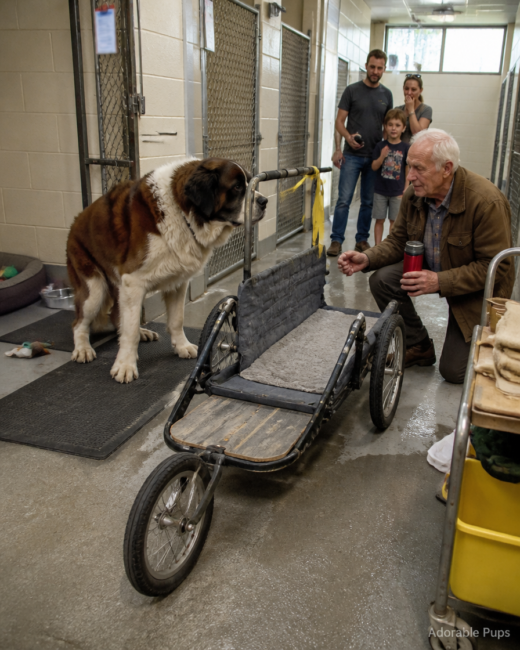
The split in his left ear had healed years earlier. Three lower teeth were missing. A broad patch of fur above his right hip had grown back darker after an old surgery.
His owner, Margaret Ellis, had died four days before we met him.
Margaret’s daughter, Claire, drove from Raleigh to settle the house. She brought Moose to us in a rented cargo van because he could no longer climb into her SUV. She completed every line of the surrender form except the box asking what frightened him.
“I don’t know,” she said. “I haven’t lived here since college.”
Under favorite activities, she wrote: Watching ducks.
Under behavior concerns, she wrote: May refuse to walk in late afternoon.
Inside the bag of belongings were two orthopedic dog beds, a bottle of joint supplements, a green plush duck, a faded brown leash, and a yellow ribbon tied around a red thermos.
Claire almost threw the ribbon away.
Moose moved between her and the trash can.
We kept it.
Dr. Lena Patel found arthritis in both hips, spinal stiffness, and moderate degeneration in his right knee. His heart was strong. His bloodwork was better than expected. Pain medication and a monthly injection made him more comfortable, but nothing could turn his joints young again.
“He can still enjoy his days,” Dr. Patel said. “He’ll need someone willing to redefine what a walk looks like.”
That sentence narrowed his adoption pool.
People wanted a Saint Bernard they could photograph beside a fireplace in December. They did not want to wash urine from the hind legs of a dog too stiff to squat properly. They wanted the size, the soft eyes, and the enormous paws.
They did not want the work.
Moose remained polite with everyone. He accepted treats by touching them first with his lips. He leaned against volunteers but never put his full weight on them. When children approached, he lowered his head until they could reach the white blaze between his eyes.
He never barked at visitors.
He saved his voice for 4:12.
Every afternoon, Moose rose from his bed, collected the green duck, and walked toward the west exit. If the door stayed closed, he produced one low sound—not a howl, not a bark, but a rough breath that lifted from his chest.
At 4:38, he returned to his bed.
The exactness bothered me.
Dogs often hold routines after losing a home. They wake at old mealtimes. They wait beside doors. They react to familiar engines. Moose’s routine contained too many steps.
He waited for the wall clock’s minute hand to pass the two.
He selected the duck instead of any other toy.
He went only to the west door.
He stayed twenty-six minutes.
The first twist seed sat inside those numbers, though I wrote it down as a grief response.
The second arrived whenever a cart passed his kennel.
Our supply cart had one worn front bearing. Each full rotation produced a click, followed by a soft scrape. Moose raised his head at the click but lowered it when the scrape followed.
A smooth click held his attention.
A broken one did not.
Henry first called on June 7 after seeing Moose’s photograph in a Sunday post. He asked six questions.
What time did Moose stop walking?
Did he still carry a green duck?
Did he respond to a red thermos?
Could he place his front feet on a twelve-degree ramp?
Did he turn his head when a wheel clicked?
Was the yellow ribbon still there?
I answered the first four.
Then I asked how he knew the last two.
The line remained quiet for so long that I thought we had lost the connection.
“Because Margaret kept everything,” Henry said.
He scheduled his visit for the following Saturday.
Not the morning.
He wanted to meet Moose at 4:12.
Part 3, A Machine Built for the Last Twenty-Seven Yards
Henry arrived early because he did not trust the stroller’s left brake.
He spent forty minutes in the parking lot adjusting it with a socket wrench. The stroller had begun as a navy double jogger purchased in 1981. Its original seats, sun canopy, footrests, and plastic tray were gone.
Henry had widened the rear axle by eight inches. He replaced the small front wheels with a single twelve-inch tire that could cross gravel. A marine-plywood platform sat low between the frame rails, covered by closed-cell foam and a washable gray pad.
The ramp folded beneath the platform.
He had even installed two removable side panels because, as he explained, a dog with weak hips might slide when the path tilted.
“This isn’t something you found online,” I said.
“Online wanted six hundred dollars before shipping.”
“So you built it.”
“I repaired buses for a living. A stroller has fewer parts.”
Henry had loaded the frame with six fifty-pound bags of sand, pushed it around his block, and left it overnight with the brakes locked on his sloped driveway. He showed me the photographs because he knew we would worry about an elderly man handling a giant dog.
The stroller had held 300 pounds without bending.
Moose weighed almost half that.
Henry’s first meeting lasted eighteen minutes. He did not hug Moose, call him a good boy, or bury his fingers in the dog’s coat. He sat sideways on the floor and placed the red thermos between his shoes.
Moose smelled it for almost a minute.
Then he lay down with his nose against Henry’s left boot.
At 4:12, Henry stood.
Moose collected the duck.
Henry tapped the stroller frame twice and locked the brake. Moose walked to the ramp, climbed halfway, and stopped.
His rear legs trembled.
I reached for the sling, but Henry waited until Moose turned his head. Then he slipped one end beneath the dog’s belly and gave only enough lift to keep the right paw from folding.
Moose completed the climb himself.
Henry’s mouth moved as if counting.
One front paw.
Second front paw.
Left rear.
Right rear.
The order mattered to him.
Henry pushed Moose around the shelter’s exercise yard. The stroller turned wide, but the frame stayed level. Moose sat for the first lap and lay down during the second.
On the third, he lifted his head when Henry turned west.
We approved a seven-day foster trial with daily phone check-ins. Henry had converted his dining room into Moose’s sleeping area because the bedroom was upstairs. Rubber runners covered the floor from the back door to the kitchen.
He slept on the living-room sofa for the first week.
“If he needs help at night, I need to hear him,” he said.
The first evening was quiet until 4:12.
Moose stood beside the back door with the duck in his mouth.
Henry opened it.
The dog walked down the ramp, crossed the yard, and stopped at the gate facing west. He remained there until 4:38.
Henry did not call him back.
He carried a folding chair outside and waited beside him.
The next afternoon, Henry placed the stroller at the gate. Moose walked to it, climbed halfway, and backed out. Henry moved the yellow ribbon from the handle to the side rail.
Moose climbed again.
That was our second seed.
We believed the ribbon helped because it smelled like his former owner. That was partly true, but scent alone did not explain why Moose needed it on his right side or why he stared at the empty half of the platform after lying down.
Henry fastened the ribbon there permanently.
On the third day, he took Moose to the sidewalk. They traveled one block east and returned. Moose rode going out and walked twenty-three yards coming home.
On the fourth, they reached the corner.
On the fifth, a neighbor named Gloria Cruz watched from her porch while Henry pushed the giant dog past two schoolchildren. One boy laughed and called it a baby carriage.
Moose did not react.
Henry did.
He stopped, locked the brake, and looked at the boy.
“You’ll be lucky if somebody saves you a seat when your legs get old.”
The boy’s face changed.
Henry softened his voice.
“Want to help me test the water bowl?”
Both children walked beside them for the next block.
By Friday, Henry had developed a routine. Before Moose entered the stroller, he checked the tire pressure, touched each axle cap, pressed both brakes, and tapped the frame twice.
Moose waited for the taps.
If Henry tapped once, the dog remained on the ground.
If he tapped three times, Moose looked toward the house.
Two taps meant climb.
No one had trained him to do that.
Henry denied teaching it. Moose had brought the sequence with him.
The foster trial should have ended on June 21, but Henry asked for another week. He did not doubt the adoption. He doubted himself.
His right shoulder had begun hurting while pushing the stroller uphill. Moose had developed loose stool after switching food. Henry worried about lifting him during an emergency.
He called me at 6:20 one morning.
“If he falls and I can’t get him up, I’ve failed before we start.”
We arranged a support harness with handles over the shoulders and hips. Gloria learned how to help. Henry paid a carpenter to replace the three back steps with a long ramp, though he had built most of it himself.
He sold a cabinet of antique bus tools to cover the veterinary plan.
The cabinet had belonged to him for forty-one years.
“Were they worth much?” I asked.
“Enough for nine injections.”
“What happens after nine months?”
“I’ll find ten.”
Henry’s daughter, Rebecca, lived in Knoxville and called me after seeing his foster paperwork. She did not object to Moose. She objected to everything around him.
Her father had stopped attending church after her mother died. He had abandoned Tuesday breakfasts with former coworkers. He sometimes let the telephone ring until voicemail answered.
Now he planned his whole day around a dog who might not live through the year.
“What happens when Moose dies?” she asked.
I did not pretend to know.
“What is happening while he lives?” I asked.
Rebecca came to Asheville the next Saturday.
Moose met her at the gate. He smelled her palms, circled once, and pressed his shoulder against her legs. She nearly lost her balance.
Henry handed her the rear support strap.
They practiced lifting him together.
Later, Rebecca found three index cards taped above the kitchen sink. One listed medications. One recorded food and bowel movements. The third contained a route to Beaver Lake with five shaded rest points and the words BENCH 7 — 4:12 underlined twice.
She showed it to me.
“Why that bench?”
Henry folded the card and returned it to his pocket.
“It has the right view.”
On June 24, Dr. Patel examined Moose after the second week of foster care. He had lost three pounds, gained muscle over his shoulders, and developed a small rub mark where the support sling crossed his abdomen.
Henry had already added fleece padding.
Moose’s adoption became official at 3:47 that afternoon.
The fee was sixty dollars.
Henry paid in cash, placed the receipt inside the stroller pocket, and asked if we could take one photograph without showing his face.
“Make him the large part,” he said.
Moose already was.
The shelter posted the photograph at 5:10. It showed a seventy-nine-year-old man pushing a 155-pound Saint Bernard in a converted baby stroller while the dog held a green duck between his paws.
By bedtime, the image had been shared 8,000 times.
Most comments praised Henry.
Some mocked him.
A few said keeping an old dog alive in a stroller served the owner more than the animal.
Henry read none of them.
He was measuring the gravel path between Beaver Lake’s parking lot and the seventh bench.
The stroller could cover 163 yards.
Moose would have to decide what to do with the final twenty-seven.
Part 4, The Afternoon the Stroller Stopped at the Gravel
Henry chose June 27 for their first lake trip.
The forecast called for seventy-six degrees, light cloud, and no rain until evening. He packed Moose’s medication, two quarts of water, a cooling towel, the green duck, the red thermos, and two metal cups.
One cup nested inside the other.
At 3:31, Gloria helped Moose down the house ramp. He walked to the stroller without being asked, waited for Henry’s two taps, and climbed.
Henry pushed him to the end of the block, where Rebecca waited with her SUV. The stroller folded, but Moose did not fit comfortably in the back seat.
Henry sat beside him on the cargo floor.
They reached Beaver Lake at 3:58.
Summer walkers filled the path. A woman in running clothes slowed when she saw Moose. Two teenagers lifted their phones. A father told his little girl the stroller held the largest baby in North Carolina.
Henry smiled at that one.
Moose lay with his chin above the side rail. Wind moved the silver fur around his eyes. He showed no interest in the dogs passing beside them.
At 4:06, he raised his head.
At 4:09, his front paws shifted beneath him.
At 4:12, he began to breathe through his nose in short, sharp pulls.
Henry stopped.
The paved path ended 190 yards from Bench 7. A strip of packed gravel continued beside the water, curving through maple trees and tall grass.
Henry lowered the ramp.
“Not all of it,” Rebecca said.
“I know.”
Moose stood in the stroller. His right rear paw slipped once, then found the rubber mat. Henry fitted the support harness, and Rebecca held the rear strap.
The dog descended slowly.
His first three steps were stiff. His fourth lengthened. He ignored the nearest ducks and headed toward the bend.
Henry did not guide him.
Moose knew the path.
He passed Bench 3.
Then Bench 5.
Near the wooden footbridge, a flock of mallards lifted from the reeds. Moose watched them land but did not stop.
Twenty-seven yards from Bench 7, his right leg folded.
Rebecca caught the harness.
Moose remained upright. He breathed hard, lowered his head, and tried another step.
Henry moved the stroller beside him.
“That’s enough.”
Moose turned away from it.
The watchers behind us grew quiet. One woman suggested bringing the stroller closer to the bench. Henry shook his head.
“If I push him the last part, he won’t know he got there.”
Moose took five more steps.
He rested.
Four more.
His left rear paw dragged a pale line through the gravel. Rebecca supported only the weight he could not hold. Henry walked beside his head with one palm under the loose skin at his neck.
“Easy,” he said. “The ducks aren’t leaving.”
Moose reached Bench 7 at 4:19.
He did not look at the water.
He smelled the ground beneath the right side of the bench. Then he placed the green duck on the empty wooden seat and rested his chin beside it.
Henry stopped moving.
Rebecca covered her mouth with the back of her hand.
A shallow scratch marked the bench slat near Moose’s nose: two initials inside a crooked heart.
E + H.
Henry sat on the left.
Moose remained beside the right.
From the stroller pocket, Henry removed the red thermos and poured coffee into one metal cup. He set the second cup on the empty end of the bench.
The handle faced outward.
Moose watched the path behind us.
Not the ducks.
The path.
People lowered their phones because the moment no longer felt like something they owned. The father who had joked about the giant baby removed his baseball cap.
At 4:38, Moose picked up the green duck.
He turned toward Henry.
The old man held the cup against both palms. His right hand shook, but the metal did not rattle.
“She’s not late,” he said. “She’s gone.”
Moose kept watching the bend.
Henry touched the yellow ribbon tied to the stroller.
“I know,” he said. “I didn’t come either.”
Moose walked back only nine yards before his hips failed. This time he allowed Henry and Rebecca to guide him onto the ramp.
He lay down without circling.
The green duck remained beneath his chin, and the empty metal cup rode beside his right paw.
The video reached our shelter before they left the parking lot. It showed the people who had laughed at the stroller standing silent while Henry pushed Moose away from the bench.
Viewers believed they understood the whole story.
A lonely widower had adopted an old dog.
A weak dog had reached the lake.
They had given each other one more afternoon.
That would have been enough.
Two days later, a woman drove from Raleigh carrying a sealed envelope, a stack of photographs, and the missing half of the yellow ribbon.
Part 5, The Women Who Met Without Their Families
Claire Ellis entered the shelter at 9:14 on Monday morning.
She was Margaret’s daughter, the woman who had surrendered Moose. Her hair was still damp from the rain, and she held the photographs against her chest inside a clear grocery bag.
“I saw the lake video,” she said. “I need to speak with Henry.”
We called him.
He arrived thirty minutes later without Moose because the dog was resting after his injection. Claire placed the sealed envelope on the desk between them.
The front carried Henry’s full name in Margaret’s handwriting.
The envelope had been found behind a drawer in Margaret’s kitchen. Claire discovered it while clearing the last cabinet. Beside it sat a photograph of two women at Beaver Lake.
One was Margaret.
The other was Eleanor Whitaker, Henry’s wife.
Moose lay between them with his head across Eleanor’s shoes.
The photograph had been taken four years earlier. Margaret held the green duck. Eleanor carried the red thermos. A yellow ribbon tied the two metal cups to the handle of the same double stroller Henry had brought into our shelter.
The stroller was full of picnic blankets, library books, dog treats, and a folded cane.
Claire looked at Henry.
“You knew him.”
Henry nodded.
He had known Moose for nearly six years.
Eleanor met Margaret at Beaver Lake after both women began walking on their doctors’ orders. Margaret had lost her husband. Eleanor had been diagnosed with Parkinson’s disease and hated exercising where neighbors could watch her hands shake.
Moose removed the need for conversation.
The first morning, he placed the green duck at Eleanor’s feet. She threw it six feet. He carried it to Margaret, who threw it back.
By the third week, the women were meeting every afternoon.
Always 4:12.
Eleanor chose the time because Henry’s bus-maintenance shift ended at 3:30. He drove her to the lake, unloaded the old stroller, and joined them after buying coffee.
The stroller had carried their twin daughters in 1981. Decades later, Eleanor pulled it from the attic because its large wheels could haul books, blankets, water, and Moose’s supplies across the gravel.
When her balance worsened, she held the handle while walking.
Moose stayed on her right.
If Eleanor stopped, he stopped. If her knee shook, he pressed his shoulder against it. Nobody trained him. He watched the result of standing beside her and repeated it.
Eleanor tied a yellow ribbon around the handle so she could find it when her vision blurred.
Henry maintained the wheels.
Two taps on the frame meant the brakes were locked.
That was why Moose waited for two.
Eleanor died on October 16, ten months before Moose entered our shelter.
Henry stopped visiting Beaver Lake the following day.
Margaret continued.
Each afternoon, Moose carried the duck to Bench 7, placed it on Eleanor’s side, and watched the path for Henry and the stroller.
Neither came.
Margaret wrote Henry three letters. He opened none of them. He placed them in a kitchen drawer because every envelope carried her handwriting, and her handwriting belonged to the lake.
“I thought staying away would make the days move faster,” Henry said.
Claire pushed the sealed envelope toward him.
“This one never reached you.”
Inside was a short note Margaret had written after a cardiologist told her she might need surgery.
Henry read it twice.
Then he handed it to me.
If I leave before Moose does, don’t let him lose the lake too. His hips are failing. Eleanor always said you could make that old stroller carry anything. I think it has one more passenger left.
Beneath Margaret’s signature, another sentence had been added.
He still saves Eleanor’s side. Maybe he has been saving yours too.
Henry folded the note along its existing crease.
The old man had not come to our shelter because he wanted a dog to heal him.
He had come because two women had left him unfinished work.
Moose had been waiting at 4:12 for the three of them.
Henry was the only one still able to arrive.
Part 6, Everything Moose Had Been Trying to Keep
The earlier details changed meaning once we knew.
Moose had not walked to our west exit because Margaret’s car might appear there. Beaver Lake lay west of the shelter. Wind arriving through that door carried water, cut grass, and the summer reeds surrounding the path.
He had not waited twenty-six random minutes.
Eleanor and Henry usually reached Bench 7 at 4:12. They left at 4:38 because Henry wanted to avoid traffic near Merrimon Avenue Avenue.
Moose preserved both times.
The green duck had never been his ordinary toy. Eleanor bought it at a pharmacy after Moose stole a child’s rubber duck near the lake and refused to surrender it. She wrote his name beneath one fabric wing, though the ink had faded before he entered our care.
Moose placed it on the bench because that was how their game began.
The smooth wheel click mattered because Henry lubricated the old stroller’s bearings each Sunday. One bearing retained a tiny dent, producing a single clean click under weight.
Our damaged supply cart clicked, then scraped.
Moose knew the difference.
The yellow ribbon did carry Margaret’s scent, but that was not the only reason he needed it on the stroller’s right side. Eleanor had tied it to the right handle. She walked there, with Moose beside her leg and Margaret on the left.
Inside Henry’s converted platform, Moose left that half empty.
We had thought a 155-pound dog was protecting his space.
He was preserving hers.
The red thermos explained his first step toward Henry. Eleanor brought coffee in it every afternoon. Henry poured three cups: one for himself, one for Margaret, and half a cup diluted with hot water for Eleanor because her medication made strong coffee bitter.
Moose received an ice cube after the pouring ended.
He did not understand marriage, Parkinson’s disease, death certificates, or promises written inside envelopes.
He understood sequence.
Wheel click.
Yellow ribbon.
Two taps.
Red thermos.
Green duck.
The west path.
4:12.
When those things occurred in the correct order, Eleanor appeared and the four of them sat beside the lake.
When the sequence broke, Moose waited.
Henry listened while we worked through every detail. He sat with Margaret’s note open across his knee, smoothing the corner with one thumb.
Then he told us what the stroller had meant before the lake.
He and Eleanor bought it after their twin daughters were born seven weeks early. Rebecca came home first. Her sister, Anna, remained in the hospital for nineteen more days.
Eleanor refused to assemble the stroller until both girls could use it.
Henry built it in the hospital parking lot on the morning Anna was discharged. The first object he placed inside was not a baby.
It was the red thermos.
He and Eleanor pushed their daughters around that same lake for three summers. The stroller later carried soccer bags, library books, groceries when their car broke, and picnic supplies after the girls left home.
Eleanor kept it through every garage cleanout.
Henry complained each time.
She always gave the same answer.
“It still rolls.”
After her death, Henry placed the stroller at the curb twice.
Both times he brought it back before the sanitation truck came.
When he saw Moose’s shelter photograph, the dog was lying beside the green duck. Behind him, taped to the kennel wall, was our note about his 4:12 routine.
Henry opened Margaret’s first letter that night.
She had written it eight months earlier.
He watched for you again today.
The second said:
His back legs are getting worse. Eleanor was right about the stroller.
The third contained only seven words:
Please come before waiting becomes all he has.
Henry spent four days in his garage.
He removed the seats. He widened the axle. He tested the platform. He tied Eleanor’s ribbon to the handle and drove to our shelter.
The laughter did not matter because, in Henry’s mind, the stroller was already full.
Two infant daughters.
Thirty-eight years of books and blankets.
A red thermos.
Eleanor’s unsteady hands.
And a dog who had kept an appointment longer than any person had asked him to.
Claire brought Moose to meet Henry at Margaret’s empty house the following week. They entered through the kitchen because the front steps were too steep.
Moose walked first to the refrigerator.
A calendar still hung beside it, frozen on April. Every afternoon square carried a small green mark at 4:12.
Claire had assumed Margaret was tracking medication.
Henry recognized the marks.
They were lake days.
The last six squares were empty because Margaret had been too ill to walk. Moose had waited at the door anyway.
Henry opened the back closet. Inside stood two umbrellas, Margaret’s cane, and a canvas tote containing three tennis balls. Moose ignored them.
He smelled the floor beneath a row of coats and pulled out a second metal cup.
It matched the one Henry had placed on the empty side of Bench 7.
Claire sat on the kitchen floor.
Moose carried the cup to Henry, then returned to the closet and waited.
Henry checked the pockets of Margaret’s green raincoat. He found a folded photograph showing Eleanor seated on Bench 7. Moose’s head rested in her lap. Henry stood behind them, one hand on the stroller.
Written on the back were four words:
Save him a seat.
Claire had not known about the friendship.
Rebecca had not known either.
The two older women had created a life that belonged only to the hour between 4:12 and 4:38. They did not tell their children every joke, every fear, or every afternoon when one helped the other stand.
Their families knew the diagnoses.
Moose knew the routine.
That was the part he saved.
Henry began reading Margaret’s letters at the lake. He read one each afternoon, never more. Some described Moose stealing a sandwich. Others described Eleanor’s final months.
One letter explained why Margaret continued setting out three cups after Eleanor died.
Moose looks at the bend until you should arrive. Then he looks at me. I tell him you are taking the long way. I don’t know why I say it. Maybe because that is what grief is—the long way back to a place you already know.
Henry folded the letter.
Moose lay in the stroller beside him, one paw over the empty cup.
“I took too long,” Henry said.
The dog raised his head at Henry’s voice, shifted across the foam, and rested his chin on the old man’s forearm.
Henry did not call it forgiveness.
Neither did I.
He simply remained there until Moose moved.
The first lake video brought donations to our senior-dog fund. Henry refused any money for himself, but he accepted a lighter aluminum ramp and a padded lifting harness.
He also accepted help.
Gloria joined them on Mondays. Rebecca drove from Knoxville every second weekend. Claire began coming once a month, carrying one object from Margaret’s house for Henry to identify.
A scarf.
A book.
A cracked plastic container full of stale dog biscuits.
Moose smelled each item. Some held his attention. Others did not.
Henry never forced a reaction.
“He isn’t a museum,” he told Claire. “Let him keep what matters to him.”
By September, Moose could no longer walk the full final twenty-seven yards. Henry moved the stroller closer to the bench but always lowered the ramp before they arrived.
Some afternoons, Moose managed twelve steps.
Some afternoons, three.
Once, none.
Henry still opened the ramp.
Choice mattered even when the answer was no.
On October 16, the first anniversary of Eleanor’s death, Moose climbed down and walked seven steps to the bench. Henry placed the duck on Eleanor’s side.
Moose picked it up.
For the first time, he did not return it to the empty seat.
He carried it to Henry.
The old man held the toy against his coat while Moose lowered himself across both of Henry’s shoes.
At 4:38, Henry poured the untouched second cup back into the thermos.
The next afternoon, he brought only one coffee cup and Moose’s water bowl.
The empty place remained.
The waiting changed.
Part 7, The Bench With Room for Three
Moose lived seventeen months after Henry adopted him.
Dr. Patel had predicted six to twelve.
Henry did not treat the extra months as a victory over age. He tracked good mornings, difficult stairs, appetite, breathing, sleep, and whether Moose still chose the ramp when it opened.
The stroller stayed beside the back door.
Every afternoon at 3:54, Henry checked the tires. At 4:02, he filled the red thermos. At 4:06, he tied the green duck beneath the yellow ribbon and fitted Moose’s support harness.
At 4:12, he tapped the frame twice.
Moose climbed when he could.
When he could not, Henry and Gloria lifted him together.
The lake became part of both their bodies. Henry’s shoulder grew stronger from pushing. Moose’s rear legs weakened, but his front paws continued to strike the stroller platform whenever ducks crossed the path.
People stopped laughing.
Children waited near Bench 3 to walk beside them. Runners slowed without being asked. One carpenter built a small ramp from the gravel path to Bench 7 so Moose no longer had to cross the roughest ground.
He left before Henry could pay him.
During Moose’s final week, he stopped carrying the green duck. Henry placed it beside him anyway.
On a cold November afternoon, Moose rode to the lake beneath two blankets. His breathing remained steady, but he did not lift his head when the ducks approached.
Henry sat on Bench 7.
He poured coffee.
He waited.
At 4:31, Moose opened his eyes and looked toward the path’s bend. Then he turned away from it and rested his chin on Henry’s knee.
He did not look back.
Moose died at home three days later with Henry’s hand beneath his split left ear. The stroller stood beside his bed. The yellow ribbon hung low enough to touch his paw.
Henry kept the stroller.
He did not return it to the attic or leave it at the curb. He cleaned the foam, replaced one wheel bearing, and stored Moose’s green duck inside the mesh pocket.
Every Tuesday, Henry now volunteers with our senior-dog program. He brings the stroller when an old dog needs fresh air but cannot manage the shelter trail.
He never chooses the dog.
He opens the gate and waits to see which one approaches the ramp.
Some refuse.
Some climb.
For each dog that enters, Henry locks the brakes and taps the frame twice.
At 4:12, he pushes the stroller west.
The red thermos rides beneath the handle. The yellow ribbon moves in the wind. Moose’s duck remains in the pocket, one worn wing visible above the seam.
They stop at Bench 7.
Henry sits on the left.
The dog receives the right.
The bench still has room.
Follow this page for more gripping dog stories about quiet loyalty, second chances, and the people who finally learn how deeply an old dog remembers.