Part 2: Every Night, the Patchy-Coated Samoyed Dug Beneath an Empty Shelter Bed — Then Staff Found the Photograph He Had Been Guarding From Everyone
Part 2, The Dog Whose Coat Had Begun to Disappear
Atlas had entered the shelter as a stray seven months earlier, before the reading photograph was taken. A delivery driver found him beneath the loading ramp behind a closed grocery store, lying against a concrete wall that blocked the wind.
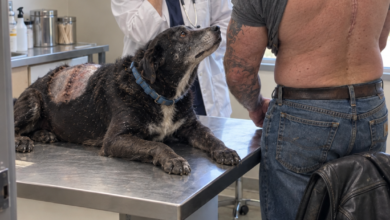
His white coat initially concealed how much hair he had lost. Once our intake technician separated the tangled fur, she found two irregular bald areas over his hips and a wider strip across his lower back. The exposed skin was dry and thickened rather than injured, but Atlas recoiled whenever a brush reached it.
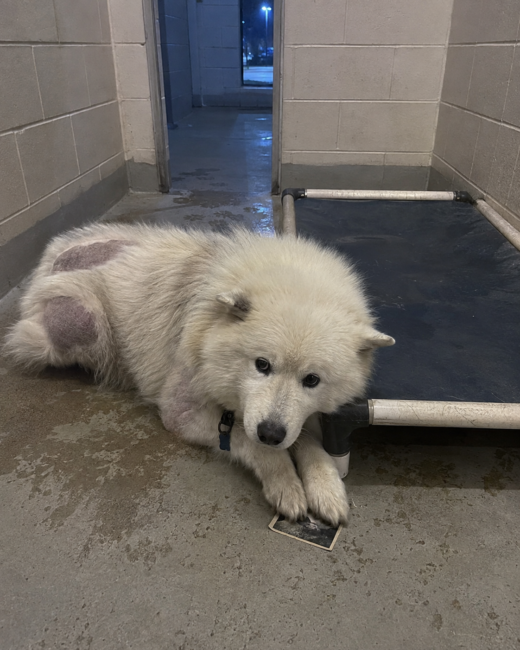
He was neither aggressive nor comfortable. He walked where a leash directed him, ate after people withdrew, and watched every hand closely. When someone leaned over his back, his muscles tightened beneath the remaining coat.
Our veterinarian could see the hair loss but would not guess at its cause before testing. Skin scrapings, a fungal culture, bloodwork, and a thorough examination ruled out several contagious and hormonal conditions. The final assessment was chronic allergic dermatitis complicated by an old flea infestation and repeated scratching.
Treatment required medicated baths, parasite prevention, anti-itch medication, a consistent diet, and time. It also required handling the very areas Atlas did not want anyone to touch.
The first bath took nearly forty minutes. One technician fed him small pieces of chicken while another worked diluted shampoo into the remaining fur without rubbing the tender skin. Atlas shook from his shoulders to his feet. He never tried to bite, but his breathing became rapid whenever water reached his hips.
Afterward, he refused the blanket we placed inside his kennel. He stood until midnight rather than letting fabric touch his lower back.
We changed the plan. His bedding was stretched flat, without folds that could scrape his skin. His medication was hidden in soft food rather than forced into his mouth. Staff announced every touch before making it.
Improvement came slowly. The redness faded first. Then Atlas began sleeping for twenty minutes at a time. Fine white fuzz appeared along the edges of the bald patches, although the central areas remained clearly visible.
He still avoided visitors.
Our reading program became the exception. Children sat outside kennel gates and read without reaching toward the dogs. They were instructed to ignore barking, keep their voices low, and allow each animal to decide whether to approach.
Sophie and Lucy chose Atlas during their second visit.
Sophie was thirteen and carried a stack of fantasy novels. Lucy was ten, small for her age, and frequently tired. A thin medical bracelet circled one wrist, but she never discussed it with shelter staff. Their mother, Angela, sat several feet behind them.
On the first afternoon, Atlas remained in the rear corner. Sophie completed two chapters. Lucy read half a page, pausing often to catch her breath.
Atlas eventually moved closer.
He did not ask to be touched. He lay three feet from the gate with his bald hips turned away from the children and his muzzle pointing toward Lucy. The next time she visited, he settled after the first paragraph.
By the fourth week, Atlas was waiting for them.
Part 3, The Photograph Beneath the Blanket
The sisters followed the same routine every Tuesday and Thursday. Sophie selected the book. Lucy carried a small blue cushion. Angela signed them in at 3:45, and by four o’clock both girls were seated outside Atlas’s kennel.
Lucy’s voice was quieter than her sister’s, but Atlas recognized its rhythm. She paused at punctuation, repeated unfamiliar words, and occasionally rested between sentences. During those pauses, Atlas did not become impatient. He watched her until she continued.
His skin treatment was also becoming easier. Because the girls were present after several bathing appointments, we discovered that Lucy’s reading helped him settle while his coat dried. She never entered the bathing room. She sat beyond the open doorway and continued the story while a technician gently pressed towels against his sides.
After five weeks, Atlas allowed us to inspect his lower back without pulling away. New fur appeared as a pale fringe along both hips. The skin remained visible, but it no longer looked inflamed.
That was when the photograph was taken.
One of our volunteers captured Sophie pointing to a page while Lucy leaned toward the kennel. Atlas lay with his muzzle near Lucy’s sneaker. We printed a copy for the family and another for the program board.
The following Tuesday, Lucy seemed unusually quiet. She read only three pages before closing the book. Angela asked for the photograph from the board, telling us that Lucy wanted to keep it with Atlas for a few days.
No one understood why.
Before leaving, Lucy folded the photograph once and pushed it beneath the corner of his blanket. Atlas sniffed it, then looked toward her. She placed her palm flat on the floor, still making no attempt to touch him.
“I have to go somewhere else for a while,” she said.
Atlas could not understand the sentence, but he knew her voice. He moved close enough for his whiskers to brush the edge of her fingers.
It was their last visit.
The next morning, Angela called the volunteer coordinator. A complication connected to Lucy’s congenital heart condition had required hospitalization. She would be transferred to a pediatric specialty center in Salt Lake City, where the family expected to remain for several months.
Angela had little time to explain. Sophie would travel with them, their apartment lease was ending, and all shelter visits had to stop.
The message was entered into our system as a brief administrative note. Most of us never heard the details.
Atlas only experienced the absence.
The first Tuesday without the girls, he waited at the gate from 3:50 until the reading session ended. When another child began speaking, Atlas lifted his head, listened, and walked back to his cot.
That evening, he found the photograph beneath the blanket.
He began storing it under the bed because staff removed loose objects during morning sanitation. Whenever the cot shifted, he retrieved the image, carried it in his mouth, and concealed it again.
The repeated movement created a problem. Dragging the cot caused its frame to rub his healing hips, while digging against concrete increased his agitation and interrupted his sleep. We could not simply confiscate the photograph without removing the only familiar object he consistently protected.
Instead, we needed a way to preserve it safely—and determine whether hearing Lucy again would comfort him or make his waiting worse.
Part 4, The Call From Room 614
The nurse who contacted us was Renee Parker, a pediatric recreation specialist at Lucy’s new hospital. Lucy kept a copy of the shelter photograph beside her bed and frequently asked her mother about Atlas.
Angela had avoided calling because she could not promise another visit or adoption. The family’s housing situation was uncertain, and Lucy’s treatment schedule changed almost daily. She worried that reintroducing her voice might upset Atlas after the call ended.
Renee asked whether we could try a short recorded message first.
Our behavior team agreed, provided Atlas controlled the interaction. We would play the recording at low volume from outside his kennel. If he paced, scratched, stopped eating, or became more distressed afterward, we would not repeat it.
Lucy recorded twelve seconds.
“Hi, Atlas. It’s Lucy. I’m still reading. I didn’t forget your chapter.”
We played it on a small speaker at four o’clock on Tuesday.
Atlas had been lying at the rear of his kennel. At the first word, his head rose. His ears moved forward, and he crossed the floor so quickly that his front paw slid on the edge of the runner.
He stopped beside the gate.
When the message ended, Atlas remained still. He looked toward the corridor, then back at the speaker. We played it once more. This time he lowered his chest onto the floor and placed his muzzle between his paws.
He did not scratch beneath the bed that night.
The result was promising but incomplete. Atlas could not build a stable routine around an occasional twelve-second message, and Lucy could not be expected to manage his recovery from a hospital room. We scheduled one supervised audio call each Thursday, limited to ten minutes. The phone stayed outside the kennel, and no one forced Atlas to remain nearby.
During the first call, Sophie read most of a chapter. Lucy read the final paragraph.
Atlas lay beside the gate, eyes half closed. When either girl stopped, he lifted his head. When their voices resumed, his breathing slowed.
Yet after the third call, the shelter’s internet connection failed before Lucy finished. The sudden silence made Atlas stand and search the corridor. He pulled the cot away from the wall that evening and uncovered the photograph again.
We adjusted. Every call ended with the same sentence: “The chapter is finished for today.” Afterward, a staff member placed the protected photograph beside his bed and gave him a food puzzle, creating a predictable transition rather than an unexplained disappearance.
We also laminated a copy of the picture so Atlas could keep it without destroying it or swallowing damp paper. The original was stored in his medical file. The copy went inside a soft transparent sleeve attached to the wall at nose height.
Atlas inspected it several times. Then he lay beneath it.
His treatment continued alongside the reading calls. Twice-weekly medicated baths became weekly as the irritation improved. A veterinary nutrition plan reduced likely dietary triggers. His anti-itch medication was adjusted after he became drowsy on the original dose.
By the tenth week, new white growth covered much of his lower back, although both hips still showed visible pink-gray patches. The veterinarian warned us that a full coat could take months and that allergic dermatitis might require lifelong management.
Atlas was improving, but he still had no home.
Several potential adopters admired him and then hesitated when they learned about his skin care. Others wanted the fluffy appearance associated with a Samoyed and seemed disappointed by the missing coat. We declined one application from a family unwilling to continue his medication.
The sisters remained too far away to take him.
Then Angela called with news no one at the shelter expected: Lucy was stable enough to return to Denver for outpatient care—but the family had nowhere suitable to keep a large dog.
Part 5, A Visit Without a Promise
Angela and her daughters returned to Denver eleven weeks after leaving. They were staying temporarily with Angela’s sister, whose apartment did not allow pets. Lucy used a lightweight wheelchair for longer distances and tired easily. Any shelter visit required approval from her medical team, careful timing, and a quiet room away from public traffic.
We arranged fifteen minutes on a Thursday morning before opening.
Atlas had not seen either girl since the photograph was hidden beneath his blanket. His coat was cleaner and beginning to fill in, but the two hairless hip patches remained visible. We placed a flat nonslip mat across the visitation room and brought in the same blue cushion Lucy had once used.
Sophie entered first. She sat on the floor with a book open in her lap.
Atlas walked through the side door, saw her, and stopped. His tail did not wag wildly. He studied her for several seconds, approached, and sniffed the sleeve of her jacket.
Then Lucy entered with Angela.
The wheelchair made a sound Atlas had never heard from her before. He backed away, ears low, and moved behind the shelter technician. Lucy stopped immediately. No one called him closer.
She opened the book.
Her first sentence was barely above a whisper. Atlas turned his head. She read the sentence again.
He stepped around the technician and approached in a wide curve, avoiding the chair’s front wheels. When he reached Lucy’s side, he sniffed the blue cushion resting across her knees.
Lucy lowered it onto the floor.
Atlas lay beside the cushion with his hairless hips facing away from the chair. He did not climb onto her or demand contact. He simply placed his muzzle near her shoe while she read the page he had heard over the hospital call.
The visit lasted twelve minutes.
When it ended, Lucy used their familiar closing sentence. Atlas watched the family leave, but he did not run to the door. He returned to the cushion, circled once, and lay down.
Angela could not adopt him that day. She did not pretend otherwise.
Her sister’s apartment remained temporary, Lucy’s appointments occupied most weekdays, and the family’s finances had been strained by relocation. A large dog with continuing veterinary needs required a plan that affection alone could not supply.
Our foster coordinator proposed an intermediate solution. Ruth Ellis, a retired school librarian who had previously fostered older dogs, offered to take Atlas for eight weeks. She lived ten minutes from Angela’s sister and could bring him to scheduled reading visits if his adjustment went well.
Before approving the placement, we inspected Ruth’s house, reviewed the medication schedule, and ensured her resident cat could remain in a separate area during introductions. Atlas visited twice before staying overnight.
The first evening, he would not enter Ruth’s bedroom. He slept beside the hallway bookcase instead, his laminated photograph lying near his front paws.
Ruth did not move it.
At seven the next morning, she sat in a nearby chair and began reading aloud. Atlas listened from the floor. After four pages, he lowered his chin.
It was not Lucy’s voice.
But it was a voice that remained after the chapter ended.
Part 6, The Night the Photograph Disappeared
Atlas adapted to Ruth’s house through repetition. Meals arrived at the same times, his medication was hidden in the same spoonful of wet food, and every evening ended with twenty minutes of reading beside his bed.
His fur continued to return. By the fourth foster week, soft white growth covered most of his lower back, while the hip patches had narrowed to the size of two open hands. Ruth photographed them weekly so the veterinarian could compare progress without unnecessary handling.
Then Atlas experienced a setback.
One afternoon, Ruth washed his bedding after he spilled water across it. She placed the laminated photograph on a high shelf for safekeeping and replaced the wet bed with another one from the guest room.
That night, Atlas began searching.
He pushed his muzzle beneath the temporary bed, scratched the floor, and paced between the bookcase and hallway. When Ruth tried to redirect him with food, he ignored it. By midnight, repeated turning had irritated the newly grown fur near his right hip.
Ruth called our overnight line.
We asked her to restore as much of the familiar arrangement as possible. The photograph returned to floor level inside its protective sleeve. Ruth placed the washed bed back after drying it thoroughly and sat nearby with a book.
Atlas inspected the picture, circled twice, and lay down.
The irritated area did not require emergency care, but our veterinarian recommended several days of reduced friction and a topical treatment. More importantly, the incident showed that Atlas’s routine still depended heavily on physical anchors.
We began teaching him that familiar voices could occur in more than one location. Ruth read in the living room, then in the kitchen, then beside the back door. The photograph moved only a few inches at first. Atlas received a reward whenever he chose to settle without digging.
Sophie visited twice a week. Lucy came when her medical schedule allowed, sometimes in person and sometimes through an audio call. Each session ended predictably.
Gradually, Atlas stopped checking beneath the bed.
Angela used those weeks to prepare for him. She secured a ground-floor rental with a small fenced patio. A local veterinary assistance fund approved partial support for his dermatitis medication. Sophie accepted responsibility for evening brushing, while Angela arranged transportation for appointments.
The family completed a home visit and three weekend trials. Atlas initially slept near the front door, photograph beneath his paw. By the second weekend, he moved to the bedroom shared by the sisters and chose the rug between their beds.
The final trial included a difficult moment. Lucy returned unexpectedly from a late appointment using crutches rather than her chair. Atlas startled at the unfamiliar movement and retreated behind the dining table.
Lucy sat down without approaching him and opened her book.
After three paragraphs, Atlas emerged.
He did not come directly to her. He first inspected the room, then the cushion, then the photograph. Only after confirming those familiar points did he settle beside her.
Trust had not erased his caution.
It had given him a reliable path back.
Part 7, The Place Beside the Reader
Atlas was adopted five months after the pediatric nurse first called our shelter. By then, his coat covered most of his back, though both hips remained thinner than the rest of his body. His allergies still required medication, planned bathing, dietary management, and veterinary monitoring.
Angela signed the paperwork. Sophie carried his supplies. Lucy held the paperback they had never finished at the shelter.
There was no guarantee that life would remain simple. Lucy still faced regular hospital appointments. Atlas could experience another skin flare. The family had agreed that Ruth would care for him whenever medical travel took them away.
On his first night in the apartment, Atlas inspected every room. Angela placed his orthopedic bed beside the sisters’ bookcase. The laminated photograph rested in a clear pocket near the bed—not hidden beneath it.
Lucy sat on her blue cushion and resumed the unfinished chapter.
Atlas circled once before lying down. As he had done in the kennel, he occupied only one side of the bed. This time, however, the empty half was not waiting for someone who had disappeared. Lucy’s cushion rested beside it, close enough for her shoe to touch the edge.
Several weeks later, Ruth visited during an evening reading session. Atlas greeted her, returned to the bedroom, and settled between both girls while Sophie continued the story.
When the chapter ended, Lucy spoke their familiar closing sentence. Atlas lifted his head, looked toward her, and then rested again instead of searching beneath the bed.
The creased original photograph remained in his shelter file. The laminated copy stayed near his family’s bookcase, where it no longer needed to be guarded.
Atlas had once dug through the night to preserve the last physical proof of two familiar voices. Now, even when one voice left for a hospital appointment, another remained nearby—and everyone came back when they said they would.
Follow our page for more realistic dog rescue stories about patient healing, quiet loyalty, second chances, and the bonds animals remember long after people leave.