Part 2: I Quit the Force After My K9 Partner of 8 Years Died — Then the Puppy They Sent Me Wouldn’t Stop Scratching at My Door
Part 2
I should tell you about the leaning, because the leaning is the whole language of this, and you will need it later.
A working German shepherd does not show affection the way a pet does. Diesel did not jump, did not paw, did not do the wiggling-whole-body thing. What Diesel did was lean. He would come and stand beside me and put his weight against my leg — just lean into me, solid, eighty pounds of dog deciding to make me his wall — and hold it. That was his I’m here. That was his you’re mine. That was eight years of everything he had no words for, delivered through one shoulder pressed against my knee.
My name is Reyes. I am thirty-five. I have been a cop since I was twenty-three, and I was a K9 handler from twenty-seven on, which means that for the entire adult part of my life that mattered, I had a dog leaning on my leg.
Here is the small thing about Junior. The thing I refused to see for two weeks.
That puppy, fourteen weeks old, did not know me. Had no reason to want me. I gave him nothing — no warmth, no play, no name said in a kind voice. I was a man who fed him and turned away.
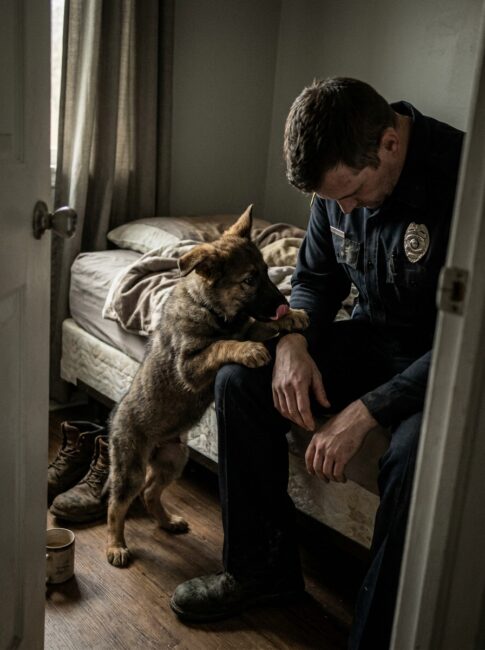
And from the very first day, when I would sit on the edge of the bed in the morning with the badge in my hand, that puppy — if he could get into the room — would come and put his shoulder against my shin. Lean. Hold it. The exact thing. Eighty pounds someday, fourteen weeks now, leaning on a man who was giving him nothing back.
I told myself it was a coincidence. Puppies lean. They’re unsteady. They flop on whatever’s nearest.
I told myself that for fourteen days.
But it mattered. The leaning mattered. I just wasn’t ready to know why.
Part 3
The mornings went like this.
I would wake before the alarm I no longer set, out of eight years of habit, in the gray before sunrise. And I would lie there in my uniform on top of the covers, listening to the house.
And then I would hear him.
The click of small claws on the hallway floor, coming down from the spare room — I’d started leaving the crate open, I couldn’t stand the thought of him shut in — and then the soft scrape of him sitting down outside my bedroom door. A pause. Then two scratches. One paw, twice, against the bottom of the door. Then one bark. Not a demand. Not a puppy yowl. A single, soft, almost questioning bark.
Then nothing. Then the sound of him lying down in the hallway, against the door, with a little sigh, to wait.
He did it every morning. Same sequence. Two scratches, one bark, lie down, wait.
I knew that sequence. That is the thing that undid me, eventually, though it took two weeks. That was not random puppy behavior. That was Diesel’s morning. For eight years, Diesel had woken me by scratching the door twice and giving one low bark — I had trained it into him, ask, don’t demand, two scratches and one quiet bark to tell me it was time to work, and then he would wait, because I had taught him that good dogs wait.
Junior had never met Diesel. Junior had never met me, really. Nobody had trained Junior to do anything yet; he was a fourteen-week-old pup fresh from the breeder the department uses.
And he was running Diesel’s exact morning ritual at my door.
I lay in that bed on the first morning and the second and the third and I told myself it didn’t mean anything. Coincidence. All shepherds scratch. All puppies bark.
By the fifth morning I had stopped being able to fully believe that, and I started doing a thing I am not proud of, which is that I would lie very still and silent and let him scratch and bark and wait and eventually give up and pad away, because answering the door meant something I was not strong enough to do.
I would hear him sigh out there. I would hear him settle against the door. And I would lie six feet away in the dark in my dead partner’s uniform and refuse to open it.
This went on for almost two weeks.
Around the tenth morning, I made the mistake of getting up to use the bathroom while he was still out there, and I opened the bedroom door without thinking, and there he was — sitting up, immediately, ears up, tail going, looking up at me with a face of such uncomplicated hope that I shut the door again before I’d fully processed it, and I sat back down on the edge of the bed and I shook.
Because the thing about a working dog’s hope is that it does not have a backup plan. It does not hedge. It does not protect itself. He had been refused, ignored, and left in a hallway by a man who gave him nothing, for ten days, and he showed up on the eleventh morning with the exact same undiminished hope, because hope was the only tool he had and he was going to use all of it on me whether I deserved it or not.
I held the badge in my hand and I thought about Diesel going through doors first.
And I still didn’t open it.
Part 4
The fifteenth morning was a Thursday. I remember because Diesel had died on a Wednesday and I had been counting Wednesdays the way you count things when you have nothing else to do with your hands.
I woke in the gray. I heard the claws on the hallway floor. I heard him sit down. Two scratches. One bark.
And then I heard him do something he had not done before.
He whined.
Not loud. A small, high, broken sound, right at the base of the door, the sound a dog makes when it has been patient for as long as it knows how to be patient and the patience has run out into something it doesn’t have a name for. He scratched again — not the polite two, but a real scrape, claws dragging down the wood — and he whined again, and I understood, lying there, that the puppy was not going to give up, that he was going to come to this door every morning of his life and ask, that I had been outlasted by a creature with no concept of how thoroughly he was losing.
I got up off the bed.
My knees did not want to. My whole body had the heaviness of two weeks of lying down. I crossed the six feet of floor in the dark, and I put my hand on the knob, and I stood there for a long moment with my forehead nearly against the wood, listening to him breathe on the other side.
And I opened the door.
Junior came up off the floor like he’d been launched. All fourteen weeks of him, all that gangly puppy weight, hit me at the knees and then tried to climb me, scrabbling up my legs, and I went down — not gracefully, I just sat down hard on the floor of my own hallway in my uniform — and the puppy got in my lap and got his paws on my chest and started licking my face, my jaw, my neck, frantic, joyful, like he’d been waiting eight years instead of fourteen days.
And I put my arms around him.
And I put my face down into the side of his neck, into the puppy fur that smelled like nothing, like new, like a dog who had no history with me at all, and I cried in a way I had not cried at the steel table, had not cried at the notice, had not let myself cry in front of a single human being.
I cried for an hour. I am not exaggerating. I sat on the floor of that hallway with the sun coming up through the window and I held a fourteen-week-old puppy and I cried until there was nothing left, and I said Diesel’s name out loud for the first time since he died, over and over, into the neck of a dog who had never met him.
And Junior did not move.
He could have squirmed. He was a puppy; puppies squirm. He could have gotten bored, gotten distracted, wandered off after a sock. He did not. He stayed in my lap, pressed against my chest, his chin eventually coming to rest on my shoulder, and he held still for a full hour while a grown man fell apart on top of him.
He leaned.
He just leaned, and he held it, and he let me.
Part 5
I want to be careful, because the easy version of this is that the puppy was magic, or that Diesel’s spirit was in him, and I don’t believe either of those things, and Diesel would have rolled his eyes at me for even thinking it.
Here is what I came to understand instead, and it is stranger and better than magic.
The department’s K9 program runs the same line of dogs. Diesel had come from it. Junior came from it. They are, in the loose way of working lines, related — generations apart, but the same breeding program, the same temperament selected for over decades, the same raw material.
But that is not the part that matters.
The part that matters is that puppies in that program are not raised in isolation. They are socialized around the working dogs. And in the months before Diesel died, when he was already slowing down, the trainers had brought the new litter through for early exposure — and Diesel, old pro that he was, had been one of the adult dogs the pups were around.
Junior had been in a pen near Diesel. As a tiny pup. For weeks.
Young dogs learn by watching older dogs. It is the oldest transmission there is, older than any command. And what Junior had watched, in those formative weeks, was Diesel — Diesel being handled, Diesel working, Diesel doing the morning ritual that eight years with me had drilled into him so deep it had become simply who Diesel was.
Two scratches. One bark. Wait.
Junior hadn’t inherited it through blood, like a ghost. He had learned it, the way dogs actually do learn — by being a small animal in the presence of a competent adult animal and absorbing the shape of how things are done.
He brought Diesel’s morning to my door because he had learned Diesel’s morning from Diesel. The leaning, the patience, the ask-don’t-demand — all of it was Diesel’s, taught to a puppy by example in the last weeks of an old dog’s life, and then carried, unknowing, to the door of the one man on earth it was designed for.
Diesel had trained my next partner. He just hadn’t told me.
Part 6
Once I understood that, the fourteen days rearranged themselves into something I could not stop looking at.
The leaning, from day one — the shoulder against my shin. I’d told myself puppies just flop. They don’t lean and hold, not like that, not with that specific steady pressure. Junior leaned because leaning was what he’d watched the big dog do to the man, and some part of his small brain had filed it as this is how you tell this kind of human you’re here.
The morning ritual at the door. Not coincidence. Not all-shepherds-scratch. The precise sequence — two, one, wait — that I had built into Diesel over eight years and that Junior had no way of knowing except that he had watched it happen.
The hope that wouldn’t dim after ten days of refusal. I’d thought it was just puppy resilience. But Diesel had been the most patient dog I ever worked, because I had spent eight years teaching him that the wait is part of the work, that good dogs hold position until released. And Junior, who had watched Diesel hold position, held his — at my door, for two weeks, refusing to release himself from a job no one had officially given him.
He had been doing the job. The whole time. The job of getting me up. The job Diesel did every morning for eight years.
And the hour on the floor — Junior not moving while I came apart. I understand that one too, now. A young dog around a steady older dog learns stillness. Learns that when the handler is down, you don’t add chaos, you add weight. You lean. You hold. You wait it out with him.
Diesel used to do exactly that. The night my father died, three years into our partnership, Diesel had come and put his whole body across my feet on the kitchen floor and stayed there until morning, not moving, just present, just weight.
Junior had never seen that night. But he had seen the dog who’d done it. And he did it for me on a hallway floor at fourteen weeks old, because somewhere in those weeks near Diesel he had learned what a good dog does when his person breaks.
I picked Junior up off my lap, finally, when the crying was done. I held him out in front of me and looked at his ridiculous oversized ears and his serious puppy face, and I said his name — Junior — in a kind voice, for the first time.
Then I went and put on a clean uniform.
Part 7
I called the lieutenant that afternoon and told him to tear up my notice. He didn’t say anything smug. He just said, “What changed your mind?” and I said, “The dog wouldn’t let me quit,” and he let it go at that, because he is a K9 man too and he understood every word of it.
Junior and I went back to work.
He was, it turned out, an exceptional dog. Calm under pressure. Sharp on a track. Fearless through a door. I built his training the way I’d built Diesel’s, the same ask-don’t-demand, the same two-scratches-and-a-bark in the morning that he already, somehow, half knew. We did five years together.
Five good years. And then Junior started to gray at the muzzle, and slow on the long tracks, and sleep harder, and I knew the shape of what was coming because I had lived it once before.
But this time I did something different.
When the department’s new litter came through for early socialization, I asked specifically that the next pup assigned to me be brought around Junior. Early. For weeks. The way Junior had been brought around Diesel.
I named the new one Junior Jr., which the whole unit gives me grief about, and I do not care.
And I watched the old dog teach the young one.
I watched Junior, gray-faced and stiff, show a fourteen-week-old puppy how to hold a wait. How to lean and mean it. How to do the morning ritual at the door — two scratches, one bark, lie down and wait — the ritual that came down from Diesel, through Junior, and now into a third dog who would never meet the first one.
Junior remembered how I’d taught him. And he taught it forward.
Part 8
That was years ago now. I am still on the job. I am still a K9 handler. I am on my third dog in this line, and the line goes back through Junior to Diesel and forward into a puppy who is, as I write this, learning to hold a down-stay from a dog who learned it from a dog who learned it from a dog I buried.
Every eight years or so, I lose one. I will not pretend that part gets easier, because it does not, and I would not trust myself if it did.
But here is the thing the puppy taught me on the hallway floor, the thing I did not know on the morning I tried to quit.
I have not been alone for a single day since.
Each one teaches the next one. The leaning gets handed down. The morning ritual gets handed down. The stillness when a man breaks gets handed down. And so the dog I am losing is always, already, living in the dog I am keeping — not as a ghost, but as a lesson, passed paw to paw, the only kind of forever a working dog gets, and the only kind I have ever needed.
Diesel scratched at my door for eight years.
When he couldn’t anymore, he taught someone else to do it.
And that puppy would not let me quit.
Follow this page for more stories about the partners who hand down everything they were, one good dog at a time.