Part 2: My 15-Year-Old Golden Was Dying. Every Time My Baby Cried, He Lifted His Head One More Time. The Last Time, He Didn’t Lift It for Himself.
I want to tell you about Sully when he was young, because I do not want you to know him only as a fifteen-year-old dog who could no longer walk.
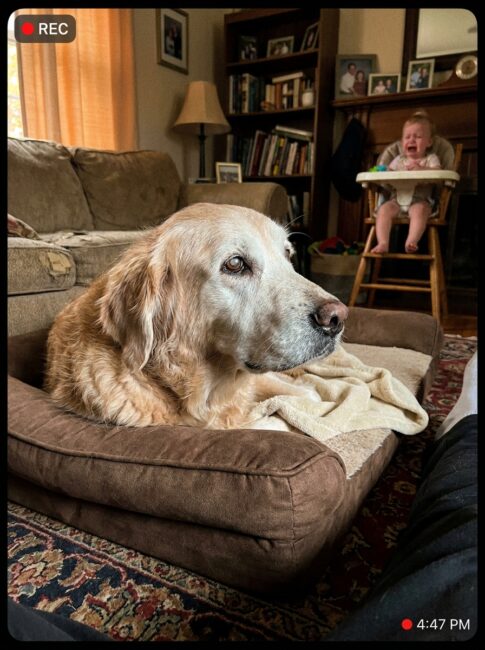
He was forty-three pounds when he died. He had weighed seventy-four pounds at the prime of his life.
He was the color of clover honey when he was young — that warm, deep, golden-honey color that some Goldens have. His coat darkened across the back to a richer caramel. The feathering on his tail was always pale and fine. His muzzle was square and a little broader than show-line Goldens. He had the soft, slightly mournful Golden expression — the perpetual mild apology of his breed.
He was the kindest creature I have ever lived with.
I want you to know what kind means in a dog. He greeted every person who came to my apartment in 2010, 2011, 2012, 2013 — every roommate, every boyfriend, every UPS driver — by walking calmly to them, sitting at their feet, and putting his head against their leg. He did not jump. He did not bark. He simply walked over and stood with them, like he had been their dog the whole time.
He greeted Owen the night I brought him home in 2014.
Owen sat down on my couch. Sully walked over. Sully put his chin on Owen’s knee.
Owen looked up at me and said, “Well. I guess this is settled, then.”
We were married in 2018.
Sully had a way of finding people who needed him. He would press his weight against the leg of a friend going through a divorce. He would lie down on the feet of my mother during the long visits in the year my father was sick. He would put his head on the bed when one of us had the flu and stay there for hours.
He was not a service dog. He was not trained. He simply was.
When Wren came home from the hospital on a snowy Tuesday in November of 2023, Sully was thirteen and a half years old. His back hips had started to give out. He could no longer climb the stairs to our second floor. He slept on a thick orthopedic bed in the corner of the living room.
I had been worried about how he would react to a baby. I had read articles. I had asked the vet. I had a plan for slow introductions.
I did not need any of it.
Owen carried Wren in her car seat through the front door. He set the seat down on the rug about four feet from Sully’s bed. Sully had been asleep. He lifted his head. He looked at the car seat for a long time.
Then he got up — slow, hitched, with the small grunt his hips made by then — and he walked across the rug, and he lay down, very carefully, with his body curved around the base of the car seat.
He did not sniff her. He did not whine. He did not lick.
He just lay around her. The way a body curves around another body to keep it warm.
He stayed there for two hours.
That was the day he became Wren’s dog.
I want to tell you about Sully and Wren, because the rest of this story does not work without them.
For the first six months of her life, Sully was almost always within five feet of her.
When she was on her play mat, he was beside it. When she was in her swing, he was under it. When she was in her crib at night, he tried — every single night, no matter how many times I redirected him — to walk into our bedroom and lie down at the foot of her crib. By the time she was two months old, I had given up. I let him in. He slept at her crib all night. He woke up at every cry. He looked at me. He waited for me to come.
When she started crawling at seven months, Sully became her destination. She would crawl across the rug toward him. He would lie still and let her grab his fur, his ears, his tail, his face. She would put her tiny baby fingers into his mouth. He would not move.
I have a video from the day she pulled herself up to standing for the first time, at nine months. She did it using Sully’s back. She had been crawling toward him on the rug. She had grabbed two fistfuls of his fur. She had pulled herself up — slow, wobbling — until she was on her feet. He had stayed perfectly still for the entire forty-five seconds it took her.
When she was finally upright, she put her cheek down against his neck.
He turned his head.
He licked her once on the side of her face.
She had laughed.
That was the first laugh I ever heard out of my daughter.
I want to tell you something I have not told anyone outside my family yet.
Sully knew he was leaving us.
I am not saying this in some sentimental way. I am saying it because he started doing things in the last three months of his life that I did not understand at the time and do understand now.
He started, in November of 2024, sleeping pressed up against the side of Wren’s crib at night instead of at the foot of it. As close as he could physically get to her. Every night. His back curved against the crib slats.
He started, in December, lying down on the kitchen floor when I sat to feed her in her highchair, with his chin pointed toward her chair.
He started, in January, refusing to eat from his bowl unless Wren was in the room.
I had taken him to the vet in early January. The vet — a woman who had treated him for nine years, named Dr. Voss — had told me his bloodwork was bad. His kidneys were failing. His heart had a murmur that had gotten louder. He had probably weeks. Maybe a month or two.
I had cried at the vet.
I had not told Owen yet. I had not been ready.
When I came home with him from that appointment, Wren had been napping. I had carried him into the house — he was light enough by then that I could — and I had set him down on his bed in the living room.
He had not moved from his bed for the rest of the day.
When Wren had woken up from her nap and started crying, he had lifted his head.
He had not gotten up.
But he had lifted his head.
I had not, at the time, understood what I had just seen.
The morning of February 9th, a Sunday, was the day I knew.
I had woken up at 6 a.m. to feed Wren. Sully had been on his bed. He had not lifted his head when I came down the stairs.
That had been the first sign.
I had gone over to him. I had put my hand on his side. He had been breathing. He had thumped his tail once when I touched him. But he had not lifted his head.
I had known.
I called Dr. Voss’s office. They were closed on Sundays but had an emergency line. The vet on call was a man named Dr. Reyes. He listened to me describe Sully. He said, gentle, “Hazel. It sounds like he is letting you know it’s time. Do you want to bring him in?”
I said no.
I said, “He has been on this rug for fifteen years. I want him here.”
Dr. Reyes said, “I understand. We can come to you. I have an appointment open at six tonight. I will come at six. You’ll have today with him.”
I hung up. I sat on the floor next to Sully. I cried for a long time.
Owen came down the stairs at about 7. He saw us on the floor. He understood without my saying anything.
He went into the kitchen and made coffee. He brought me a cup. He sat down on the rug on the other side of Sully. The three of us sat there for a long time without talking.
At 7:30, we heard Wren on the baby monitor.
She had been waking up. She had been making the small babbling sounds she made before she started actually crying. We had a few minutes.
I looked at Sully.
I said, “Buddy. She’s awake.”
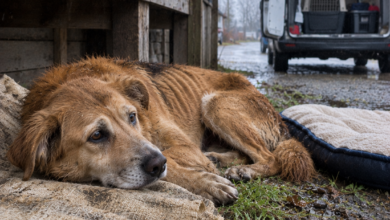
Sully lifted his head.
His head was so heavy. I could see the effort. His neck shook. His ears tried to come forward. His eyes — his weak old amber eyes, gone a little cloudy in the last year — looked up the stairs toward Wren’s room.
He held his head up for about three seconds.
Then he lowered it back down to the bed.
That was when I started to film.
I am not a person who films things, normally. I have a journalist’s instinct against it. I spend most of my life telling teenagers to put their phones down.
But I picked up my phone at 7:32 a.m. on Sunday, February 9th, and I started recording, because I had just realized what Sully was doing.
I want to tell you what was on the video.
Wren cried. She had moved from babbling to actual crying — the small intermittent wail of a thirteen-month-old who is hungry. The cry came down the stairs.
Sully lifted his head.
He looked toward the staircase.
He lowered his head.
Wren cried again, a longer cry this time.
Sully lifted his head. Looked toward the staircase. Lowered his head.
He did this nine times in the next twenty minutes.
I went up to get her at 7:55. I brought her down. I sat on the rug next to Sully. I put her in my lap. She had her morning bottle.
She looked at Sully. She had not, until that morning, ever cried near him without him coming over to her. She had cried his entire life, and he had always, always come to her. He had been on his bed across the room from her many times. But he had never not come.
She looked at him. She put her small hand out.
He could not reach her.
He was three feet away. He could not get up.
I moved her. I scooted across the rug with her in my lap until I was sitting up against his bed. I put her against his side.
She put her cheek against his neck. The way she had done at nine months when she had first stood up using him.
He turned his head, slow, toward her. He licked her once on the side of her face.
She laughed.
He closed his eyes.
I sat with both of them for almost an hour.
I did not stop recording for the rest of the day.
I want you to understand. I did not record him constantly. I would put the phone down. I would pick it up when something happened. By the end of the day my phone had thirty-one separate clips on it.
In every single clip, the same thing happened.
Wren cried — at 9:02, when she dropped a toy. At 10:14, when she fell against the coffee table. At 11:30, when she was hungry. At 1:00, when she was overtired. At 2:12, when she did not want to nap. At 3:47, when she woke up. At 4:30, when she was hungry again.
Each time, Sully lifted his head.
He looked toward the sound.
He lowered his head back down.
Each time, the lift took longer than the time before. Each time, his head came up less far. By 4:00 in the afternoon, he was barely lifting it at all — just an inch off the bed, his neck trembling with the effort, his ears flicking once toward the sound.
He was answering her.
I want to write this clearly because I am not a sentimental person and I do not believe dogs have language and I do not believe in attributing things to them they cannot do.
But I am also a teacher. I am paid to read. I am paid to interpret. I have spent twenty years of my career reading what people say with their bodies when they cannot say it with their words.
Sully was answering her.
He could not get to her. He could not stand. He could not walk. He could not lift his head high enough to see her across the room anymore.
But every single time her voice reached him, his body did the only thing it had left to do. It lifted. It pointed toward her. It said, in the only language a dying body still has, I hear you. I am still here. I just cannot come to you anymore.
He had been coming to her for fourteen months.
He could not stop just because he was leaving.
Dr. Reyes arrived at our front door at exactly 6:00 p.m.
I had spent the afternoon on the rug with Sully. Owen had taken Wren upstairs for her bath at 5:45. I wanted Sully to have the last hour quiet. I wanted to sit with him.
I had been sitting with him.
He had not lifted his head since 4:47 p.m.
That had been Wren’s last cry of the afternoon. She had been hungry before her dinner. She had cried in her highchair. The cry had reached Sully on his bed.
He had lifted his head.
Slowly. Slowly. His neck had shaken so badly. His head had come up — maybe an inch and a half. His eyes had pointed toward the kitchen.
He had held it there for a long time.
Then he had lowered his head.
He had not lifted it again.
I did not know it had been the last time, until 6:00 p.m. when Dr. Reyes was standing in my doorway with his bag.
I was sitting on the rug with my hand on Sully’s side. I was watching him breathe. His breathing had changed in the last twenty minutes. Slower. Shallower.
I want you to know that he was already going.
Dr. Reyes came in. He was kind. He sat on the rug with us. He listened to Sully’s heart. He looked at me. He said, “Hazel. He is already letting go. I do not think we need to do anything. I think we just need to be here.”
I asked him to stay.
He stayed.
Sully died at 6:14 p.m. with my hand on his side and Owen’s hand on his head and Dr. Reyes sitting with us on our rug.
He died quiet. Without struggle. He had been ready.
I want to tell you what I have been thinking about for the last eleven months.
I have been thinking about what it costs a dying creature to lift its head one more time.
I have been thinking about how much energy it takes a fifteen-year-old Golden whose kidneys are shutting down and whose heart is failing to lift seven pounds of head off a bed.
I have been thinking about the math of it. Sully had nine hours of consciousness left on Sunday morning when he started doing this. He had a finite amount of strength. He could have used that strength to live a few minutes longer at the end. He could have conserved every ounce.
He spent it on Wren.
Every cry. Every time. He spent it.
I have thought about whether he knew, on some level, what he was doing. Whether he understood that each lift was one less he had left.
I do not know.
I know what I think.
I think he could not stop. I think he had been answering her cries her entire life — for the fourteen months she had been alive — and his body did not know how to stop because his love did not know how to stop.
I think he was not making a decision. I think he was being who he had always been, all the way to the floor of his life.
I think the last lift, at 4:47 p.m., when he heard her cry for dinner — I think that lift was not for him. He had nothing to gain from it. He could not get to her. He could not feed her. He could not soothe her.
He lifted his head because she was crying.
He lifted his head because the only response his body had ever known to her crying was come to her. He could not come to her anymore. So he did the only motion he had left.
He pointed.
He pointed his face toward her voice. He told her, with the only equipment he had left, I am still here. I am still listening. I love you.
Then he closed his eyes.
He died ninety-seven minutes later.
Wren is now twenty-five months old.
She does not remember Sully.
I have to write that sentence and not let it gut me.
She was thirteen months old when he died. She is too young. The pediatrician told me, kindly, that she will not have memories from before she was about three. Sully will be a dog she sees in photographs and in the small video clips I have kept.
I have not deleted the thirty-one clips from February 9th.
I keep them in a folder on my phone called Sully’s Last Day.
I have watched them many times. Owen has watched a few of them. We have not shown them to anyone else. We have not posted any of them. I do not know if I ever will.
When Wren is old enough — I do not know what age that will be — I am going to sit her down. I am going to show her one of the clips. I am going to tell her about a Golden Retriever named Sully who lived with me for fifteen years before she was born and for fourteen months after she was born, and who spent the last day of his life lifting his head every time she cried.
I am going to tell her: Wren. He could not come to you anymore. But he answered you. Until he couldn’t.
I do not know what she will do with that information.
I hope she carries it.
We have a new puppy now. We waited eight months before we got him. He is a Golden Retriever, like Sully. He is six months old. His name is Otto.
He is not Sully.
He is his own dog. He is louder. He is dumber. He chews shoes. He eats things he should not eat. He is, in every way, a normal six-month-old Golden Retriever puppy.
He is also obsessed with Wren.
He sleeps next to her crib every night. He follows her from room to room. He lies down at her feet when she is in her highchair. He licks her face when she falls.
I do not believe in reincarnation. I do not believe Sully sent him.
But I have noticed Otto does something I did not teach him. When Wren cries from across the room, he lifts his head and looks at her. He does it every single time.
He learned it on his own.
I do not know what to do with that, either.
I keep one of the videos on my home screen.
It is the 4:47 p.m. clip. The last lift.
I have not watched it in two months.
I do not need to watch it.
I just need to know it is there.
Sully. If you can hear me.
I heard you, too.
Follow this page for more stories about the dogs who answer us until they can’t.