Part 2: My Brother Left a Rescue Pit Bull Outside My Locked Door — Three Rainy Days Later, I Discovered Why She Refused to Leave
Part 2 — The House After Daniel
Before Daniel died, my house had never been truly quiet.
Even after he moved into his own apartment, he entered as though doors were suggestions rather than barriers. He would call from the driveway, then use the spare key before I answered.
“Mom, you home?”
“No, Daniel. This is an elaborate recording.”
He would laugh and enter carrying groceries I had not requested, tools I did not need, or some wounded living thing he had decided was temporarily his responsibility.
A bird with an injured wing.
A box turtle found in the road.
Once, a Beagle belonging to a neighbor three streets away.
Daniel worked as a physical therapist assistant at a rehabilitation clinic, but he spent weekends volunteering at animal shelters. He liked difficult dogs—the ones who hid in corners, rejected treats, or frightened potential adopters by standing too still.
“Happy dogs sell themselves,” he told me. “The quiet ones need somebody to translate.”
I had not known how much I would hate remembering ordinary sentences.
After the accident, people came to my house carrying casseroles and words that felt equally impossible to swallow.
“He didn’t suffer.”
“He knew you loved him.”
“At least you had thirty-two years.”
As if a year could be placed beside a life and declared sufficient.
I stopped answering calls.
I retired early from my job as an elementary-school librarian, claiming I needed time to “handle family matters.” The family matter was that I could no longer pass the children’s section without remembering Daniel at seven, sitting cross-legged beneath a table with six books about wolves.
I stopped going to church because people watched me during hymns.
I stopped shopping in person because the grocery store played a song Daniel once sang badly in my kitchen.
I stopped cooking because recipes assumed someone wanted tomorrow.
Robert came every Sunday.
He changed light bulbs that were not burned out.
He cleaned gutters.
He left containers of soup inside a cooler on the porch because I no longer opened the door reliably.
Sometimes he sat on the steps and talked to me through the wood.
He never asked me to move on.
That phrase would have ended our relationship.
Instead, he talked about weather, his aching knee, baseball trades, and the tomatoes he planned to plant when spring came.
Once, after nearly an hour of one-sided conversation, he said, “I miss him too.”
I sat on the other side of the door with my back pressed against it.
Neither of us spoke again that afternoon.
Robert’s attempt with Patience was not his first.
He had invited me to lunch.
Left grief-counseling brochures.
Asked me to join a group for parents who had lost adult children.
Suggested volunteering.
Suggested moving.
Suggested selling the house because Daniel’s fingerprints seemed to remain on every light switch.
I rejected everything.
A dog was different because a dog could not explain what I should do with my grief.
Patience also did not appear interested in improving me.
During her first week inside, she slept more than she moved.
She ate slowly and only when I sat several feet away. If I left the room, she stopped until I returned.
She did not climb onto furniture.
She did not bark when delivery drivers approached.
She did not ask to go outside until the need became obvious, then stood silently beside the back door.
Her restraint made me uneasy.
It felt practiced.
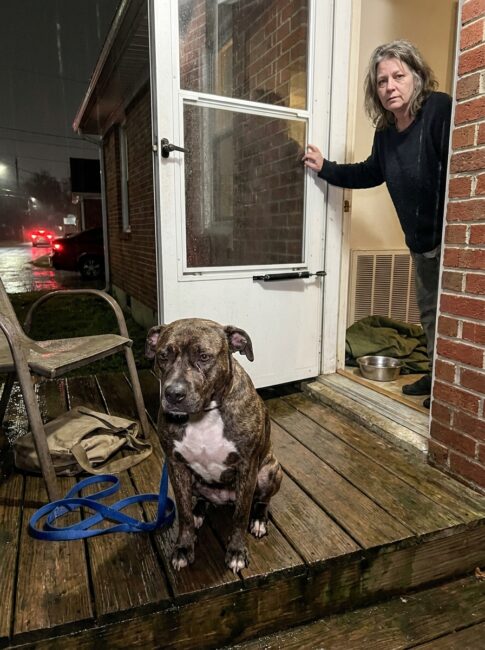
On the fourth day, I opened the canvas bag Robert had left. Inside were food, a leash, a bottle of joint supplements, shelter records, and a handwritten note.
She has been returned twice. Do not read that as failure.
I almost threw the note away.
Instead, I read the shelter file.
Molly.
Female.
Brindle Pit Bull mix.
Approximately five years old.
Found wandering near a closed manufacturing plant.
No microchip.
No evidence of aggression.
“Slow to approach.”
“Freezes near raised voices.”
“Prefers quiet rooms.”
“Will wait near exits when distressed.”
The first family returned her after two weeks because she “didn’t bond.”
The second returned her after nine days because she refused to play, remained near the front door, and would not sleep in the bedroom.
The final note was underlined:
Dog appears to attach through proximity rather than interaction. Does not demand affection. Needs adopter willing to allow relationship to develop without pressure.
I looked toward the mattress.
Patience was awake, watching me without lifting her head.
“They said you didn’t bond,” I told her.
Her eyes moved toward the door.
“I understand.”
That afternoon, I attached the leash and attempted our first walk.
Patience stepped outside, stood on the porch where she had waited, and looked back at the doorway.
“You’re allowed to leave now.”
She took three steps down.
Stopped.
Looked back again.
I realized she was checking whether the door would remain open.
I left it ajar.
Only then did she walk to the sidewalk.
We traveled less than one block. I had not walked farther than the mailbox in months, and Patience moved as if every yard required mutual agreement. She did not pull. She did not sniff every bush.
She stayed beside me.
At the corner, a truck passed too quickly and hit a pothole.
The sharp sound made her flatten to the pavement.
I crouched instinctively.
“It’s all right.”
She pressed her side against my leg.
My hand settled on her shoulder.
It was the first time I touched her deliberately.
Her fur was warmer than I expected.
She trembled for another minute, then stood.
We returned home.
That night, she moved her sleeping position six inches closer to mine.
Small distances became our language.
Part 3 — The Things Patience Did Not Ask For
People later imagined Patience rescued me through constant companionship and cheerful dog behavior.
That is not what happened.
She did not drag toys into my lap.
She did not lick away my tears.
She did not perform happiness until I copied her.
Patience helped because she required so little theater.
Grief had made every human interaction exhausting. When people visited, I could feel them measuring my progress. Was I showered? Had I eaten? Was I speaking about Daniel in the past tense? Did I seem better than last month?
Patience measured nothing.
If I stayed in bed until noon, she remained on the rug.
If I ate toast for dinner, she accepted her kibble without judgment.
If I stood in Daniel’s room holding one of his shirts for forty minutes, she sat in the hallway rather than entering.
She never crossed that doorway during the first month.
Not once.
I wondered whether she sensed the room belonged to someone absent.
Or whether my body changed whenever I approached it.
One rainy Tuesday, I sat on Daniel’s bedroom floor sorting through a box of things from his apartment. His college sweatshirt. Old movie tickets. A cracked phone charger. A birthday card he had bought but never given anyone.
I found a photo of him holding a shelter dog.
The image was small and badly printed. Daniel sat on concrete with a large brown dog leaning against his shoulder. I did not study it carefully. Animal shelters all looked the same to me then—chain-link gates, washable floors, bright volunteer shirts.
I placed it back in the box.
Patience was waiting outside the room.
“You don’t want to come in?”
She looked away.
“Smart dog.”
By the second month, our routine expanded.
Morning walk at seven.
Breakfast.
Coffee for me at the kitchen table while Patience slept beneath it.
A longer walk at four.
Lights off before midnight.
Sleep.
I began eating real meals because opening dog food twice a day reminded me hunger was a schedule rather than an opinion.
I began showering before morning walks because February became March, and more neighbors were outside.
I reopened one set of curtains.
Then another.
The first time sunlight reached the living-room floor, Patience moved into it and slept on her side, exposing the soft white fur across her stomach.
Trust does not always look like a tail wag.
Sometimes it looks like an animal allowing its vulnerable side to face the room.
Robert visited on a Sunday afternoon.
This time, I opened the door.
His eyes moved over me quickly, checking without wanting to be caught checking.
“You look taller,” he said.
“That doesn’t make sense.”
“I know.”
Patience stood behind my leg.
Robert crouched.
“Hey, Molly.”
She did not approach.
“Her name is Patience.”
He smiled.
“That sounds like a criticism of both of you.”
I almost laughed.
The sound escaped before I could stop it.
Robert’s face crumpled for one second.
He hid it by tying his shoe.
It was the first time he had heard me laugh since Daniel died.
We drank coffee at the kitchen table while Patience lay between our chairs. Robert told me how he found her listing online.
The shelter had posted a photograph of her sitting beside a kennel door while other dogs jumped against their gates.
The caption read:
She doesn’t ask people to choose her. She just waits to see if they will.
Robert drove there the next morning.
“Why her?” I asked.
He looked at me for a long moment.
“Because she knew how to stay near a closed door without taking it personally.”
I stared into my coffee.
“That is not funny.”
“I wasn’t joking.”
The shelter staff had warned him not to leave her outside my house. He did it anyway because Patience refused to climb back into his truck after reaching my porch.
“She sat down,” Robert said. “Wouldn’t move.”
“You abandoned her.”
“I watched from down the road for six hours.”
I looked up.
“You what?”
“I parked where you couldn’t see me. She had shelter. I had blankets and a crate. I wasn’t going to let her freeze.”
“You left overnight.”
“I came back at four in the morning. She was still sitting there.”
“And on the second day?”
“I checked every few hours.”
Anger rose, then softened against the simple fact that my brother had spent two nights in his truck because he refused to abandon either the dog or me.
“Why didn’t you tell me?”
“Because you would have made the story about me.”
He looked down at Patience.
“It had to be about whether you opened the door.”
After he left, Patience followed me into the hallway.
For the first time, she stopped at the entrance to Daniel’s room.
She sniffed the air.
Then backed away.
I thought she was responding to my grief.
I did not know she had been in that room before.
Not physically.
But through the scent of the person who once sat beside her for hours and taught her that waiting could end safely.
Part 4 — The Night I Finally Slept
Three months after Patience arrived, a thunderstorm moved across Knoxville.
The rain began shortly after dark, heavier than the weather during her days on the porch. Wind bent the bare branches outside, and water hammered the windows hard enough to make the old house creak.
Patience disappeared.
I found her behind the dining-room table, body low, paws spread across the floor. Each crack of thunder tightened every muscle along her back.
I sat several feet away.
“You stayed outside in rain for three days.”
She stared past me.
“I suppose rain and thunder aren’t the same thing.”
Another crack sounded.
Patience crawled toward the wall.
I remembered the truck backfiring during our first walk.
Raised voices.
Sharp sounds.
The scar under her eye.
There were gaps in her shelter history that would remain gaps. Animals rarely arrive with accurate accounts of what taught them fear.
I moved closer without touching her.
The storm continued.
After almost an hour, Patience placed her chin on my ankle.
That was all.
I stayed there until midnight.
When the thunder faded, I attempted to stand. She lifted her head, and the loss of contact seemed to frighten her more than the storm.
So I brought blankets from the bedroom and slept on the dining-room floor beside her.
It mirrored our first night together.
Only now, I understood we were not repeating the moment.
We were revising it.
The first night, I lay beside her because I had forgotten how to sleep alone with my thoughts.
This time, I stayed because she needed someone to remain when the noise became too large.
That morning, I woke before her.
Patience lay pressed against my back. Her nose rested between my shoulder blades.
I did not feel healed.
I no longer trusted that word.
But I felt necessary.
There is a difference.
During the following weeks, I began leaving the house for reasons unrelated to dog care. I visited the library after closing time so I would not see former coworkers. I sat in Robert’s kitchen while his wife cooked dinner. I attended one session of the grief group whose brochure had remained beneath a stack of mail for six months.
I said only my name.
Then another woman introduced herself and told us her daughter had died from an overdose.
No one tried to improve the sentence.
No one said “at least.”
I returned the next week.
Patience began riding in the car, though she remained uncertain near busy roads. She sat low in the back seat whenever trucks passed and relaxed only after we turned onto quieter streets.
At the grief center, she waited in the lobby with a volunteer.
One afternoon, a man came out of group crying. He sat on the floor beside the coat rack, unable to stand.
Patience approached.
She did not lick him or climb into his lap.
She lowered herself three feet away.
The man reached toward her but stopped before touching.
Patience waited.
Eventually, his hand crossed the distance.
That became her unofficial work.
The grief-center director asked whether I would consider having her evaluated as a support dog. Patience did not have the outgoing temperament people expected from therapy animals, but she had something else.
She understood the dignity of silence.
Her presence said: I will not ask you to perform recovery for me.
People responded to that.
One year after Daniel’s death, I visited the crash-site memorial for the first time. Robert drove. Patience sat in the back.
The roadside cross had faded. Artificial flowers were tangled around its base. Someone—probably Robert—had replaced the photograph after winter damaged the original.
I remained inside the car for twenty minutes.
Patience did not pressure me.
When I finally opened the door, she stepped out and waited.
We approached together.
I touched Daniel’s picture.
Then I sat in the grass.
Cars passed loudly.
Patience flinched at each one, but she did not leave.
Neither did I.
That should have been the emotional ending.
A grieving mother faces the place.
The dog stays beside her.
The road loses some power.
But our story had one more door to open.
It happened two weeks later at the animal shelter where Robert found Patience.
We returned for a routine vaccine appointment.
An elderly volunteer saw her across the lobby and dropped a clipboard.
“Oh my God,” she whispered. “That’s Daniel’s girl.”
Part 5 — The Name She Had Before Patience
The volunteer’s name was Carol Jensen.
She had worked weekday mornings at the Knox County rescue for nearly twelve years. She was seventy-one, with white hair cut close around her face and reading glasses hanging from a purple cord.
She approached slowly.
Patience stood.
Not frightened.
Alert.
Carol knelt several feet away.
“Hey, Patient Girl.”
The dog’s head tilted.
Then her tail moved.
Not wildly.
One slow sweep.
The exact movement she gave me when I named her.
My knees weakened enough that I sat in a plastic chair without choosing to.
“What did you call her?”
Carol looked from me to the dog.
“Patient Girl. That’s what one of our old volunteers used to call her.”
She studied my face.
“Are you Daniel Harper’s mother?”
The lobby seemed to narrow.
I heard dogs barking behind the adoption doors. A printer ran at the front desk. Someone opened a bag of food in another room.
“Yes.”
Carol covered her mouth.
She had known Daniel.
Not socially. Not outside the shelter. But he volunteered there during the final eight months of his life, working mostly with anxious dogs who could not manage public adoption events.
Patience had arrived during that period.
Her first shelter name had been Molly, but she refused to approach visitors. She sat at the back of the kennel when people stood near the gate and moved toward the door only after they walked away.
Daniel began spending his Saturday afternoons inside her kennel.
He read books aloud.
At first, he sat against the opposite wall.
Then closer.
After several weeks, Patience began lying beside him.
Carol led us to the shelter office and opened an old digital folder of volunteer photographs.
The image I had found in Daniel’s room appeared on the screen.
This time, I looked.
Daniel sat on the concrete floor wearing a green shelter T-shirt. Patience leaned against his shoulder.
The scar beneath her eye.
The white chest.
The folded ear.
It was her.
I gripped the edge of the desk.
Daniel’s face looked ordinary in the photograph. Alive in the casual way that hurts most. Hair too long. One shoelace untied. A coffee cup near his knee.
Carol clicked through more images.
Daniel walking Patience behind the shelter.
Daniel sitting beside her during a thunderstorm.
Patience asleep with her head on his boot.
“He wanted to foster her,” Carol said.
“Why didn’t he?”
“His apartment had a breed restriction. He was trying to move.”
She opened a scanned document.
It was a foster application in Daniel’s handwriting.
Under the question Why are you interested in this animal?, he had written:
Because she waits until everyone leaves before admitting she wanted them to stay.
My vision blurred.
There was more.
Under What type of home do you believe would suit this dog?, Daniel wrote:
Quiet. Patient. No one who needs a dog to entertain them. She needs someone who understands that sitting nearby counts as love.
Carol reached toward me but stopped before touching.
“He talked about you.”
I could not answer.
“He said his mom had a quiet house and was better with hurt things than she believed.”
A laugh escaped me, broken and sharp.
“I told him I didn’t want a dog.”
“He told us that too.”
Carol smiled through tears.
“He said you always said no first when the answer scared you.”
Daniel had submitted the foster paperwork three weeks before the accident.
The application was never completed.
After he died, Patience remained at the shelter for another two months. She was adopted, returned, adopted again, then returned again.
When Robert found her listing nearly a year later, he did not know Daniel had worked with her. He knew only that the shelter was one his nephew had supported and that this particular dog looked like grief made visible.
The coincidence felt impossible.
Yet it was made from ordinary parts.
Daniel volunteered with difficult dogs.
Robert searched the same local shelter.
Patience remained unwanted long enough for their paths to cross.
No magic was required.
Only time.
The shelter director gave me copies of Daniel’s volunteer notes. Most were practical:
Ate chicken from hand.
Startles at metal bowls.
Settles when someone reads.
Do not force eye contact.
The final note was dated four days before his death.
Molly sat by the kennel door after I left today. Went back inside. She was asleep before I finished the chapter. Progress means returning before someone has to wonder.
I read that line three times.
Then I looked at Patience.
She was sitting beside the office door.
Waiting.
But not alone anymore.
That was the revelation hidden inside her three days on my porch.
She had not come to replace Daniel.
She could not.
She carried no message from beyond death.
But she had known his voice.
Known his patience.
Known the shape of his body sitting beside her without making demands.
When she reached my porch, she may have smelled him on the old blanket I placed inside.
She may have smelled him on me.
Or she may simply have recognized another closed door and believed what Daniel taught her: sometimes the person behind it is afraid, not gone.
So she waited.
And for the second time in her life, someone came back before she had to stop hoping.
Part 6 — What We Built From Waiting
After learning about Daniel and Patience, people expected me to describe the connection as fate.
I resisted.
Fate sounded too smooth.
It erased the shelter workers, Robert’s stubbornness, Daniel’s weekends, the adopters who returned her, the three rainy days, and every small choice that kept Patience available long enough to reach me.
I preferred continuation.
Daniel started something.
Patience carried it.
I became capable of finishing part of it.
That spring, I began volunteering at the shelter once a week.
Not with puppies or adoption events.
I worked in the quiet wing.
The dogs who hid.
The dogs who froze.
The dogs who had been returned because they did not become grateful quickly enough.
I brought a folding chair and library books.
Patience came with me after completing a basic behavior evaluation. She lay outside kennels while I read.
Some dogs approached the bars because of her.
Others did not.
We counted both as work.
Carol helped us start a small program for older and shut-down dogs called Wait With Me. Volunteers committed to sitting beside the same dog for one hour each week without forcing interaction. No reaching through bars. No constant commands. No filming a transformation for social media.
Just dependable presence.
Adoptions increased slowly.
More important, returns decreased among participating dogs because potential families received a truthful explanation of what bonding might look like.
Robert funded the first set of chairs.
He claimed it was because the shelter’s folding stools were “an insult to adult spines.”
We all knew better.
Patience also continued visiting the grief center. She never became a conventional therapy dog. She ignored cheerful people and chose the quietest person in the room.
Once, she lay beside a woman whose son had died in military service. The woman did not touch Patience for almost an hour.
Then she whispered, “You don’t know what to do either, do you?”
Patience exhaled.
The woman smiled.
That was enough.
At home, we developed rituals.
Every Sunday morning, I made scrambled eggs and gave Patience one small portion after her regular food.
Every Tuesday evening, we walked past Daniel’s apartment building.
Every month, we visited Robert, who pretended Patience preferred him and produced no evidence.
On Daniel’s birthday, we went to the shelter and read the last chapter of whatever book he had been reading to Patience in the old photograph.
We never discovered the title.
So I chose one.
The first year, it was The Call of the Wild.
Patience slept before chapter two.
Daniel would have found that funny.
My sleep improved.
Not perfectly.
Some nights grief still woke me at three with the old sensation that something terrible was about to be announced.
Patience would lift her head from the mattress beside my bed.
I would place my hand against her shoulder.
Neither of us needed the door opened.
We were already inside.
Part 7 — The Door We Kept Open
Patience lived with me for seven years.
Her brindle coat faded along the muzzle. The scar beneath her eye remained. Her back leg grew stiffer, and eventually we replaced long walks with slow trips around the block.
She never became playful in the expected way.
She carried no tennis balls.
She performed no tricks beyond sitting when she felt the request was reasonable.
But she learned to wag when Robert arrived.
She barked exactly once at a raccoon and appeared embarrassed afterward.
She slept through thunderstorms if I remained within sight.
Most importantly, she stopped waiting beside doors.
When visitors came, Patience stayed on her bed rather than positioning herself near the exit. If I left for groceries, she watched from the window but returned to sleep before my car disappeared.
Her body had learned that departure did not always mean abandonment.
Mine learned that love could reenter without betraying what came before.
On the seventh anniversary of Daniel’s death, I stood at the roadside memorial with Patience beside me.
Traffic moved in long waves.
The old fear still lived somewhere in my chest, but it no longer controlled my feet.
I placed fresh flowers beneath Daniel’s photograph.
Then I read aloud the final note he had written about Patience:
“Progress means returning before someone has to wonder.”
Patience looked toward the road.
Then back at me.
“We did that,” I said.
She leaned against my leg.
Several months later, her heart began failing.
The veterinarian gave us medication and time, though no one can prescribe the amount a person wants.
Patience remained comfortable through summer.
By October, she could no longer manage the porch steps without help.
Robert built a ramp.
On her final morning, rain fell lightly.
Not cold rain.
A soft autumn rain tapping against the roof in the same steady rhythm I remembered from the three days outside my door.
Patience lay on Daniel’s old camping blanket near the front entrance.
I sat beside her.
Robert sat on the other side.
She breathed slowly.
At one point, the wind shifted and the screen door moved slightly open.
Patience looked toward it.
For a moment, I saw the dog on the porch again—wet, tired, waiting for someone inside to become brave enough.
I reached over and pushed the door fully open.
“You don’t have to wait anymore,” I whispered.
Her eyes returned to me.
Her tail moved once against the blanket.
Then she slept.
We buried her beneath the maple tree in my backyard, facing the porch.
Her stone reads:
PATIENCE
SHE WAITED.
I OPENED.
WE STAYED.
The house is quiet again now, but it is not closed.
That distinction is the life she gave me.
The curtains remain open.
I answer Robert’s knock.
I volunteer every Thursday at the shelter, where there is always another dog sitting behind a gate as if wanting nothing.
Sometimes people ask how I knew to open the door on the third day.
I did not know.
I was tired.
She was tired.
One of us made a sound.
The other finally listened.
Perhaps that is all rescue is in its most honest form—not one broken life saving another, but two lives admitting they cannot remain outside forever.
Patience sat in the rain because she believed the door might open.
I opened it because some part of me still believed something worth loving might be on the other side.
Daniel began the lesson.
Patience finished it.
And now, every time I leave the shelter’s quiet wing, I turn back before closing the door.
Just once.
To make sure no one is still waiting.
Follow this page for more unforgettable dog stories about grief, healing, and love patient enough to wait outside the door.