Part 2: My Rescue Pit Bull Touches Every Door and Window With Her Nose Before Bed. I Thought It Was OCD. The Truth Was Worse.
I want to describe the routine, because I have watched it for two hundred and forty-seven nights, and I know it better than my own.
I usually go to bed around 11 p.m. I brush my teeth. I turn off the kitchen light. I check that the dishwasher is running. I walk down the hallway to my bedroom. Penny is normally already on her bed by then, head down, eyes following me.
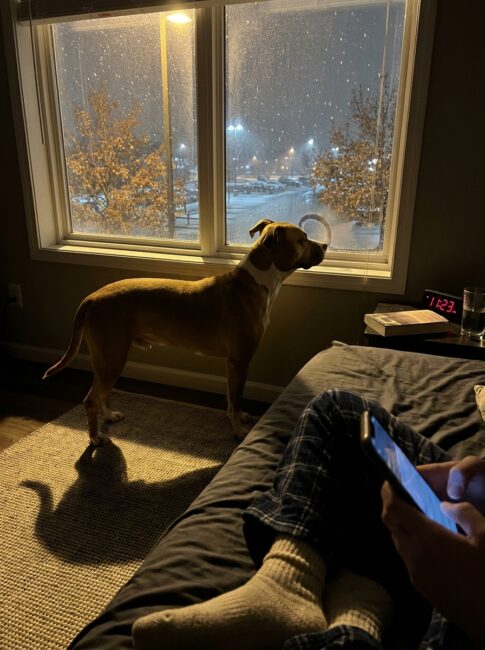
The moment I turn off my bedroom lamp, she gets up.
Every. Single. Night.
She walks out of my bedroom into the hallway. She turns left into the living room. She crosses to the front door. She presses her nose against the bottom corner of the door for about half a second. Sometimes she pushes it — gently, with her muzzle — to make sure it is fully shut. If the deadbolt is not turned, she will look back at me through the doorway like she’s waiting. I learned to start turning the deadbolt before I went to brush my teeth, because if I forgot, she would not stop checking until I did.
After the front door, she walks to the living room window. The big one that looks out over the parking lot. She presses her nose against the bottom edge of the glass. She moves to the second window — there are two in the living room — and does the same thing.
If I have left a window cracked open for air, she stares at the gap.
She does not whine. She does not bark. She does not push it. She just stares at it until I get up, walk over, and close it.
Then she moves on.
She walks back through the hallway. She stops at the bathroom. She checks the bathroom window — small, frosted, above the toilet. Nose. Half a second. Done.
She continues down the hallway to the spare bedroom. I use it as my office. She checks the two windows in there — one against the radiator, one against the desk. Then she pushes the door open with her shoulder, walks inside, walks all the way around the perimeter of the room, and walks back out. She has never explained to me why she does the perimeter walk in that one room. I think it is because the spare bedroom is the room she is least familiar with. I think she is being thorough.
She walks back into my bedroom. She checks the two windows in there — the one over my dresser, and the one above my bed. The one above my bed is the last one she checks. Always.
She presses her nose against the bottom of that window.
She holds it there for a second longer than the others.
Then she walks to her dog bed. She turns three times in a circle. She lies down. She lets out a long, slow breath.
She closes her eyes.
The whole routine takes between four and six minutes, depending on whether I have left anything open.
She has done it every night for two hundred and forty-seven nights.
She has not skipped one.
I called the first trainer in May.
I had been living with Penny for about three months by then. The routine had stayed identical. It had not gotten longer. It had not gotten shorter. It had not faded the way I had assumed a quirky habit would fade as she settled into the apartment.
The first trainer was a woman named Susan. I described the routine over the phone.
She said, “It sounds like compulsive behavior. Some rescues have anxiety patterns that look ritualistic. Have you considered that she might have OCD?”
I said, “I didn’t know dogs got OCD.”
Susan said, “They do. It’s actually relatively common in dogs from unstable backgrounds. The technical term is canine compulsive disorder. We can do training to interrupt the pattern.”
I said, “Should I?”
Susan said, “If it’s not bothering you, no. But if it’s stressing her, yes.”
I told her Penny did not seem stressed. She seemed calm. She seemed more calm after the routine, in fact. The way I felt after I locked my own front door at night.
Susan said, “Then leave it alone. But it’s compulsive. It’s not rational.”
I hung up.
I called a second trainer in June. He told me almost the same thing. He used the words ritual, compulsion, and anxiety pattern. He recommended I redirect her with a chew toy at bedtime.
I tried that one night. I gave Penny a Kong stuffed with peanut butter at 11 p.m.
She set it down on the floor.
She did the routine.
She came back. She picked up the Kong. She lay down. She chewed it.
She is not stupid. She had a job to do first.
I called a third trainer in August. Her name was Rachel. She was younger than the other two. She specialized in shelter dogs.
She listened to me describe the routine for almost ten minutes without interrupting. When I was done, she was quiet for a second.
Then she said, “Maya. I don’t think it’s OCD.”
I said, “What is it?”
She said, “I think she’s checking the perimeter.”
I said, “What?”
Rachel said, “Some dogs do that. Especially dogs from homes where something happened. Have you read her full intake file?”
I said, “I read what they sent me.”
Rachel said, “Sometimes the front-of-file info isn’t the whole story. The shelter usually has notes from the surrender appointment. You can request them. Ask for the full file. Tell them you’re trying to understand a behavior.”
I said okay.
I emailed the shelter that night.
The response came back five days later.
It was a thirty-one-page PDF.
I read the first ten pages standing in my kitchen. They were the same as what I’d seen at adoption — vaccinations, weight, behavioral assessment, leash test results.
Page eleven was different.
Page eleven was a typed account from the surrendering owner, dated October 14, 2024.
I sat down on the kitchen floor.
I want to be careful with what I write next, because the story on page eleven belongs to a family I do not know, and they have been through something I would never wish on anyone.
I will tell you the parts that are necessary.
Penny had lived with this family for two years before she was surrendered. The family consisted of two parents — both teachers — and a daughter, age four. The mother had written the surrender statement.
She wrote that they had loved Penny very much. She wrote that Penny was patient with their daughter. She wrote that Penny had slept on the daughter’s bed for the first year and on the living room couch the second year.
She wrote that their house had been broken into twice in the previous eighteen months.
The first break-in had been during the day. Nobody had been home. The thief had come in through the back door. He had taken electronics and jewelry. They had reinforced the back door. They had installed a security system. They had told themselves it was a one-time thing.
The second break-in had been at night.
Penny had been asleep on the living room couch. She had not heard the thief come in. The thief had entered through the bedroom window of the four-year-old daughter, who had been asleep in her bed.
The mother wrote that the daughter had woken up. She had screamed. She had run out of her bedroom into the hallway. The mother had heard her scream. The father had run downstairs with a baseball bat. By the time he got there, the thief was already going back out the window.
Nobody was hurt.
The four-year-old had not slept in her own bedroom for six weeks afterward.
The mother wrote that they had decided to move. They had decided to move because the daughter could not sleep in the house anymore. She wrote that they had also decided, after a lot of agonizing, that Penny needed to be rehomed.
She wrote that this was not because Penny had failed them.
She wrote that this was because their daughter, every night, when they tried to put her to bed, would whisper to her parents, “But where was Penny? Where was Penny?”
She wrote that they could not give the daughter an answer.
She wrote that they were moving across the country to start over, and they had decided that bringing Penny would be a daily reminder for the child of what had happened.
She wrote that she was so sorry.
She wrote that Penny was a wonderful dog and that whoever adopted her would be so lucky.
She wrote one final paragraph.
She wrote: Please tell her new family that since the night of the break-in, Penny has had a habit of checking the doors and windows before she sleeps. She does it every night. We do not know how to make her stop. We do not know if she should. We do not know if she even understands what she is doing. We just know she does it. Please don’t try to train it out of her. We think she’s trying to take care of someone.
I sat on my kitchen floor and cried.
I want to write the part that broke me, because writing it down is the only way I know how to handle it.
Penny had been on the couch when the man came in.
She had not heard him.
She had failed — the way a young dog fails when something happens she has no framework for — to do the one job a dog believes she has, which is to keep her people safe.
A four-year-old had screamed at 2 a.m. in her own bedroom because somebody had crawled through her window, and Penny had been twenty feet away on a couch and had slept through it.
The little girl had asked her parents, every night, where was Penny.
Penny did not know that she had been surrendered because of the break-in. She did not know that her family had moved away. She did not know that the four-year-old who had screamed had been part of the reason she ended up in a kennel two hours from her old neighborhood.
She knew one thing. She knew it the way dogs know things — without language, without timeline, without the word before and the word after.
She knew: the last time I slept and a window was open, a bad person came in.
She did not know it had been the daughter’s window. She did not know how the man had gotten in. She did not know any of the engineering of what had happened. She knew the function.
The function was: open window plus me asleep equals bad people in the house.
So she had decided, in whatever way a dog decides things, that she was never going to do that again.
She was not going to sleep until she had checked.
Every door. Every window. Every room.
For the rest of her life.
She had been doing it for over two years.
She had done it in her old house, in her old town, with her old family.
She had done it through her surrender, through her transport, through the kennel — though I will never know how she did it in a kennel; maybe she had not been able to, and she had lain awake every night.
She had done it through her first night in my apartment.
She had done it for two hundred and forty-seven nights in a row in a home she did not yet know was permanent, for a person who had not yet earned what she was giving her.
I sat on my kitchen floor at 11:47 p.m. on a Tuesday in October with the surrender file in my hand and I cried in a way I had not cried as an adult in many years.
Penny came into the kitchen.
She had finished her routine for the night. She had been on her dog bed.
She walked over to me. She put her head in my lap.
I put my hand on her face.
I said, out loud, to a dog I had been calling broken for eight months, “I’m so sorry, baby. I’m so sorry. I am so, so sorry.”
She thumped her tail.
Twice.
She did not understand the word sorry.
But she understood the function of being held.
I sat with Penny on the kitchen floor that night until almost 1 a.m.
I read the rest of the file. I read about the four-year-old. I read about the move. I read about the two months Penny had spent in the kennel before I’d come for her, lying in the back of her cage with her chin on her paws.
I thought about the trainers I had called. I thought about Susan. I thought about the second one. I thought about the word OCD. I thought about how easy it had been for two professionals to look at a dog doing the most reasonable thing in the world — protecting the people she loved from a thing she had failed to stop once before — and call it a malfunction.
It was not a malfunction.
It was the most rational behavior I have ever witnessed in my life.
It was a lesson learned. It was a vow taken. It was a job assumed.
It was a creature with no language and no calendar and no concept of next time doing the only thing she could think of to make sure that the next time would be different.
I have spent eight months of my adult life calling something compulsive that was, in fact, devotion.
I want to write something here that I have been thinking about, and I want you to hear me.
We use the word trauma about animals like it is a flaw. Like it is a thing you fix, or untrain, or work around. We bring rescue dogs home and we say, she has trauma. She has anxiety. She has issues. She has habits. We say it like it is a deficit they came with.
I want to suggest something else.
Penny did not come to me with a deficit.
Penny came to me with a vow. She had survived a thing she did not understand and she had decided, at the level a dog can decide things, that she would never let it happen again on her watch.
She brought that vow to my apartment.
She has been keeping it in my apartment for two hundred and forty-seven nights.
She is the reason I sleep deeper than I have slept in years.
I did not know that, until I read page eleven.
I know it now.
I do not try to interrupt the routine anymore.
I have made small changes. I close all the windows now before she starts. I turn the deadbolt before I brush my teeth. I put the spare bedroom door fully open or fully closed, never ajar, because I do not want her to have to push it. I make her job easier where I can.
I sit on the edge of my bed every night and watch her do the loop.
I do not look at my phone. I do not read. I just watch.
She does not need an audience. I am not doing it for her.
I am doing it for me.
I am bearing witness to something that was done by hand, every night, for over two years, with no acknowledgment, no reward, and no understanding. A creature has been protecting me — and the four-year-old before me, and the family before that — from the dark, and she has not asked for one thing in return.
When she lies down on her bed, I tell her, every night, “Thank you, Penny. We’re safe.”
She has started, in the last two months, lifting her head briefly when I say it.
I do not know if she understands the words.
I think she understands the function.
Last week I had a friend stay over.
She is from out of town. She slept on the couch.
I told her about Penny’s routine. I asked her to please not be startled if she felt a wet nose against the front door at 11 p.m.
She laughed.
At 11:14, Penny did the loop.
The last window she checked was the one above my bed.
She paused. Pressed her nose against the glass. Held it there a second longer than the others.
Then she came to her bed.
She looked at me.
I said, “Thank you, Penny. We’re safe.”
She lay down.
She closed her eyes.
The four-year-old is six now.
I hope she sleeps.
Tag a rescue parent who’s ever been told their dog had “issues.”