Part 2: Our Family Dog Jumped Into a Flooded River and Held My Elderly Father Above Water Until Rescuers Could Reach Them Both Alive
Part 2 – The Water Took the Yard
The flood did not look dangerous until it was already too late.
That is what I remember most. Earlier that morning, it had looked inconvenient, messy, worrisome, but not deadly. The creek behind Dad’s house had risen before. Every family in that hollow had stories about sandbags, washed-out driveways, and water creeping toward porches. Dad had a measuring mark carved into the old sycamore tree, a habit from years of watching storms. He checked it every hour like a farmer reading the sky.
By noon, the mark was gone beneath muddy water.
By two, the lower yard was underwater.
By three, the fence line shook as if something alive was pushing against it from the other side.
I had driven over that morning because Dad would never admit he needed help. My mother, Ellen, had passed four years earlier, and since then, Ranger had become more than a pet. He was Dad’s shadow, guard, alarm clock, walking partner, and warm body beside the recliner on nights when grief made the house too quiet. Dad talked to Ranger in the kitchen while making coffee. He fed him bites of toast he claimed were accidental. He pretended not to need him.
Everyone knew better.
That afternoon, I had been helping Dad move photo albums and important papers from the lower cabinet to the dining table. Ranger paced between us and the window, uneasy in the way dogs get when they hear danger before humans name it. His tail stayed low. His ears twitched at every crack of thunder. Twice, he pressed his body against Dad’s leg as if trying to herd him away from the door.
“Dog’s worried,” I said.
Dad scratched Ranger behind one ear. “He worries when the toaster pops.”
But Ranger was not worried about toast.
He stared toward the barn.
The barn sat lower than the house, near the edge of the field. Dad kept tools there, a few old feed bags for the neighbor’s goats, and boxes of things he should have thrown away years before but never did. When the barn door broke loose in the wind, it slammed open and shut with a sound like a rifle shot. Dad stood from the table too fast.
“I need to secure that.”
“No, you do not,” I said.
He reached for his rain jacket. “If that door tears off, it will hit the fence.”
“Let it hit the fence.”
He gave me the look fathers give grown daughters when they still see a child arguing about bedtime.
“Laura, I have lived here longer than you have been alive.”
“And that does not make you waterproof.”
He almost smiled.
Almost.
Then another gust slammed the barn door open, and something inside fell with a crash. Ranger barked once, sharp and anxious. Dad took that as agreement when it was probably a warning.
“I will be right back,” he said.
Those words haunt me because people say them before ordinary things. Before taking out trash. Before checking mail. Before stepping into a storm that changes a family forever.
Dad made it halfway across the yard.
The water was not deep at first, maybe up to his boots, then his shins. He held his cane in one hand and moved carefully, shoulders hunched against the rain. I stayed on the porch, furious, scared, ready to yell again. Ranger stood beside me, every muscle locked.
Then the ground shifted.
It happened near the old fence corner where the creek had eaten the soil from below. Dad’s right boot sank. He twisted. The cane slipped from his hand and vanished into the water. He reached for the fence rail, but the rail broke free, and the whole muddy edge collapsed beneath him.
One second my father was standing.
The next, the flood had him.
I ran down the steps before thinking. Ranger exploded past me, nearly knocking me sideways. He did not wait for a command. He did not look back. He knew Dad was in the water, and everything in that dog’s body moved toward him.
Dad surfaced once, coughing.
Then the current rolled him.
“Dad!”
My voice disappeared under the rain.
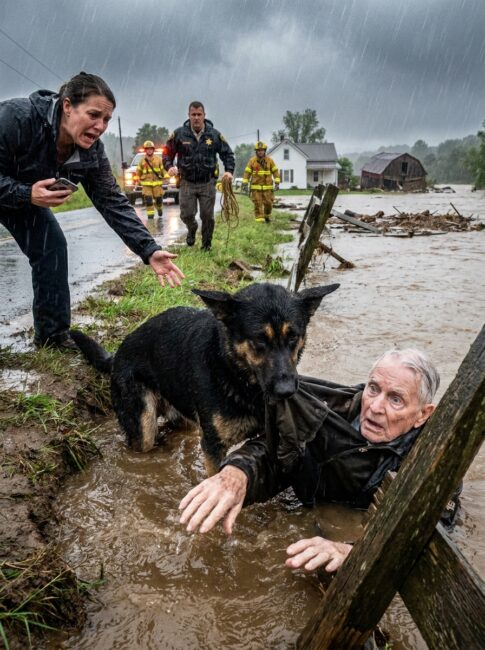
Ranger hit the water with a splash so hard I felt it in my chest. He swam in a diagonal line, not straight toward Dad, but slightly ahead of him, as if instinct told him to meet the current instead of chasing from behind. I had never seen him swim in water like that. He had played in ponds. He had splashed in summer creeks. But this was not play. This was a brown, swollen force full of debris and cold.
A branch struck Ranger’s shoulder.
He kept going.
Dad’s face went under again.
Ranger lunged.
His teeth caught the collar.
And the whole world narrowed to one dog’s jaw holding one wet piece of fabric between my father and death.
Part 3 – Not Strong Enough to Pull, Strong Enough to Hold
For a few seconds, I thought Ranger would pull Dad straight to the bank.
That is how the mind works when terror is too large. It imagines the simplest rescue because it cannot bear the real one. I saw Ranger’s teeth locked in Dad’s coat collar and thought, he has him, he has him, he will bring him back. But the current was stronger than any dog, stronger than my father, stronger than my pleading voice from the bank.
Ranger tried.
I saw the strain move through his whole body. His neck arched. His shoulders fought against the water. His back legs kicked hard beneath the muddy surface. Dad’s coat tugged between his teeth. For a moment, they shifted toward the bank.
Then the flood shoved them sideways.
Ranger’s head dipped.
Dad’s mouth went under.
“No!”
I ran along the bank, slipping in mud, holding my phone so tightly my knuckles hurt. Dispatch was on the line. I do not remember every word I said. I remember repeating the address. I remember saying my father was seventy-eight. I remember saying the water was moving fast. I remember yelling, “The dog has him, the dog has him, but he cannot pull him out.”
The dispatcher, a woman with a steady voice I will never forget, told me help was coming. She told me not to enter the water. She told me to keep them in sight. She told me rescue crews were being dispatched. All of that was right. All of it felt impossible.
Because my father was twenty feet away.
Because Ranger was already tiring.
Because standing on the bank while someone you love fights for breath is one of the hardest kinds of obedience.
Dad came up coughing. Ranger adjusted his grip and pulled backward again, not toward me now, but toward a shallower swale near the broken fence where floodwater spread wider and slower. I did not understand at first. Later, one of the rescue workers explained that Ranger may have felt the current weakening near that spot. Or maybe he was simply trying anything. Whatever the reason, it saved time.
Ranger changed strategy.
He stopped fighting for the bank directly.
He began fighting to keep Dad’s face above water.
Every time Dad sagged, Ranger lifted his head and leaned backward. Every time the current twisted Dad’s body, Ranger circled just enough to keep the collar from slipping out of his mouth. His front paws struck the water in uneven, frantic rhythm. His eyes stayed open against the rain. He made no sound because his mouth was full of my father’s coat.
Dad’s hands moved weakly.
“Hold on!” I screamed. “Dad, hold on!”
I do not know if he heard me.
I think Ranger did.
The dog’s eyes flicked toward me once. They were wide, dark, and full of a determination I had seen before only in moments that mattered to him. When my mother became ill, Ranger used to lie outside her bedroom door and refuse to move until Dad let him in. When Dad fell on the porch the winter after Mom died, Ranger barked until the neighbor came. He had always treated Dad as his person, not in a possessive way, but in a steady, chosen way.
Now he was choosing him in the flood.
The first rescue vehicle arrived eight minutes after the call.
Eight minutes can be fast on paper.
In floodwater, it is a lifetime.
Deputy Marcus Cole, a thirty-five-year-old Black American sheriff’s deputy with a shaved head, dark brown eyes, and a rain jacket over his uniform, came running across the yard with a throw rope. Behind him, two volunteer firefighters from the county station pulled on swift-water gear. More sirens sounded on the road above the hollow.
Deputy Cole shouted, “Where?”
I pointed, unable to form a sentence.
Ranger and Dad had drifted to the edge of the shallower swale, but the water was still deep enough to drown an exhausted man. Ranger had managed to wedge one rear paw against something under the water, maybe a buried root or broken fence post. His whole body shook as he held Dad’s collar.
The deputy saw them and whispered, “That dog is holding him up.”
Then everyone moved.
A firefighter named Luke Bennett, a twenty-nine-year-old white American man with sandy hair, a red rescue helmet, and a yellow swift-water jacket, tied off with another rescuer and entered the water at an angle. Deputy Cole threw a rope downstream. Another firefighter, Angela Morris, a forty-two-year-old Black American woman with braided hair tucked under a helmet and fierce focused eyes, moved along the bank calling instructions.
The whole time, Ranger did not let go.
Not when the firefighters shouted.
Not when the rope splashed near him.
Not when Dad’s hand brushed his face.
Not even when Luke finally reached them and grabbed Dad under the arms.
Ranger held until a human hand had my father.
Only then did his jaw loosen.
And even then, he stayed pressed against Dad’s shoulder, as if he did not trust the river to keep its distance.
Part 4 – The Rescue Line
Getting my father out of the water was not one clean pull.
It was mud, ropes, shouting, rain, and the terrible sight of a man you love looking too pale against a rescuer’s jacket. Luke had one arm under Dad’s chest while the safety line pulled against both of them. Angela moved closer from the bank, helping guide the rope around a drowned fence post. Deputy Cole kept calling to Dad, asking if he could hear him, asking him to keep his head up.
Dad did not answer.
Ranger tried to swim beside them, but his body had spent everything. The moment his teeth left the collar, the exhaustion became visible. His strokes weakened. His head dipped once, then came back up. I screamed for him too, because the terrible truth arrived all at once: Ranger had kept Dad alive, but now Ranger might not make it.
Angela saw it.
“The dog!” she shouted.
Luke had Dad. Another rescuer, Ben Carter, a thirty-eight-year-old white American firefighter with a brown beard and a red helmet, entered from the bank with a second rope. He reached Ranger just as the dog’s front paws slipped against the current. Ranger did not snap or fight. He looked confused, as if his only task had been Dad, and now that task had been taken from his mouth.
Ben hooked one arm under Ranger’s chest and pulled him toward shallower water.
Ranger still tried to turn back toward Dad.
“Easy, boy,” Ben said. “We have him. We have him.”
That phrase finally reached me.
We have him.
I fell to my knees in the mud as Dad was pulled onto the flooded grass. Paramedics moved in immediately. They cut away the soaked coat, checked his breathing, wrapped him in thermal blankets, and placed oxygen over his face. His eyes fluttered. He coughed water. He looked impossibly old, older than he had that morning, older than any father should look to his daughter.
But he was breathing.
Ranger collapsed two feet away.
I crawled to him because my legs would not stand. His fur was full of mud. His chest heaved. His tongue hung out, pale from exhaustion and cold. His eyes searched past me until he saw Dad on the blanket. Only then did his body seem to give up the last piece of tension.
I put both hands on his wet face.
“Ranger,” I sobbed. “Good boy. Oh, Ranger, good boy.”
He blinked slowly.
Then he tried to lift his head toward Dad.
Even then.
Even after the river had taken nearly everything from him.
He still wanted to check on his person.
Angela knelt beside us and pressed a towel around Ranger’s body. “We need to get him warm.”
“He saved my father,” I said.
“I saw.”
“He would not let go.”
“I saw,” she repeated, softer.
The ambulance crew loaded Dad first. I wanted to ride with him, but Ranger was barely able to stand, and the vet clinic was in the opposite direction from the hospital. For one agonizing second, I was split in two. My father in one vehicle. My dog in the mud. Both alive because of each other and both needing help.
Deputy Cole made the decision easier.
“I will drive you to the hospital,” he said. “Angela can take Ranger to the emergency vet. I will radio ahead. You can call from the ambulance bay.”
Angela nodded. “I have him.”
Ranger heard my voice as they lifted him onto a blanket.
I leaned close. “Go with her, boy. Dad is safe. You are safe.”
His eyes moved toward the ambulance.
Dad’s hand, pale and shaking, lifted weakly from the stretcher.
Not much.
Just two fingers.
But Ranger saw it.
His tail moved once against the wet blanket.
That small movement nearly undid every person standing in the rain.
At the hospital, doctors treated Dad for hypothermia, water inhalation, bruising, and shock. His age made everything more dangerous. The first hours were full of tests and careful words. I sat in a chair with my wet clothes sticking to my skin, holding a phone in both hands, waiting for updates from two places at once.
Dad was stable.
Ranger was stable.
I repeated those words until they became something I could stand on.
Late that night, after Dad was moved to a monitored room, he opened his eyes fully and looked at me.
His voice was rough.
“Dog?”
I started crying again.
“Ranger is alive.”
Dad closed his eyes.
A tear slipped sideways into his hair.
“Held me,” he whispered.
“Yes.”
He swallowed.
“Couldn’t pull me.”
“I know.”
“Kept me up.”
I took his hand.
“Yes, Dad. He kept you up.”
Part 5 – Ranger Comes Home First
Ranger came home before Dad did.
That felt wrong and right at the same time.
Dad stayed in the hospital for four days. At seventy-eight, near-drowning is not something a body shrugs off. His lungs needed monitoring. His heart rhythm wobbled from stress and cold. His ribs hurt from being tossed in the current and pulled by rescuers. But the doctors said the outcome could have been far worse, and every time one of them said that, I pictured Ranger’s teeth locked in Dad’s collar.
Ranger spent one night at Cumberland Animal Emergency Clinic under the care of Dr. Hannah Brooks, a forty-five-year-old white American veterinarian with dark blond hair, calm gray eyes, and hands that moved gently even when the room was urgent. He had hypothermia, muscle exhaustion, swallowed floodwater, bruising along one shoulder, and raw places on his gums from gripping the soaked coat so hard. No broken bones. No major internal injury. Dr. Brooks said he needed rest, warmth, fluids, and careful monitoring.
Then she looked at me and said, “He is very lucky.”
I laughed once, badly.
“My father is lucky.”
She glanced at Ranger asleep under warm blankets, still twitching as if swimming in a dream.
“I think they both are.”
When I brought Ranger home, he did not want to go inside at first. He stood on the porch, staring toward the flooded yard. The creek had begun to recede, leaving mud, branches, and broken boards everywhere. The fence was gone. The barn door hung crooked. The whole place smelled like river silt and storm damage.
Ranger’s body trembled, but not from cold this time.
Memory, maybe.
Fear, maybe.
Or the unfinished feeling of a dog whose person was not home yet.
I knelt beside him. “Dad is at the hospital. He is coming back.”
Ranger looked at me.
I did not know whether he understood hospital, or coming back, or the difference between temporary absence and loss. But he understood my tone. He leaned against me, heavy and tired.
Inside, he walked straight to Dad’s recliner and lay down beside it.
He barely moved for two days.
I brought food to him there. Water. Medicine. Warm towels. He ate little. Slept hard. Woke every time my phone rang. When I played a voice message Dad recorded from the hospital, Ranger lifted his head so fast his paws slid on the rug.
“Hey, boy,” Dad’s rough voice said through the speaker. “I am all right. You hear me? You did good.”
Ranger whined.
Not loud.
Just one soft sound from deep in his chest.
Then he pressed his nose to the phone.
I sent Dad a photo.
He called me crying.
On the fifth day, Dad came home in a borrowed wheelchair because walking tired him too quickly. Deputy Cole drove us from the hospital because he said he wanted to see the reunion and because, as he put it, “That dog earned an escort.” Angela and Luke came too, standing near the driveway with muddy boots and shy smiles, pretending they had just happened to be in the area.
Ranger heard the car before it stopped.
He struggled up from beside the recliner and limped to the door. I opened it carefully, one hand ready to hold him back if excitement became too much. But Ranger did not jump. He did not bark wildly. He stood on the porch, stiff with emotion, watching Dad being helped from the car.
Dad sat in the wheelchair wrapped in a brown jacket, thinner, pale, alive.
Ranger walked to him slowly.
Then he placed his wet-looking, healing head in Dad’s lap.
Dad bent over him as far as his sore ribs allowed and pressed both hands into Ranger’s fur.
Neither of them made a sound at first.
Then Dad whispered, “You held on.”
Ranger closed his eyes.
The rest of us turned away because some reunions are too private even when everyone is standing right there.
After that, recovery became a shared routine. Dad practiced walking again, first across the living room, then to the porch, then to the edge of the yard where the flood had taken him. Ranger healed beside him. They were both slower. Both tired easily. Both startled at heavy rain for a while. Dad would wake from naps breathing too fast. Ranger would lift his head from the floor and go to him without being called.
They had been in the river together.
Some bond had changed there.
Or maybe it had only become visible.
Part 6 – The Day They Returned to the Water
For months, Dad would not go near the creek.
No one blamed him.
The flood had carved new lines into the land behind the house. The bank was steeper in places, missing in others. The county repaired the road. Neighbors rebuilt fences. Tom Miller from down the hollow helped replace the barn door. Church volunteers cleaned debris from the yard. People brought casseroles, tools, sandbags, and stories of where they had been when the water rose.
Everyone in that county had a flood story.
Ours had Ranger in it.
The local newspaper heard about the rescue through the fire department. A reporter called. Dad said no twice. He did not want attention. Ranger did not need fame. But Angela convinced him to let them write about water safety, emergency response, and the importance of not entering floodwater. The story ran with a photo of Dad in his recliner, Ranger beside him, and the headline describing the dog who kept an elderly man afloat.
People sent letters.
Some were from strangers who had lost pets. Some were from rescue workers. Some were from elderly people who said their dogs were the reason they still got up in the morning. Children drew pictures of Ranger swimming with a cape, though Dad insisted Ranger would hate a cape because it would interfere with practical movement.
Ranger received a medal from the county.
He tried to eat the ribbon.
Dad laughed for the first time without sounding tired.
But the creek remained difficult.
On sunny days, Dad would stand at the kitchen window and look toward it. Ranger would stand beside him. Neither moved closer. It was as if the yard ended where memory began.
Then one morning in late spring, nearly six months after the flood, Dad picked up Ranger’s leash.
I was making coffee.
“Where are you going?”
“Just to the sycamore.”
The sycamore tree stood near the old measuring mark, above the safe side of the bank. I wanted to say no. I wanted to wrap both of them in blankets and keep them in the living room forever. But recovery cannot only mean avoiding the place that hurt you. Sometimes it means returning with someone beside you and learning the place did not get the final word.
So I walked with them.
Dad used his cane. Ranger walked slowly at his left side, close enough that their shoulders almost touched. His coat had grown glossy again. The raw places in his mouth had healed. Dad’s color had improved, though he still tired easily. Together they crossed the yard that had once become a river.
At the sycamore, Dad stopped.
The creek below was narrow again, moving over stones with a soft sound that felt almost innocent. It was hard to believe the same water had become something that could take him. Ranger stared at it, ears forward, body tense.
Dad lowered his hand.
Ranger pressed his head beneath it.
“I was scared,” Dad said.
I thought he was talking to me.
Then I realized he was talking to Ranger.
“I was under, and then I felt you pulling. I knew it was you. I could not help you. Could not even help myself. But I knew you were there.”
Ranger leaned harder against his leg.
Dad wiped his eyes with the back of his hand.
“You were not big enough to beat that river,” he said. “But you were stubborn enough to argue with it.”
I laughed and cried at the same time.
Dad sat on a bench the church volunteers had placed near the tree. Ranger lay at his feet, facing the creek. Not relaxed at first. Watchful. But after a while, his breathing slowed. Dad’s hand rested on his back. The water moved below them, no longer silent, no longer monstrous, just water again.
That became their place.
Not every day. Not in bad weather. But on clear mornings, Dad and Ranger walked to the sycamore. Sometimes Dad talked to Mom as if she were sitting beside him. Sometimes he talked to Ranger. Sometimes he said nothing, and the silence felt full instead of empty.
The flood changed Dad.
He admitted weakness more easily after that, though not gracefully. He let me fix loose rails. He accepted help moving heavy things. He promised, under threat from me, Angela, and Deputy Cole, never to cross a flooded yard again for a barn door, feed bag, or any other object that could be replaced. Ranger became stricter too. If rain grew heavy, he blocked the back door with his body. Dad called him bossy.
I called him correct.
A year after the flood, the fire department held a community preparedness day. Ranger attended with Dad. Luke demonstrated throw ropes. Angela taught families how quickly moving water can become deadly. Deputy Cole spoke about calling early and staying out of flood zones. Dad stood with Ranger beside him and told everyone, “Do not make your dog save you from your own stubbornness.”
People laughed.
Dad did not.
Then he added, “But if mine had not, I would not be standing here.”
He placed his hand on Ranger’s head.
Ranger leaned into him.
The crowd went quiet.
Some stories do that. They begin as danger and become instruction. They make people listen because the lesson has a heartbeat.
And in our case, a tail.
Part 7 – The Dog Who Held the Line
Ranger lived seven more years after the flood.
Dad lived five.
I wish those numbers were larger. Everyone who has loved a parent or a dog understands that time, even when generous, still feels unfair at the end. But those five years Dad had after the flood were years he almost did not get. Birthdays. Christmas mornings. Porch coffee. Slow walks to the sycamore. Stories told to grandchildren. Apologies he finally made. Laughter that returned to the house in small pieces. All of it existed because Ranger had held a collar in brown water and refused to let go.
Dad never forgot that.
He told the story less often than people wanted him to. He did not like making himself the center. When asked, he always shifted the attention to Ranger, then to the rescuers. “Dog kept me up. Firefighters got me out. My daughter yelled loud enough to wake three counties.” That was his official version.
But privately, he gave Ranger credit for more than survival.
“You brought me back to the living,” he told him once.
I heard it from the hallway.
Dad did not mean only the river. After Mom died, he had been half in the house and half somewhere else, moving through routines without much hunger for tomorrow. Ranger had kept him company, yes, but after the flood, their bond became more deliberate. Dad seemed to understand that being alive was not only something that had happened to him. It was something Ranger had fought for.
So Dad tried harder.
He went to physical therapy when he did not want to.
He let neighbors visit.
He joined the church breakfast group again.
He taught my son how to change a bicycle tire.
He planted tomatoes badly and blamed the weather.
He adopted a rescue kitten for Ranger, though he claimed the kitten had adopted the porch first and he had no legal choice in the matter. Ranger accepted the kitten with weary patience and allowed it to sleep against his side, which Dad said proved Ranger had a weakness for small dramatic creatures.
The county placed a flood marker near the sycamore after a later safety project. Not a memorial, just a practical sign showing historic high-water levels and warning residents to stay clear during storms. Dad stood beside it with Ranger the day it was installed.
“That is where the water was,” I said.
Dad looked down at Ranger. “No. It was higher than that when he found me.”
The worker installing the sign paused.
Ranger wagged slowly.
Stories attach themselves to places. After a while, neighbors started calling that part of the yard Ranger’s Bend. Dad pretended to dislike it. He absolutely did not dislike it. When children visited, he pointed toward the creek and said, “That is where Ranger argued with the river.” They loved that phrase. So did I.
In Dad’s final year, his heart began failing.
Not suddenly. Slowly. In the way age sometimes tightens its hand. He moved from cane to walker. Then the porch became far enough. Then even the porch tired him. Ranger was old too by then, black muzzle silvering, hips stiff, but he still rose every time Dad stood. Two old bodies moving carefully together through the house.
On Dad’s last good afternoon, he asked to go to the sycamore.
We used a wheelchair. Ranger walked beside it, limping slightly, determined as ever. The creek was low and clear that day. Sunlight moved across the stones. Dad sat under the tree with a blanket over his knees and Ranger’s head in his lap.
He looked at me.
“You know what I remember most?”
“The flood?”
He shook his head. “His teeth.”
I blinked.
“Not the water. Not the cold. Not even being scared. I remember feeling his teeth catch my collar. I remember thinking, Ranger has me. Fool dog thinks he can fight a river.”
His hand moved over Ranger’s ears.
“Then I thought, if he is not giving up, I better not either.”
Ranger closed his eyes.
Dad smiled.
“He saved my life twice,” he said. “Once in the water. Once after.”
Dad passed three months later, at home, with me beside him and Ranger lying at the foot of the bed. Ranger knew before I said anything. Dogs often do. When Dad’s breathing changed, Ranger lifted his head, moved carefully to the side of the bed, and rested his chin near Dad’s hand. Dad’s fingers touched his fur one last time.
After Dad was gone, Ranger stayed beside the bed for hours.
I sat on the floor with him.
Neither of us knew what the house was without the man we both loved.
The days after were hard. Ranger searched the rooms. He slept near Dad’s recliner. He refused food unless I sat beside him. I understood then, in a new way, that he had not only saved my father. He had belonged to him completely. Grief moved through Ranger’s body like weather.
We walked to the sycamore every morning.
At first, he moved slowly, reluctantly. Then, little by little, he began to rest there. I would sit on Dad’s bench. Ranger would lie at my feet, facing the creek. Sometimes I talked to Dad. Sometimes I talked to Ranger. Sometimes I listened to the water and remembered the day it nearly took everything.
Ranger lived two more years.
Old age softened him. He became slower, sweeter, less interested in mail trucks and more interested in sun patches. The kitten, now a large orange cat with too much confidence, slept against his back. Children still asked about him when they passed the yard. The fire department sent him a new bandana every year on the anniversary of the rescue.
On his last day, Ranger could not walk to the sycamore.
So we brought the sycamore to him.
I opened the back windows so he could hear the creek. I placed Dad’s old coat beside him, the same coat from the flood, cleaned long ago but still bearing a faint repaired tear at the collar where Ranger’s teeth had held. Ranger rested his nose on it.
His tail moved once.
I thanked him for my father’s extra years.
I thanked him for holding the line.
I thanked him for teaching all of us that saving someone does not always mean carrying them all the way to shore. Sometimes it means keeping them above water until help arrives. Sometimes it means refusing to let go when the current is stronger than you are. Sometimes it means staying afterward, through recovery, grief, old age, and all the quiet days that make a life worth saving.
We buried Ranger’s ashes beneath the sycamore, near Dad’s bench, overlooking the creek. On the small stone marker, my son painted these words:
Ranger, who held on.
The creek still rises when heavy rain comes. I still watch it carefully. I still hear that day in certain storms. But I also hear Dad’s voice, rough and grateful, saying, Dog kept me up. I see Ranger’s dark head in brown water. I see the collar between his teeth. I see a love stronger than fear, even if it was not stronger than the river.
That is the part I want people to remember.
Ranger did not have to be powerful enough to defeat the flood.
He only had to hold my father long enough for help to come.
And he did.
If this story touched your heart, follow this page for more unforgettable dog stories about loyalty, rescue, second chances, and the animals who hold us above water when life becomes too strong to face alone.