Part 2: An Elderly Guide Dog With One Clouded Eye Blocked a Blind Woman’s Stairs — Then Her Neighbor Saw the Missing Step
Part 2 — The Hole Beneath My Memory
The city repair crew arrived before noon.
They placed barriers around the porch, blocked the front door from outside, and inspected the staircase from the yard. The third tread was only the visible failure. Termite damage had spread into the support stringer and two adjacent boards.
The carpenter pushed a screwdriver into what looked like solid wood.
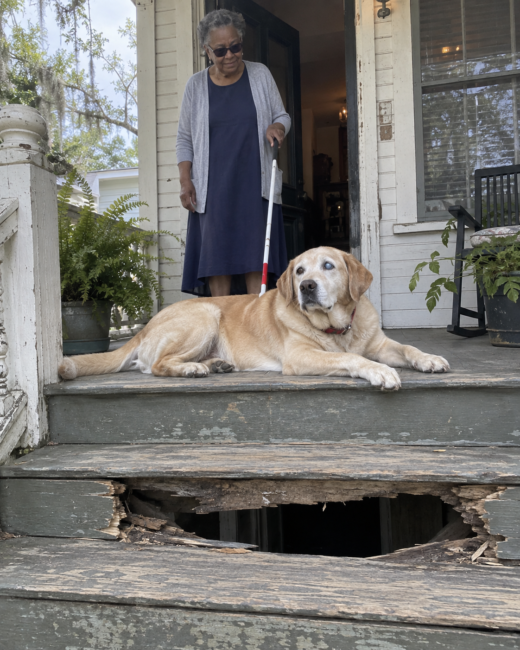
It passed through.
I heard fragments fall into the cellar stairwell.
The staircase had been hollow long before it collapsed.
I had reported the occasional creak to my landlord’s maintenance office, but nobody had performed a structural inspection. A contractor had replaced one surface board three years earlier and painted over the rest.
Fresh paint had hidden old damage.
My cane had found familiar edges. My feet had followed memory. Neither could detect what remained beneath the painted surface.
Hollis could.
No one could say exactly what he noticed. Perhaps the board shifted under one paw. Perhaps he smelled rot, heard wood break, or saw the opening with his clear right eye.
What mattered was what he did afterward.
He lay across the route.
Animal-control officer Lena Ortiz approached him with a slip lead. Hollis stepped calmly beside her, then turned his head toward me.
“He’s checking whether you’re coming,” she said.
I disliked hearing intention assigned too easily to an animal. People often translated every movement into a sentimental sentence.
But when I lifted my cane, Hollis returned to my left side.
He positioned his shoulder near my knee and stopped before the blocked stairs.
His body remembered the working position.
Lena scanned his microchip twice because the first record surprised her.
The chip belonged to a nonprofit guide-dog program called Coastal Independence Partners. Hollis had completed training eight years earlier and worked with a blind music teacher named Samuel Price.
Samuel died after a brief illness. Hollis was retired at eleven because of age, stiffness, and a developing cataract in his left eye.
The guide program arranged a retirement placement with a family outside Savannah. Eleven months later, that family surrendered him to the county shelter.
Their intake statement read:
“Too old. Sleeps most of the day. No longer useful.”
I asked Lena to repeat the last three words.
She did not want to.
I insisted.
No longer useful.
The shelter had contacted the guide program, but a records transition delayed the response. Two nights before Hollis appeared on my porch, thunder damaged an outdoor kennel latch during an evacuation drill.
Hollis escaped.
The shelter searched nearby streets. Nobody expected a twelve-year-old Labrador with stiff joints and limited vision to travel more than a few blocks.
My house was nearly three miles away.
“How did he find me?” I asked.
Lena could not answer.
Hollis may have followed sounds associated with pedestrian traffic. He may have noticed my cane on the porch during an early walk. He may simply have chosen shade and then responded when he recognized a blind traveler approaching a hazard.
We did not need to turn uncertainty into magic.
A trained dog encountered the kind of problem he understood.
The repair crew established a temporary ramp from my side entrance. Mae guided me through the house while Hollis remained near the front doorway.
He refused to enter.
Guide dogs are trained not to cross thresholds without direction. Even years after retirement, he waited.
I opened the side door and called his name.
“Hollis. Inside.”
He stepped across.
The first room he explored was not the kitchen or the place where Lena set down water.
He walked beside me to the hallway, stopped at my left knee, and waited for the next command.
The shelter needed him returned for medical assessment and legal processing.
When Lena clipped on the lead, Hollis followed.
At the van, he turned back toward my cane.
I had known him for only one morning.
The quiet left after he departed felt larger than it should have.
Part 3 — A Dog Who Had Already Retired
Coastal Independence Partners contacted me the following day.
The program director, Valerie Chen, confirmed Hollis’s history. He had worked for seven years with Samuel Price, traveling by bus, navigating a college campus, and guiding Samuel between home, work, church, and a neighborhood grocery store.
Samuel had described Hollis as steady rather than fast.
He disliked puddles.
He remembered doors after passing through them once.
He stopped for low branches even when his handler could have walked beneath them.
Hollis noticed spaces other people dismissed.
After Samuel died, Hollis’s health evaluation showed arthritis in both hips and a cataract forming in his left eye. He could no longer meet the physical and visual demands placed on an active guide dog.
Retirement had been appropriate.
The failure came afterward.
The family selected to adopt him initially reported no problems. Over time, they became frustrated that he slept frequently, moved slowly, and required joint medication. When their work schedules changed, they surrendered him without contacting Coastal Independence Partners directly.
The shelter intake worker did not understand that the guide program wished to reclaim retired dogs.
Hollis became an old working animal processed as an ordinary unwanted pet.
His escape had complicated everything.
Dr. Miriam Shah examined him at the shelter clinic. The cloudy left eye contained a mature cataract with little useful vision. His right eye remained functional. He had no acute eye pain, though both eyes required monitoring.
The stiffness I felt in his movements came from age-related arthritis. Medication, weight management, nonslip flooring, moderate exercise, and soft bedding could improve his comfort.
He did not need to guide anyone.
He needed a retirement home prepared to care for an elderly dog.
Valerie asked whether I wanted to visit.
I said no.
Then I called back nine minutes later and changed my answer.
Mae drove me to the shelter because the temporary ramp outside my house had not yet been completed. I carried my cane and the faded red collar Lena had removed during Hollis’s medical examination.
He was resting in a quiet kennel.
Before the attendant opened it, Hollis heard my cane touch the floor.
His nails scraped the bedding.
When the door opened, he approached and stopped at my left side.
I placed the collar around his neck. My fingers found the silver muzzle and the soft fold of his left ear.
“You are retired,” I told him.
Hollis leaned against my leg.
The guide program did not offer him to me immediately. Valerie conducted a home assessment, interviewed me about finances and daily routines, and discussed the difference between adopting a retired guide dog and receiving an active service animal.
Hollis could not replace my cane.
He could not be relied upon to judge traffic, overhead hazards, construction, or every obstacle encountered in public. His cataract and arthritis made that unsafe.
If I adopted him, he would be my companion rather than my mobility equipment.
That distinction mattered.
I told Valerie I understood.
The truth was that I understood with my head before I understood with my habits.
The day Hollis came home for a trial placement, I reached automatically for a harness that was not there.
He stood at my left side anyway.
At the temporary ramp, he stopped before the slope and looked back.
I used my cane to locate the edge and descended independently.
Hollis walked beside me.
He was no longer responsible for carrying my safety.
Yet he had not forgotten how to share the route.
Part 4 — Learning the Difference Between Work and Choice
The first weeks were harder than the ending people preferred to imagine.
Hollis paced at night.
He slept during the day, woke suddenly, and searched the hallway. When the front door opened, he moved into working position, then appeared confused when nobody gave him a destination.
Retirement had removed his harness.
It had not removed eight years of routine.
Valerie introduced us to a trainer named Marcus Bell who specialized in senior assistance dogs and retired working animals.
Marcus watched Hollis follow me through the kitchen.
“He is offering behaviors,” he said. “That doesn’t mean we should accept every offer.”
Hollis stopped at thresholds. He blocked me from harmless floor mats. He attempted to guide me around chairs I already knew were there.
At first, those actions felt comforting.
Then I realized I was beginning to trust his judgment in situations his current vision might not support.
We needed boundaries.
Love could not turn retirement into renewed certification.
Marcus taught me a release phrase: “Your choice.”
When Hollis positioned himself for work inside the house, I touched his shoulder and said the words. He could remain beside me, choose his bed, or explore without waiting for another command.
The phrase confused him.
The first time, he stayed frozen for nearly a minute.
The second time, he walked to his water bowl.
Weeks later, “your choice” sent him toward the warm patch beneath the living-room window.
His arthritis improved with medication, controlled walks, and rugs placed over slick floors. He still rose slowly, particularly in the morning. We added a ramp to the two steps leading into the yard.
The left eye remained cloudy.
Because his right eye carried most of his vision, furniture stayed in consistent locations. Mae learned not to leave packages along the hallway wall.
The house adapted to the dog who had once adapted to everyone else.
My porch staircase required complete reconstruction. The landlord replaced the stringers, treads, and railing, then paid for an independent inspection after Mae threatened to call every local television station.
The carpenter invited me to examine the finished stairs using my hands and cane. Each tread had a textured edge. The rail had been reinforced. A contractor explained every change instead of simply announcing that it was safe.
Hollis tested it before I did.
He walked down three steps, stopped at the new third tread, sniffed it, and returned to me.
I descended with my cane.
He stayed beside Mae.
That was the arrangement now.
I moved independently. Hollis accompanied me because he wanted to.
Our first trip to the neighborhood market took twice as long as usual. Mae walked several feet behind us. Hollis wore an ordinary walking harness clearly different from a guide harness.
At each curb, he stopped.
I checked with my cane and listened for traffic before deciding when to cross.
Hollis did not make the decision.
He shared the pause.
At the market, he remembered the produce aisle layout after one visit. He guided himself around displays, but I continued using my cane.
People assumed he was my working guide.
I corrected them.
“He’s retired.”
Hollis stood beside my knee, silver muzzle raised.
The word sounded less like an ending each time I said it.
Part 5 — The People Considered Finished
Hollis’s story spread after Mae told a local accessibility group about the collapsed stairs.
The group invited me to speak at a meeting on housing safety for older blind adults. I discussed termite inspections, reliable maintenance reporting, tactile stair markers, and why familiar routes become dangerous when structures change without warning.
Everyone wanted to hear about Hollis.
I resisted turning him into a saint with paws.
He had not inspected the building according to a professional checklist. He noticed a hazard, recognized a cane user, and blocked the route.
His training shaped that decision.
So did chance.
So did the fact that he had survived long enough to arrive at my porch.
After the meeting, an older man named Edward approached me. He was blind, seventy-two, and living alone after his wife’s death. He did not qualify for an active guide dog because he traveled infrequently and lacked the physical stamina required by several programs.
He did not need a working guide.
He needed companionship from an animal comfortable around canes, predictable routines, and slow walking.
A retired guide dog might suit him.
The idea sounded simple.
It was not.
Retired guide dogs were not interchangeable. Some needed homes without other animals. Some had medical costs beyond what older adopters could manage. Some preferred complete retirement from harnesses and public travel.
Blind applicants also varied in mobility, housing, support, finances, and expectations.
Matching two vulnerable lives required more than a sentimental photograph.
Valerie and I began discussing a small pilot program through Coastal Independence Partners.
Its purpose would not be to place medically retired dogs back into service. The dogs would remain companions. Participants would receive orientation, veterinary planning, home-safety assessments, and clear education about using canes or other mobility tools independently.
We named it Second Route.
The first match was Edward and a retired black Labrador named June.
June had worked for six years before chronic shoulder arthritis ended her guiding career. Edward walked only a few blocks daily. His apartment had an elevator, nonslip floors, and a niece who could assist with veterinary transportation.
They met three times before any decision.
June chose to sit beside Edward.
Edward chose not to ask her to work.
Six months later, they were still together.
The second placement failed.
A dog became anxious in the applicant’s busy apartment building and returned to its longtime retirement foster. Nobody called that a tragedy. The program had discovered the mismatch before adoption.
A humane “no” protected both sides.
Funding came from small donations, accessibility organizations, and veterinary partners. Every dog received an individual medical plan. Every person received clear explanations about public-access laws and the difference between a companion, a trained service dog, and a retired guide.
Hollis attended no promotional events during his first year.
Crowds tired him. Camera flashes startled him. He owed the program nothing.
He spent afternoons beneath my window and mornings walking with me to the market.
Sometimes he stopped me for a fallen branch or a trash bag blocking the sidewalk.
Sometimes he stopped because a pigeon had landed near his clear eye.
I learned to investigate before assigning meaning.
He learned that not every walk was a job.
Part 6 — Eighty Different Second Routes
Second Route matched fourteen pairs during its first year.
By the third year, eighty retired guide dogs had entered carefully assessed companion homes with older blind or low-vision adults.
Not every participant adopted a dog.
Some became temporary respite homes. Others joined shared-care arrangements with younger relatives or volunteers responsible for transportation and veterinary support.
The number eighty sounded impressive in interviews.
The individual arrangements mattered more.
Edward and June took slow morning walks.
A retired guide named Amos slept beside a woman who rarely left home after losing her husband.
A half-blind standard poodle named Pearl joined a former teacher who used a walker and cane. Pearl never resumed formal guide work; she simply learned the route between the woman’s apartment, garden, and community room.
Each pairing began with the same sentence:
“This dog is retired.”
The sentence protected the animal from expectations.
It also protected the person from relying on skills the dog could no longer perform safely.
Hollis became the program’s origin story without becoming its mascot. His photograph appeared in one brochure, taken while he slept beneath my rocking chair.
The caption did not call him a hero.
It said:
“He noticed a broken step.”
That was enough.
At home, his aging continued.
His hearing softened. His arthritis required medication adjustments. The cataract in his left eye remained stable, while the clear right eye developed mild age-related changes.
Our walks shortened.
The market was six blocks away, but some mornings we went only to the corner and returned.
Hollis still stopped at the rebuilt third step.
He placed one front paw on it, waited for me to locate the edge with my cane, and descended after I moved.
Neither of us pretended he was guiding.
We had created a shared ritual of checking what once failed us.
Mae replaced the broom she had carried that first morning with a bag of dog treats she kept near her door. Hollis learned the sound of the bag from across the yard.
“Retired,” Mae would say as he approached. “Except from snacks.”
He agreed.
The guide program occasionally received complaints from people who believed a trained dog should continue working as long as it could walk.
Valerie answered with medical records, welfare standards, and one simple principle:
Past service does not create an unlimited debt.
Hollis had spent years making decisions for another person’s safety. In retirement, his needs had to become part of every decision.
He could offer help without being required to offer himself.
That difference changed how I understood our first morning.
Hollis did not block my stairs because someone commanded him.
No harness was on his body.
No handler held his leash.
No reward waited.
He acted because the situation matched something deeply learned: a blind traveler, a dangerous change, and a route that needed stopping.
He had been free to leave.
He stayed.
Part 7 — The Step We Both Remembered
Hollis lived with me for four years.
By the last spring, our market trips became porch mornings. I sat in the wooden chair while he rested beside the rebuilt stairs, his silver muzzle between his paws.
The left eye remained white.
The right still followed birds across the yard.
When my cane touched the porch floor, his tail moved, though he no longer stood every time.
I began saying “your choice” before each walk.
Some mornings he rose.
Some mornings he stayed in the sun.
Both answers were correct.
Second Route continued without requiring Hollis to attend, demonstrate, or symbolize anything. The eightieth match involved an eleven-year-old retired guide named Stanley and a seventy-eight-year-old man who wanted company while listening to baseball games.
Their first shared activity was sleeping through the fourth inning.
It was considered a good placement.
The rebuilt staircase received annual inspections. So did the rest of the porch. I no longer treated familiarity as proof of safety.
Memory could guide.
Memory could also preserve a version of the world that no longer existed.
Hollis taught me that by refusing to let me step where a stair used to be.
People had described both of us in similar language.
Too old.
Too limited.
Past our useful years.
Hollis had been surrendered because he could no longer provide perfect guidance. I had been advised more than once to stop living alone because blindness and age supposedly made independence reckless.
Neither judgment understood the difference between needing support and having nothing left to give.
On our final trip to the market together, Hollis walked slowly beside me in his ordinary harness. At every curb, he stopped. I checked with my cane, listened, and chose when to cross.
He was not my official guide.
He was my witness, my companion, and the old dog who still believed a changed route deserved attention.
At home, he paused at the third step.
I found the edge with my cane.
“Safe,” I said.
We climbed together.
Follow our page for more stories about rescued dogs, second chances, and the quiet lives that still have something important left to offer.