Part 2: She Adopted a Blind Golden Everyone Had Given Up On — Then He Began Saving Her Before Anyone Knew Why
Walter’s first week with us was less inspiring than the shelter’s adoption photo suggested.
He walked into the coffee table three times.
I misjudged the distance between his water bowl and the kitchen wall, stepped into it barefoot, and sent half a gallon across the tile.
My father found us both sitting in the mess.
Walter was licking water from my sock.
I was laughing too hard to stand.
Dad did not laugh immediately, but I heard the corners of his mouth give in when he said, “This is going extremely well.”
The house became a shared map.
I placed textured mats near Walter’s food, bed, and the back door. I kept furniture exactly where it belonged and made my father promise not to move chairs without warning us both.
Walter learned the distance from his bed to my room in four days.
By the end of the second week, he could reach the porch without touching a wall.
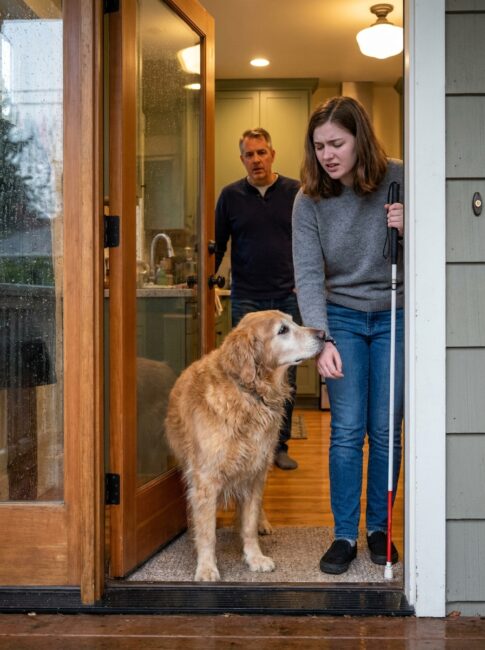
He still hesitated at thresholds, especially when rain changed the smell of the wood or wind moved the chime too hard. I began tapping each doorway twice with my cane.
He listened.
Then he followed.
Our walks started in the backyard.
I counted seven steps from the porch to the grass, twelve to the cedar fence, and five from the fence to the old maple tree. Walter tracked the route through scent and pressure on the leash.
Neither of us moved quickly.
That became part of the peace.
People often assume blindness means living in darkness. It does not. Darkness is a visual idea.
Blindness is missing information.
It is reaching for a counter somebody has cleared without telling you. It is listening for traffic while a construction machine covers the signal. It is recognizing a room by its echo, then losing the room when forty people enter at once.
Walter understood missing information.
When he became uncertain, his breathing changed first. His paws shortened their steps. His shoulder brushed my leg.
When I became uncertain, my cane moved more slowly.
We learned each other through those changes.
By October, we could walk one full block without my father following twenty feet behind us pretending to check the mail.
The first route passed a bakery, a laundromat, and a garden with rosemary spilling through a chain-link fence. I used the bakery’s warm yeast smell as one marker and the laundromat’s dryer vents as another.
Walter used everything.
He knew the house where a terrier barked behind a wooden gate. He knew the storm drain that smelled like metal after rain. He knew the corner where someone dropped fried food often enough to make the sidewalk permanently interesting.
At the curb, he waited for me.
I listened for the accessible signal.
Then we crossed together.
Walter was not a guide dog. I never treated him as one. He could not see obstacles, judge traffic, or lead me through unfamiliar streets.
What he could do was stay connected.
If my pace changed, he noticed.
If his confidence dropped, I noticed.
We were two imperfect travelers comparing information.
That arrangement confused people.
A woman outside the grocery store once asked whether the shelter had “run out of sighted dogs.”
A man at the bus stop said, “That seems like the blind leading the blind.”
He laughed at his own joke.
Walter leaned against my knee.
I smiled and said, “We prefer cooperative navigation.”
The man did not laugh again.
The ordinary days mattered most.
Walter waited outside the bathroom every morning and sneezed when the shower steam reached him.
He learned the sound of my father opening a cheese wrapper from two rooms away.
He slept with one paw touching the leg of my bed.
Every evening at nine, I checked his blood sugar, prepared his insulin, and fed him one small piece of chicken afterward.
The first few injections frightened me.
Not because I doubted the technique. The shelter nurse had trained me carefully.
I feared hurting a creature who had already lost one home.
Walter made it easy.
He stood still beneath my hand, accepted the needle without flinching, then turned toward the refrigerator before I had capped the syringe.
“Shameless,” I told him.
His tail thumped.
By November, my life began moving again.
I applied to a community college social work program.
I took two buses across town to attend an orientation without my father.
I agreed to speak at a small disability advocacy meeting, though public speaking made my stomach tighten.
Walter was always there afterward.
Not as a symbol.
Not as proof.
As a warm body waiting by the door.
The dizzy episodes continued.
They were small at first.
A wave of weakness after lunch.
Cold sweat while folding laundry.
A shaking hand I blamed on too much coffee.
Each time, Walter noticed before I said anything.
He sniffed my wrist.
Then he pressed his chin against my thigh.
Sometimes he nudged my cane away from the door.
I assumed he had become overprotective.
My father blamed stress.
I blamed skipped meals.
None of us saw the pattern.
The second seed had already been planted.
We simply did not know how to read it.
The winter rain arrived in December and stayed.
Walter hated deep puddles because they erased the familiar scent of sidewalk edges. I hated them because cold water soaked through my shoes.
We adapted.
I bought waterproof boots.
Walter learned to follow the raised concrete seams beneath his paws.
On difficult mornings, we walked only to the bakery and back. The cashier began keeping a plain scrambled egg in a paper cup for him.
On better mornings, we crossed two intersections and reached the river path, where the air smelled open and gulls shouted above the water.
Those walks changed my father too.
At first, he waited near the window whenever we left.
Then he stopped checking the time.
Then one morning, he handed me the leash and said, “Bring me coffee if Walter lets you pass the café.”
It was the first joke he made about our independence that did not hide fear inside it.
I remembered it because those were the days we did not know we would miss.
The quiet mornings.
The wet sidewalks.
Walter’s nails clicking beside my cane.
My father’s coffee growing cold on the counter because he had finally stopped watching the clock.
In January, Rose City Rescue asked to film a short update.
A volunteer named Melissa recorded Walter and me walking from the clinic lobby to the small fenced yard behind the building.
I tapped the doorway.
Walter followed.
We crossed the rubber floor, found the ramp, and stepped into the cold air.
At the center of the yard, I unclipped his leash.
Walter walked six slow circles, mapping the fence.
Then he returned to me and placed his head against my hip.
Melissa posted the video that night.
The caption said:
They cannot see each other, but they never lose each other.
The video spread quickly.
Thousands of strangers watched us walk.
Most messages were kind.
Some people wrote about blind dogs who had learned new homes. Others told me about old pets abandoned after illness. Blind adults sent notes saying they understood the difference between needing support and being treated as helpless.
Then came the comments about inspiration.
People called me brave for pouring dog food.
They called Walter heroic for crossing a room.
I understood the kindness behind those words, but I also knew how easily ordinary survival becomes entertainment when disabled bodies perform it.
Walter did not care.
He slept through his new fame with his nose against my shoe.
Three days after the video went viral, an email arrived at the rescue.
The subject line read:
That dog used to save my father’s life.
Melissa called me immediately.
The sender was a twenty-four-year-old woman named Leah Morgan from Boise, Idaho. She believed Walter had belonged to her father, Stephen, a retired high school music teacher with Type 1 diabetes.
Walter had lived with him for nearly nine years.
He had not been an ordinary pet.
He had been trained to detect dangerous blood sugar changes.
Leah attached photographs.
Melissa described them over the phone while I sat on my bedroom floor with Walter’s head in my lap.
In one photograph, Walter wore a red working vest and stood beside a gray-haired man holding a trumpet case.
In another, he rested one paw on the man’s knee.
In a third, Stephen lay in a hospital bed while Walter slept beneath his hand.
My fingers tightened in Walter’s fur.
Leah explained that her father gradually lost much of his vision from diabetic complications. Walter learned to guide him along familiar routes inside the house, retrieve his glucose kit, and alert when Stephen’s blood sugar dropped.
He saved him repeatedly.
Then Stephen died from a stroke.
Leah had been away at college.
Her stepmother kept Walter for several months, but when he developed diabetes and lost his own sight, she surrendered him.
The phrase on the form had been hers.
No longer useful.
Leah ended her email with one line:
My father never called Walter useful. He called him trustworthy.
I read that sentence again through my screen reader.
Then Walter lifted his head and pressed his nose into my wrist.
The old gesture.
The one he had made in the shelter.
The one he made before every dizzy spell.
Something inside me shifted.
I had believed Walter was anxious when he blocked the doorway.
I had believed he was copying my fear.
I had believed the pressure of his chin against my leg was comfort.
It was not only comfort.
It was an alert.
The false ending came two days later.
I was scheduled to attend my first college interview alone.
My father had offered to drive. I refused because the campus was on a bus route I had practiced for weeks.
That morning, Walter blocked the front door.
He did not wag.
He did not lean casually.
He lowered himself across the threshold and pressed both front paws against my shoes.
“Move, Walter.”
He touched my wrist with his nose.
I stepped around him.
He stood and blocked me again.
I became angry because fear had already made the morning difficult. I had changed clothes twice. I had checked my bag four times. My father was standing in the kitchen trying not to offer help.
“Walter, enough.”
The dog made a low sound.
Not a bark.
A strained hum from deep in his chest.
Then he pawed my leg twice.
The room tilted.
My cane slipped from my hand.
I reached for the wall and found nothing.
Walter moved beneath me as I fell, taking part of my weight across his back. My shoulder struck the floor, but my head missed the edge of the shoe cabinet by inches.
My father shouted my name.
The next few minutes came in fragments.
Cold tile against my cheek.
Walter’s fur under my fingers.
A glucose meter beeping.
My father saying “forty-six” in a voice I had never heard before.
Orange juice against my lips.
Walter pressed along the length of my body, refusing to move until the shaking stopped.
At the hospital, blood tests showed more than a missed breakfast.
I had Type 1 diabetes.
The doctor said it had likely developed over several months. The dizziness, sweating, weakness, and sudden fatigue were not random. My blood sugar had been shifting in dangerous ways while I dismissed every sign.
Walter had not dismissed them.
He had been alerting me from the first week.
The dog everyone called useless had recognized my illness before any person did.
That would have been enough.
It was not the final twist.
Leah came to Portland the following month.
She arrived carrying a worn leather collar, a red vest with a cracked reflective strip, and a small digital recorder that had belonged to her father.
Walter recognized her voice before she reached the living room.
He rose too quickly, bumped the side table, corrected himself, and crossed the rug toward her.
Leah knelt.
“Hey, old man.”
Walter pressed his muzzle into her neck.
She began crying without making any attempt to hide it.
For several minutes, no one spoke.
My father stood near the kitchen.
I sat on the couch with Walter’s leash loose in my hands.
Leah stroked Walter’s ears and told him he had been a good boy, though he clearly already knew.
Then she gave me the recorder.
“My dad made notes when Walter started training,” she said. “There’s one you should hear.”
The recording began with static.
Then a man’s voice filled the room.
Stephen sounded older, warm, and slightly out of breath.
He described Walter’s alert pattern.
First, the wrist.
Then the chin against the leg.
Then two paw taps if ignored.
Exactly what Walter had done with me.
Stephen laughed in the recording and said, “He does not need sight for this work. He listens to breathing. He smells changes. He notices what people miss.”
The recording clicked.
Then Stephen added something else.
“If anything happens to me, Walter needs someone who understands that dependence goes both ways. Do not place him with someone looking for a tool. Place him with someone willing to become a team.”
Leah stopped the audio.
The room went silent.
Walter lay between us with his head resting across my foot.
That was the truth hidden beneath the first twist.
Walter had not simply remembered an old job.
His former owner had understood exactly what kind of life Walter needed.
Not a person he could serve.
A person who would share the work of living.
Leah told us Stephen had written instructions in his will asking that Walter remain with family or be placed through a specific service-dog retirement network.
Her stepmother had ignored them.
She had also hidden the surrender from Leah.
The old dog had not been abandoned because his first owner stopped loving him.
He had been removed from the plan made to protect him.
For months, I had imagined Walter’s past as a closed door.
Now I understood why certain sounds changed him.
The click of my glucose meter made his ears rise because he had heard Stephen’s meter for years.
The brass bell near our leash hook made him stand because Stephen had kept a similar bell beside his back door.
Walter slept with one paw touching my bed because he had slept beside a man whose blood sugar could fall during the night.
He pressed his nose against my left wrist because that was where Stephen had taught him to begin.
Even his habit of blocking the doorway made sense.
He was not afraid I would leave.
He was checking whether I was safe enough to go.
Every overlooked detail returned with a new meaning.
I thought Walter followed the tap of my cane because he needed direction.
Sometimes he did.
But he had also learned to use sound as a map long before blindness took his eyes.
I thought we were inventing our partnership from nothing.
We were not.
Walter brought years of experience into my house.
I brought a way of moving through the world that did not treat blindness as the end of movement.
We met in the middle.
After my diagnosis, life became crowded with numbers.
Carbohydrates.
Insulin ratios.
Blood sugar ranges.
Correction doses.
Appointments.
Emergency plans.
My father wanted to monitor everything. I wanted to pretend nothing had changed.
Walter allowed neither response.
He remained steady.
At night, when I checked my glucose, he rested nearby and listened to the meter.
During meals, he settled beneath my chair.
On walks, he continued to follow my cane, the curb signals, and our familiar routes.
But now I understood his pauses.
If he sniffed my wrist and moved on, I was fine.
If he stayed, I checked.
Twice during the first month, he alerted before my monitor sounded.
Once at the grocery store.
Once in the college library.
Both times, his body became still first.
Then his nose found my wrist.
Then the chin.
I checked.
He was right.
People began calling him my service dog.
I corrected them gently.
Walter was retired.
He was not trained for public access with me, and I did not ask him to work beyond what his age allowed.
What he did at home came from memory, attachment, and choice.
That mattered.
I did not want to turn his love into a job description.
When I attended classes, Walter stayed with my father, sleeping beside the radiator or wandering into the kitchen whenever cheese wrappers opened.
When I came home, he greeted me at the door.
Sometimes he checked my wrist.
Sometimes he simply leaned against me.
Not every touch needed to mean danger.
That was part of the healing too.
My father changed after the diagnosis.
He still worried, but he learned to ask before helping.
“Do you want me to come?” replaced “I’m coming.”
“Do you need anything?” replaced “Let me do that.”
The difference was four words.
It felt like a new house.
Walter helped him learn that.
My father saw us struggle, adapt, fail, and try again. He saw Walter walk into a chair, shake himself off, and continue. He saw me miscalculate insulin, call the clinic, correct the dose, and make dinner afterward.
Nothing dramatic happened.
Competence grew through repetition.
That is how most freedom arrives.
In June, I moved into a small studio apartment near Portland Community College.
My father helped carry boxes.
Leah mailed Walter’s old bell from Boise, and I hung it by the new door beside his leash.
The first evening, Walter mapped the apartment slowly.
Bed to water bowl.
Water bowl to kitchen mat.
Kitchen to front door.
Front door to my chair.
Then he returned to the middle of the room and stood still.
I tapped the floor twice with my cane.
He came to me.
That night, I experienced my first panic attack in the new apartment.
I sat between unopened boxes while my chest tightened and the room seemed to shift around me.
Walter rose from his bed.
He crossed the unfamiliar floor without hitting a single object.
His nose touched my wrist.
My blood sugar was normal.
Still, he placed his chin on my knee.
This time, it was only comfort.
He knew the difference.
So did I.
Every Tuesday morning, Walter and I began a ritual.
We walked to a small café two blocks from my apartment. The owner placed one black coffee and one plain scrambled egg on the counter.
I sat near the front window.
Walter lay beneath the table.
Before I drank the coffee, I checked my glucose. The meter beeped. Walter lifted his head.
I touched his ear.
“All good.”
Then he ate the egg in three bites and searched the paper cup for a fourth.
The ritual repeated through summer, fall, and rain.
Some mornings, Leah joined us by phone.
Some mornings, my father walked over and pretended he was only in the neighborhood.
Some mornings, Walter was stiff, and the two-block trip took nearly half an hour.
We never hurried him.
He had spent enough of his life proving what he could do.
At the café, people occasionally recognized us from the rescue video.
They asked how a blind girl walks a blind dog.
I told them the answer had changed.
At first, I thought we depended on each other because neither of us had sight.
Now I knew sight had very little to do with it.
Walter depended on my cane, my routes, my voice, and my willingness to keep his world predictable.
I depended on his hearing, his nose, his memory, and the quiet pressure of his body when mine began to fail.
Our weaknesses did not cancel each other out.
Neither did they become strengths through magic.
We simply learned where one body ended and the other could help.
Walter is twelve now.
His muzzle has thinned.
His hips ache in cold weather.
He sleeps more deeply and sometimes wakes confused, standing in the middle of the room until I call his name.
When that happens, I tap the floor twice.
He turns toward the sound.
He always finds me.
My diabetes remains part of every day.
I carry glucose tablets, insulin, a monitor, spare supplies, and more patience than I used to own.
Walter still alerts occasionally.
Not every time.
He is old.
I do not expect perfection from him.
That was never the promise.
The promise is smaller.
Every Tuesday, we walk to the café.
I count the curb.
He listens for the door.
I find the table.
He finds my foot.
The meter beeps.
His head rises.
I say, “All good.”
Sometimes it is.
Sometimes it is not.
Either way, we know what to do next.
People once asked which of us was helping the other.
I used to offer explanations.
Now I let the question pass.
Walter rests his chin on my shoe.
I place my hand between his ears.
Outside, buses sigh against wet pavement.
The crossing signal begins.
I stand.
Walter stands too.
Two taps.
One doorway.
Then forward.
Together.
Follow this page for more powerful stories about dogs, loyalty, rescue, and healing.