Part 2: A German Shepherd Was Hours From Being Put Down for Biting Four Families — Then a Retired K9 Officer Said One Word and the Dog Dropped to the Floor
Part 2
I should tell you what I mean by a growl being perfect, because it is the whole hinge of this, and almost nobody but a handler would have caught it.
There are two kinds of aggression in a dog, and they do not look the same once you have seen ten thousand hours of it.
There is fear aggression — the dog that is terrified, cornered, firing off warning shots because it does not know what else to do. That dog is loud and sloppy. Its eyes dart. It lunges and retreats. Its whole body is a panic.
And there is trained aggression — the controlled, deliberate, almost formal threat display of a dog that has been taught to give warning, that is holding a clear line, that is telling you this far and no farther with the precision of something rehearsed.
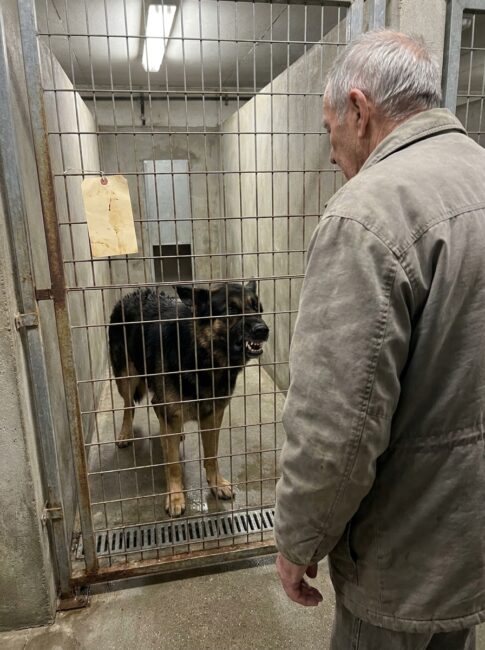
My name is Walt. And standing at that cage, watching the shepherd snarl, I was not seeing a panicking animal throwing bites at the world.
I was seeing posture.
The growl held steady — not the ragged stutter of fear, but a long, even, deliberate warning. The front feet stayed planted, square, not scrabbling. The eyes were not darting; they were locked on mine, reading me, measuring. The whole display had a shape to it. A discipline. A grammar.
Here is the small thing I noticed, the thing I filed away and did not understand for another forty minutes.
When I shifted my weight, the dog’s eyes flicked — not to my face, the way a fearful dog watches your face for the next bad thing — but to my hands. Then to my feet. Then back up.
He was watching me for a signal.
He was waiting, in the middle of his own snarling, for me to tell him what to do.
I did not understand it yet. I’m not sure I’d have understood it at all if I hadn’t spent my whole working life on the other end of exactly that look.
But it mattered. The steadiness of the growl, the planted feet, the eyes going to my hands — every piece of it mattered.
Part 3
I told Priya I wanted to sit with him. Just sit. Outside the run, on the floor, no leash, no pressure. She looked at her watch — it was maybe one-fifteen by then — and she looked at the clipboard, and she said the words that I think she had said about a lot of dogs to a lot of hopeful strangers.
“He doesn’t have long,” she said. “If you’re going to be heartbroken, be heartbroken about one that has a chance.”
I said I’d take my chances.
So I lowered myself down onto the concrete across the aisle from his run, with my bad knees complaining the whole way, and I did the thing you cannot rush and cannot fake and cannot do if you are in a hurry. I did nothing.
I did not talk to him. I did not coax. I did not hold out my hand or click my tongue or do any of the small begging things people do at a cage. I sat with my side half-turned to him, my eyes soft and off his face, and I let him have the whole hour to decide what I was.
And I watched everything.
I watched the growl run down, over about ten minutes, from a full snarl to a low idle to nothing. I watched him stop showing teeth. I watched him stand there, ninety pounds of him, vibrating with a tension that had nowhere to go.
And then I watched the thing that turned the file in my hands into a lie.
The dog began to pace his run in a pattern. Not the mindless wall-to-wall stagger of a kennel-broken animal. A pattern. He went to the front, sat, held it for a beat, stood, went to the back corner, turned, came to the front, sat again. Over and over. Like a drill. Like a soldier running through the only movements he had left, alone, because nobody had given him a command in a very long time and he was practicing the shape of obedience by himself.
I had seen that before. I had seen exactly that, once, in a dog whose handler had been killed, a dog who kept running his patterns in the kennel for weeks because the patterns were the last place his person still lived.
I sat up a little straighter on that cold floor.
And I started running the other possibility in my head — the one that had been knocking since the moment I saw the steadiness of that growl. Four families. Four bites. Aggressive. Do not rehome. A ninety-pound shepherd, clearly trained, clearly disciplined, clearly waiting for a signal, who attacked the people who took him home.
What if the dog wasn’t dangerous?
What if the dog just didn’t speak English?
Part 4
I got up off the floor — it took me a minute — and I asked Priya for the full intake history. Everything the four families had written when they returned him.
She brought me a thin folder. I read it standing in the aisle.
The first family had him three weeks. Their note said he was “great at first, then started ignoring commands, then snapped when corrected.” The second family, two weeks: “won’t listen, growls when told to get off furniture, bit my husband’s hand.” The third, nine days: “unpredictable, lunged when we tried to crate him.” The fourth had him four days and the note was just six words: Tried everything. He won’t obey. Bites.
I read it twice.
And every single one of them described the same thing, and not one of them had seen it.
They gave him commands. He ignored them. They escalated — repeated the command louder, reached for him, grabbed his collar, pushed him off the couch, forced him toward a crate. And the dog, who did not understand a single word any of them were saying, experienced a stranger suddenly looming, raising their voice, and putting hands on a ninety-pound animal that had been trained to respond to correct handling and was getting none of it.
He did the only thing a confused, cornered, highly trained dog does when the inputs make no sense and the hands keep coming.
He warned. And when the warning wasn’t read — because they didn’t speak dog any better than they spoke his commands — he bit.
I walked back to his run. He was standing at the front of it, watching me come, ears up now, the growl gone, the eyes going again to my hands.
I had no leash. I had no relationship. I had no right to expect anything. But I had a hunch built on twenty-six years, and a dog three and a half hours from a needle, and nothing to lose.
I have imported dogs from Europe. I have worked beside handlers who command in Czech, in Dutch, in French. And the most common working language of all, the one stamped into more police shepherds than any other on earth, is German.
I squared up to the run. I stood the way I used to stand in front of a dog who was mine. And I dropped my voice into the flat, calm, unmistakable register of a command — not a request, not a hope, a command — and I said one word.
“Platz.“
It is German. It means down.
And the dog dropped.
Not slowly. Not unsurely. The whole ninety pounds of him folded to the concrete in one clean, instant, beautiful motion — elbows down, chin level, eyes up on me — into a perfect, textbook, competition-grade down-stay, holding it, waiting, trembling, looking up at me like a man who has been lost in a foreign country for four years and has just heard, from a stranger in a crowd, one sentence in his own language.
Behind me, I heard Priya say, “Oh my God.”
Part 5
I want to be careful here, because the easy version of this story is a magic trick, and it was not a magic trick. It was the opposite of magic. It was the plainest thing in the world, once you knew the one fact nobody had known.
This dog was a trained police service dog.
Not a pet who’d had some obedience class. A working K9, schooled to the highest standard, given his commands — every one of them — in German. Platz. Sitz. Bleib. Fuss. Hier. Down, sit, stay, heel, come. The vocabulary that had been drilled into him in another country was the operating system of his entire mind. It was how the world made sense. It was how he knew what was being asked, and therefore how he knew he was a good dog.
And then, somehow, he had ended up in an American county shelter, and four well-meaning families had taken him home and spoken to him in English.
“Sit.” “Down.” “Off.” “No.” “Come here.” “Get in your crate.”
To him, none of it was language. It was noise. Mouth-noise from a stranger, followed by hands.
Imagine it. Imagine being fluent, disciplined, eager to do right — and being dropped into a house where every person speaks gibberish, and gets frustrated that you don’t understand the gibberish, and gets louder, and then grabs you. Imagine that happening four times. Imagine being graded aggressive and unpredictable and do not rehome for the crime of not being spoken to in the only language you were ever given.
He was not broken. He was not dangerous. He was not even disobedient.
He was a dog who had been waiting four years for someone to say one word correctly.
I said it. And he obeyed it before the second syllable was out of my mouth.
Part 6
I stood there in that aisle and the whole file rewrote itself in front of me.
Great at first, then started ignoring commands. He wasn’t ignoring them. The “great at first” was a dog on his best behavior offering everything he knew — and then slowly realizing, over days, that none of his training was being recognized, that the commands weren’t coming, that he was failing at a test whose questions were in a language that wasn’t being spoken.
Growls when told to get off furniture. Of course. A stranger looms, makes an angry noise he can’t parse, and reaches for a ninety-pound trained dog. The growl wasn’t malice. It was the correct, trained warning of a dog under pressure he doesn’t understand — the same perfect, steady, disciplined growl I’d seen at the cage. He was holding his line and announcing it, exactly as he’d been taught. They read a death sentence in it.
Lunged when we tried to crate him. The eyes going to the hands. He’d been watching every one of those families for the signal, the command, the handler-grammar that would tell him what they wanted — and instead of a signal he got grabbed.
The pacing pattern in the kennel. Front, sit, hold, back, turn, front, sit. He had been running his drills alone for who knows how long, keeping the shape of the work alive in a place where no one would give him the words.
And the eyes going to my hands, at the cage, in the middle of his snarl. He had been doing it the whole time. Looking for the handler. Looking for someone who knew the language. Even while warning me off, he had been hoping I was the one.
I knelt down — bad knees and all — at the front of his run, and I opened it, which Priya later told me she nearly stopped me from doing and is very glad she did not. And I said, quiet, in German, “Hier.”
Come.
And the dog walked out of the run that was supposed to be the last room of his life, crossed the three feet of concrete between us, and pressed the full ninety pounds of his head and chest into me, and leaned, and shook, and did not bite, and did not growl, and did not do one single thing his file said he would do.
I put my arms around a dog the county had given up on, and I said, in the only language he trusted, that he was a good boy.
“Braver Hund.”
I felt him let go of four years.
Part 7
I named him Kazimir, because he needed a name that wasn’t on any file, and I call him Kaz.
I run his life in German now. It took me about a week to confirm what I’d guessed — I made some calls, worked some old contacts, and the microchip, when a vet finally scanned it deep, traced back to a European registry. He had been a certified police service dog overseas. He’d been imported to the States years ago through a vendor that supplies working dogs to departments. And his handler — the man who held the other end of his language, the one person on this continent who spoke to Kaz in the words he understood — had died. Suddenly. Off the job.
After that, the records just stopped. No department picked him up. No one in the chain knew, or thought to write down, that this dog’s entire training was in German. He got surrendered as “owner deceased,” relabeled as an adoptable pet, and sent out into a country of people who said sit and meant well and could not have known they were speaking to him in static.
Four homes. Four returns. Four bites. One death sentence.
For the want of one word in the right language.
Kaz lives with my wife and me now in a house that, she informs me, has the right kind of man in it again. He is, I will say plainly, the most obedient, most intelligent, most stable dog I have handled in a career full of good dogs, and I do not say that lightly, and I am including the ones I am not able to talk about.
He has never growled at me. He has never growled at my wife. He has not so much as bared a tooth at the grandkids, who climb on him like he is furniture, which he tolerates with the patience of a professional who has decided this, too, is the work.
He just needed to be spoken to.
Part 8
People ask me if it makes me angry. Four years. Four families. How close he came.
It doesn’t make me angry at the families. They didn’t know. You can’t read a language nobody told you the dog was speaking.
What it does is keep me up some nights, thinking about all the others. The ones in the last runs with the underlined files. Aggressive. Unpredictable. Do not rehome. How many of them are not dangerous at all. How many are just waiting, the way Kaz waited, for one person to stop and watch the growl long enough to see that it’s perfect — and to wonder if the problem was never the dog.
Kaz is asleep at my feet as I write this. Ninety-one pounds. The most dangerous dog the county ever processed.
I have one regret. That it took me sixty-three years and somebody else’s dying wish to walk into that shelter on the right Tuesday.
I said one word. He’d been waiting four years to hear it.
“Platz,” I said.
And the good dog lay down.
Follow this page for more stories about the ones everyone gave up on, and the people who finally spoke their language.