An Old Saint Bernard Gave Her Only Blanket to Every Frightened New Dog — The Night We Found Her Shivering, We Finally Looked Beneath the Divider
Part 2, The Dog Everyone Called Easy
Twelve days before the heating failure, Mabel arrived in the back of a county transport van with a folded blanket, a half-empty bag of food, and an envelope containing more gaps than answers.
The driver lowered the ramp and waited. Mabel stood at its top, looking from the pavement to his face, then down again. Her feet were broad enough to cover my palm, but she placed them carefully, testing the ramp before committing her weight.
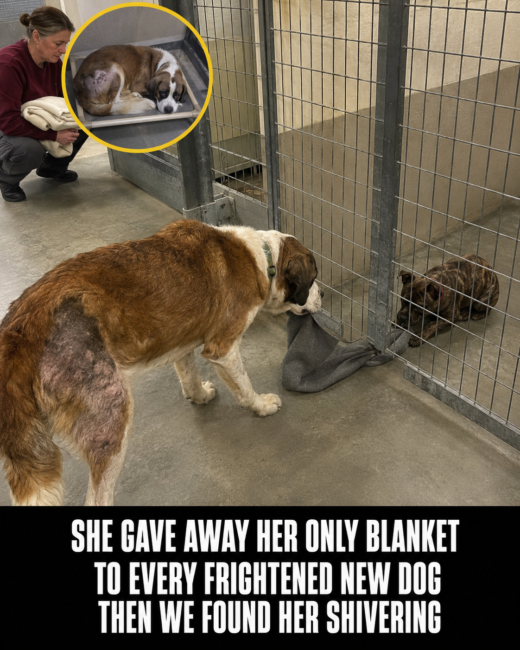
I remember Luis saying, “That’s a lot of dog.”
Then she turned sideways, and we saw the hollows beneath her coat.
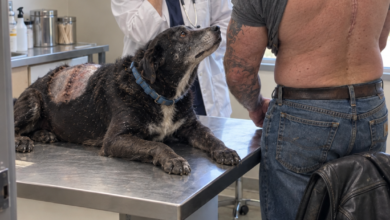
At ninety-six pounds, Mabel still occupied an impressive amount of space. Her head was heavy, her chest deep, her shoulders broad. Yet her waist drew inward sharply, and the remaining hair over her hips could not conceal how little padding lay underneath.
The bare patches were not small cosmetic spots. They spread across both hips and joined thinner fur around the base of her tail. The skin looked dark and dry, with areas thickened from longstanding irritation.
Her coat had been hiding what her body needed.
The transfer summary said she had lived with a private foster caregiver named Rose Connelly. Rose had fallen at home and been hospitalized. A niece had arranged emergency care for the animals while sorting out what would happen next.
Several dogs had found temporary placements through people who already knew them. Mabel, being older, larger, and in need of continuing skin care, had remained without an offer.
No one had written that she was difficult.
The word repeated throughout her paperwork was easy.
Easy to handle. Easy on a leash. Easy around other dogs.
I would come to dislike how quickly we used that word.
Dr. Elena Park examined Mabel that afternoon. The assessment pointed toward longstanding flea-associated skin irritation, with scratching and hair loss that would take time to improve. Mabel had already begun treatment before transfer; Elena reviewed it, continued an appropriate parasite-control plan, and prescribed further skin care based on the examination.
Her low body condition needed attention too. We recorded her meals, watched her appetite, and planned repeat weights. Nothing about recovery was going to happen because someone finally took a flattering photograph.
Mabel stood throughout the examination without trying to leave. When Elena lifted her tail to inspect the thin coat beneath it, Mabel turned her head and looked at us.
Not a warning. A question held still.
Elena paused, changed her position, and let Luis steady Mabel from the front. Afterward, Mabel accepted a small treat, chewed it twice, and leaned her chin against his wrist.
We placed her in kennel five because it offered room for a large cot and stood away from the busiest entrance. The neighboring pen was used for medically screened dogs needing a quieter first night before their next placement.
The pens had separate gates and a shared divider. Near the front, the divider stopped a few inches above the floor.
We knew the gap existed. We did not know Mabel would find a use for it.
Her gray fleece had a blue square stitched into one corner. The stitches were uneven, with one side repaired more recently than the others. I assumed it covered a tear.
When I spread it across her cot, Mabel touched the blue corner with her nose.
Twice.
Then she looked at my hands.
“Good enough?” I asked.
She remained standing.
I sat on the low stool we kept beside the kennels to fill out her intake notes. Only then did Mabel step onto the fleece and lower herself, one broad shoulder followed by the rest of her body.
I recorded that she settled well with a person nearby.
I did not record the order.
For the next several days, Mabel made few demands. She waited while smaller dogs shouted for breakfast. She stepped back when we opened her gate. She permitted us to examine her skin, replace bedding, and check her feet.
During walks, she stopped whenever a dog cried inside the building.
At first, I thought she wanted to go back indoors. Then I noticed she did the same thing while we were heading in.
The sound mattered more than the direction.
My daughter, Hannah, visited during a weekend volunteer shift. She was twenty-seven and less easily impressed by a dog’s size than I was. She crouched near Mabel’s gate and watched the old dog follow a laundry cart with her eyes.
“She likes blankets,” Hannah said.
“She likes that one.”
Hannah looked at the gray fleece, then at Mabel’s face. “I don’t think she’s looking at the blanket.”
Mabel’s eyes had followed the attendant’s hands.
I should have asked more questions then. Instead, I accepted the quiet as evidence that she was comfortable, and the comfortable dog became the one I checked after the noisy ones.
My mother had once done something similar in a hospital bed. She would say she was fine while holding an empty water cup because the nurses looked busy.
I recognized that habit in people.
It took a dog to make me recognize it again.
Part 3, The Things That Disappeared Overnight
The first missing blanket was a tan one.
Mabel’s gray fleece had gone into the wash during her scheduled skin-care day, so I left a freshly laundered replacement on her cot. I remember smoothing it beneath her hips and checking that she had water before I moved down the row.
A young Beagle occupied kennel six that evening. He had been picked up near a rural road and spent his first hours following every footstep with a high, breathless cry.
Mabel ate half her dinner, then stood beside the divider.
When I returned at midnight, she was lying near the front of her pen. I encouraged her onto the cot and checked her bedding. The tan fleece was still there, pulled into a long fold.
At the next round, I found her trembling.
Her cot was bare.
The Beagle had a tan blanket bunched near his chest, but there were tan blankets throughout the building. I assumed someone had changed both pens while I was helping with a late intake.
Luis checked the laundry bin.
No obvious answer.
Mabel’s skin was dry, her cot clean, and there was no sign of an accident. We gave her fresh bedding and moved the cot farther from the exterior draft. She settled against the new fleece while I sat nearby.
I wrote “bedding replaced; shivering resolved” in her notes.
The entry was accurate.
It was also incomplete.
The next evening, a small brown mixed-breed dog named Pip took the neighboring pen while waiting for a foster pickup the following morning. Pip did not bark much. He made a soft sound in the back of his throat whenever a door closed.
Mabel responded to that sound more quickly than she responded to her name.
She would rise, approach the shared divider, and lower her head. Sometimes she nudged the corner of her bedding. Sometimes she looked toward the hallway, waiting for someone to pass.
I tried bringing her a chew.
She sniffed it and left it on the cot.
A volunteer suggested the other dogs might be pulling blankets through the gap. That seemed possible. Pip could reach a corner if it lay close enough, and Mabel was not the sort of dog who defended possessions.
We began placing her bedding at the back of the cot, away from the divider.
That should have settled it.
By morning, Pip had Mabel’s replacement fleece.
Mabel had the chew.
The chew was untouched.
We kept finding the evidence and explaining away its shape.
I do not mean nobody cared. Luis stayed late to fix a loose latch so an anxious hound would not keep startling at the noise. Our director, Dana, had driven two hours the previous weekend to return a lost dog to an owner who could not travel.
But care can be sincere and still miss something.
The handoff between shifts was crowded with medication times, transport arrangements, appetite changes, cleaning needs, and dogs who had bitten at a leash. A blanket in the wrong kennel looked like a small problem among larger ones.
Mabel’s silence made the problem smaller.
On Wednesday afternoon, Elena reviewed the trembling episodes. Mabel’s skin treatment continued, and her appetite had improved, but her reduced coat and low body condition made a comfortable sleeping environment especially important.
We checked the wall thermometer. The reading was within the building’s normal range.
Elena asked us to check where the dog actually lay.
The floor near the loading-door end of the row was cooler. A worn door seal was allowing a draft, and the airflow did not match what the wall sensor suggested. Maintenance adjusted the door, moved the cots, and placed a separate thermometer lower down.
For the rest of that shift, the readings improved.
I believed we had found the cause.
Then Wren arrived.
A property owner had heard him beneath the boards of an unused chicken coop and called for help after failing to coax him out. The responding officer waited while the owner removed a loose side panel. Wren came out on his own, then flattened himself when anyone reached toward him.
By the time he reached us, he was exhausted, medically screened, and still unable to believe that an open hand did not require him to disappear.
We gave him a covered retreat, fresh water, and bedding. We kept voices low. Nobody pulled him from beneath the cot for a photograph.
Mabel watched his arrival through the mesh.
She had been lying down for twenty minutes. At his first thin cry, she stood.
I placed her familiar gray fleece on the cot. It had come back from the laundry with the blue patch intact and the edges folded neatly.
Mabel went directly to that corner.
Two touches of her nose. Then my hands.
“Not tonight,” I told her, thinking I was asking her to keep her bedding where it belonged.
I moved the fleece toward the cot’s far edge. Mabel waited until my fingers lifted away, then took the corner in her mouth and brought it back toward the front.
She did not shake it.
She did not paw at it as though preparing a nest.
She held it and watched Wren.
At 10:40, I sat outside his gate while Luis finished cleaning. Wren’s cries became less frequent. Mabel lay down with the fleece beneath her.
At 11:05, I stood to answer the intake phone.
Mabel stood too.
Looking back, that was the last uncomplicated chance I had to see the pattern before cold made it impossible to ignore.
She had not been asking for another blanket.
She had been asking us not to leave yet.
Part 4, What We Found at 3:14
The heating failure began quietly.
No alarm sounded throughout the building. The examination wing stayed warm, the overhead lights remained on, and the wall near the office felt no different when I brushed past it carrying clean bowls.
The problem belonged to one heating zone.
Luis noticed first because a radiator that usually clicked beneath the window had gone silent. He checked the new floor-level thermometer, called Dana, and began opening the warmer rooms we used for examinations and recovery.
We did not wait for the building to become an emergency before treating it as one.
Carriers went into the interior room. Larger dogs moved into warmed individual spaces. I called the veterinarian on duty and described what we were seeing while Luis counted occupied kennels.
Mabel was the fifth dog I reached.
By then, the cold near the floor was unmistakable. My knees felt it through my work pants as I crouched beside her cot. She stood when I spoke, but the effort passed visibly through her body.
The gray fleece was gone.
Her identification tag tapped the gate.
That small sound was worse than barking.
I brought a clean blanket from the cart and held it around her shoulders. She turned away from its warmth, found the loose edge, and drew it down.
For one second, I thought she was uncomfortable being covered.
Then Wren cried.
Mabel brought the corner to the divider.
I saw her lower her muzzle, press the fabric toward the floor, and work it beneath the gap. Wren’s nose appeared, then his teeth caught the edge.
No theft.
No laundry error.
She was giving it to him.
My first response was practical. She needed warmth, and blankets passing between kennels were not a safe bedding system, whatever meaning we placed on it afterward.
I asked Luis for a second fleece, covered her again, and moved Wren’s borrowed bedding out of circulation once he was transferred. Both dogs received clean replacements in separate warm spaces.
I did not allow the exchange to continue because it looked generous.
I wanted Mabel warm.
She wanted to remain by the gate.
When I opened it, she stepped forward and stopped at Wren’s next cry. Her body angled back toward him. She did not fight the harness; she simply planted her feet and looked from his kennel to mine.
I could have mistaken that pause for stubbornness.
Instead, I remembered Hannah watching her watch our hands.
I sat beside Wren’s gate.
Not close enough to crowd him. Just low enough that he could see my shoulder and the towel resting across my knees.
Wren stopped crying for a breath.
Mabel watched him.
I stayed.
Then the old dog let her weight shift toward Luis.
The leash loosened.
He guided her into the examination wing while I remained with Wren until another worker brought the covered carrier. We moved him without dragging him from his hiding place, keeping the process slow despite how urgently I wanted the row empty.
By four, every dog was accounted for.
The repair technician was at the boiler room. Dana was speaking with maintenance about the pump and reviewing the temperature records. Elena examined Mabel, assessed her temperature and circulation, and supervised warming while we watched her response.
Mabel stayed alert. Her trembling eased in the warm room, and further checks did not show the deterioration we had feared. We continued monitoring her rather than treating one improved reading as the end of the problem.
Wren slept in his carrier several feet away.
Mabel lay with her head turned toward him.
When his feet twitched in sleep, she lifted her chin. When he settled, she lowered it.
Luis pulled up a chair between them.
“You can sleep,” he told her. “I heard him.”
Mabel’s eyelids lowered.
I went to the office and opened the camera recordings.
The first night showed the tan fleece. The Beagle was crying. Mabel carried a corner from the back of her cot to the gap, pushed it forward, and waited until he took it.
Then she looked toward the corridor.
On the second recording, Pip caught the edge of a cream-colored blanket. Mabel let go immediately. She returned to the cot but did not lie down until a volunteer stopped outside Pip’s gate.
On the third, Wren received the gray fleece.
After each exchange, Mabel watched the human traffic.
She never tried to take the bedding back.
I replayed the clips with the sound low. The sequence was not perfect, and not every new dog responded in the same way. Sometimes the fabric remained near the gap. Sometimes a dog ignored it until later.
But Mabel’s part scarcely changed.
Cry. Blanket. Hands. Wait.
Dana stood behind my chair.
“We fix the gap,” she said. “And the checks. All of them.”
She was not angry at the dog or searching for an employee to blame. She wanted the building repaired, the bedding procedure clarified, and every future temperature concern checked at the animal’s level.
By late morning, Mabel had eaten. Wren had accepted water while Luis sat sideways nearby. Clean bedding was stocked outside every temporary room.
I put a second fleece beside Mabel’s bed and felt the relief of having a simple solution.
Enough blankets. Working heat. More careful rounds.
Then, from the next room, an unfamiliar dog began to cry.
Mabel rose, picked up a clean towel, and brought it to the door.
The room around her was already warm.
Part 5, The Woman Who Recognized the Blue Corner
Rose called that afternoon.
I had left the message on the second number in Mabel’s envelope and expected a relative to answer. Instead, I heard an older woman speaking carefully between breaths, as though she had been preparing questions since someone first told her where Mabel had gone.
“Has she eaten today?”
“Yes.”
“Is the skin getting any worse?”
“No. The veterinarian is following it.”
A pause.
“Does she still have her blanket?”
I looked toward the examination room. Mabel was asleep, one ear folded inside out against the fleece.
“She does,” I said. “But I need to ask you about what she does with it.”
I described the missing bedding, the three new dogs, and the blue square sewn into the gray corner. I explained the heating failure too. I did not soften that part or make the camera discovery sound like compensation for it.
Rose listened without interrupting.
Then she asked, “Did somebody sit with the other dog?”
My fingers stopped against the edge of the desk.
“Eventually,” I said.
“After she brought the blanket?”
“Yes.”
Rose let out a breath.
“That’s what she was waiting for.”
I had built a story in my head by then. Mabel was old, female, and gentle with frightened dogs. Some part of me had imagined lost puppies or a life spent raising litters, as though the only possible explanation for care had to be motherhood.
Rose gave me something different.
Mabel had been the frightened newcomer once.
Eight years earlier, Rose had agreed to foster a young Saint Bernard who had been living beneath the back steps of a house after her family left. Neighbors supplied food, but no one had been able to persuade her into another home.
Mabel would approach an offered bowl and retreat at the sound of a door.
Rose did not bring her home in triumph. She spent several days helping the rescue team establish a routine, then took her into a quiet room with a low cot and an open crate.
The dog cried at night.
Not loudly enough to fill a house.
Just enough that Rose could hear it from bed.
The first night, Rose carried in a gray fleece and sat on the floor until Mabel stopped pacing. The next night, she did the same thing.
On the fourth night, the young dog crossed the room, caught the blanket corner between her teeth, and carried it toward Rose’s knees.
Rose thought she wanted it spread out again.
She placed it on the cot.
Mabel brought the corner back.
“So I sat down,” Rose told me. “And she finally lay beside me.”
The blanket had become part of a sequence.
Someone frightened. Something soft. A person staying.
Rose was careful not to claim more than she had observed. She did not tell me Mabel understood loneliness the way a person did, or that she had made some conscious promise to every animal she would ever meet.
She told me what happened.
When Rose began fostering other dogs again, she carried clean bedding into the spare room and sat with each arrival. Mabel watched from behind a gate during introductions and later remained nearby when a pairing was appropriate.
Over time, she began picking up blanket corners.
Sometimes Rose accepted them. Sometimes she redirected Mabel and chose a clean towel from the cupboard instead. But often the dog carried fleece toward the room where an unsettled animal waited, and Rose followed.
Then Rose sat.
The behavior had worked for years.
At our shelter, the blanket reached the frightened dog.
The person did not always follow.
“I thought she was giving away her bed,” I said.
“She might be doing that too,” Rose answered. “But she always looked for my hands afterward.”
I looked down at mine.
The two nose presses had belonged to that household as well. Rose had sometimes tapped the blue corner before picking up the fleece. Mabel had developed her own small nudge when she wanted the routine to begin.
The blue patch was not a symbol designed for anyone else. Rose had sewn it over a chewed corner years earlier because replacing an otherwise usable blanket seemed wasteful.
But its familiarity mattered to Mabel.
Rose sent me a short video her niece found on an old phone. In it, a younger, fuller-coated Mabel stood beside a hallway gate with that same corner in her mouth. Beyond the gate, a little black dog was crying inside an open crate.
Rose entered the frame carrying a mug.
Mabel looked at the mug, then at her free hand.
“Let me sit,” Rose said.
The dog released the fabric.
Nothing dramatic happened after that. Rose lowered herself onto a cushion. The little dog’s cries spaced farther apart. Mabel circled once and lay beside the doorway.
The recording ended while all three were still there.
I watched it twice.
The part that caught in my throat was not the blanket.
It was how familiar Mabel looked while waiting to be answered.
Rose’s fall had broken her hip and interrupted the routines that held her house together. During the weeks of hospitalization and hurried substitute care, Mabel’s existing skin trouble had become harder to manage. Everyone had been trying to solve immediate problems, and the older dog’s needs had been divided among people who did not know her well.
Rose was in rehabilitation when we spoke. Her niece was arranging accessible housing, and no one could promise that Rose would soon be able to manage a large dog safely.
“I want her back,” she said.
“I know.”
“But wanting isn’t the same as being able to lift a water bowl and get down the steps.”
She went quiet. I could hear a television somewhere beyond the phone.
“I don’t want her waiting on me while people keep deciding.”
That was the second thing I had misunderstood.
Mabel was not simply missing a blanket routine.
She had lost the person who used to respond to it.
And now, whenever another dog cried, she kept bringing us the beginning of a familiar answer.
Part 6, A Bed She Didn’t Have to Earn
The next morning, I changed the wording in Mabel’s care notes.
I did not write that she was the shelter’s mother, its night nurse, or its unpaid guardian. Those descriptions would have made an attractive post, but they would also have given us a way to admire her exhaustion instead of preventing it.
I wrote what we had seen.
She carried bedding toward distressed dogs. She watched staff hands. She settled more readily when a person stayed nearby. She needed her own warmth, skin care, food, rest, and freedom from having to monitor every new arrival.
Being useful was not her treatment plan.
Dana had the divider gap closed before that row reopened. The heating repair was completed, the door seal replaced, and the low temperature checks added to the rounds rather than left as an informal concern.
We stopped allowing bedding to pass between pens. New arrivals received their own clean supplies, and used items went through the normal laundry process. No one staged another blanket exchange for a camera.
But we did not scold Mabel for carrying fabric.
When she lifted a towel and looked toward a crying dog, a staff member checked the other animal, took over whatever care was needed, and guided Mabel back to her own resting place.
Sometimes that worked quickly.
Sometimes she stood and watched for several minutes.
We learned not to pretend a phrase alone could replace what she was waiting to see.
“I’ve got him” meant more after someone actually sat down.
Wren began emerging from beneath his bed while Luis was nearby. He remained wary of direct reaching, so Luis kept his hands low and let the terrier choose the distance.
Mabel watched from her separate warm room.
On Friday, Wren drank while she lay down.
On Saturday, he ate several bites from a bowl with Luis in the doorway.
Mabel did not get up.
Those were small changes, but they belonged to both dogs.
At home that weekend, I found myself looking at the space beside my couch.
My mother had lived with me for the last two years of her life. After she died, I had taken overnight work because the house was easiest to bear when I could leave it before dark.
I kept the rooms clean. I answered Hannah’s calls. I worked, slept, and bought groceries in quantities that looked temporary, though fourteen months had passed.
The space beside the couch once held my mother’s basket of knitting.
I had never put anything else there.
I measured it on Sunday morning.
Then I measured the back doorway.
Hannah found me kneeling with the tape stretched across the floor.
“You’re checking for Mabel.”
“I’m checking whether it’s practical.”
“That’s checking for Mabel.”
She did not laugh at me. She helped measure.
We discussed costs, veterinary appointments, my work hours, and how a large older dog would manage the two back steps. Hannah could help, but I could not build the plan around her being available whenever I needed her.
Dana approved a foster trial after we arranged a workable schedule and backup care.
Rose agreed too.
She asked that the gray fleece go with Mabel.
“It will,” I said.
“And she needs something under her hips besides that thin blanket.”
“I know.”
Rose’s voice softened. “Good.”
Mabel entered my house eleven days after the heating failure. She wore her faded green collar and a harness, and she walked up the temporary ramp as though every board required a private conversation with her feet.
Inside, she checked the kitchen, the hallway, and the back door.
Then she found the bed beside the couch.
I had placed a plain washable cover over thick padding and laid her gray fleece nearby. Her medication and skin-care supplies were stored out of reach. Rugs covered the slippery path between the bed and the door.
Nothing in the house needed her to be brave.
She stood beside the bed for a long time.
I sat on the couch.
Mabel picked up the blue corner and carried it to my knees.
So I moved to the floor.
She put the fleece down beside me, looked toward the hallway, and waited.
There was no other dog.
No crying from the next pen.
No one for me to go and comfort.
The refrigerator clicked off, leaving a silence I could hear in my jaw.
For the first time since she arrived at the shelter, Mabel had brought the blanket to someone and had no obvious second destination.
I placed one hand on the floor near her paw.
“You can stay here,” I said.
She did not settle immediately. She walked to the back door, returned, and sniffed the plain bed cover. Then she lowered her front half, paused with her hips still raised, and eased the rest of her body onto the padding.
I remained beside her until her breathing lengthened.
The first week was not a smooth passage into belonging. Mabel woke at unfamiliar sounds and checked the hallway. When a dog barked outside, she sometimes collected the gray fleece and carried it to the front door.
I checked the sound, returned, and sat near her bed.
I did not open the door and send her out to solve it.
Her skin remained uncomfortable in places. One evening, increased scratching made her restless, and I contacted Elena rather than assuming every unsettled night was about her past. We adjusted her care after a recheck and kept watching for changes.
The bare areas did not vanish.
New fur appeared slowly along some edges over the following weeks. Her weight improved gradually. The skin near the tail base remained darker than the surrounding area, and the thick coat she had once worn was not restored overnight.
She was still a dog who required care.
She was also a dog who discovered that my kitchen rug offered the best place to intercept crumbs.
By the third week, she had begun carrying a soft orange toy from room to room. She would set it near my shoe, back away, and wait with one ear tipped sideways.
The first time she did it, I said, “Is this another job?”
She picked it up and bumped my ankle.
Hannah laughed from the table.
“No, Mom. I think that one’s just a toy.”
Mabel was allowed to want something small and unnecessary.
When the foster trial ended, Rose and I spoke before I signed the adoption papers. She asked about the ramp, the scratching, the night waking, and whether Mabel still preferred sitting beside a person rather than directly in front of them.
I answered every question.
Then Rose said, “Tell her I didn’t forget.”
“I will.”
I knew Mabel could not understand that message as a human would.
But Rose needed to say it.
And I could make sure the old dog’s life did not feel like she had been forgotten.
Part 7, The Blanket Came Back
Rose visited in late spring.
By then, Mabel had lived with me for three months. The fur over her hips had begun filling in unevenly, leaving the recovering areas shorter and darker than the coat around them. We still followed her skin-care plan and kept the padded bed where she could reach it without steps.
Her body had changed in quieter ways too.
She no longer rose every time I walked toward the kitchen.
She sometimes slept through the sound of the laundry basket being set down.
Once, when a dog barked in the street, she lifted her head, looked at me, and remained exactly where she was.
The world could make a noise without becoming her assignment.
Rose’s niece brought her on a Saturday afternoon. We kept the visit simple, with a clear path, a stable chair, and no expectation that Rose would kneel or Mabel would perform a reunion for us.
Mabel heard the voices at the doorway.
She stood.
Rose said her name.
For a moment, the old dog remained still, her ears lifted just enough to change the shape of her face. Then she crossed the room with a speed I had not seen since the day she found my toast cooling on the counter.
She stopped at Rose’s knees.
Her tail swept the floor.
Rose rested both hands against the heavy white chest and bent forward as far as she comfortably could. Mabel pressed closer, placing her muzzle along the outside of Rose’s wrist.
Neither of them needed a speech.
I turned away to give them a little space and found Hannah holding four empty mugs.
She had forgotten why she picked them up.
Rose stayed for nearly two hours. We talked about appointments, the new housing arrangement, and the weather. Mabel lay beside her chair, rising once when Rose adjusted her position, then settling again when she saw no help was needed.
The gray fleece was folded across the arm of the couch.
Mabel noticed it near the end of the visit.
She stood, took the blue corner, and brought it toward Rose.
I felt my body prepare for the old sequence.
Blanket. Hands. Wait.
Rose accepted the edge, rubbed the familiar patch between her fingers, and looked at the bed beside the couch.
“Come here, girl.”
Mabel followed her gesture.
Rose could not walk over and arrange the bed herself, so she handed me the fleece.
I spread it across Mabel’s hips.
For a moment, the dog held the blue corner in her mouth.
Then she released it.
The blanket stayed with her.
Rose watched her settle, one large paw hanging over the bed’s edge. The barest patch near her tail was covered without pressure, and her chin rested where she could see both the couch and the doorway.
“She always did that,” Rose said.
“Gave things away?”
Rose shook her head.
“Made sure somebody came.”
I sat in the chair beside her.
Outside, a truck rolled past, rattling briefly over a patch in the road. Mabel’s ear turned toward it. Her body did not follow.
After Rose left, Mabel checked the doorway twice. I expected her to pace or carry the blanket back to the entrance, and I had prepared myself to sit through whatever the evening required.
Instead, she returned to her bed.
I called Rose that night.
“She’s sleeping,” I said.
“Good.”
“With the blanket.”
Rose was quiet for a few seconds.
Then she said, “That’s better.”
At the shelter, Wren had found a patient adopter who understood that fear did not disappear because a dog had been handed new paperwork. Luis sent me a photograph of him asleep beside a chair, one narrow brindle leg stretched beyond his clean bed.
Mabel was not in the photograph.
She did not need to be.
The dogs who received her blankets would go on to have lives she never saw, in rooms she would never check. Other people would notice when they shivered. Other hands would straighten their bedding.
That part belonged to us now.
Every night before bed, I still check the water, the back door, and the room temperature. Then I straighten the gray fleece if it has slipped from Mabel’s hips.
She sometimes opens one eye.
Sometimes she catches the blue corner briefly between her teeth, as though testing whether the old routine is about to begin again.
I sit beside her for a minute.
Not because she has earned it by caring for someone else.
Not because she has carried something to the right door.
Because that is where her bed is, and she is in it.
Last night, rain tapped the window while she slept. The soft orange toy lay beneath one paw. Her gray muzzle had sunk into the fleece, and the little blue patch was folded just below her chin.
I reached down to straighten it.
Mabel opened her eyes, looked at my hand, and put her head back.
This time, she kept the blanket.
Follow this page for more dog stories about quiet courage, patient rescue, and the second chances that finally let a caring heart rest.