Part 2: The Frightened Pit Bull Could Not Lift His Head Because His Tongue Was Frozen to the Bowl — Then a Rescuer Put Away Every Tool and Sat in the Snow
Part 2, The Distance Set by His Eyes
Luis moved the delivery van to block the wind without aiming its headlights at the dog. I remained crouched near the edge of the overhang, turned slightly sideways, and avoided staring directly at him. He watched every shift of my boots. When I moved one knee forward, his shoulders tightened and his paws pressed against the icy concrete.
I stopped before he pulled.
The simplest rescue would have been to hold his head and pour water over the bowl. It was also the plan most likely to make him thrash. A frightened dog restrained around the muzzle may bite from reflex, and this dog already associated movement toward his face with pain. If he tore free before the ice softened, a manageable cold injury could become a much larger one.
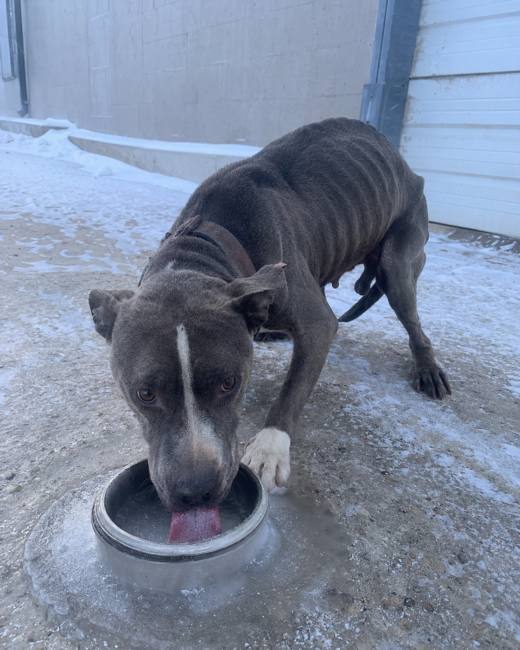
We first reduced what he had to fear. Luis placed two portable kennel panels several feet behind the dog, leaving them wide and open. They were not meant to trap him. If the tongue released and he bolted, the panels would guide him away from the traffic lane and toward the open transport crate rather than toward the road.
I took out a soft plastic squeeze bottle and filled it with water warmed to approximately body temperature. I poured a little over my bare wrist, then let the dog hear it trickle onto the concrete. His eyes shifted to the sound. He could not turn his head more than an inch, so his whole body leaned away.
I put the bottle down.
For several minutes, nothing happened except the wind brushing snow under the overhang. The dog kept his ears pinned, mouth partly open, and tongue fixed to the rim. His left front paw—the one with the white sock—lifted and lowered twice without finding a comfortable place. He was not threatening us. He was trying to solve a problem that offered no safe direction.
Food could not be used as it normally would. He could not close his mouth or take a treat, and placing anything near his nose risked making him jerk toward it. We used scent instead. Luis opened a container of warmed chicken several feet away and set it near the transport crate. The dog smelled it; his nostrils widened, but the rest of him remained still.
I shortened the distance by inches. I slid forward, paused, placed my hands on my thighs, and waited for his breathing to slow. At five feet, he gave a low, continuous growl without raising his lip. I leaned back until the sound stopped. At four and a half feet, I lowered my gaze and rested the squeeze bottle on the ground between us.
The practical obstacle was not only the dog. The bowl sat partly inside a shallow depression in the concrete, surrounded by a ridge of frozen water nearly an inch thick. Even if his tongue released, the bowl might remain attached to him by refreezing saliva unless we warmed the entire contact edge and kept it wet long enough for him to withdraw on his own.
We could not rush one splash and hope.
I sat fully on the cold ground, making my body lower than his shoulders. After nearly three minutes, his growl faded. His eyes remained fixed on the bottle, but his front paws stopped pushing backward. That was the first usable change—not trust, but a pause in panic long enough to try the next step.
Part 3, The First Drop of Warm Water
Dispatch estimated twenty minutes before a veterinary field technician could reach us. We requested the help but did not wait without preparing. Cold metal would continue drawing heat from the tongue, and the exposed tissue was already swelling. Our goal was to begin gentle warming while preserving the option to stop whenever the dog started pulling.
Luis brought a folded rubber mat from the vehicle and slid it across the concrete with a broom handle, stopping two feet from the dog’s paws. The mat would give him traction after release, but the scraping noise made him recoil. The steel bowl shifted less than half an inch inside the ice ring. His eyes widened, and a short sound escaped his throat.
We waited until his paws relaxed again.
I spoke in the same low phrase each time I moved: “Easy. I’m staying low.” The words mattered less than their rhythm. My hands remained visible, and the squeeze bottle stayed on the ground. When I touched it, I waited. When I lifted it an inch, I waited again.
At three feet, the dog curled his upper lip for a moment. I lowered the bottle and turned my face away. He did not have to become friendly. He only needed to discover that showing discomfort made the movement stop.
That exchange repeated six or seven times. The bottle advanced. His ears flattened. The bottle stopped. His breathing eased by one beat. Eventually, I could extend my arm without his paws sliding backward.
The narrow nozzle allowed me to send a small stream toward the outside of the bowl instead of directly at his face. The first warm water ran over the steel and pooled against the surrounding ice. Steam did not rise; the temperature difference was intentionally modest. The dog flinched, but because the water touched the bowl before reaching his tongue, he did not pull.
I stopped after two seconds.
He blinked and shifted his eyes toward me. A droplet hung from the white fur beneath his chin. I waited until his shoulders lowered slightly, then sent another thin stream along the rim. This time the water reached the contact point. His tongue moved less than a fraction of an inch, showing that some ice had begun to soften, but the broad center remained adhered.
The complication became clearer as frost melted. His tongue was not stuck at one small point. Nearly two inches of the upper surface lay flat against the inner curve of the bowl. Pulling from the tip would concentrate pressure on delicate tissue. The safest release would require warming from both ends of the contact area and allowing the dog to lift his own head when the adhesion disappeared.
Luis could not reach the far side without entering the dog’s direct view. Instead, he slid me a second squeeze bottle along the ground. I positioned one bottle on each side of my knees and alternated short streams across the near and far edges of the rim.
The dog began trembling harder, though he was no longer trying to retreat. His eyes tracked my right hand, then my left. Between pours, I rested both palms on the concrete. Once, his white paw crept forward until his nails touched the edge of the rubber mat.
The field technician arrived and stayed near the vehicle after seeing the position we had established. More people around the bowl would not improve it. She prepared towels, pain medication, and a soft muzzle for use only if the dog became unsafe after release.
I poured again. The tongue’s outer edge lifted briefly, then settled back.
We were close, but close was the moment when an animal often tried hardest to escape. I set the bottles down and waited for the dog’s eyes to soften from wide circles to a guarded, steady stare. Only then did I reach for the next measure of warm water.
Part 4, When the Metal Finally Let Go
The next pour lasted five seconds. Warm water traveled around the curved rim, darkening the frost and loosening the clear line of frozen saliva. The dog lifted his chin by instinct. The left edge of his tongue came free, but the center held, pulling his head sideways.
He panicked.
His front legs shoved backward, claws scraping for traction. I dropped both bottles and placed my hands flat on the ground rather than reaching toward him. Luis steadied the kennel panel behind him but did not close it. The bowl remained anchored, and the partially released tongue stretched toward one side.
“Easy. I’m staying low,” I repeated.
The dog froze with his rear legs braced and his head tilted. The field technician reminded us that sedating a severely frightened, underweight dog in the cold would bring its own risks and would not act fast enough to solve the immediate adhesion. Unless he began injuring himself, controlled warming remained the safer course.
I picked up only the left bottle. Because one edge had released, the remaining contact area was easier to see. The tongue looked swollen but intact, with no visible bleeding. I directed the water toward the steel below it, using the bowl to distribute warmth rather than spraying sensitive tissue directly.
One second. Stop. Three seconds. Stop.
The dog’s gaze moved from the bottle to my face. His ears stayed flat, but his paws no longer scraped. I poured from the far side, then rested the nozzle on the concrete. A thin gap appeared beneath the center of his tongue.
He lifted his head.
The tongue separated from the bowl without a snap or dramatic movement. It simply came free. The dog stumbled backward onto the rubber mat, shook his head once, and crouched with his mouth partly open. His tongue withdrew only halfway because the front portion was swollen and uncomfortable, but it moved independently of the steel.
No one reached for him.
The bowl still sat frozen to the concrete between us. I moved both bottles away and leaned back on my heels, giving him room to understand that he could move. He took one step toward the open side of the panels, stopped, and looked at the transport crate where the chicken scent remained.
Luis shifted a panel by several inches to create a broad corridor. The dog reacted to the metal rattle by lowering his body, but he did not return to the bowl. I placed a wide ceramic dish near the crate and poured room-temperature water into it. He approached, smelled the surface, then backed away when the dish clicked against the pavement.
That response told us the rescue had not ended with release. His mouth hurt, his body was cold, and any bowl might now predict the sensation he had just escaped.
The field technician moved into the open corridor and sat sideways, leaving more than six feet between them. She prepared a slip lead but kept it coiled beside her leg. I remained near the frozen bowl. If all of us followed the dog, he would feel driven. If one person stayed behind, the crate could remain the quiet direction.
He moved toward the chicken scent in three short stages. At the crate entrance, he lowered his head but did not take food. The swollen front of his tongue rested slightly between his lips. When the technician lifted the slip lead, he recoiled, so she set it down and moved the food farther inside.
For almost ten minutes, he stood between the crate and open lot, trembling. Then a gust drove snow beneath the overhang. He turned away from it, placed his white paw inside the crate, and paused. The second paw followed. Once his body crossed the threshold, the technician raised the door slowly and secured it without bringing her hands near his face.
We covered three sides of the crate and moved it into the heated vehicle. I rode beside him while Luis drove. The dog kept his head low, but he was no longer fixed to anything. Each time the van turned, he adjusted his paws and chose where to place them.
Before leaving, I looked back at the metal bowl. A shallow layer of warm water had already begun forming new ice around its rim. The difference between release and another injury had been less than a minute, a few controlled pours, and a frightened dog finally discovering that the person moving closer would also stop when asked.
Part 5, Forty-Eight Hours of Watching
The veterinary clinic had prepared a quiet examination room near the side entrance. We carried the covered crate inside and removed the top rather than pulling the dog through the door. He remained crouched on the crate floor, mouth slightly open, tongue resting just behind his lower teeth. His eyes followed every gloved hand.
The veterinarian began with what could be observed without restraint. The front two inches of the tongue were swollen and darker pink than the tissue behind them, but circulation was present and the surface remained largely intact. His breathing was steady, his gums outside the injured area had a healthy color, and his temperature was below normal but rising under controlled warming.
After pain medication took effect, the team performed a closer examination using the least restraint possible. The veterinarian diagnosed a localized freezing injury to the tongue with superficial surface damage. She explained that cold-injured tissue can change over the next forty-eight hours, so no one could promise that the full tip would remain healthy based on the first examination alone.
His weight was forty-nine pounds. Bloodwork showed mild dehydration and changes consistent with inadequate nutrition, but no immediate organ crisis. The underweight condition mattered because healing required calories, while tongue pain made eating difficult. The team planned small portions of soft food, fluids, pain control, and repeated checks of the tongue’s color, warmth, swelling, and movement.
The intake chart needed a name, so the technician wrote “Tobin.” It was brief enough to say without leaning toward him. He did not respond to it that day.
Tobin refused the first ceramic water dish. He backed against the kennel wall when it entered and kept his head turned until the technician removed it. A metal bowl produced a stronger response: pinned ears, widened eyes, and a low growl before it crossed the threshold. We replaced both with a shallow silicone tray that made no sound on the floor.
He watched the tray for nearly an hour.
That evening, a camera showed him approaching after the room had been empty for twelve minutes. He smelled the water, touched it once with the uninjured portion of his tongue, and withdrew. On the third attempt, he took two small laps. The movement was awkward, and several drops fell from the side of his mouth, but he returned after another pause.
Soft food required more adjustment. The veterinarian thinned it with warm water and spread a small amount across a flat silicone mat so Tobin would not have to press his tongue into a bowl. He ate by taking careful bites from the edge. After several mouthfuls, he stopped and tucked his chin near his white paw.
During the first night, his tongue became slightly more swollen before stabilizing. The veterinarian checked him every few hours, looking for color changes that might indicate deeper damage. By the following afternoon, the tissue remained warm and responsive. He could retract his tongue fully for short periods, though he let the tip rest between his lips when tired.
I visited at the end of my shift and sat outside the kennel. Tobin lowered his head when I entered, then recognized the squeeze bottle in my equipment bag and pressed himself against the back wall. I removed the bottle from the room. Only after several minutes did his breathing slow.
I placed my empty hand on the floor outside the gate. He watched it, ears still pinned. I did not offer food or move closer. Before I left, his white paw shifted forward until it rested near the gate, several feet from my fingers.
The tongue had been released in under an hour, but the clinic measured progress across two full days. On the second evening, the veterinarian found no sign that surgery would be needed. That was encouraging, not final. Tobin still had to eat, drink, gain weight, and learn that a dish placed near him would not hold his body in place.
Part 6, Learning to Drink Again
Tobin remained at the clinic for five days before moving to the shelter’s quiet medical wing. The swelling decreased gradually, and the front of his tongue returned to a more even pink. He could lap water, but he avoided deep containers and stopped immediately if a dish moved beneath his muzzle.
His care plan turned that fear into a practical routine. Water was offered on broad silicone trays weighted underneath so they could not slide. Soft food was spread thinly rather than piled. Caregivers placed each tray before entering fully, then sat sideways at least six feet away while he decided whether to approach.
For the first week, Tobin ate only after people left. During the second, he began taking a few bites while a familiar technician remained seated near the door. His repeated stress behavior stayed the same: ears pinned, head turned away, eyes tracking hands. When anyone reached toward his collar, his chest dropped close to the floor.
His medical setback appeared on day eleven. The tongue swelling had nearly resolved, but the healing surface remained tender. Tobin tried dry kibble during a planned diet transition, dropped several pieces, and then refused the next two meals. His weight gain stopped, and he drank less because moving his tongue had become uncomfortable again.
The veterinarian found irritation but no new freezing injury or deep tissue loss. She returned him to softened food, adjusted pain control, and delayed dry food for another ten days. The setback cost him less than a pound, yet it showed how easily a small increase in discomfort could reconnect eating with fear.
His recovery resumed through repetition. The silicone tray arrived without clatter. The food remained soft. No hand followed his face toward the dish. By the end of the third week, he drank while a technician changed bedding across the room. A few days later, he took soft food from a flat spoon laid on the floor, though he still would not accept it from a hand.
At four weeks, Tobin moved into foster care with Mara, a sixty-two-year-old retired library assistant who lived alone in a quiet duplex. She removed every metal pet bowl from the kitchen and placed two heavy ceramic dishes on rubber mats. One held water only an inch deep. The other remained empty until Tobin chose to enter the room.
He spent his first two days inside an open crate in the spare bedroom. Mara read in the hallway without facing him. On the third evening, he walked to the kitchen, saw the ceramic dishes, and retreated. Mara did not follow. She moved one dish into the hallway and filled it while he watched from a distance.
That night, he drank from it.
Trust grew in similarly modest ways. He allowed Mara to clip a leash to his cracked brown collar after she spent several days moving only the leash clasp along the floor. He began resting his chin on the edge of his bed rather than over his white paw. When Mara crossed the kitchen, he lifted his eyes without flattening his entire body.
By seven weeks, Tobin weighed fifty-five pounds. The tongue retained a faintly uneven edge at the front but moved normally, and he could eat softened kibble without dropping it. The veterinarian expected no major functional limitation. His fear of metal dishes remained, so no one tested it merely to prove that he could endure one.
Part 7, The Quiet Bowl by the Window
Mara applied to adopt Tobin after eleven weeks of fostering. She did not describe him as transformed. He still stepped back when strangers bent toward his face, and the clang of a dropped pan could send him into the spare room. What had changed was his ability to return after the sound ended.
The adoption became final in May. Tobin weighed fifty-eight pounds, close to the veterinarian’s target for his frame. His ribs no longer showed behind his elbows, though his waist remained lean. The small notch in his right ear, white blaze, and white front paw made him easy to recognize from across Mara’s fenced yard.
His tongue healed with only a slight curve along the front edge. He drank without spilling and ate regular food softened with a little warm water. Mara continued using heavy ceramic dishes on rubber mats because they stayed quiet and did not move. Accommodation was simpler than asking him to forget.
I visited on a cold morning the following winter. A thin layer of frost covered the porch, and Tobin paused when my boots crossed it. His ears tilted back, but his body stayed upright. He approached in a slow arc, smelled my coat, and stood beside me without lowering his chest to the ground.
Inside, sunlight reached a cream-colored ceramic water dish near the kitchen window. Tobin walked to it while Mara and I spoke several feet away. He lowered his head, touched the water with the front of his tongue, and drank in a steady rhythm.
The small sound of lapping carried across the room.
When I shifted my chair, he lifted his head. Months earlier, he had been unable to raise it because cold metal held his tongue and fear held the rest of him. Now water slipped harmlessly from his muzzle, and the bowl remained where it belonged—beneath him, not attached to him.
He watched my hands for a moment, then returned to the water by choice. Mara did not praise him or reach over his head. She simply stayed seated until he finished.
Tobin crossed the kitchen and rested on the rug beside her chair. His chin settled over his white paw, but his eyes closed this time. Outside, the temperature remained below freezing. Inside, the quiet bowl by the window held only water, and nothing in the room required him to pull away.
The house stayed quiet, and he stayed there.