Part 2: The Old Man Hadn’t Spoken in 3 Years. Then a Rescue Dog Walked In.
I’m Walter’s granddaughter.
My name is Claire. I’m thirty-one. I work as a school counselor in Philadelphia, about two hours south of Maplewood. I visited my grandfather once a month. I sat with him. I brought him pierogis from a Polish place he used to like. He would look at me with warm eyes and hold my hand and say nothing.
I stopped expecting words after the first year.
My father — Walter’s only son — died when I was being born, in 1984. I never met him. Walter raised me like a second father on weekends and summers. He used to call me kid and sweetheart and Claire-bear. He used to have a laugh that shook the walls of his kitchen.
After Helen died, all of that went somewhere I couldn’t reach.
My aunt was the one who called me the Wednesday after the dog came.
She said, “Claire. Your grandfather said something yesterday.”
I said, “What did he say?”
She was quiet for a second. Then she said, “You need to come see him.”
I drove up that weekend. I brought pierogis out of habit. When I walked into Room 114, Walter was in his armchair by the window, and a big gray-muzzled German Shepherd was lying across both of his feet, fast asleep.
Walter looked up at me. He smiled. It was the first smile I’d seen on his face since Helen’s wake.
He said, “Claire-bear. Meet Scout.”
I dropped the pierogis.
The nurses told me what happened that first Tuesday.
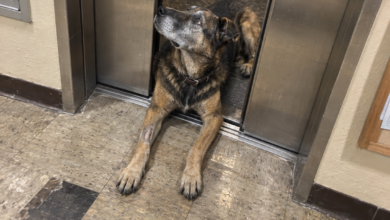
They’d walked Scout into the common room on a loose leash. He was slow. His back legs didn’t fold quite right anymore. He had the particular dignity of an old dog who knew he was an old dog.
Walter didn’t look up. He hadn’t looked up at anything in three years.
The handler from the shelter brought Scout over to Walter’s chair. She said, “Mr. Kovalski, this is Scout. He’s eleven. Nobody wanted him because he’s too old. Do you mind if he says hello?”
Walter turned his head.
Scout was standing there, tail low, ears back. Waiting. Not begging. Not performing. Just an old dog looking at an old man.
Walter looked at him for a long time.
Scout lay down. Not on his bed by the handler. At Walter’s feet. He put his chin on the top of Walter’s slipper and exhaled like he’d been walking for a hundred years.
Walter lifted his hand. Slow. Shaky. He put it on Scout’s head.
Then, quiet enough that only the nurse standing two feet away heard it, he said, “You got thrown away too, huh?”
Denise told me she had to walk out of the room. She said she made it to the hallway before she started crying. Three other nurses joined her before the shift ended, because by the end of that afternoon, Walter had said more to Scout than he’d said to anyone in three years.
He’d said good boy.
He’d said you stink, old man.
He’d said Helen would have loved you.
The last one made a nurse named Angela sit down on the floor.
For six months, Walter and Scout were inseparable.
Scout moved into Room 114 officially on the third day. The shelter program had never placed a dog as a permanent resident before, but Denise pushed the paperwork through by the end of the week. She said she’d never seen a patient come back from where Walter was coming back from, and she wasn’t going to let a bureaucracy take it away from him.
Scout slept on a donated bed next to Walter’s recliner. Walter fed him in the mornings. They walked together down the hallway to the common room at ten — Walter with his walker, Scout with his arthritic hitch, the two of them moving at the exact same pace like they’d agreed on it.
Walter talked to him constantly.
Not performance-talking. Not show-talking. Real talking. The kind a man does when he finally has somebody safe enough to say anything to.
He told Scout about Helen. About the church wedding and her mother’s disapproval and the blue dress she wore on their honeymoon in Niagara Falls in 1963. He told Scout about the war — about a mechanic named Leroy who died in an engine fire in 1969, about the smell of jet fuel, about a letter from Helen he’d kept in his breast pocket for thirteen months. He told Scout about my father — the son he lost — about teaching him to fish at six, about identifying his body at twenty, about how Helen never smiled the same way again after that and how he pretended not to notice because what else could he do.
He told Scout things he had never told me. Things he had never told my aunt. Things he had never, as far as anyone alive knew, told Helen.
Denise started sitting in the room with them in the afternoons under the excuse of charting. She kept a small notebook. She wrote down what he said. She wrote down everything.
She told me later she knew what she was doing and she knew it wasn’t technically her job and she didn’t care.
She said, “Somebody was going to need to hear these stories. I wasn’t going to let them disappear with him.”
Walter died on a Sunday morning in September. Scout was on the bed next to him. The nurse found them at 6:40 a.m. Walter’s hand was resting on Scout’s head.
I thought that was the end of the story.
It wasn’t.
Denise called me the week after the funeral.
She asked if I could come up to Maplewood. She said she had something for me.
I drove up on a Saturday. She met me in the front office. She handed me a notebook. Navy blue. The kind you buy at a drugstore for three dollars. She said, “I wrote down what he told the dog. I think your family should have it.”
I opened it in the parking lot of the nursing home.
I didn’t make it past the second page.
My grandfather had told Scout about the day I was born. About getting the call at work. About driving to the hospital already knowing from my mother’s voice on the phone that my father wasn’t going to make it. About the nurse putting me in his arms at four hours old, because my mother couldn’t stop crying and my grandmother couldn’t stop praying and somebody had to hold the baby.
He told Scout he looked down at me and whispered, “I’ll raise you for him. I promise.”
I had never heard that story.
I didn’t know I existed in him that way.
I sat in the parking lot and read the whole notebook. Ninety-four pages. Front and back. Six months of a silent man becoming audible again for a dog who didn’t understand a word of it.
I read about Helen’s last morning. I read about the war. I read about Walter’s own father, a coal miner, dying of black lung in 1971 while Walter held his hand and couldn’t stop it. I read about my father at nine, at fifteen, at the morning of his wedding, at the week before he died. I read things I will not write here because they belong to my grandmother.
At the back of the notebook, on the last page, Denise had written one line in her own handwriting.
He said the dog knew he was dying. He said the dog stayed anyway. He said that was enough.
I understood something in that parking lot I hadn’t understood before.
Walter hadn’t stopped talking because he had nothing to say.
He had stopped talking because there was nobody he could say it to.
His wife was gone. His son was gone. His father was gone. My aunt and I loved him but we needed him to be grandpa — steady, watching, holding. He had been performing okay for forty years so we wouldn’t worry. He didn’t know how to drop that with us. He didn’t know how to turn to his granddaughter and say I have been carrying a dead son in my chest since 1984 and I’m so tired.
He needed something that couldn’t need him back.
Scout couldn’t ask follow-up questions. Scout couldn’t cry. Scout couldn’t worry about him. Scout couldn’t tell him it was going to be okay or that he should try to stay positive or that Helen would want him to keep going.
Scout could only lie at his feet and listen.
That was the thing Walter had been waiting for. Not company. Not companionship. Not therapy. A listener who would not require him to be anything. A listener who would not flinch at the weight of what he had to say. A listener who would stay.
Scout stayed.
Scout was eleven and tired and nobody had wanted him and he walked into a nursing home in Scranton and lay down at the feet of a man who had been silent for three years, and he gave him the one thing nobody else in Walter’s life had been able to give him: the freedom to finally speak without being managed.
Denise told me, when I tried to thank her for the notebook, that she didn’t think she deserved thanks.
She said, “I didn’t do anything. The dog did.”
She said, “Sometimes being listened to is the difference between dying in peace and dying in silence.”
I have thought about that sentence every day for three months.
Scout lives with me now.
He’s twelve. His back legs are worse. He sleeps a lot. Denise called the morning after Walter’s funeral and asked if I wanted him. She said the shelter’s policy was to rehome program dogs if a family member was willing. She said nobody else in the facility had bonded with him. She said he hadn’t eaten since Sunday.
I drove up that afternoon.
He walked out of Room 114 with me like he’d been waiting.
Every Sunday morning at 6:40, I make coffee and sit on the floor with Scout and read one page of the notebook out loud to him. I’m rationing it. Ninety-four pages. Ninety-four Sundays.
I’m on page thirty-one.
Scout puts his chin on my knee and listens. Sometimes he falls asleep. It doesn’t matter. He isn’t listening for the content. He’s listening because that’s what he’s always done.
My grandfather’s voice is in that notebook in a way it was never in his phone calls to me or in the photographs on my aunt’s mantel. I hear him now. Late. Years late. But I hear him.
Scout is why.
Last Sunday I read Scout the page about the day I was born.
I read him the sentence — I’ll raise you for him. I promise.
Scout looked up at me.
I couldn’t breathe for a second.
I put my hand on his head, the way my grandfather used to.
I said, “You kept him here long enough for me to hear it, old man.”
Scout closed his eyes.
He’s tired.
But he’s still listening.
Tag someone who lost a grandparent before they got to say everything — they’ll understand this.