Part 2: They Found Her Inside A Cage Too Small To Stand — Six Months Later, Everyone In The Yard Went Silent
For the first month, May lived in the recovery room behind Exam Room Three.
That room had a humming mini-fridge, a stack of folded fleece blankets, and one window that faced a parking lot where grackles fought over french fries.
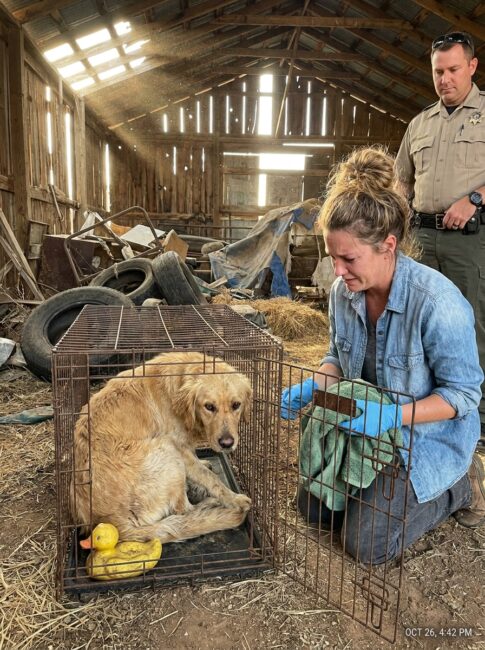
May did not care about the birds.
She cared about corners.
She slept with her back pressed against two walls, never in the middle of the room. If we moved her bed six inches, she dragged it back with her teeth, panting from the effort.
The first time I brought her food in a shallow blue bowl, she did not eat until I left.
The second time, I stayed by the door and pretended to read a chart.
She lowered her head, took one piece of kibble, and looked up at me like she expected the bowl to vanish.
It did not.
So she took another.
That was how trust started with May.
Not with hugs.
With one piece of kibble that stayed where it was.
I began coming in early before my shift. My apartment was ten minutes away, above a laundromat that shook every Saturday morning when the dryers ran full load.
I had no husband then.
No children.
My mother had died the year before after a long illness, and I had become skilled at making coffee for one person.
May did not fix that.
She simply became part of the silence.
Every morning, I sat on the floor with my back against the cabinet while she watched me over the rim of her bed.
I would open my breakfast burrito from a gas station on Grand Street, tear off a tiny piece of tortilla, and set it near her paw.
She never took it while I watched.
Not at first.
Then one Tuesday, as the mini-fridge clicked on, May stretched her neck forward and stole the tortilla so fast I almost missed it.
Her ears flicked backward.
Her eyes stayed on mine.
I smiled down at my coffee.
“Thief,” I said.
Her tail moved once.
Just once.
But in that room, it sounded like a door opening.
Physical therapy started slowly.
May’s muscles were wasted from years of crouching. Her wrists bent too far. Her back legs shook when we lifted her into a standing sling.
The first time we tried, she collapsed in six seconds.
I wrote it in her chart.
Standing tolerance: six seconds.
It looked clinical.
It was not.
It was a life measured in a number smaller than a breath.
By week three, she could stand for twelve seconds.
By week five, twenty-one.
When she reached a full minute, the whole clinic clapped softly from the hallway because loud noise still made her flinch.
May looked around at us, confused.
Then she picked up the yellow duck and carried it back to her bed.
Always the same toy.
Always tucked under her left side.
I did not understand that either.
During those months, life kept happening around us.
My landlord raised the rent, and I moved from the apartment above the laundromat into a small rental house near San Jacinto Heights.
The house had a chain-link fence, two crooked mesquite trees, and a patchy backyard that looked half dead.
To me, it looked like work.
To May, it looked like another country.
The first evening I brought her home as a foster, I carried her across the threshold because steps still scared her. She pressed her nose against my neck and shook while my neighbor’s sprinkler ticked across the street.
I set her bed in the living room corner.
She dragged it behind the couch.
So I moved my reading chair beside her.
That night, I slept in the chair with one hand hanging low enough for her to smell.
At 3:12 a.m., I woke because something warm touched my fingers.
May had placed her chin there.
Not her whole head.
Just her chin.
As if giving more would cost too much.
The next week, my sister called from Dallas and told me she was pregnant.
I cried after we hung up, not because I was jealous exactly, but because joy sometimes points at empty chairs.
May watched me from the rug.
Then she did something she had never done before.
She stood.
No sling.
No help.
Her legs shook under her, but she crossed four feet of carpet and dropped the yellow duck into my lap.
I picked it up.
It was damp from her mouth and flattened from months of carrying.
“Thank you,” I whispered.
She leaned against my knee until both of us stopped trembling.
That became our language.
When I came home tired, May brought the duck.
When thunder rolled over Amarillo and she hid behind the couch, I brought the duck to her.
When my mother’s birthday came in October and I spent the morning avoiding the phone, May placed the duck beside my shoe.
The small things repeated until they became a kind of calendar.
By November, May could walk from the living room to the kitchen.
By Thanksgiving, she could step onto the porch.
By Christmas, she could stand in the yard for ten seconds with all four paws on grass.
But still, she feared the sun.
If a bright strip of light crossed the floor, May stopped before it.
If I opened the back door on a clear morning, she waited in the shadow of the frame.
I tried treats.
I tried toys.
I tried sitting outside with my coffee, pretending nothing mattered.
May watched from the doorway, her yellow duck pressed between her paws.
The crescent scar on her nose caught the light.
And each time, she stayed where the shadow ended.
The day May ran for the first time was a Saturday in late January.
The air was cold enough to make my fingers stiff, but the sun sat clean and bright over the yard.
Our volunteer trainer, Jonah, had come by with a camera because we wanted a short update video for the rescue page. Nothing dramatic. Just May walking a few steps outside.
“She’s ready,” he said.
I wanted to believe him.
May stood at the back door wearing a purple harness that looked too cheerful for everything she had survived.
Her fur had grown back thick along her shoulders. After three medicated baths, two careful shaves, and weeks of salmon oil mixed into her food, the gold had returned in uneven patches.
Not perfect.
Better.
I clipped the leash to her harness and stepped onto the porch.
May froze.
Her front paws stayed inside.
Her back paws shook.
The sunlight touched her nose.
She pulled away.
I crouched on the porch boards, keeping my voice low.
“You don’t have to,” I said.
Jonah lowered the camera.
For a moment, I thought that would be the whole video.
A rescued dog at a doorway.
A woman kneeling in a sweater with dog hair on both sleeves.
A yard waiting.
Then May looked past me.
Not at the grass.
Not at the sun.
At the yellow duck sitting near the bottom porch step.
I had set it there by accident while carrying towels outside.
May stared at it.
Her ears shifted.
Then she took one careful step.
Her paw landed in sunlight.
She flinched, but she did not run backward.
I held my breath.
May took another step.
Then another.
When her front paws touched grass, she lifted one high and shook it like a cat.
Jonah laughed under his breath.
May looked offended again.
Then the wind moved through the mesquite branches, and something changed in her body.
Her head came up.
Her nose opened.
She smelled dirt, dry grass, cold air, old leaves, and maybe the neighbor’s bacon from two yards over.
She took three clumsy steps.
Then five.
Then she stumbled.
I reached for her, but she got up before I touched her.
And then May ran.
Not gracefully.
Not like the dogs in commercials.
She ran like a creature whose body had been given back piece by piece and had decided to spend it all at once.
Her back legs kicked too wide.
Her ears flew.
Her mouth opened in a crooked smile.
She bounced sideways, spun once, barked at the sky, then chased nothing across the yard.
Jonah kept filming.
I covered my mouth.
May reached the far fence, turned, and ran back toward me with the yellow duck in her mouth.
Sunlight flashed across the crescent scar on her nose.
For the first time, May did not look away from the light.
She ran straight through it.
When the rescue posted the video that night, the caption was simple.
She lived her whole life in a cage. Today, she learned the world was wide. And she ran.
People shared it.
Hundreds at first.
Then thousands.
By Monday morning, my phone would not stop buzzing.
Messages came from strangers in Ohio, Oregon, Maine, Arizona.
People wrote about old dogs they had adopted.
Dogs who had never climbed stairs.
Dogs afraid of bowls.
Dogs who slept standing up because nobody had ever given them a bed.
I read every message while May slept beside the couch, exhausted from twenty-three seconds of freedom.
Twenty-three seconds.
That was the false ending everyone loved.
The cage was behind her.
The grass was under her feet.
The sun no longer owned her fear.
It felt complete.
It was not.
Three days after the video spread, the rescue received an email from a woman named Caroline Mercer in Tulsa.
The subject line said:
I think that dog had puppies.
I almost deleted it.
Not because I did not care, but because viral videos invite every kind of message.
Some people see a dog and remember their dog.
Some see a scar and invent a story.
Some see pain and want to attach themselves to it.
But Caroline attached three photos.
The first photo showed a row of cages inside a dim barn.
The second showed a Golden Retriever pressed low against wire.
The third made my stomach tighten.
In the corner of the cage, barely visible beneath the dog’s body, were two pale shapes.
Puppies.
Caroline wrote that she had worked at the property for six weeks four years earlier, hired to clean stalls. She had quit after finding out the place was breeding dogs without proper care.
She said most adult females were numbered, not named.
May had not been May.
Her tag had read M-A-Y because she was assigned to the May breeding group.
The dog in the photo had the same crescent scar.
Same folded left paw.
Same empty stare.
But the part I kept reading over and over was the last line.
She used to push the yellow toy against the cage door when they took her puppies.
I sat at my kitchen table with the laptop open and May asleep under my chair.
The yellow duck rested between her paws.
For months, I had thought the toy was comfort.
I had thought May hid it because she feared losing the only soft thing she owned.
But Caroline said the breeding facility sometimes tossed cheap toys into cages for photos when selling puppies online. A yellow duck had been in May’s cage during at least two litters.
When workers came to take the puppies away, May would drag the toy toward the door.
Again and again.
Not to play.
Not to hide.
To trade.
That was what Caroline believed.
A mother with nothing else to offer had tried to give them the only thing in her cage.
I looked down at May.
Her paws twitched in sleep.
The duck squeaked once beneath her chin.
The sound was tiny.
It filled the room.
Caroline’s email did not end there.
She had saved an old notebook from her weeks at the property, mostly because she had planned to report them. In it, she wrote down cage numbers, dates, and details she thought might matter.
One note mentioned a Golden female in Cage 14.
Weak legs. Keeps covering smallest pup. Scar on nose.
Another note mentioned that the smallest puppy from one litter had been marked as unsellable.
Not dead.
Not adopted.
Transferred.
The word sat there like a locked door.
Caroline did not know where the puppy went.
But the dates matched.
The puppy would have been about four years old now.
May woke when I pushed my chair back.
She blinked up at me, slow and trusting.
Then she picked up the yellow duck and placed it on my foot.
I did not cry then.
I called Jonah.
The twist was not that May had survived.
The twist was that May had spent years trying to save someone else.
We started with Caroline’s notebook.
Then the rescue director called the county officer who had helped seize the dogs.
Then we contacted two other rescues that had taken animals from related properties across the Texas panhandle.
Paperwork in cases like that is never clean.
Names change.
Microchips are missing.
Dates are guessed.
Dogs become numbers, and numbers become boxes on forms.
But one transfer record kept appearing in fragments.
A small Golden mix puppy.
Female.
Front leg deformity.
Moved from a breeding property near Amarillo to a roadside broker in New Mexico.
Then sold.
Then returned.
Then vanished from the record.
I did not tell May any of this.
Of course I did not.
But dogs know when humans carry tension in their hands.
She began following me from room to room, her nails clicking softly against the floor. When I sat at the table with printed records spread around my coffee mug, she lay across my feet like a sandbag.
The yellow duck stayed close.
One evening, while sorting photos from the seizure, Jonah paused at one image on his laptop.
“Look at her left side,” he said.
It was May in the cage, months before rescue, taken by an investigator through a crack in the barn wall.
She was curled around something.
At first, I thought it was bedding.
Then Jonah brightened the image.
A puppy’s face appeared beneath her neck.
Small.
Pale gold.
One front paw bent inward.
May’s body covered most of the pup, blocking the camera, blocking the door, blocking the world.
I remembered the way May always slept with one paw curled under her.
The way she pressed the duck beneath her left side.
The way she placed it beside me when I hurt.
Her body had kept doing the same thing.
Even after the puppy was gone.
Even after the cage opened.
Even after grass.
Body memory.
That is what our vet called it when I showed her the photos.
“Sometimes the nervous system remembers what the mind can’t organize,” Dr. Patel said.
She was standing in the clinic hallway, one hand on May’s chart, her mouth tight with the kind of anger medical people learn to keep quiet.
“So the toy—” I started.
“She may be covering it,” Dr. Patel said. “Or guarding it. Or replacing something.”
Something.
We kept searching.
Two weeks later, a shelter in Flagstaff, Arizona answered an email with a photo attached.
The dog’s name was June.
She was a Golden mix, around four years old, surrendered by an owner who said she was “too nervous” and “walked weird.”
In the photo, June stood in the corner of a kennel with one front paw turned inward.
Her coat was pale.
Her eyes were honey-brown.
Across the bridge of her nose was a faint curved mark.
Not as deep as May’s.
But close enough to make my hands go cold.
The shelter worker wrote, “She doesn’t play with toys, but she carries one old towel everywhere.”
I stared at the sentence.
Then I looked down at May.
She was sleeping in a patch of sunlight.
Not outside.
Not yet.
But beside the sliding glass door, where the light had warmed the floor.
The yellow duck was tucked under her chin.
I whispered her name.
May opened her eyes.
For the first time, I wondered whether she had been waiting for more than freedom.
The reunion took place on a Tuesday because shelters, rescues, and miracles all still have schedules.
Jonah drove with me to Flagstaff in the blue Tacoma.
May rode in the back seat on a quilt, wearing her purple harness, with the yellow duck pressed between her front paws.
The drive took all day.
Flat Texas opened into New Mexico, then rose into Arizona, where the sky seemed bigger and colder.
May slept most of the way, but every time I stopped for gas, she lifted her head and looked toward the horizon.
Not nervous.
Listening.
At the Flagstaff shelter, they brought June into a fenced meet-and-greet yard before letting May out.
I remember the sound first.
Not barking.
June made a low, broken hum from her throat when she saw May through the gate.
May froze.
Her ears moved forward.
The yellow duck dropped from her mouth.
For six months, I had watched that dog fight for every step.
I had seen her stumble on carpet, panic at sunlight, and shake at the edge of grass.
But when June made that sound, May moved without thinking.
She crossed the yard.
Fast.
No hesitation.
No fear of sun.
No fear of space.
Her legs knew before the rest of her did.
June lowered herself to the ground.
May reached the fence and pushed her nose through the chain link.
Their noses touched.
One second.
Two.
Then June folded sideways, pressing her body against the fence like she was trying to become small enough to fit through it.
May began to lick her face.
Not frantic.
Not wild.
Careful.
One eye.
One ear.
The bridge of her nose.
The same place where the faint scar curved.
The shelter worker covered her mouth and turned away.
Jonah kept the camera low.
Nobody spoke.
When they opened the gate, June crawled under May’s chest.
She was too big to be a puppy.
Almost the same height.
But she tucked herself there anyway, nose pressed into May’s neck, front paw bent inward against the grass.
May stood over her.
Shaking.
Holding.
Then she looked at me.
I had misunderstood so many things.
I thought I had taught May to walk.
But some part of her had been walking toward this.
I thought the yellow duck was her first toy.
It had been her last offer.
I thought she feared sunlight because it was new.
Maybe she did.
But maybe sunlight also meant the tarp was being lifted.
The cage was being opened.
Someone was coming to take what she loved.
That afternoon, May picked up the yellow duck and carried it to June.
She set it between June’s paws.
Then she stepped back.
June sniffed it once.
Then she took the duck gently in her mouth and tucked it under her bent leg.
May lay down beside her.
Their bodies touched from shoulder to hip.
Two dogs who had lived on opposite sides of a missing story.
The Flagstaff shelter approved a rescue transfer within forty-eight hours.
June came home with us in the Tacoma, curled beside May on the quilt.
For the first hundred miles, neither dog slept.
They watched each other.
Every few minutes, June reached her nose toward May’s cheek.
Every few minutes, May answered by touching June’s ear.
By the time we crossed into New Mexico, June had fallen asleep with her paw across May’s shoulder.
May did not move for three hours.
Back in Amarillo, my little rental house changed shape.
I bought a second bed, but they used one.
I bought a second bowl, but June waited until May began eating.
I bought three new toys, but both dogs ignored them and carried the same flattened yellow duck from room to room.
Dr. Patel examined June and confirmed what the shelter had suspected.
Her leg had not been broken.
It had developed wrong from being cramped too young.
She could walk.
She could even run.
But one paw would always turn inward, a small sign written into bone.
May seemed to know this without being told.
When June stumbled, May slowed.
When June hesitated at the back door, May stepped into the sunlight first and looked back.
When June lifted her paw from the grass in offense, May barked once, sharp and bossy.
I laughed so hard I had to sit on the porch.
May had become a teacher.
A strict one.
Spring came early that year.
The dead-looking backyard woke in patches of green, and the mesquite trees threw thin shade across the fence.
Every morning before work, I opened the back door and waited.
May always stepped out first.
June followed with the duck.
They crossed the porch together, down the one step May had once feared, into the yard where sunlight lay in wide strips across the grass.
At first, they only walked.
Then June began to bounce.
Then May began to run.
Not every day.
Some mornings her legs were stiff, and she moved like an old woman carrying groceries up stairs.
Some mornings June’s paw bothered her, and she lay under the mesquite tree with the duck between her ankles.
But on good mornings, they ran.
May ran wide circles around the yard, and June chased her with a crooked gait that made her look like she was skipping over invisible stones.
They were not graceful.
They were better than graceful.
They were free without knowing anyone was watching.
The rescue posted a second video in April.
No caption could hold it.
May and June running through sunlight.
The yellow duck lying in the grass.
Two dogs stopping at the same time to smell the same patch of dirt.
Then May nudging the duck toward June, and June carrying it into the shade.
The comments filled again.
But this time, I did not read them all.
Some stories belong partly to strangers.
Some have to return home.
Now I have a ritual.
Every Tuesday morning, before the clinic opens, I stop at a small coffee stand on Route 60 and order one black coffee and two plain scrambled eggs in a paper cup.
The woman at the window knows the order.
She writes MAY/JUNE on the cup even though the eggs are not for me.
Then I drive to the rescue clinic, park under the same crooked sign, and let both dogs out in the fenced rehab yard before anyone else arrives.
May waits at the gate.
June waits behind her.
I unclip the leashes.
I place the yellow duck in the middle of the grass.
Then I step back.
May always looks at the sun first.
Just for a second.
As if checking whether it has changed its mind.
Then she looks at June.
June looks at the duck.
And the yard holds its breath.
Some Tuesdays, they only walk.
Some Tuesdays, they nose through the grass for crumbs of egg and leave the duck untouched.
But some Tuesdays, when the light hits the ground in the right wide stripe, May lowers her front half like a puppy.
June answers.
The duck flies.
The grass bends.
Two dogs run through the morning like the world is still being introduced to them.
I keep the first cage tag in my glove box.
Not on display.
Not as a trophy.
It is sealed in a plastic sleeve with Caroline’s first email printed behind it.
M-A-Y.
Three letters that once meant a breeding group.
Now they mean the month my life opened.
Sometimes people ask whether May remembers the cage.
I do not know.
I know she still sleeps with her back against the wall when storms come.
I know June still carries towels when strangers visit.
I know the yellow duck has been repaired nine times with yellow thread that does not match.
I know May no longer runs from sunlight.
She steps into it first.
Then she waits.
Near the end of summer, the rescue held an adoption event at a park in Amarillo.
May and June were not available for adoption anymore.
I had signed the papers in May, with both dogs lying under the office desk while Dr. Patel pretended not to smile.
They came to the event as ambassadors.
That was the word on the flyer.
Ambassadors.
May wore a purple bandana.
June wore blue.
Children knelt to pet them, and both dogs stood patient and still, though May kept one shoulder lightly pressed against June the whole time.
A little girl with red glasses asked why June’s paw turned inward.
Her mother started to apologize.
But I crouched and said, “Because she learned to walk in a hard place.”
The girl thought about that.
Then she touched June’s paw with two fingers, soft as dust.
“My brother walks different too,” she said.
June licked her wrist.
May picked up the yellow duck and dropped it at the girl’s feet.
Everyone laughed.
I did not.
Not right away.
I watched the girl lift the toy, careful with its crooked stitches, and hand it back to May like returning something sacred.
May took it gently.
Then she turned and gave it to June.
That is how they live now.
Passing back what was almost lost.
One toy.
One patch of sun.
One morning at a time.
The cage is gone.
The barn is gone.
The woman who wrote the email still sends Christmas cards with no long message, just a photo of her garden and the words, “For May.”
The first video still appears online sometimes.
A Golden Retriever running badly across a patchy Texas yard.
People still write beneath it.
They say she looks happy.
They say she looks healed.
Maybe.
But I know what happened after the camera stopped.
May carried the duck to the porch.
She turned back toward the yard.
She waited for someone who was not there yet.
And six months after leaving a cage too small to stand in, she found her.
Not because I knew.
Not because the paperwork helped.
Because a mother’s body remembered the shape of loss.
Now, when May runs, June runs beside her.
When June stumbles, May slows down.
When sunlight crosses the floor, neither dog hides.
They lie inside it.
Shoulder to shoulder.
The yellow duck between them.
Some mornings, I still sit on the porch with coffee going cold in my hands.
May lifts her head from the grass.
June keeps sleeping.
The sun moves over both of them without asking permission.
May blinks once.
Then she runs.
Wide world.
Open gate.
No cage.
Just grass.
Write “MAY” if you want to see the run that changed everything.