Part 2: Thirty Bikers Led an Empty Harley at Sunset — But the Pit Bull in the Sidecar Wouldn’t Move Until His Rider Spoke One Last Time
Part 2 — How Eli Found Him
Most people thought Eli named Roscoe as a joke.
Back when the dog was younger, he carried himself like a bouncer with trust issues—broad head, blocky chest, scar over one shoulder, and that stare Pit Bulls get when they’re deciding whether the world deserves good behavior.
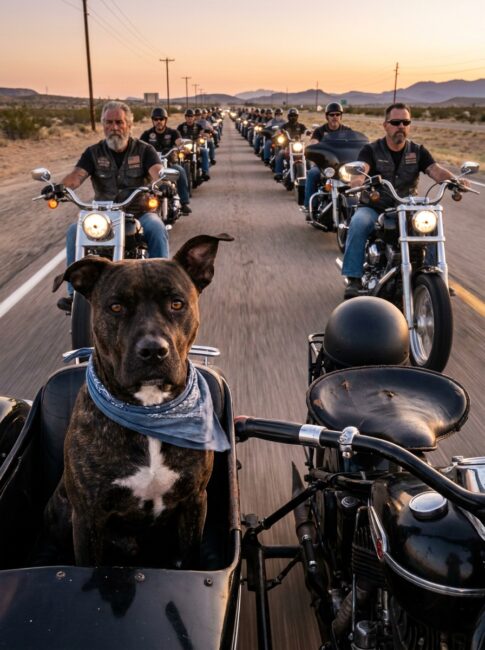
But Eli never joked about the dog’s name.
“Named him after my granddad,” he once told me. “Only two creatures I ever met who looked mean and meant better.”
I first saw Roscoe eight years before the last ride, at a rescue yard outside Tucson, where Eli and I had gone to drop off a charity check from one of our club poker runs. The shelter director asked whether we’d mind looking at one dog they couldn’t place.
“Not because he’s bad,” she said. “Because he’s been taught the world is.”
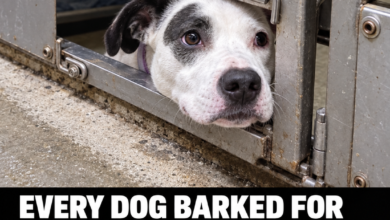
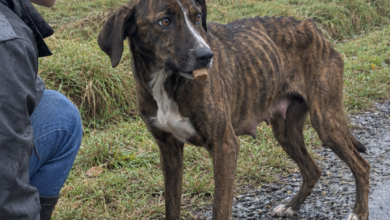
Roscoe was in an isolation kennel at the far end, separate from the barking, spinning adoptables that pressed their faces through chain link and begged for second chances. He was lean then, too lean, his brindle coat patchy around the ribs, bite marks showing in old ridges across his neck and flank. Someone had cropped his ears badly before dumping him. One eye had a slight droop from an older injury.
He did not bark when we approached.
He stood.
That was all.
But the stillness had weight.
The shelter director explained that animal control had seized him during a raid on a backyard fighting operation. Several dogs were too gone to save. Roscoe survived, though “survive” felt like a technical word at that stage. He had no interest in toys, no idea how to be touched kindly, and a habit of pressing himself into corners so hard his nails scraped concrete.
“He only relaxes around old music,” she said, almost embarrassed to admit it.
Eli laughed. “You serious?”
She nodded and held up her phone.
A Johnny Cash song drifted faintly into the kennel corridor.
Roscoe’s body did not soften exactly, but something in his face stopped bracing.
That was all it took.
Not for me.
For Eli.
Maybe because Eli had that same look when certain memories walked into a room.
You need to understand what kind of man Eli was. He was huge—six-three, broad as a door, beard full and going gray, tattoos up both arms and across his chest. Kids loved him because he always bent down to their eye level. Women trusted him because he listened more than he talked. Men underestimated him because his calm looked lazy right up until it became immovable.
He had been a mechanic, a Marine for six years before that, and a widower for twelve. Most people knew the first two facts. Very few knew the third. His wife, Anna, had died of ovarian cancer before I joined the club. After that, Eli became the man everyone called when an engine failed, a roof blew off, a brother relapsed, or a kid needed Christmas money.
He took in damage.
That was his private religion.
He stared at Roscoe for a long time.
Then he sat down on the concrete outside the kennel without saying a word.
No reaching.
No baby voice.
No performance.
Just a large tattooed man lowering himself to the ground like he understood that broken things deserve to choose the distance.
Ten minutes passed.
Then twenty.
At some point, I got bored enough to walk away and help unload supplies.
When I came back, Eli still hadn’t moved.
Roscoe had.
The dog was lying down now.
Not close.
But not at the back wall either.
That was the beginning.
The shelter director warned Eli twice that the dog could take months. Eli signed the papers anyway. When she suggested they could “start with weekend fosters,” Eli looked at her as if she had proposed a trial marriage.
“He goes home once,” Eli said. “That’s the whole point.”
And that is exactly what happened.
Not smoothly.
Not sweetly.
The first week, Roscoe ate only at night after Eli left the room. The first time Eli tried clipping on a leash, the dog chewed through it. The first time he heard thunder, he took a running hit at the garage door hard enough to crack a hinge.
Eli never raised his voice.
He changed his routines instead.
He moved a mattress into the garage because Roscoe trusted the space more than the house. He played old country records low at night. He left pieces of roast chicken near his boots without looking directly at the dog.
On the tenth day, Roscoe took food from Eli’s hand.
On the twelfth, he let Eli touch the back of his neck.
On the fifteenth, he followed Eli into the house.
By the second month, Roscoe had claimed the passenger seat of Eli’s truck and the patch of sun beside the kitchen door. By the sixth, he had learned that sidecars were not traps. By the end of the year, he was riding in charity events like he had been born to public admiration.
That was Eli’s quiet talent with broken creatures.
He never asked them to become softer for his comfort.
He just stayed long enough for them to discover softness was allowed.
So when people later said Roscoe was “Eli’s dog,” the phrase was true, but incomplete.
Roscoe was also Eli’s mirror.
A creature people misread at first sight.
A survivor of things nobody should survive.
A body built for conflict, carrying around a heart far gentler than the packaging suggested.
After Eli died, several of us worried about what would happen when Roscoe understood he wasn’t coming back.
What none of us understood was that the dog already knew enough to make it worse.
He knew hospitals.
He knew ambulances.
He knew funeral clothes.
He knew stillness.
And by the time we loaded him into that lead sidecar for the memorial ride, he also knew that every brother in the club smelled like grief.
Part 3 — The Funeral Everyone Thought Was the Ending
If you’ve never been around a biker funeral, you may picture chaos—pipes screaming, patches and whiskey, men trying to hide tears under bad sunglasses.
Sometimes that happens.
But a Last Ride is different.
It is disciplined.
Intentional.
A ritual built from road manners, respect, and the understanding that the man at the center once rode with you shoulder to shoulder and deserves to be escorted from this world the same way.
We lined up at the clubhouse two hours before departure. Some men polished chrome that didn’t need polishing. Some checked straps twice. Our treasurer, a tattooed ex-lineman named Curtis who could bench-press a motorcycle and had cried only once in fifteen years, stood in the corner with Eli’s flag patch folded in his hands like it was glass.
Roscoe wandered the lot at first, sniffing tires, doors, boots.
He was looking.
Not frantically.
That would have been easier to watch.
He looked with purpose, moving from place to place the way a man checks a workshop after misplacing one essential tool he assumes must still be there somewhere.
Eli’s cousin showed up late in a dress shirt and immediately asked about the bike title.
President Wade shut that down with one look.
“Today ain’t your paperwork day.”
The cousin left before the engines started.
Good.
Some scenes don’t deserve spectators.
At the chapel service, Roscoe lay in the aisle near the closed casket. He did not whine. He did not scratch the wood. He just rested his head between his paws and stared forward while the pastor—who had never met Eli and clearly found our entire club mildly alarming—read from notes people had helped him prepare.
I expected the room to break when Anna’s old photograph was mentioned, or when Wade talked about Eli fixing bikes for kids who couldn’t afford labor, or when I stood to read the list of volunteer runs he never let us skip.
It didn’t.
The room broke later.
After the service, when everyone rose and the pallbearers wheeled the casket out, Roscoe stood, moved beside it, and paced the full length of the aisle without once bumping the cart.
That level of control from a grieving animal unsettled people more than crying would have.
Outside, women from town stood with their hands pressed over their hearts. One old veteran in a wheelchair saluted the entire procession. Children held handmade signs that said RIDE FREE, ELI and THANK YOU, REAPER because every Thanksgiving Eli had helped organize the turkey run.
Roscoe saw none of it.
All his attention remained on the man-shaped absence ahead of him.
That’s the thing about grief in dogs. People romanticize it until they actually have to stand in the room with it. Then it becomes unbearable because it is so pure. No theory. No denial. Just a body that knows what shape is missing and keeps orienting itself toward the loss.
We loaded the empty Harley.
We secured the hidden guide lines.
We placed Eli’s gloves in the side pouch and his jacket across the backrest.
Roscoe climbed into the sidecar on his own.
President Wade pulled his helmet down, looked over the whole formation, and said into the radio, “For Eli.”
Thirty engines answered.
At that point, every one of us believed the ceremony itself would be the hardest part. The ride, the cemetery, the salute, the lowering of the casket—that seemed like the structure grief needed. A road map. A final shape.
And maybe for us, it was.
For Roscoe, the story was still stuck at one unfinished step.
We reached the graveside just as the sun dropped low enough to set the headstones on fire with orange light. The cemetery sat on a rise outside town, the desert stretching open behind it. Wind moved through the flags. Gravel crunched beneath boots as thirty bikers took their places around one fresh rectangle of earth.
Wade gave the eulogy.
I thought it was beautiful.
I remember almost none of it now because all I can really recall is Roscoe sitting in the sidecar twenty feet away, straight-backed, waiting.
Then came that moment.
Wade telling him, “We’re here, buddy.”
Roscoe refusing.
The helmet placed on the empty seat.
And the instant the dog finally understood what his eyes were seeing.
He stared at that helmet for maybe three seconds.
Then he stood.
No drama.
No cry.
Just one controlled movement of a body making room for truth.
He stepped out of the sidecar.
Walked past Wade.
Walked past me.
Walked directly to the grave.
And lay down beside it with his chin on the dirt.
That should have been the ending.
It would have satisfied every story instinct a person has.
The dog says goodbye. The brotherhood bears witness. Fade out.
But real grief is stubborn.
Roscoe stayed there for three hours.
Part 4 — The Three Hours Nobody Knew What to Do With
At first, we let him be.
That was the right call.
The casket went down. Wade removed his shades and cried openly. Curtis folded the club flag with hands that shook more than mine. A local bugler played taps because Eli had served and because some sounds deserve brass more than speakers.
Roscoe never lifted his head.
He did not flinch when dirt struck the casket.
He did not react when people came forward to place roses, patches, coins, and small notes into the grave.
He just remained there, close enough that one forepaw rested against the edge of the disturbed earth.
After the non-club folks left, we stayed.
That’s another rule.
You don’t leave a brother alone immediately after burial, even if he’s already beyond hearing it.
So thirty bikers stood around in the cooling desert evening while one exhausted Pit Bull kept watch.
Eventually the cemetery crew approached uncertainly. One man, maybe sixty, asked if we needed “a little more time.”
Wade looked at Roscoe and said, “Yeah. We do.”
The crew withdrew without argument.
We tried coaxing him with treats.
Nothing.
Water.
Nothing.
His favorite squeaky duck from Eli’s garage, fetched by a prospect who tore back to town for it.
Nothing.
At one point Curtis, who had never fully trusted dogs bigger than loaf bread, crouched six feet away and said, “Come on, man. You’re killin’ us.”
Roscoe did not even blink.
I went and sat beside him eventually, not close enough to crowd, just close enough to share the ground. The dirt was still loose and smelled raw under the dry evening air. I remember looking at the headstone temporary marker and feeling something ugly rise in me—anger, maybe, that a whole man could get reduced to dates and a hole in the ground while his dog still expected one more cue.
Then I noticed something.
Roscoe wasn’t looking at the grave exactly.
He was looking toward the bike.
Toward the empty Harley parked near the drive.
And suddenly I remembered a tiny habit of Eli’s I’d seen a hundred times without registering its meaning. Every single time he parked somewhere after a ride, he would remove his helmet, set it on the seat, and say the same words before Roscoe hopped out.
“All right, brother. We’re there.”
Not “okay.”
Not “let’s go.”
Always that.
All right, brother. We’re there.
Wade had unknowingly completed only half the ritual when he put the helmet on the seat.
Roscoe had gotten out because he recognized the setup.
But maybe he was still waiting on the words.
I stood up so fast my knees popped.
Wade looked over. “What?”
I told him.
He swore softly, then nodded once like a man accepting both the stupidity and the beauty of how specific love becomes.
We walked back to the bike together.
Wade lifted Eli’s helmet from the seat, cradled it for a second, then replaced it more deliberately.
He turned toward Roscoe.
“All right, brother,” he said, his voice carrying across the fading light. “We’re there.”
Roscoe lifted his head.
Not high.
Just enough.
His ears twitched.
Then he lowered his muzzle back onto the ground.
Wade exhaled.
“That all he needed?”
“No,” I said.
“It’s what he needed to know.”
That was the twist inside the grief none of us had anticipated.
Roscoe wasn’t refusing the cemetery out of confusion.
He was honoring a completed ride.
Waiting for the exact signal Eli always gave him at journey’s end.
Once he heard it, something in his posture changed. Not relief. More like permission. He remained by the grave another hour, but the waiting had gone out of him. He was no longer expecting Eli to stand up from someplace impossible.
He was keeping company.
There’s a difference.
By then the sky had turned purple and the temperature was dropping. I took off my leather cut and draped it loosely over Roscoe’s back. He allowed it, which surprised me. Eli was the only man he usually tolerated that kind of closeness from when stressed.
That is when the final decision began, though I didn’t know it yet.
Roscoe shifted against the weight of my vest but did not shake it off.
He smelled it.
My house.
My bike.
My skin.
Familiar enough.
At last, when full dark settled and the cemetery lights came on, Wade looked at me.
“You takin’ him?”
It wasn’t asked lightly. The whole club knew I had the most stable home situation—no young kids, a fenced yard, a half-retired schedule, and already enough room in my garage apartment for one grieving dog and all the complications that come with him. I’d also been the one Eli trusted to feed Roscoe during out-of-town runs.
Still, I hesitated.
Because taking a dead brother’s dog isn’t just pet ownership.
It’s an inheritance.
A promise.
A quiet way of saying you’ll carry a piece of the man whether you’re ready or not.
Roscoe solved it himself.
When I bent and slid my arms under him, expecting resistance, he stood first. His joints cracked. He leaned his chest against my thigh for one second, exhausted to the bone, and then allowed me to lift him the rest of the way.
He weighed more than grief should.
Less than before.
As I carried him toward my truck, his head turned once over my shoulder toward the grave.
Then he rested against me.
That was the moment he came home with me.
Not because Wade decided.
Not because the club voted.
Because Roscoe accepted a next place to stand.
Part 5 — The Dog Who Inherited a Brotherhood
The first night at my house, Roscoe refused the dog bed I’d borrowed from our club secretary’s wife and instead lay beside the garage door where Eli used to park whenever he stopped by for late beer and earlier opinions.
I let him.
You learn quickly with grieving animals that comfort is less important than orientation. They need to know where the edges are. Where the sounds come from. Which silences belong to this house and which belong to the one they lost.
I lived alone in a one-story place outside Kingman, with enough land for three broken motorcycles, one shed full of tools, and a pecan tree I kept meaning to cut back. I was forty-six then, divorced, with a son in the Air Force and a daughter in nursing school who both loved me mostly on holidays and by text.
The club had been my family for years.
But family in patches and bar stools is different from family at breakfast.
Roscoe changed that quicker than I expected.
The first week, he did not eat unless I sat nearby.
The second week, he started following me into the workshop.
The third, he finally climbed into the passenger side of my pickup without needing to be coaxed, though he spent the whole ride staring out the window with that old waiting face.
He never once whined for Eli.
That would have been easier to forgive in myself.
Instead, he carried his grief the way older men often do—quiet, scheduled, folded neatly inside routine.
Every morning he walked the fence line.
Every afternoon he slept near my tool bench.
Every evening he sat by the road around the time Eli used to visit.
At exactly that hour, I started pouring a second coffee again even though nobody else was there.
That was one of the smaller sub-twists in the story, though maybe it mattered most to me: I thought I was taking care of Eli’s dog, but the dog was also taking care of the shape Eli left behind in my days.
The club stepped in too.
Curtis brought meat scraps.
Wade brought Eli’s old flannel and a photo album from club runs.
Two prospects spent a weekend moving Eli’s sidecar rig onto my own Harley because none of us could stand storing it untouched in a unit somewhere like a museum piece.
Roscoe watched every minute of that work.
When the rig was ready, I opened the gate.
He climbed into the sidecar.
No hesitation.
Sat down.
Looked at the empty rider’s seat.
Then looked at me.
That nearly wrecked me.
“Yeah,” I said, swallowing hard. “I know.”
We started with short rides.
Back roads.
Ten minutes.
Then twenty.
The first time we passed the cemetery turnoff, Roscoe stood up in the sidecar and leaned hard enough that I pulled over, worried he’d jump. Instead, he simply faced that direction until the road bent away.
After that, I began stopping there once a week.
He would step out, walk to Eli’s grave, sit for a while, then come back on his own.
Never frantic.
Never dramatic.
Just a visit.
The club began joining us on some Sundays. Not all thirty every time, but enough. We cleaned the grave marker. Planted tougher flowers that could survive desert wind. Installed a small metal stand for coins and challenge chips people kept leaving.
Word about the empty Harley and the dog in the sidecar spread farther than any of us expected. Local papers wrote it up. Then biker pages online. Then a small regional news crew asked if they could film our next memorial ride. Wade nearly threw them off the property for calling Roscoe “the sad motorcycle dog,” but after they apologized and promised to keep it respectful, he allowed it.
The attention brought donations to the veterans fund Eli cared about.
It also brought letters.
So many letters.
Widows wrote.
Sons of bikers wrote.
Women whose fathers rode Harleys before they died wrote.
Men in recovery wrote to say they’d watched the story at three in the morning and remembered there were still decent things in the world.
I read some of them aloud in the garage while Roscoe listened.
Maybe he understood none of it.
Maybe he understood tone.
Either way, his tail would sometimes tap once at the sound of Eli’s name.
The biggest change came the following year.
On the anniversary of Eli’s death, Wade said, “We doin’ it again.”
I thought he meant a small cemetery meet-up.
He meant the whole thing.
Thirty bikes if we could get them.
Lead position reserved.
Roscoe in the sidecar at the front.
Not to repeat grief.
To turn grief into tradition.
That is how the Last Ride stopped being a single funeral and became a yearly run.
We met at the clubhouse, same hour, same road, same formation. Not an exact copy—nothing living should become a shrine—but a respectful echo. Roscoe climbed into the front sidecar like the date lived in his bones. At the cemetery, Wade put Eli’s helmet onto the empty seat and said the words.
“All right, brother. We’re there.”
Roscoe got out.
Visited the grave.
Came back.
A full ritual now.
No confusion left inside it.
That year another club from Nevada sent riders to join us.
The next year one from California came too.
By the fourth anniversary, the ride had raised enough money in Eli’s name to sponsor medical bills for rescued bully breeds and cover transport for old shelter dogs considered “unadoptable.”
That was the last twist Eli would have laughed at most.
A man with no living children died, and somehow his empty bike, his dog, and thirty stubborn bikers kept multiplying care in his name.
Part 6 — What Roscoe Taught Men Like Us
Men in clubs like ours are good at visible loyalty.
We’ll show up at 2 a.m.
We’ll rebuild an engine in silence if talking would make something worse.
We’ll stand in a hospital hall three days straight if a brother’s kid is inside.
What we’re less good at is explaining tenderness without making a joke out of it.
Roscoe fixed some of that.
Not deliberately.
Just by continuing to live in front of us.
He got older at my house. His muzzle went whiter. His hips stiffened. He developed the habit of groaning when he lay down, like every old mechanic I’ve ever known. Yet every time I rolled the Harley out and clipped on his blue bandana, he straightened into that same dignified posture he’d carried in Eli’s sidecar.
The club started calling the front position Roscoe’s seat.
No one else used it.
Not prospects.
Not visiting officers.
Not even Wade, though as president he could have done anything he liked.
That little act of respect mattered more than it looks on paper. In biker culture, position means something. Who rides where says who is trusted, who leads, who sets pace, who is being protected.
A dead brother’s dog held the front.
And everyone accepted it.
I think because deep down we all knew he had earned it twice over—once with Eli, and again with the way he bore loss without ever making it smaller for our convenience.
When newcomers asked about him, the old guys each had their own version of the story.
Curtis always led with the graveyard.
Wade led with the helmet on the seat.
I led with the first night in Tucson, because that was where Eli’s love started.
But the truth of Roscoe can’t be captured by one scene. It sits in the accumulation.
The thirty-mile ride.
The three hours at the grave.
The way he learned my house without erasing Eli’s.
The annual return.
The fact that a club built to survive road rash, jail nights, layoffs, divorces, and war stories suddenly adjusted itself around one Pit Bull’s grief because that was the honorable thing to do.
People imagine biker brotherhood as loud.
Sometimes it is.
Sometimes it’s engines and leather and a hundred pounds of attitude.
Sometimes it’s an old dog getting arthritis medication wrapped in lunch meat by men with skull tattoos.
Sometimes it’s a sidecar cleaned by hand the night before a memorial ride.
Sometimes it’s thirty big men going quiet because a dog at the front is staring at an empty seat.
Roscoe lived with me six more years after Eli died.
Long enough to memorize the sound of my boots.
Long enough to start sleeping inside instead of by the garage door.
Long enough to stop waiting by the road every evening.
That last one took the longest.
One night I noticed he hadn’t gone to the driveway at Eli’s old visiting hour. He stayed on the rug while I made coffee. He lifted his head only when I said his name.
That was when I understood something had healed—not the loss, exactly, but the expectation of return.
He no longer spent that part of the day searching.
He just lived it.
There’s mercy in that.
For both dogs and men.
Part 7 — The Lead Position Stays His
Roscoe died on a cool October morning at home, nose resting on the faded corner of Eli’s old flannel. He was fourteen, maybe a little older. The vet came to the house because some departures deserve familiar walls. Wade, Curtis, and two others stood in the garage. I held his head.
Just before the end, I tied Eli’s blue bandana around his neck one last time.
Then I leaned close and said the words that had once helped him leave the sidecar beside a grave.
“All right, brother. We’re there.”
His breathing eased.
Then stopped.
We buried him beside Eli with permission from the cemetery board after more paperwork than seemed spiritually necessary. The club paid for a matched stone below Eli’s marker. On Roscoe’s it says:
ROSCOE
HE RODE LEAD
Every year, we still hold the ride.
Thirty bikes if we can gather them. Sometimes more.
There is still an empty bike at the front, guided carefully, respectfully. Eli’s helmet still goes on the seat at the cemetery. Roscoe’s sidecar remains attached to the lead bike, and no living dog sits there now because some seats are not for filling. They are for remembering.
But we carry his blue bandana folded over the edge.
It snaps in the wind the same way.
And every year, when we stop at the graveside, Wade speaks to both of them.
“All right, brothers. We’re there.”
Then thirty bikers stand quiet while desert light goes soft around two names cut into stone.
People still come.
Some know the story.
Some don’t.
A few ask why the lead position stays empty when the man and the dog are both gone.
Because that’s the point.
Some love doesn’t need replacement.
It needs witness.
Eli saved Roscoe from a world that had taught him hands were for pain.
Roscoe escorted Eli to the edge of the earth and would not leave until the ritual was complete.
I took the dog home thinking I was doing a favor for a dead brother.
Years later, I understand it differently.
Roscoe gave the club a visible shape for grief.
He made loyalty impossible to talk around.
He reminded tough men that tenderness is not the opposite of strength.
It is one of its proofs.
When the engines start and the empty Harley rolls out in front of us, people on the roadside still stare. They see the absent rider, the quiet sidecar, the blue bandana moving in the air, and they understand enough without needing the full history.
Something precious was lost here.
Something faithful remains.
That’s the whole story, if I know it right.
A brother died.
A dog waited.
A helmet touched a seat.
A ride ended.
Another kind of ride began.
And somehow, years later, we are all still following them home.
Follow this page for more unforgettable dog stories about loyalty, rescue, and love that outlives goodbye.