Part 2: A Homeless Man Saw Only a Dog’s Head Above the Snow During a Blizzard — What He Dug Out With Bare Hands Gave Him a Life He Thought Was Gone
Rising Action
Before Luna, winter had become my address.
I did not plan to lose my apartment. People like tidy stories, where one bad choice leads to one hard lesson, but life usually breaks slower than that. First the warehouse cut hours. Then my knee gave out on a loading dock. Then the bills came faster than the work. Then my wife’s old medical debt, which had sat in envelopes for years, found me like it had been patient.
My wife, Ellen, had been gone six years by then.
Cancer took her in April, which felt wrong because April is supposed to be when things come back. For two years after she died, I kept her red scarf on the chair by the door. It still smelled faintly like lavender soap if I held it close enough and lied to myself a little.
We never had children.
We had dogs.
Not many. Two in thirty-four years. A black Lab named Joe and a shepherd mix named Penny, both gone before Ellen. After Penny died, Ellen said she could not do the last day again. I agreed because agreeing was easier than admitting I missed the sound of paws following us from room to room.
The first small moment that mattered happened three nights before the blizzard.
I was sleeping under an overpass with a man named Ray, a Black American veteran with a silver beard, quiet hands, and a habit of sharing coffee even when he only had half a cup. He told me to go south before the storm.
“There’s cold,” he said, “and then there’s cold that wants names.”
I laughed because I thought he was being dramatic.
Ray had once worked with search dogs in the military. He could not pass a dog without making a little clicking sound with his tongue. The week before, he gave half a gas-station burrito to a stray and said, “A hungry animal still asks nicer than most people.”
I remembered that when Luna licked the air near my wrist.
The second small moment was the church.
St. Brigid’s on Cedar Avenue served soup on Tuesdays, socks when they had enough donations, and short sermons if Pastor Elaine felt the room could take one. I had eaten there for months. I knew which volunteer gave extra crackers and which one looked through you like you were already a problem solved badly.
I also knew the sign near the side entrance.
No animals inside except service animals.
I had passed it a hundred times and never cared.
That night, it would feel like a locked gate.
The third small moment was my coat.
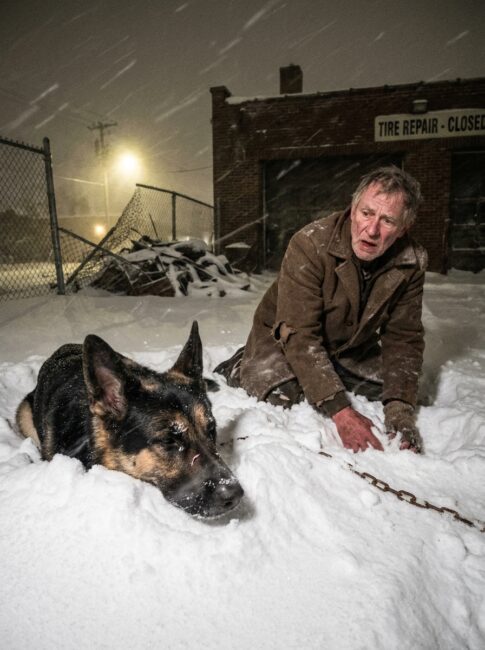
Brown wool. Heavy when dry. Dead weight when wet. The lining had torn under the left arm, and one pocket had a hole that swallowed coins. Ellen bought it for me at a thrift store after I complained about price tags in regular stores. She said it made me look like a professor who had misplaced his classroom.
It was the warmest thing I owned.
When I wrapped Luna and the puppy in it, I heard Ellen’s voice so clearly I turned my head in the storm.
“Tom,” she would have said, “you finally found a decent use for that ugly coat.”
That thought kept me moving longer than my body wanted to.
The fourth small moment was the puppy’s sound.
Inside the coat, against my chest, the puppy made a tiny clicking breath every few seconds. I timed my steps to it.
Click.
Step.
Click.
Step.
If the sound stopped, I stopped.
If the sound came back, I moved.
Luna hung in my arms like wet laundry and bones, but twice she lifted her head enough to nudge the bundle where the puppy lay. Even half-gone, she was counting him.
I did not know then that she was teaching me how to carry something forward.
One breath.
One step.
One more.
False Climax
The church door was locked.
That is the part I still remember with a strange kind of calm.
Not the wind.
Not my hands.
The locked door.
I banged with my shoulder because both arms were full. Luna’s head rested near my collarbone, her cold ear pressed against my neck. The puppy was wrapped between her body and the inside of my coat, quiet now, which frightened me more than crying would have.
A volunteer opened the side door halfway.
Warm air came out first.
Coffee.
Floor wax.
Candle smoke.
People.
Then his face changed when he saw the dogs.
“We can’t bring animals in,” he said.
I thought I had heard wrong.
“She’s dying.”
“I’m sorry, sir. We’re not set up for animals.”
“There’s a baby.”
He looked past me into the storm, then back at the dogs, then at my clothes. Fear and rules wrestled on his face. Rules won first.
“You can call animal control.”
“My phone’s dead.”
“We have people inside with allergies. Liability. Health codes.”
Luna shifted in my arms.
I felt the puppy move once.
Not enough.
“Please,” I said.
That word cost more than I expected.
The volunteer opened the door wider, then hesitated again. Behind him, someone said, “What’s going on?”
A woman stepped into view.
She was white American, maybe forty, with dark blond hair pulled into a messy bun and a navy parka over a church sweater. Her name, I would learn later, was Rebecca Hale. She ran a small family dog rescue outside Stillwater with her father and sister. That night, she was at St. Brigid’s helping sort blankets after their outreach van got stuck in the snow.
She saw Luna’s face.
Everything in her stopped.
The room behind her kept moving. Volunteers stacked towels. Someone carried soup. A man laughed too loudly at a table.
Rebecca did not blink.
“Where did you get that dog?”
“Lot behind Carlson Tire,” I said. “She was chained.”
Rebecca stepped closer.
Luna’s eyes opened at the sound of her voice.
“Luna?”
The dog’s tail did not wag. She had no strength for that. But her ear moved.
Rebecca made a sound that had no full word inside it.
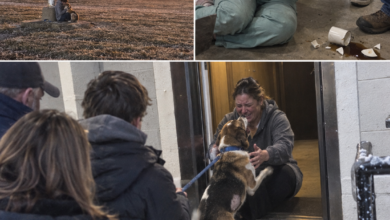
Then she pushed past the volunteer and took Luna’s head between both gloved hands.
“Luna. Oh my God. Luna.”
The church rule disappeared after that, not officially, but practically. People moved when Rebecca told them to. Towels came. Blankets came. Someone brought a space heater. Someone else called an emergency vet. The volunteer who had said no carried the puppy inside with hands so careful they shook.
I stood just inside the door, suddenly empty-armed and colder than I had been outside.
My sweater was soaked.
My hands had started bleeding in little cracks along the knuckles, though I do not remember when. My teeth chattered so hard my jaw hurt. I watched Rebecca kneel over Luna, watched her pull a photo from her phone with trembling fingers.
The dog in the photo was healthy. Black-and-tan. Bright eyes. Same scar on the nose.
“My dog,” she said to the room. “She was stolen six months ago.”
That should have been the ending.
Lost dog found.
Puppy saved.
Homeless man gets thanked.
The world puts one small thing back where it belongs.
Then Rebecca turned toward me with tears frozen on her lashes and said, “There was a reward.”
I shook my head before she finished.
“I didn’t do it for money.”
I meant to sound strong.
Instead, I fell against the wall.
The last thing I remember was the puppy crying again, loud enough for everyone to hear.
The Twist
I woke under bright lights.
Not church lights.
Hospital lights.
There was a plastic bracelet on my wrist and a heated blanket tucked around my chest. My hands were bandaged. An IV line ran into my arm. A nurse was saying my name like she had been saying it for a while.
“Mr. Avery. Thomas. Can you hear me?”
I tried to sit up.
That was a poor decision.
The room tilted.
“Dogs,” I said.
The nurse smiled gently.
“They’re alive.”
That was enough for my body to lie back down.
The first twist had been Luna’s identity.
She belonged to Rebecca Hale, who had searched for six months after Luna vanished from a fenced yard during a rescue fundraiser. Someone had cut the gate latch. A neighbor saw a white van but not enough to make a case. Rebecca had put up flyers from Minneapolis to Duluth, posted online, checked shelters, called vets, and driven county roads after every possible sighting.
She had been told to move on.
She did not.
Luna had not been a stray. She had not wandered into trouble. She had been stolen, then passed through hands no one could trace cleanly, and somehow ended chained in a vacant lot with a newborn puppy under her body.
The second twist was the puppy.
Rebecca told me later that Luna had not been pregnant when she was stolen.
That meant the puppy was born during the months she was missing. No one knew where. No one knew how many there had been. The vet said the puppy was maybe two weeks old, male, underweight, chilled, but fighting. Rebecca named him Cooper before I ever saw him awake, after the copper-colored tag Luna used to wear on her collar.
The third twist was me.
I had not known I was near death too.
When I gave Luna and Cooper my coat, I had surrendered the only real protection I had against the storm. By the time I reached the church, my temperature had dropped enough that the paramedics used words like moderate hypothermia and cardiac risk while I floated in and out of hearing.
Rebecca found me sliding down the wall after I refused the reward.
She rode in the ambulance.
I did not know that until later.
I also did not know she told the admissions desk, “He is not leaving here without someone responsible.”
The hospital asked for insurance.
I had none.
They asked for an address.
I gave the name of an underpass before I could stop myself.
Rebecca stood beside the bed and said, “Use mine for contact.”
When I woke the second time, she was sitting in the visitor chair wearing the same navy parka, now dried stiff at the sleeves. Her eyes were red. Her phone was in her hand, full of photos I could not yet focus on.
“Luna is stable,” she said before I asked. “Cooper is in a warming unit. He’s loud, which the vet says is rude but good.”
I closed my eyes.
“Good.”
“You saved them.”
“No.”
She leaned forward.
“Yes.”
I looked at my bandaged hands.
“I had a coat.”
Rebecca did not answer right away.
Then she said, “Sometimes that’s the difference.”
The fourth twist came when she tried again to give me the reward money.
Five thousand dollars.
People had donated to help find Luna. Rebecca had kept the money in a separate account in case the tip came. She said it belonged to me.
I said no.
She said I could use it.
I said no again.
Not because I was noble.
Because taking money for that felt like selling the only decent thing I had done in months.
Rebecca studied me for a long moment.
Then she said, “Then don’t take it as a reward.”
“I’m not taking it.”
“Fine,” she said. “Take a job.”
Revelation
At first, I thought she meant pity.
People offer pity carefully when you have nowhere to live. They wrap it in softer words so they do not have to see how sharp it feels.
But Rebecca Hale did not speak softly when something mattered.
“My family runs Northwind Canine Rescue,” she said. “We need night help. Cleaning runs. Feeding. Laundry. Watching senior dogs after surgery. It comes with a small room over the kennel. It is not fancy. It smells like bleach and wet paws. My father snores through the office wall on Thursdays when he forgets to go home.”
I stared at her.
“You don’t know me.”
“I know what you did with no audience and no coat.”
“That’s not a background check.”
“No,” she said. “It’s not. We’ll do that too.”
It was the first time I laughed in the hospital, and it came out rough.
The small details began lining up in ways I did not understand until later.
Ray warning me about cold that wants names.
The church sign saying no animals, then the right person standing behind the wrong door.
The puppy’s clicking breath that kept my feet moving.
Ellen’s ugly brown coat, which I had kept because it was warm, becoming the thing that brought Luna, Cooper, Rebecca, and me into the same room.
Even my old warehouse work mattered. At Northwind, dog food came in heavy bags. Laundry came in heavy loads. Crates needed repair. Gates needed fixing. I knew how to move things without wasting motion. I knew how to notice a latch that did not hold.
The first week after the hospital, Rebecca drove me to the rescue.
Northwind sat on a few acres east of the city, where fields opened behind a long red barn and pine trees held snow on their branches. The kennel building was heated, clean, and loud with dogs who believed every door should open faster.
My room was above the feed storage area.
Small bed.
Old dresser.
Lamp.
Two blankets.
A window facing the yard.
I stood in the doorway with my backpack in one hand and did not know how to enter a room meant for me.
Rebecca pretended not to notice.
“Bathroom’s down the hall. Coffee starts at six. Dogs start at five-thirty because dogs are tyrants.”
Luna was in the medical room, wrapped in blankets, eating small meals, her eyes brighter each day. When I walked in, she lifted her head. Not much. Enough.
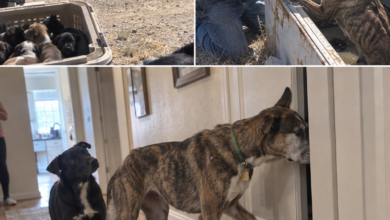
Cooper slept in a box lined with fleece beside her, round-bellied now, paws twitching in dreams.
Rebecca said Luna had never trusted men quickly.
I did not know what to do with that.
So I did what felt safest.
I worked.
I scrubbed bowls. I folded towels. I mopped floors. I learned which dogs needed pills in cheese and which dogs spit out cheese like detectives. I learned that senior dogs sleep deeply but wake if a lonely person tries to pass by without greeting them.
My hands healed.
My knee still complained, but less when I had a reason to stand.
The fifth twist came from Luna herself.
Three weeks after rescue, she was strong enough to walk outside on a short lead. Rebecca held the leash. I stood by the gate, giving them space. Luna stepped into the snow, stopped, and turned toward me.
Then she pulled.
Gently.
Not to Rebecca.
To me.
Rebecca let the leash go slack.
Luna came close, pressed her scarred nose into my palm, and stood there, breathing warm against my skin.
That was when I understood something I had missed in the storm.
I had thought I was the one saving her because I had hands and a coat.
But Luna had dragged me to a door I would never have knocked on for myself.
She brought me inside.
Echo
The ritual began with the coat.
Rebecca wanted to throw it away because it was torn, soaked, stained with street salt, and beyond repair. I said no before I knew why.
So her father, Bill Hale, a seventy-one-year-old white American man with a bad hip and a voice like gravel in a coffee can, helped me hang it in the kennel office. Not like a trophy. More like a reminder near the leashes and cleaning schedule.
The left sleeve still had the rip where the puppy’s nose had poked through.
Under it, Rebecca placed a small handwritten card.
For the next cold night.
After that, we started keeping emergency winter kits in the rescue van. Blankets. bolt cutters. gloves. towels. heat packs. slip leads. pet-safe warming pads. Granola bars. Socks. I added extra socks because cold feet make bad decisions.
Every Wednesday, I checked the kits.
Not because anyone asked after the first month.
Because I knew what it felt like to have almost enough.
Luna recovered slowly. She gained weight. Her fur grew thick again. Her eyes cleared. She never liked chains, not even the sound of one hitting the floor, so we removed chain leads from the rescue entirely. Rebecca said there were better tools.
Cooper grew like a weed.
At first, he was only a potato with paws. Then he became ears, teeth, and terrible judgment. He chewed the corner of my boot, stole Bill’s gloves, and slept under Luna’s chin as if he still remembered the first roof he had ever known.
When Cooper was old enough, Rebecca said he could be adopted.
People came.
Good people.
Families with fenced yards. A retired couple with soft voices. A young woman who worked from home and cried when Cooper climbed into her lap.
I told myself any of them would be fine.
Cooper disagreed.
He greeted everyone, then returned to my boot.
Every time.
Rebecca watched this happen three Saturdays in a row.
Finally, she handed me an adoption form.
I looked at it.
“I live above a kennel.”
“You work above a kennel,” she said. “You live here.”
I looked through the office window. Cooper was outside trying to carry a stick twice his size while Luna watched with the tired patience of mothers everywhere.
“I don’t have much.”
Rebecca smiled.
“You had a coat once. Look what happened.”
So Cooper stayed with me.
At night, he slept on a blanket beside my bed. Luna slept downstairs in the medical office while she recovered, then later in Rebecca’s farmhouse, where she had a couch, a yard, and the woman who never stopped looking for her.
But every morning, Cooper and I walked to the barn together.
Snow or sun.
Five-thirty.
Coffee after dogs.
Always in that order.
Ending
One year later, I stood in the same kind of snow.
Not the same storm.
Not the same man.
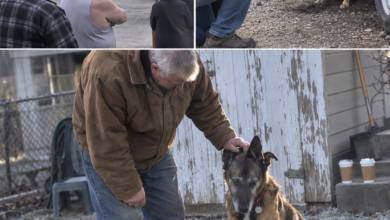
I had a room key in my pocket, work boots on my feet, and Cooper walking beside me on a blue leash. He had grown into a tall German Shepherd mix with Luna’s honey eyes, one ear that stood up, one that leaned, and a little white patch on his chest shaped like a thumbprint.
He did not remember the storm.
Or maybe he did in ways dogs do not explain.
He hated being cold. He loved my old blanket. He pressed close whenever wind shook the barn doors. Sometimes, when I lifted him into the rescue van, he tucked his nose into my coat sleeve and sighed.
My new coat was black, warmer than the old one, donated by Bill after he said he was tired of watching me dress like a man losing an argument with January.
The brown coat still hung in the office.
Torn.
Empty.
Enough.
On the anniversary of Luna’s rescue, Rebecca drove us past the church, then the vacant lot. The tire shop had been boarded tighter. Snow covered the ground again, smooth and innocent.
Luna sat in the back seat with Cooper, gray now around the muzzle but alive, her scar catching the pale winter light.
I looked at the lot and thought of the dog’s head above the snow.
The chain under the ice.
The puppy hidden beneath her ribs.
My hands.
My coat.
The door.
For a long time, I had believed I had nothing left to give.
That night proved me wrong.
I had one coat.
One pair of hands.
One more step in me.
It was enough.
A dog lived.
A puppy grew.
A man came home.
Follow this page for more unforgettable dog stories about rescue, sacrifice, second chances, and the quiet animals who change human lives without ever asking for anything back.