The Deaf Boy Signed “Safe” Through the Kennel Glass, and the One-Eyed Mother Dog Stopped Pacing — But What Made Her Finally Lie Beside Her Puppies That Night?
Part 2, The Side She Could Still See
Eli’s idea was simple enough to sound obvious once he showed it to us: before anyone moved closer, that person would stand where the mother dog’s left eye could see them, pause, make the same gentle sign, and wait for her body to soften.
We did not pretend the gesture carried a magical meaning. To the dog, it was initially just a predictable movement. Its value came from what always followed: no sudden step, no hand reaching over her head, no person appearing from her blind side.
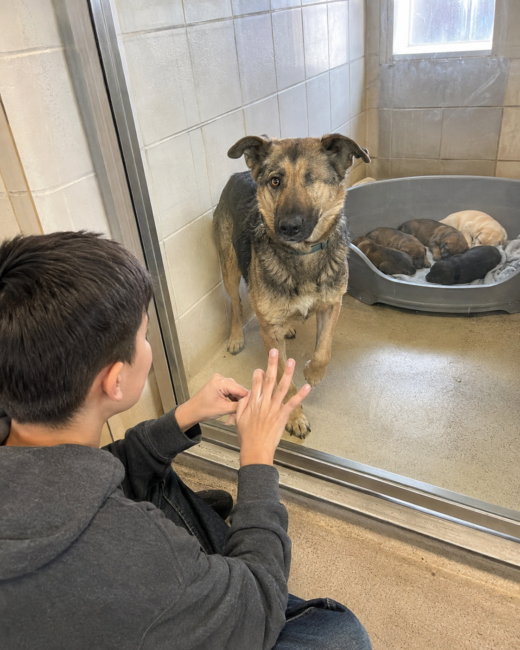
Dr. Priya Shah, our veterinarian, watched the mother through the glass while I explained the plan. The family had been inside the shelter for seventeen hours, and we still had not completed a physical examination. From a distance, we could see that the mother was thin, favoring no limb, breathing evenly, and producing enough milk for the puppies. We could not yet check hydration, body temperature, mammary tissue, or the healed eye socket.
The puppies also needed individual weights. One black male appeared smaller than his littermates and frequently lost his position while nursing.
The obvious solution was sedation, but using medication on a nursing mother required careful dosing and would not solve the larger problem. After the examination, she would still need to tolerate daily feeding, cleaning, puppy checks, transport and eventually foster care. We needed a safe emergency option, but we also needed a language built from repetition.
We moved unnecessary equipment away from the nursery and marked the floor with a strip of blue tape indicating the edge of her reliable visual field. Anyone entering the corridor had to approach from the left, stop behind the line and wait until she looked directly at them.
Eli remained seated beyond the glass.
I stepped into view, raised my hands and repeated the sign he had shown me. My version was clumsy. Eli adjusted one wrist by demonstrating again, and I copied him more slowly.
The mother dog froze near the puppy bed. Her ears tilted backward, but her paws did not resume their six-foot route.
I lowered a small dish of chicken through the feeding hatch. Instead of sliding it toward her, I left it just inside and moved away. She watched me retreat, waited thirty seconds, then crossed the kennel and ate three pieces.
That was our first measurable change.
The second came eleven minutes later. A veterinary technician named Rosa entered the corridor, paused at the blue tape, gave the sign and waited. The mother glanced toward Eli, then back to Rosa. She remained beside the puppy bed.
By early evening, we had repeated the sequence with four staff members. Each person approached from the visible side, signed, paused and withdrew. Nobody attempted to touch her. Nobody entered the kennel.
The mother eventually folded her rear legs beneath herself. Her chest remained upright, ready to spring, yet it was the first time she had stopped carrying her full weight since arriving.
Eli placed his palm against the outside of the glass.
The dog lowered her head until her chin rested across the edge of the puppy bed. Within seconds, three puppies crawled beneath her front leg. Her remaining eye stayed open, watching the corridor, but the frantic movement had ceased.
We named her Mara that evening, not because she responded to it, but because her medical record needed something kinder than “stray nursing female.”
At 7:05 p.m., after most visitors had gone, Dr. Shah said we could not postpone the examination any longer. The smaller puppy had lost body warmth despite the heated bedding, and Mara’s refusal to settle earlier may have prevented him from nursing properly.
The door would have to open.
Eli had gone home, but before leaving, he recorded a short video showing the sign. We placed the phone outside Mara’s view and practiced until every member of the team could repeat the movement at the same slow pace.
Then Rosa warmed a carrier, I prepared a portable barrier, and Dr. Shah stood ready with medication only if Mara’s fear became dangerous.
I moved to the left side of the kennel door.
Mara rose.
I gave the signal and waited.
For the first time, she did not place her body over the puppies. She looked at my hands, looked at the opening latch, and took one careful step backward.
It was not permission. But it was room.
Part 3, Five Blankets and One Open Door
Opening a kennel occupied by a frightened mother required more than courage. Maternal dogs can react quickly when they believe their puppies are threatened, and Mara’s missing right eye made distance and movement harder to judge.
We arranged the room so she would never need to guess where a person had gone.
A lightweight barrier divided the kennel into two sections. Rosa stood outside Mara’s visible side with warmed chicken. I opened the door only six inches and rested my hand on the frame without reaching inside. Dr. Shah remained behind me, watching Mara’s breathing, mouth and weight distribution.
Mara stared at the gap. Her lips stayed relaxed, but her ears flattened so tightly that they almost disappeared into the sable fur of her head. She moved toward the puppy bed, then stopped.
I signed safe, waited and gently pushed the barrier into position.
The kennel was now divided. Mara could remain on one side while we lifted the puppy bed from the other, but she would still be able to smell and see her litter through the mesh. The method was slower than simply leashing her. It also gave her a choice.
Rosa placed chicken near the far wall. Mara sniffed without eating. When I shifted the barrier another two inches, she retreated toward the food instead of charging the opening.
That was enough.
Dr. Shah entered the puppy section and examined each newborn on the warm bedding. There were three females and two males, all between nine and eleven days old. Four had full stomachs and normal temperatures. The smaller black male weighed only fourteen ounces and was mildly chilled, but he responded when rubbed beneath a warm towel.
We called him Button because his white chest marking was no larger than a shirt button.
Mara watched every movement. When Button squeaked, she stood so abruptly that her shoulder touched the barrier. I stopped moving, brought my hands into her visible field and repeated the sign. Rosa placed Button where Mara could smell him through the mesh.
Mara’s nose pressed against it. She exhaled twice, then sat.
Only after the puppies had been checked did we shift the barrier to examine her. Mara would not accept a slip lead over her head, so we used a wide panel to guide her into a transport crate positioned against the kennel wall. The crate had been lined with her own blanket and left open for several hours.
She approached it once, then recoiled when the door moved within her blind field.
That reaction explained part of what we had been seeing. Objects did not merely surprise her. Their movement on the right side caused her to lose her sense of space. She turned rapidly to locate them, and the puppies happened to be positioned along the same route.
We secured the crate door so it could not swing. I showed Mara my hands and moved toward the left side. Rosa dropped chicken just beyond the entrance.
Mara stretched her neck into the crate. One paw followed, then another. When her missing-eye side brushed the doorframe, she jerked backward and began pacing again.
We stopped immediately.
The puppies remained warm, but Button needed supplemental feeding if he could not nurse soon. Time mattered, though rushing Mara would likely cost more time later.
I removed my shelter jacket and draped it over the right side of the crate, creating a soft boundary she could feel with her whiskers and shoulder. Nothing would swing or appear unexpectedly. We moved the crate five inches so its entrance aligned with her usual path.
On her next pass, Mara reached the threshold without turning. She smelled the blanket, stepped halfway inside and looked back toward the puppies.
Rosa placed the puppy bed on the other side of the mesh, directly within Mara’s remaining field of vision.
I made the sign.
Mara stepped into the crate.
Dr. Shah completed the examination through the crate’s side access while we fed Mara small pieces of chicken. Mara weighed 53.6 pounds, roughly eight pounds below a healthy target for her frame. Her heart and lungs sounded normal. Her right eye was absent beneath a fully healed socket, likely from an old injury or previous surgery, though there was no way to determine which. Her left eye was healthy.
There was no fresh wound and no immediate surgical emergency. Her greatest medical vulnerabilities were low body condition, exhaustion and the demands of nursing five puppies.
When the examination ended, we returned the family to the quiet kennel. Button found a nipple with Rosa’s guidance and remained latched for eleven minutes.
Mara lay on her side.
She did not sleep. Not yet.
But for the first time, she allowed her body to become the warm place her puppies had been searching for.
Part 4, The Ride That Could Not Be Rushed
The shelter nursery was not designed for a frightened mother to raise five puppies. Doors opened every few minutes, carts passed the glass, and dogs barked from the intake wing whenever delivery trucks backed toward the building.
Mara needed a quieter foster room. The challenge was moving her without breaking the fragile routine that had helped her settle.
A foster volunteer named Hannah Ruiz offered a converted laundry room in her single-story home outside Denver. It had a washable floor, a separate entrance and enough space for a low puppy enclosure. Hannah had fostered nursing dogs before, and her household included no other animals.
The transfer was scheduled for the following morning.
We prepared two carriers: a warmed box for the puppies and the covered crate Mara had entered during her examination. The plan was to move the puppies first but keep them visible through the front of Mara’s crate. Rosa would drive while I sat beside the carriers and monitored them.
At 8:10 a.m., I approached Mara from the left, signed and opened the feeding hatch. She came forward for chicken but withdrew when she saw the puppy box.
Instead of forcing the next step, we placed the box on the floor and waited. Mara examined it from several feet away. I rubbed one of her blankets along its edge and put it inside.
Twenty minutes later, she allowed Rosa to lift the first puppy.
Mara followed every movement with her amber eye. Her body stiffened each time a puppy left the bed, but she did not pace. Between each transfer, Rosa showed her the warm box, allowing her to smell the puppies through its ventilated top.
Button was moved last.
When he squeaked, Mara pressed her nose against the carrier and released a low, vibrating whine—the first sound we had heard from her that was not a warning.
Then the hallway fire door closed behind a staff member.
The sudden vibration traveled through the floor. Mara wheeled toward her blind side, lost her footing and struck the wall with her hip. The puppy carrier shifted several inches on the cart.
She began racing the old six-foot path.
We could have sedated her and completed the transfer. Instead, Dr. Shah gave us fifteen minutes to try the routine once more, provided Mara did not injure herself.
I moved the puppy carrier off the cart and set it on the floor where it could not roll. Rosa dimmed the corridor lights. I approached from the left, made the sign and sat down.
Mara completed seven passes before slowing.
On the eighth, she stopped beside the puppy carrier. On the ninth, she touched her nose to it. When I opened the stationary crate, she looked at my hands and entered without waiting for chicken.
No one celebrated celebrated. Any sudden voice or movement could have reversed the moment. Rosa closed the door, covered the blind side and secured the crate to the vehicle.
During the forty-minute drive, Mara remained upright. She could smell the puppies but could not see them whenever the vehicle turned. Each time she began scratching at the door, I moved my hands into view through the front grate and repeated the familiar signal.
By the third repetition, she would pause and listen for the puppies’ small noises.
Hannah had prepared the foster room exactly as instructed. The puppy bed stood against a solid wall, so nothing could approach Mara from behind. Food and water remained on her left. The crate entrance faced the bed, and the furniture would not be moved without first showing Mara.
We placed the puppy carrier inside the enclosure and opened it. The five newborns tumbled into a warm pile.
Mara’s crate opened next.
She did not rush out. She examined the doorway with her good eye, extended one paw, then touched the covered side with her shoulder as if confirming its position.
Hannah stood several feet away and made the sign.
Mara looked at her hands.
She stepped out, walked directly to the puppies and counted them with her nose—one, two, three, four, five. Then she circled the bed twice and lay down.
Button crawled beneath her foreleg. Mara shifted carefully, creating space for him without disturbing the others.
That night, Hannah watched through a camera mounted outside the room. Mara raised her head whenever the furnace started or a vehicle passed, but she no longer paced. At 2:13 a.m., her left eye finally closed.
She slept for nine minutes.
Then twelve.
By dawn, she had remained beside her puppies for almost five uninterrupted hours.
Part 5, What the Veterinarian Could Not Promise
Recovery did not arrive as one dramatic change. It appeared in measurements written on a clipboard: Mara finishing another half cup of food, Button gaining an ounce, the mother resting through a closing door, her body no longer tightening when Hannah entered.
Dr. Shah visited the foster home two days later. The right eye socket remained healthy and painless. There was no medical treatment that could restore the missing eye, but Mara could navigate well if people respected her reduced field of vision.
Her low weight required gradual improvement rather than oversized meals. Hannah divided her food into four portions enriched for nursing mothers. Too much at once could upset her stomach, while too little would make milk production harder to sustain.
The puppies were weighed twice daily. Button received brief supplemental feedings only after nursing, so he would not lose interest in Mara. By the fourth day, he had gained nearly three ounces.
Eli visited that Saturday with his mother. He sat outside the foster-room gate while Hannah approached first, signed and entered. Mara watched Eli closely but did not stand over the puppies.
He gave the sign.
Mara lowered her chin to the blanket.
Eli did not touch her. Instead, he remained seated and read a graphic novel while the puppies slept. Forty minutes later, Mara shifted closer to the gate and rested one front paw against the mesh.
It was the nearest she had voluntarily moved toward a visitor.
The setback came during the second week.
A laundry basket slipped from Hannah’s hand in the hallway and landed on Mara’s blind side. The basket never touched her, yet the sudden movement triggered the old response. Mara sprang across the room, knocked over her water and began pacing between the wall and puppy enclosure.
For the next six hours, she refused food and would not lie down to nurse unless Hannah left the room.
Nothing about the progress had been false. Fear simply had a longer memory than we wanted.
Hannah dried the floor, restored every object to its original position and reduced movement in the hallway. She sat where Mara could see her, gave the sign once and waited.
Mara paced.
Hannah waited.
After twenty-three minutes, Mara stopped long enough to look at her. Hannah repeated the signal, then placed food near the puppy bed and left.
Mara ate after sunset. She resumed nursing during the night.
The following morning, she allowed Hannah to enter but kept her body between Hannah and the puppies. We returned to the earliest routine: approach from the left, sign, pause, move only after Mara’s shoulders relaxed.
It took four days for her to rest during a human presence again.
The experience changed our recovery plan. Rather than trying to make Mara “get used to” surprises, we taught her a small set of visual cues. One meant someone was entering. Another meant food was being placed down. A flat open palm told her the person would stop moving.
The signs did not replace training or veterinary care. They gave Mara information she had been missing.
At six weeks, the puppies began leaving the bed to explore the room. Mara followed them with her left eye and repositioned herself whenever one crossed toward her blind side. She never stepped on them, but she sometimes turned too sharply and sent them rolling into the blankets.
Hannah added textured mats along the enclosure edges. Mara could feel the change beneath her paws and knew when she was nearing a wall or puppy barrier.
By seven weeks, Button was no longer the smallest. The cream-colored female, Maple, had become the lightest, though she remained healthy. All five puppies received vaccinations and gradually transitioned to solid food.
Mara gained six pounds.
Her ribs became less visible, her coat thickened around her shoulders, and her pacing route faded from daily behavior into something seen only after a major surprise.
She had not become fearless.
She had learned that fear no longer had to decide every movement.
Part 6, The Empty Puppy Bed
The puppies became eligible for adoption shortly after eight weeks of age. Applications arrived quickly, but we staggered their departures so Mara would not lose the entire litter in one afternoon.
Maple left first with a retired couple. Two days later, the sable males went to separate families. Button and his black-and-tan sister remained for another week.
Each departure changed Mara’s behavior.
She inspected the carrier, watched the puppy leave and searched the foster room afterward. Hannah showed her the empty carrier before removing it, then returned the room to its familiar arrangement.
Mara ate normally and accepted the visual cue, yet she slept with her nose pressed against the remaining puppies.
When Button left, Eli came to sit outside the gate.
Mara had begun approaching him on her own. He never reached through the mesh. He placed one hand flat against it and waited until she chose the distance.
That afternoon, Mara touched her nose to the opposite side of his palm.
The last puppy went home three days later.
Mara searched the bedding, the crate and the area behind the water bowl. She returned to the empty bed and stood there for nearly a minute. Then she began pacing.
Six feet toward the gate. Turn. Six feet toward the bed. Turn.
The route was shorter than the one at the shelter, but its rhythm was the same.
Hannah sat in the room and gave the sign. Mara glanced at her without stopping. Food remained untouched until evening.
We had prepared for this response. Mara’s milk production was already decreasing, and Dr. Shah had confirmed there were no physical complications from weaning. What remained was adjustment—a mother dog waking in a room that no longer contained the bodies she had organized her entire life around.
For four nights, Hannah slept on a cot outside the gate. She did not call Mara or invite her onto the furniture. She simply remained visible.
On the fifth night, Mara lay in the empty puppy bed.
On the sixth, she carried one small blanket out and placed it near the gate.
Eli visited on the seventh day. He sat beside the blanket, signed and waited. Mara approached with her head lowered. She smelled his sleeve, backed away and returned.
The second time, she stood close enough for him to touch her shoulder.
Eli moved only after she turned her seeing side toward him. He placed two fingers lightly against the thick fur below her teal collar.
Mara’s ears tilted backward, but she did not retreat.
Ten seconds later, she sat.
The Mercer family had not planned to adopt a dog. Eli’s mother, Lena, worked from home, but their small house had an unfenced yard, and they understood that affection alone did not make a suitable placement.
They began with supervised visits. Then Mara spent an afternoon at their house. Hannah brought her familiar crate, bed and textured mats. Eli labeled the household routine with the same visual cues used in foster care.
Mara inspected every room with her left side leading. She startled at a coat hanging behind a door and refused to enter the kitchen when sunlight reflected from the refrigerator. Nobody pushed her.
By the third visit, she followed Eli into the living room.
By the fifth, she slept while he sat on the floor reading.
The adoption application was submitted after six weeks, not six minutes. The Mercers installed a secure fence, added night-lights along the hallway and agreed not to rearrange furniture without guiding Mara through the new layout.
Dr. Shah cleared Mara for spay surgery once her body condition and milk production stabilized. Recovery required ten quiet days, during which Eli slept outside her room on a folding mattress.
Whenever Mara woke disoriented, she found his hands before she tried to stand.
Part 7, A Different Meaning of Safe
Mara’s adoption became final four months after the afternoon Eli first sat outside the nursery glass.
She entered the Mercer home wearing the same faded teal collar. Lena had purchased a new one, but Eli asked to keep the old collar nearby because its smell belonged to the places Mara already knew. They attached her identification to a soft teal replacement and placed the original in a drawer beside her veterinary records.
Her world remained shaped by one eye. People approached from the left. Visitors were asked to stand still until Mara located them. Furniture stayed in predictable places, and the visual cues remained part of daily life.
The routines did not make her disability disappear. They made the house understandable.
Mara’s puppies sent updates through their adopters. Maple slept beneath a retired teacher’s desk. The sable brothers grew into long-legged dogs with ears too large for their heads. Button, once the smallest, became the heaviest of the litter and still carried blankets from room to room before sleeping.
Eli kept a photograph of all five beside Mara’s bed.
On the first snowy evening of winter, Mara heard a delivery box drop outside and woke abruptly. Her body tensed, and one paw moved toward the beginning of an old pacing route.
Eli stepped into her remaining field of vision.
He signed safe.
Mara looked toward the front door, then back at him. Instead of pacing, she crossed the living room and lay beside his feet. Her chin settled over the toe of his sock while snow gathered against the window.
The first time Eli made that sign, Mara had been standing above five puppies behind kennel glass, too exhausted to rest and too frightened to look away.
Now there was no glass between them.
Eli lowered his hand to the floor. Mara placed one paw across his fingers, closed her amber eye and remained there as the house grew quiet around them.
Follow our page for more grounded rescue stories about frightened dogs, patient people, and the small moments when trust finally begins to feel possible.